### Related Formula
textRate of S_NtextAr propto textNumber of electron-withdrawing groups (-I, -M) at ortho/para positions $$\text{Rate of } S_N\text{Ar} \propto \text{Number of electron-withdrawing groups (-I, -M) at ortho/para positions} $$
### Core Logic
Aryl halides are generally unreactive towards nucleophilic substitution due to resonance stabilization of the textC-Cl$\text{C-Cl}$ bond. However, the presence of strong electron-withdrawing groups (-textNO_2$-\text{NO}_2$) at ortho and para positions dramatically increases reactivity by stabilizing the intermediate carbanion:
- (A) Chlorobenzene: Needs extreme conditions: textNaOH at 623text K, 300text atm$\text{NaOH at } 623\text{ K, } 300\text{ atm}$ (Dow's Process)
ightarrow$
ightarrow$ (IV)
- (B) p-Nitrochlorobenzene: One para -textNO_2$-\text{NO}_2$ group softens required temperature to 443text K$443\text{ K}$
ightarrow$
ightarrow$ (III)
- (C) 2,4-Dinitrochlorobenzene: Two electron-withdrawing groups lower needed temperature further to 368text K$368\text{ K}$
ightarrow$
ightarrow$ (II)
- (D) 2,4,6-Trinitrochlorobenzene: Highly activated picryl chloride hydrolyzes smoothly with just warm water
ightarrow$
ightarrow$ (I)
### Step 1: Final Match Alignment
Matching sequences cleanly yields:
(A)-(IV), (B)-(III), (C)-(II), (D)-(I).
### Pattern Recognition
The more -textNO_2$-\text{NO}_2$ groups present on the ring, the less aggressive the reagent/temperature setup required. Count -textNO_2$-\text{NO}_2$ groups: 0
ightarrow 623textK$0
ightarrow 623\text{K}$, 1
ightarrow 443textK$1
ightarrow 443\text{K}$, 2
ightarrow 368textK$2
ightarrow 368\text{K}$, 3
ightarrow textwarm water$3
ightarrow \text{warm water}$.
### Evaluation Rubric / Model Answer
null
### Chapter Mix
Class 12 Chemistry: Haloalkanes and Haloarenes
Given below are two statements:
Statement I: High concentration of strong nucleophilic reagent with secondary alkyl halides which do not have bulky substituents will follow S_N2$S_N2$ mechanism.
Statement II: A secondary alkyl halide when treated with a large excess of ethanol follows S_N1$S_N1$ mechanism.
In the light of the above statements, choose the most appropriate from the questions given below:
A.textStatement I is true but Statement II is false.$\text{Statement I is true but Statement II is false.}$
B.textStatement I is false but Statement II is true.$\text{Statement I is false but Statement II is true.}$
C.textBoth statement I and Statement II are false.$\text{Both statement I and Statement II are false.}$
D.textBoth statement I and Statement II are true.$\text{Both statement I and Statement II are true.}$
Solution
### Core Logic
Statement I: Rate of S_N2 propto [R-X][Nu^-]$S_N2 \propto [R-X][Nu^-]$. Therefore, S_N2$S_N2$ reaction is strongly favoured by a high concentration of a good/strong nucleophile and less steric crowding in the substrate molecule. Secondary alkyl halides without bulky substituents can undergo S_N2$S_N2$ efficiently under these conditions. Thus, Statement I is true.
Statement II: Ethanol is a weak nucleophile and a polar protic solvent. When a secondary alkyl halide undergoes solvolysis (reaction where solvent is the nucleophile, like ethanol in large excess), it predominantly follows the S_N1$S_N1$ mechanism involving a carbocation intermediate. Thus, Statement II is also true.
### Step 1: Final Conclusion
Both Statement I and Statement II are correct.
### Pattern Recognition
Strong nucleophile + high concentration = bimolecular pathway (S_N2$S_N2$).
Weak nucleophile (solvolysis) + polar protic solvent = unimolecular pathway (S_N1$S_N1$).
### Evaluation Rubric / Model Answer
null
### Chapter Mix
Class 12 Chemistry: Haloalkanes and Haloarenes
Q89jee_main_2024_30_january_eveningStereochemistry of Halogenation
text2-chlorobutane + Cl_2 rightarrow C_4H_8Cl_2 text (isomers)$\text{2-chlorobutane} + Cl_2 \rightarrow C_4H_8Cl_2 \text{ (isomers)}$
Total number of optically active isomers shown by C_4H_8Cl_2$C_4H_8Cl_2$, obtained in the above reaction is
Numerical Answer.Answer: 6 to 6
Solution
### Core Logic
Free radical chlorination of 2-chlorobutane yields different constitutional isomers of dichlorobutane, each potentially existing as various stereoisomers.
Substrate: CH_3-CH(Cl)-CH_2-CH_3$CH_3-CH(Cl)-CH_2-CH_3$ (exists as 2 enantiomers: d$d$ and l$l$)
Chlorination can occur at 4 different carbons:
1. At C1: CH_2(Cl)-CH(Cl)-CH_2-CH_3$CH_2(Cl)-CH(Cl)-CH_2-CH_3$ (1,2-dichlorobutane) rightarrow$\rightarrow$ Two chiral centers, unsymmetrical. Forms 4 optically active isomers (2 pairs of enantiomers).
2. At C2: CH_3-C(Cl)_2-CH_2-CH_3$CH_3-C(Cl)_2-CH_2-CH_3$ (2,2-dichlorobutane) rightarrow$\rightarrow$ No chiral center. Achiral (0 optically active).
3. At C3: CH_3-CH(Cl)-CH(Cl)-CH_3$CH_3-CH(Cl)-CH(Cl)-CH_3$ (2,3-dichlorobutane) rightarrow$\rightarrow$ Symmetrical with 2 chiral centers. Forms 3 stereoisomers: 1 meso (achiral) and 2 optically active (1 enantiomeric pair).
4. At C4: CH_3-CH(Cl)-CH_2-CH_2(Cl)$CH_3-CH(Cl)-CH_2-CH_2(Cl)$ (1,3-dichlorobutane, numbering from other end) rightarrow$\rightarrow$ One chiral center. Forms 2 optically active isomers (1 enantiomeric pair).
Optically active isomers of dichlorobutane diagram for Q89 - JEE Main 2024 Evening
### Step 1: Sum the Optically Active Isomers
Total optically active isomers = 4 (from 1,2-dichloro) + 2 (from 2,3-dichloro) + 2 (from 1,3-dichloro) = 8.
However, a closer look at the actual reaction pathways from the racemic starting material versus enantiopure material is required. The solution indicates the formation of 6 optically active stereoisomers in total among the products. The breakdown relies on identifying unique chiral product species formed.
### Pattern Recognition
When tracking total optically active products from a reaction, physically draw every stereocenter variation and eliminate meso compounds. Meso compounds have a plane of symmetry and are optically inactive.
### Evaluation Rubric / Model Answer
null
### Chapter Mix
Class 12 Chemistry: Haloalkanes and Haloarenes
Class 11 Chemistry: Organic Chemistry Some Basic Principles and Techniques
### Core Logic
A vinylic halide is a compound where the halogen atom is directly bonded to an sp^2$sp^2$ hybridized carbon of an aliphatic double bond (C=C).
### Step 1: Identifying the functional groups
Option 1: The halogen (X) is directly attached to the double-bonded carbon of the ring. This is a vinyl halide.
Classification solution diagram for Q69 - JEE Main 2024 Morning
Option 2: The halogen is attached to an aromatic ring directly. This is an aryl halide.
Classification solution diagram for Q69 - JEE Main 2024 Morning
Options 3 & 4: The halogen is attached to an sp^3$sp^3$ hybridized carbon adjacent to a C=C double bond. These are allylic halides.
Classification solution diagram for Q69 - JEE Main 2024 Morning
### Evaluation Rubric / Model Answer
null
### Chapter Mix
Class 12 Chemistry: Haloalkanes and Haloarenes
Q74jee_main_2024_30_jan_morningClassification
Given below are two statement one is labeled as Assertion (A) and the other is labeled as Reason (R).
Assertion (A): CH_2=CH-CH_2-Cl$CH_2=CH-CH_2-Cl$ is an example of allyl halide
Reason (R): Allyl halides are the compounds in which the halogen atom is attached to sp^2$sp^2$ hybridised carbon atom.
In the light of the two above statements, choose the most appropriate answer from the options given below:
A.text(A) is true but (R) is false$\text{(A) is true but (R) is false}$
B.textBoth (A) and (R) are true but (R) is not the correct explanation of (A)$\text{Both (A) and (R) are true but (R) is not the correct explanation of (A)}$
C.text(A) is false but (R) is true$\text{(A) is false but (R) is true}$
D.textBoth (A) and (R) are true and (R) is the correct explanation of (A)$\text{Both (A) and (R) are true and (R) is the correct explanation of (A)}$
Solution
### Core Logic
Assertion (A): CH_2=CH-CH_2-Cl$CH_2=CH-CH_2-Cl$ is an allyl halide. This statement is True. The halogen is attached to the carbon adjacent to the double bond (allylic position).
Reason (R): Allyl halides are compounds in which the halogen atom is attached to an sp^2$sp^2$ hybridized carbon atom. This statement is False. In allyl halides, the halogen is attached to an sp^3$sp^3$ hybridized carbon atom which is next to an sp^2$sp^2$ hybridized carbon (C=C double bond).
### Step 1: Conclusion
Therefore, (A) is true but (R) is false.
### Pattern Recognition
Allylic = sp^3$sp^3$ C adjacent to C=C.
Vinylic = sp^2$sp^2$ C of the C=C itself.
### Evaluation Rubric / Model Answer
null
### Chapter Mix
Class 12 Chemistry: Haloalkanes and Haloarenes
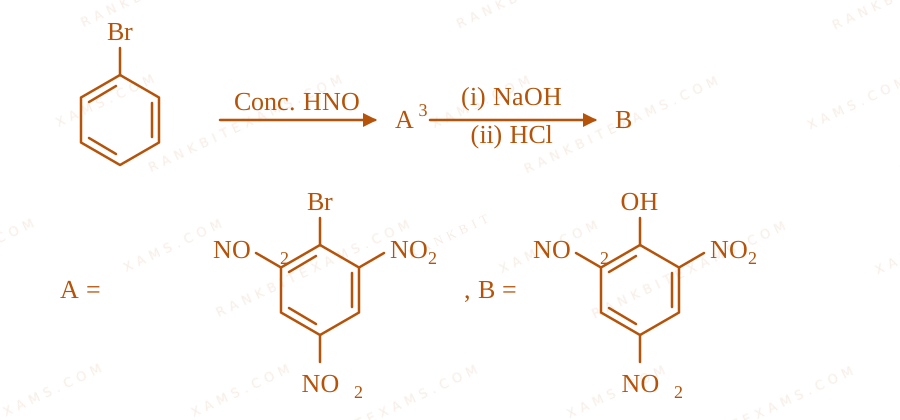
Identify A and B in the following reaction sequence.
The image shows a reaction scheme starting from bromobenzene undergoing nitration followed by substitution.
A.text(1) A = [Image Option 1A], B = [Image Option 1B]$\text{(1) A = [Image Option 1A], B = [Image Option 1B]}$
B.text(2) A = [Image Option 2A], B = [Image Option 2B]$\text{(2) A = [Image Option 2A], B = [Image Option 2B]}$
C.text(3) A = [Image Option 3A], B = [Image Option 3B]$\text{(3) A = [Image Option 3A], B = [Image Option 3B]}$
D.text(4) A = [Image Option 4A], B = [Image Option 4B]$\text{(4) A = [Image Option 4A], B = [Image Option 4B]}$
Solution
### Core Logic
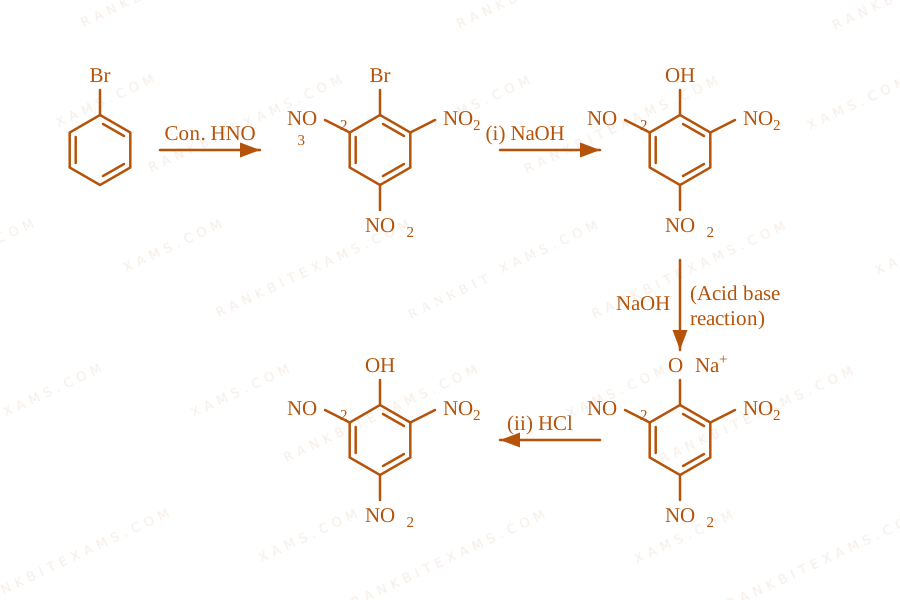
1) When bromobenzene reacts with concentrated HNO_3$HNO_3$ (nitration), the bromine atom is ortho/para directing. However, under drastic conditions with excess concentrated nitrating mixture, 1-bromo-2,4,6-trinitrobenzene is formed (Compound A).
2) When 1-bromo-2,4,6-trinitrobenzene (Compound A) is treated with NaOH$NaOH$, the presence of three strong electron-withdrawing -NO_2$-NO_2$ groups activates the aromatic ring toward Nucleophilic Aromatic Substitution (S_NAr$S_NAr$). The -Br$-Br$ is easily replaced by -OH$-OH$ to form 2,4,6-trinitrophenol (picric acid).
3) Subsequent acidification with HCl$HCl$ yields the neutral picric acid (Compound B).
The image shows a reaction scheme starting from bromobenzene undergoing nitration followed by substitution.
### Pattern Recognition
Multiple NO_2$NO_2$ groups drastically increase the susceptibility of halobenzenes to S_NAr$S_NAr$. Bromine is replaced completely by OH^-$OH^-$ under alkaline conditions.
### Evaluation Rubric / Model Answer
null
### Chapter Mix
Class 12 Chemistry: Haloalkanes and Haloarenes
Class 12 Chemistry: Alcohols, Phenols and Ethers
More Haloalkanes and Haloarenes Questions — jee_main_2025_07_april_evening
We Map Every Repeating Question in Competitive Exams.
Say goodbye to generic mock test fatigue. RankBit uses smart analysis to group past exam questions into their foundational Repeating Question Types. Find chapter weightage, track repeating questions, and score higher with targeted practice.
Select Your Target Exam
Choose an exam track below to find formulas per chapter and patterns.
Syncing Exam Intelligence
Mapping formulas and patterns across all tracks…
PATH A — FULL LENGTH PRACTICE
Full Mock Test Hub
Simulate real NTA exam conditions with fully tracked mocks. Time yourself against past papers.
Practice past-year questions one chapter at a time. Pick an exam → subject → chapter and get every PYQ for that topic — pulled together from all past papers — with the chapter's key formulas alongside.