JEE Main · Chemistry ↓ Falling

Haloalkanes and Haloarenes appeared 40 times across 3 years — 4.7% of Chemistry. This question is from Physical Properties of Dihalobenzenes.

Year 2026 2025 2024 Total
Questions 11 16 13 40

Given below are two statements: Statement (I):
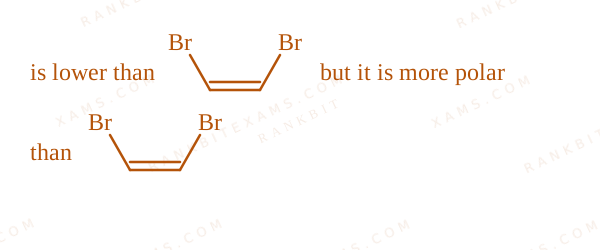
Physical Properties of Dihalobenzenes diagram for Q42 - JEE Main 2025 Evening
The structural layouts show ortho and para halobenzene isomers (1,2-dichlorobenzene vs 1,2-dibromobenzene, and para-dibromobenzene).
is more polar than
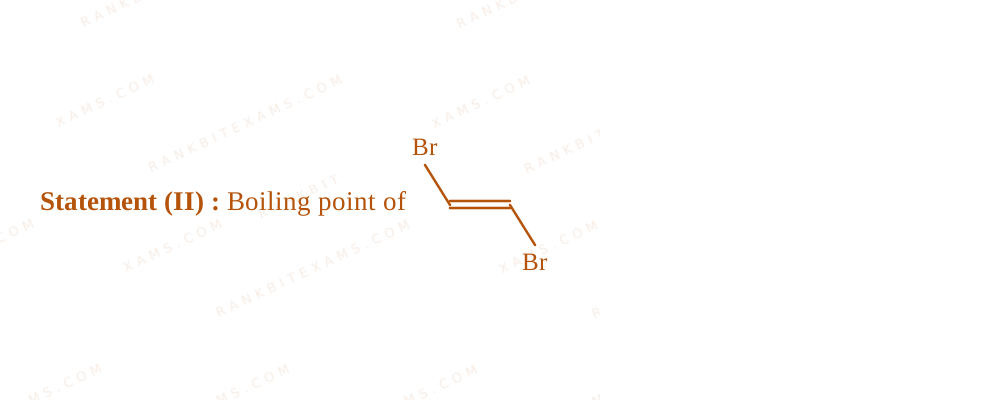
Physical Properties of Dihalobenzenes diagram for Q42 - JEE Main 2025 Evening
The structural layouts show ortho and para halobenzene isomers (1,2-dichlorobenzene vs 1,2-dibromobenzene, and para-dibromobenzene).
. Statement (II): Boiling point of
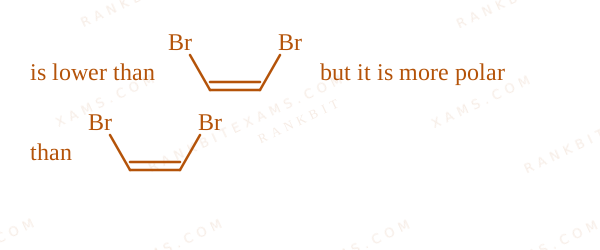
Physical Properties of Dihalobenzenes diagram for Q42 - JEE Main 2025 Evening
The structural layouts show ortho and para halobenzene isomers (1,2-dichlorobenzene vs 1,2-dibromobenzene, and para-dibromobenzene).
is lower than the ortho-isomer, but it is more polar than the meta-isomer. In the light of the above statements, choose the most appropriate answer from the options given below:

Solution & Explanation

Related Formula
μnet = √(μ₁² + μ₂² + 2μ₁μ₂ θ) Boiling point ∝ Dipole-dipole interactions + Van der Waals forces
Core Logic

Let's analyze the visual structures alongside their scientific orientations:

  • Statement (I) compares 1,2-dichlorobenzene and 1,2-dibromobenzene. Chlorine has a higher electronegativity than bromine, creating a larger bond dipole. The vacant d-orbital interactions do not invert this baseline dipole trend. Thus, 1,2-dichlorobenzene is more polar, making Statement I correct.
  • Statement (II) evaluates dihalobenzene isomers. For the para-isomer, individual bond dipoles are oriented at 180°, cancelling out completely:
μpara = 0

Since μmeta > 0, the para-isomer is less polar than the meta-isomer. This directly falsifies Statement II.

Step 1: Spatial Alignments

The geometric configurations map out as follows:

Physical Properties of Isomers vector diagram for Q42 - JEE Main 2025 Evening
The structural layouts show ortho and para halobenzene isomers (1,2-dichlorobenzene vs 1,2-dibromobenzene, and para-dibromobenzene).

Physical Properties of Isomers vector diagram for Q42 - JEE Main 2025 Evening
The structural layouts show ortho and para halobenzene isomers (1,2-dichlorobenzene vs 1,2-dibromobenzene, and para-dibromobenzene).

Physical Properties of Isomers vector diagram for Q42 - JEE Main 2025 Evening
The structural layouts show ortho and para halobenzene isomers (1,2-dichlorobenzene vs 1,2-dibromobenzene, and para-dibromobenzene).

Hence, Statement I is correct, but Statement II is incorrect.

Pattern Recognition

Dipole tracking rule: Para-substituted benzenes with identical groups possess a structural center of inversion, guaranteeing a net dipole moment of exactly zero (μ = 0). They can never be more polar than any asymmetric ortho or meta structural isomer.

Chapter Mix

Class 12 Chemistry: Haloalkanes and Haloarenes

Reference Study Guides

More Haloalkanes and Haloarenes Previous-Year Questions — Page 4

Q jee_main_2025_08_april_evening Preparation and Reactions of Styrene derivatives
Choose the correct set of reagents for the following conversion: Ethyl benzene 4-bromostyrene {{Q_IMG1}}
Conversion scheme of ethylbenzene to 4-bromostyrene for Q29
The figure illustrates the multi-step conversion starting from ethylbenzene to yield a brominated styrene derivative.
Conversion scheme of ethylbenzene to 4-bromostyrene for Q29
The figure illustrates the multi-step conversion starting from ethylbenzene to yield a brominated styrene derivative.
  • A. Br₂/Fe; Cl₂, Δ; alc. KOH
  • B. Cl₂/Fe; Br₂/anhy. AlCl₃; aq. KOH
  • C. Br₂/anhy. AlCl₃; Cl₂, Δ; aq. KOH
  • D. Cl₂/anhy. AlCl₃; Br₂/Fe; alc. KOH

Solution

Core Logic

To synthesize 4-bromostyrene starting from ethyl benzene, we must carry out ring functionalization prior to developing the side-chain double bond:

  • Ring Bromination: Treatment of ethylbenzene with Br₂ in the presence of Fe (or FeBr₃) acts via electrophilic aromatic substitution. The ethyl group is an ortho/para director, yielding 1-bromo-4-ethylbenzene as the major product owing to steric mitigation.
  • Side-Chain Halogenation: Free radical substitution with Cl₂ under thermal conditions (Δ) or UV light specifically chlorinates the benzylic position because the benzylic radical is exceptionally stable via resonance.
  • Elimination: Heating with alcoholic KOH drives an E2 elimination of the benzylic chloride, cleanly synthesizing the terminal alkene linkage of the styrene system.
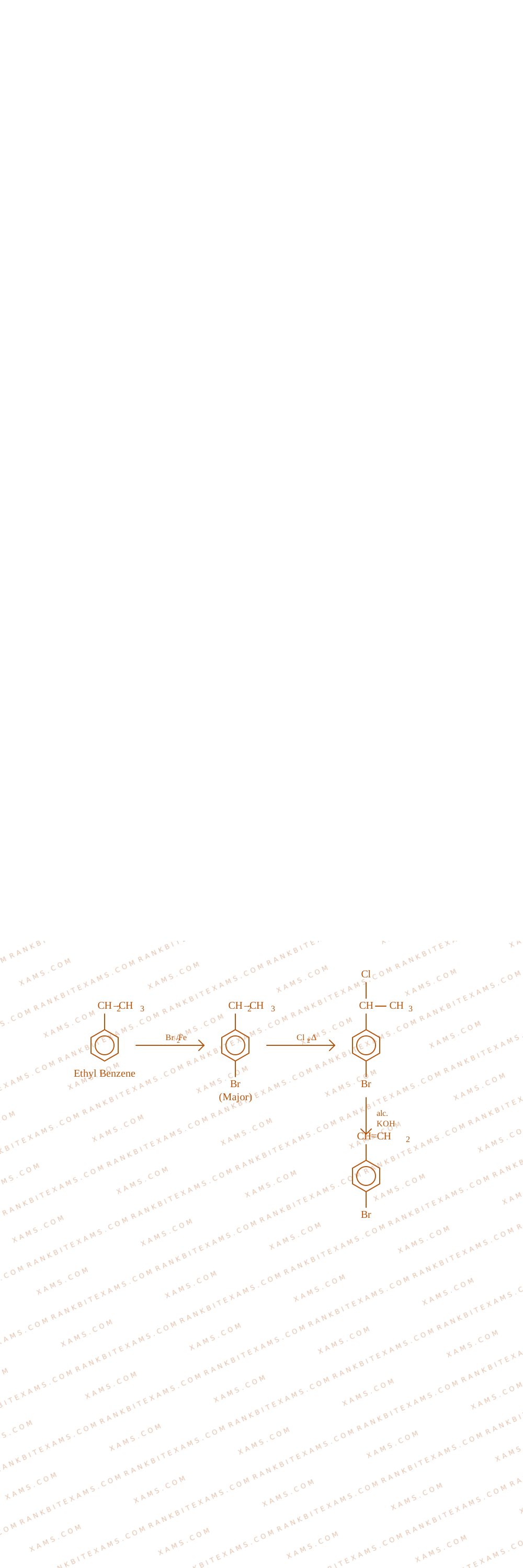
    Detailed mechanism of 4-bromostyrene synthesis from ethylbenzene
    The figure illustrates the multi-step conversion starting from ethylbenzene to yield a brominated styrene derivative.
Pattern Recognition

If you perform side-chain halogenation/alkene generation first, the ring substitution later would lack para-selectivity control and risk reacting across the alkene path. Hence, ring substitution MUST precede double bond creation.

Chapter Mix

Class 12 Chemistry: Haloalkanes and Haloarenes Class 11 Chemistry: Hydrocarbons

Q30 jee_main_2025_29_jan_evening Nucleophilic Substitution Mechanisms
Which among the following halides will generate the most stable carbocation in Nucleophilic substitution reaction?
  • A. Allylic halide option (1)
  • B. Secondary halide option (2)
  • C. Secondary benzylic halide option (3)
  • D. Triphenylmethyl halide option (4)

Solution

Core Logic

The mechanism of SN1 substitution proceeds via carbocation intermediate formation. Option (4) gives a triphenylmethyl carbocation (Ph₃C⁺), which is exceptionally stable due to extensive delocalization of positive charge across three phenyl rings (resonance stabilization via 9 canonical structures).

Nucleophilic Substitution Mechanisms diagram for Q30 - JEE Main 2025 Evening

Step 1: Stability Comparison

Stability sequence:

Ph₃C⁺ > benzylic > allylic > alkyl carbocations
Pattern Recognition

Look for maximum phenyl groups attached directly to the carbon bearing the leaving group to maximize resonance contribution.

Chapter Mix

Class 12 Chemistry: Haloalkanes and Haloarenes

Q29 jee_main_2025_28_jan_morning Alkaline Hydrolysis and NGP
Given below are two statements : Statement I: Et₂N-CH₂-CH₂-Cl will undergo alkaline hydrolysis at a faster rate than Et₂CH-CH₂-Cl. Statement II: In Et₂N-CH₂-CH₂-Cl, intramolecular substitution takes place first by involving lone pair of electrons on nitrogen. In the light of the above statements, choose the most appropriate answer from the options given below:
  • A. Both Statement I and Statement II are incorrect
  • B. Statement I is incorrect but statement II is correct
  • C. Both Statement I and Statement II are correct
  • D. Statement I is correct but Statement II is incorrect

Solution

Core Logic

Statement I is correct because the nitrogen atom contains a lone pair situated at the β-position relative to the chlorine atom, promoting Neighboring Group Participation (NGP).

Statement II is correct because the lone pair on nitrogen attacks internally to kick out the chloride ion, forming a cyclic aziridinium ion intermediate. This quick intramolecular cyclization leads to an exceptionally rapid hydrolysis rate compared to standard aliphatic substitution.

Pattern Recognition

Sees: Nitrogen with lone pair β to a leaving group. Shortcut: NGP (Neighboring Group Participation) accelerates substitution dramatically via intramolecular assistance.

Chapter Mix

Class 12 Chemistry: Haloalkanes and Haloarenes

Q39 jee_main_2025_28_jan_morning Ambident Nucleophiles Reactions
The products A and B in the following reactions, respectively are A A g - N O _ 2 C H _ 3 - C H _ 2 - C H _ 2 - B r A g C N B
  • A. CH₃ - CH₂ - CH₂ - ONO, CH₃ - CH₂ - CH₂ - NC
  • B. CH₃-CH₂-CH₂-ONO, CH₃-CH₂-CH₂-CN
  • C. CH₃ - CH₂ - CH₂ - NO₂, CH₃ - CH₂ - CH₂ - CN
  • D. CH₃ - CH₂ - CH₂ - NO₂, CH₃ - CH₂ - CH₂ - NC

Solution

Core Logic

Both silver reagents exhibit significantly covalent bond characters:

  • Reaction with AgNO₂: The bond between silver and oxygen is covalent, making the lone pair on the nitrogen atom the primary nucleophilic site. Attack via nitrogen yields a nitroalkane product:
A = CH₃-CH₂-CH₂-NO₂
  • Reaction with AgCN: The covalent Ag-C bond directs the nucleophilic attack to proceed through the lone pair on nitrogen, yielding an isocyanide compound:
B = CH₃-CH₂-CH₂-NC

Hence, option (4) represents the correct combination.

Pattern Recognition

Sees: Alkyl halide reacting with covalent silver salts of ambident anions. Shortcut: Silver reagents (AgCN or AgNO₂) drive bond formatting via the nitrogen center, producing isocyanides and nitroalkanes respectively.

Chapter Mix

Class 12 Chemistry: Haloalkanes and Haloarenes

Q jee_main_2025_04_april_evening Substitution versus Elimination
Given below are two statements : Statement (I): Alcohols are formed when alkyl chlorides are treated with aqueous potassium hydroxide by elimination reaction. Statement (II) : In alcoholic potassium hydroxide, alkyl chlorides form alkenes by abstracting the hydrogen from the β-carbon. In the light of the above statements, choose the most appropriate answer from the options given below:
  • A. Both Statement I and Statement II are incorrect
  • B. Statement I is incorrect but Statement II is correct
  • C. Statement I is correct but Statement II is incorrect
  • D. Both Statement I and Statement II are correct.

Solution

Related Formula
R-Cl + KOH(aq) arrow R-OH + KCl (SN Nucleophilic Substitution) R-CH₂-CH₂-Cl + KOH(alc) arrow R-CH=CH₂ + KCl + H₂O (E2 Elimination)
Core Logic
  • Statement I is incorrect: Treatment of alkyl chlorides with aqueous KOH yields alcohols via a nucleophilic substitution (SN) reaction, not an elimination reaction.
  • Statement II is correct: Alcoholic KOH acts as a strong base (R-O^- ions present), which preferentially abstracts a proton from the β-carbon atom, leading to dehydrohalogenation to form an alkene via an elimination pathway.
Pattern Recognition

Remember: Aqueous medium = substitution (nucleophilic attack dominates due to highly hydrated, less basic hydroxide ions). Alcoholic medium = elimination (alkoxide acts as a bulky strong base to capture β-hydrogens).

Chapter Mix

Class 12 Chemistry: Haloalkanes and Haloarenes

More Haloalkanes and Haloarenes Questions — jee_main_2025_07_april_evening

Practice all Haloalkanes and Haloarenes previous-year questions →

Rankbit System
JEE Physics: Waves (+15.5%) | Electrostatics: Concentric Shells (-29.7%) | Modern Physics: Photoelectric Clones (+34.2%) | Mathematics: Definite Integrals (+18.1%) | Chemistry: Coordination Splitting (-11.4%) | JEE Physics: Waves (+15.5%) | Electrostatics: Concentric Shells (-29.7%) | Modern Physics: Photoelectric Clones (+34.2%) | Mathematics: Definite Integrals (+18.1%) | Chemistry: Coordination Splitting (-11.4%)
