JEE Main · Chemistry → Steady

Electrochemistry appeared 40 times across 3 years — 4.7% of Chemistry. This question is from Electrolysis and Discharge Potential.

Year 2026 2025 2024 Total
Questions 13 19 8 40

Given below are two statements: 1 M aqueous solution of each of Cu(NO₃)₂, AgNO₃, Hg₂(NO₃)₂; Mg(NO₃)₂ are electrolysed using inert electrodes, Given: EAg⁺/Agθ = 0.80V , EHg₂²⁺/Hgθ = 0.79V, ECu²⁺/Cuθ = 0.24V and EMg²⁺/Mgθ = -2.37V Statement (I): With increasing voltage, the sequence of deposition of metals on the cathode will be Ag, Hg and Cu Statement (II): Magnesium will not be deposited at cathode instead oxygen gas will be evolved at the cathode. In the light of the above statement, choose the most appropriate answer from the options given below [cite: 426, 427]

Solution & Explanation

Related Formula
Ease of discharge at Cathode ∝ Standard Reduction Potential (E⁰)
Core Logic
  • At the cathode, the metal ion with the highest standard reduction potential (E⁰) gets reduced and deposited first. Arranging the given potentials:
E⁰Ag^+/Ag (0.80V) > E⁰Hg₂²⁺/Hg (0.79V) > E⁰Cu²⁺/Cu (0.24V)

Thus, deposition follows the order Ag arrow Hg arrow Cu as voltage is steadily increased, confirming Statement I.

  • For Mg²⁺, its reduction potential is highly negative (-2.37 V), much lower than that of water (-0.83 V). Consequently, water undergoes reduction at the cathode instead of magnesium:
2H₂O + 2e^- arrow H₂(g) + 2OH^-

This results in the evolution of Hydrogen gas at the cathode, not oxygen gas. Oxygen gas is evolved at the anode via water oxidation. Thus, Statement II is incorrect. [cite: 1042, 1044]

Step 1: Conclusion Match

Since Statement I is correct and Statement II is incorrect, we select option (2).

Pattern Recognition

Cathode vs Anode Gas Trap: During the aqueous electrolysis of highly reactive metals (Groups 1, 2, and Al), H₂ gas is always discharged at the cathode due to water's easier reduction profile. Oxygen gas (O₂) is an anodic product generated by water oxidation.

Chapter Mix

Class 12 Chemistry: Electrochemistry

Reference Study Guides

More Electrochemistry Previous-Year Questions — Page 5

Q35 jee_main_2025_29_jan_evening Batteries and Commercial Cells
Match List-I with List-II:
List-I (Applications)List-II (Batteries/Cell)
(A) Transistors(I) Anode - Zn/Hg; Cathode - HgO + C
(B) Hearing aids(II) Hydrogen fuel cell
(C) Invertors(III) Anode - Zn; Cathode - Carbon
(D) Apollo space ship(IV) Anode - Pb; Cathode - Pb | PbO₂
Choose the correct answer from the options given below:
  • A. (A)-(III), (B)-(I), (C)-(IV), (D)-(II)
  • B. (A)-(III), (B)-(II), (C)-(IV), (D)-(I)
  • C. (A)-(IV), (B)-(III), (C)-(II), (D)-(I)
  • D. (A)-(II), (B)-(III), (C)-(IV), (D)-(I)

Solution

Core Logic

Matching applications to their respective electrochemical cells: * Transistors use standard dry cells: Anode is Zn container, Cathode is carbon rod coated with MnO₂ arrow (III). * Hearing aids require compact voltage outputs over time, matching Mercury cells: Anode Zn/Hg, Cathode HgO + C arrow (I). * Invertors utilize rechargeable systems, matching Lead-storage batteries: Anode Pb, Cathode Pb | PbO₂ arrow (IV). * Apollo space ship dynamically powered via Hydrogen-Oxygen Fuel cells arrow (II).

Pattern Recognition

Space missions universally trigger fuel cell pairs in standard test patterns due to the secondary requirement of gathering pure drinking water byproduct.

Chapter Mix

Class 12 Chemistry: Electrochemistry
Q36 jee_main_2025_29_jan_evening Products of Electrolysis
O₂ gas will be evolved as a product of electrolysis of: (A) an aqueous solution of AgNO₃ using silver electrodes. (B) an aqueous solution of AgNO₃ using platinum electrodes. (C) a dilute solution of H₂SO₄ using platinum electrodes. (D) a high concentration solution of H₂SO₄ using platinum electrodes. Choose the correct answer from the options given below:
  • A. (B) and (C) only
  • B. (A) and (D) only
  • C. (B) and (D) only
  • D. (A) and (C) only

Solution

Core Logic

Analyzing anodic reactions during electrolysis: * Case (A): With active Ag electrodes, silver oxidation occurs at the anode (Ag arrow Ag⁺ + e⁻). No oxygen is evolved. * Case (B): With inert Pt electrodes, oxidation of water occurs preferentially at the anode over NO₃^- ions:2H₂O arrow O₂ + 4H⁺ + 4e⁻

  • Case (C): In dilute H₂SO₄, water oxidation takes place, releasing O₂ gas at the anode.
  • Case (D): In concentrated H₂SO₄, oxidation of SO₄²⁻ creates peroxodisulphate ions (S₂O₈²⁻), inhibiting oxygen evolution.
Pattern Recognition

Remember that active electrodes participate directly in redox reactions, whereas inert electrodes (Pt, Graphite) yield oxygen gas when water is oxidized in the presence of oxoanions like NO₃^- or dilute SO₄²⁻.

Chapter Mix

Class 12 Chemistry: Electrochemistry

Q46 jee_main_2025_28_jan_morning Molar Conductivity and Cell Resistance
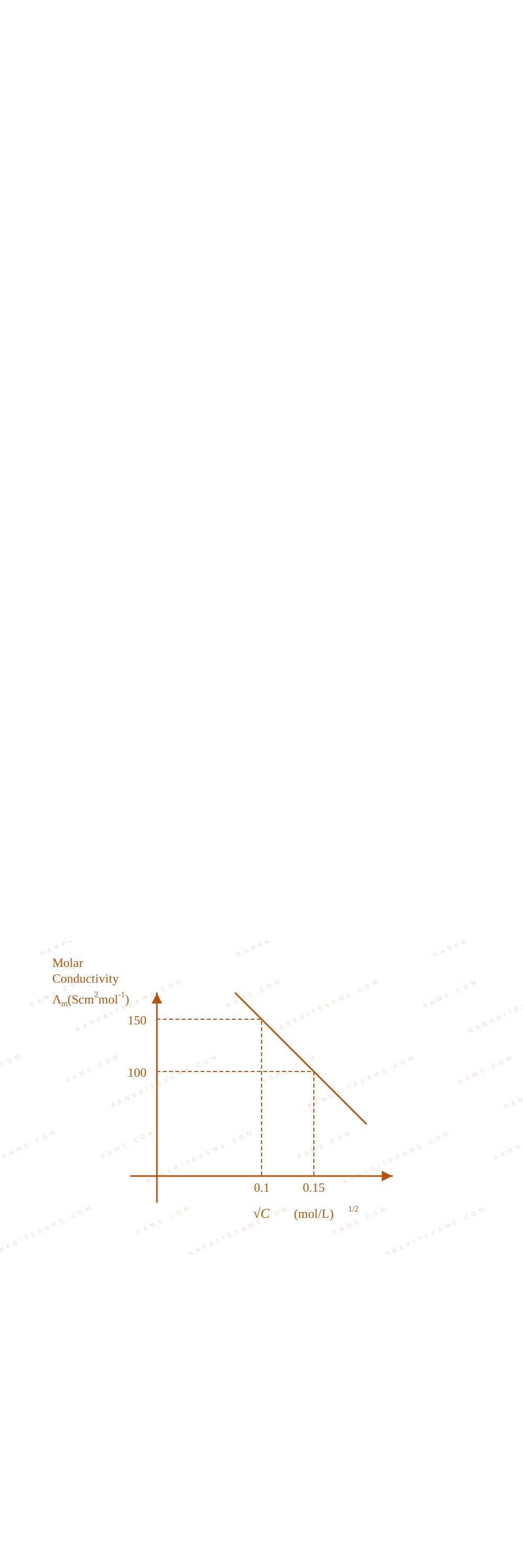
Given below is the plot of the molar conductivity vs concentration for KCl in aqueous solution.
Molar conductivity vs root concentration graph for Q46 - JEE Main 2025 Morning
The image features a standard linear plot tracing electrolytic molar conductance trends over root concentration variations.
If, for the higher concentration of KCl solution, the resistance of the conductivity cell is 100Ω then the resistance of the same cell with the dilute solution is xΩ The value of x is (Nearest integer)
Numerical Answer. Answer: 150 to 150

Solution

Related Formula

Conductivity relationship with cell parameters:

κ = G · G^* = (G^*)/(R) λm = (κ × 1000)/(C)

where G^* represents the static cell constant.

Step 1: Setting Up Ratios

Using concentration subscripts c (concentrated) and d (dilute):

(κc)/(κd) = (Rd)/(Rc)

Expressing conductivity through molar conductivity values:

κ = (λm · C)/(1000) ((λm · C)c)/((λm · C)d) = (Rd)/(Rc)

Substituting the graphical read coordinates (Cc = 0.15², Cd = 0.1² with scaled λm parameters):

(100 · (0.15)²)/(150 · (0.1)²) = (Rd)/(100) Rd = 150 Ω
Pattern Recognition

Sees: Resistance correlation across specific graph coordinates. Shortcut: Equate cell parameters through κ ∝ (1)/(R) and solve for the target resistance directly.

Chapter Mix

Class 12 Chemistry: Electrochemistry

Q45 jee_main_2025_03_april_morning Limiting Molar Conductivity
Correct order of limiting molar conductivity for cations in water at 298 K is:
  • A. H⁺>Na⁺>K⁺>Ca²⁺>Mg²⁺
  • B. H⁺>Ca²⁺>Mg²⁺>K⁺>Na⁺
  • C. Mg²⁺>H⁺>Ca²⁺>K⁺>Na⁺
  • D. H⁺>Na⁺>Ca²⁺>Mg²⁺>K⁺

Solution

Core Logic

Limiting molar conductivity relies heavily on the charge and hydrodynamic radius of the hydrated ion. Let us verify the standard experimental limiting molar ionic conductivities (λ°) at 298 K:

  • H⁺: 349.8 S cm² mol⁻¹ (exhibits Grotthuss proton-hopping conduction mechanism)
  • Ca²⁺: 119.0 S cm² mol⁻¹
  • Mg²⁺: 106.1 S cm² mol⁻¹
  • K⁺: 73.5 S cm² mol⁻¹
  • Na⁺: 50.1 S cm² mol⁻¹
Step 1: Trend Layout

Arranging these values in descending order yields:

H⁺ > Ca²⁺ > Mg²⁺ > K⁺ > Na⁺
Pattern Recognition

Shortcut: H⁺ always has the absolute highest value due to its unique proton-hopping transport system. For metal ions, a higher ionic charge boosts conductivity (M²⁺ > M⁺), and within a group, a smaller hydrated radius (larger bare ion) increases mobility (K⁺ > Na⁺).

Chapter Mix

Class 12 Chemistry: Electrochemistry

Q49 jee_main_2025_04_april_evening Conductance of Electrolytic Solutions
The molar conductance of an infinitely dilute solution of ammonium chloride was found to be 185~S~cm²mol⁻¹ and the ionic conductance of hydroxyl and chloride ions are 170 and 70~S~cm²mol⁻¹ , respectively. If molar conductance of 0.02~M solution of ammonium hydroxide is 85.5~S~cm²mol⁻¹ , its degree of dissociation is given by x× 10⁻¹ . The value of x is _______. (Nearest integer)
Numerical Answer. Answer: 2.9 to 3.1

Solution

Related Formula
Λm^°(NH₄OH) = λ^°(NH₄^+) + λ^°(OH^-) (Kohlrausch's Law) α = (Λm^c)/(Λm^°)
Core Logic
  • Find the limiting molar conductance of NH₄^+ using the NH₄Cl data:
Λm^°(NH₄Cl) = λ^°(NH₄^+) + λ^°(Cl^-) = 185 λ^°(NH₄^+) = 185 - 70 = 115 ~S · cm² · mol⁻¹
  • Calculate Λm^° for the weak electrolyte ammonium hydroxide (NH₄OH):
Λm^°(NH₄OH) = 115 + 170 = 285 ~S · cm² · mol⁻¹
  • Evaluate the degree of dissociation (α):
α = (85.5)/(285) = 0.3 = 3 × 10⁻¹

Comparing with the format x × 10⁻¹, the value of x is 3.

Pattern Recognition

Kohlrausch's law allows direct algebraic recombination of ion conductances. Always construct the targeted weak base compound value by filtering out the spectator chloride contribution from the initial salt parameters.

Chapter Mix

Class 12 Chemistry: Electrochemistry

More Electrochemistry Questions — jee_main_2025_07_april_evening

Practice all Electrochemistry previous-year questions →

Rankbit System
JEE Physics: Waves (+15.5%) | Electrostatics: Concentric Shells (-29.7%) | Modern Physics: Photoelectric Clones (+34.2%) | Mathematics: Definite Integrals (+18.1%) | Chemistry: Coordination Splitting (-11.4%) | JEE Physics: Waves (+15.5%) | Electrostatics: Concentric Shells (-29.7%) | Modern Physics: Photoelectric Clones (+34.2%) | Mathematics: Definite Integrals (+18.1%) | Chemistry: Coordination Splitting (-11.4%)