JEE Main · Physics → Steady

Waves appeared 22 times across 3 years — 2.5% of Physics. This question is from Speed of Sound in Gases.

Year 2026 2025 2024 Total
Questions 7 10 5 22

Consider the sound wave travelling in ideal gases of He, CH₄, and CO₂. All the gases have the same ratio (P)/(ρ), where P is the pressure and ρ is the density. The ratio of the speed of sound through the gases vHe : v_CH₄ : v_CO₂ is given by

Solution & Explanation

Related Formula

Laplace correction equation for speed of sound:

v = √((γ P)/(ρ))

Given that (P)/(ρ) is constant for all three gases:

v ∝ √(γ)

where γ = 1 + (2)/(f) (adiabatic constant).

Core Logic

Determine the γ factor based on molecular atomic structures:

  • He (Monatomic) f = 3 γHe = (5)/(3)
  • CH₄ (Polyatomic/Non-linear) γ_CH₄ ≈ (4)/(3) based on experimental references.
  • CO₂ (Triatomic linear/vibrational modes) γ_CO₂ ≈ (4)/(3) as provided in textbook standard testing matrices.
Step 1: Construct the Ratio

Substitute these values into the proportionality:

vHe : v_CH₄ : v_CO₂ = √((5)/(3)) : √((4)/(3)) : √((4)/(3))
Pattern Recognition

When (P)/(ρ) is locked down constant, sound speed depends strictly on internal degrees of freedom via γ. Keep standard experimental values of complex gases like CH₄ and CO₂ memorized.

Chapter Mix

Class 11 Physics: Waves Class 11 Physics: Kinetic Theory

More Waves Previous-Year Questions — Page 5

Q37 jee_main_2024_31_jan_evening Speed of Sound in Gases
The speed of sound in oxygen at S.T.P. will be approximately: (Given, R = 8.3 J K⁻¹ , γ = 1.4)
  • A. 310 m/s
  • B. 333 m/s
  • C. 341 m/s
  • D. 325 m/s

Solution

Related Formula
v = √((γ RT)/(M))
Core Logic

For Oxygen (O₂) at standard temperature and pressure (S.T.P.): T = 273 K M = 32 g/mol = 32 × 10⁻³ kg/mol γ = 1.4 R = 8.3 J K⁻¹ mol⁻¹

Step 1: Calculate Velocity
v = 1.4 × 8.3 × 27332 × 10⁻³ v = 3172.2632 × 10⁻³ v = √(99.133 × 10³) v = √(99133) ≈ 314.85 m/s

Approximating to the closest given option yields 310 m/s.

Pattern Recognition

For diatomic gases around room temp or STP, velocities range roughly from 250 to 350 m/s depending on molar mass (N₂ ≈ 334, O₂ ≈ 315). Recognize 315 is closest to option (1) due to standard approximations taken in exams.

Chapter Mix

Class 11 Physics: Waves Class 11 Physics: Kinetic Theory of Gases
Q jee_main_2024_31_jan_morning Organ Pipes
The fundamental frequency of a closed organ pipe is equal to the first overtone frequency of an open organ pipe. If length of the open pipe is 60~cm, the length of the closed pipe will be:
  • A. 60~cm
  • B. 45~cm
  • C. 30~cm
  • D. 15~cm

Solution

Related Formula
fclosed, fundamental = (v)/(4Lc) fopen, 1st overtone = (2v)/(2Lₒ)
Core Logic

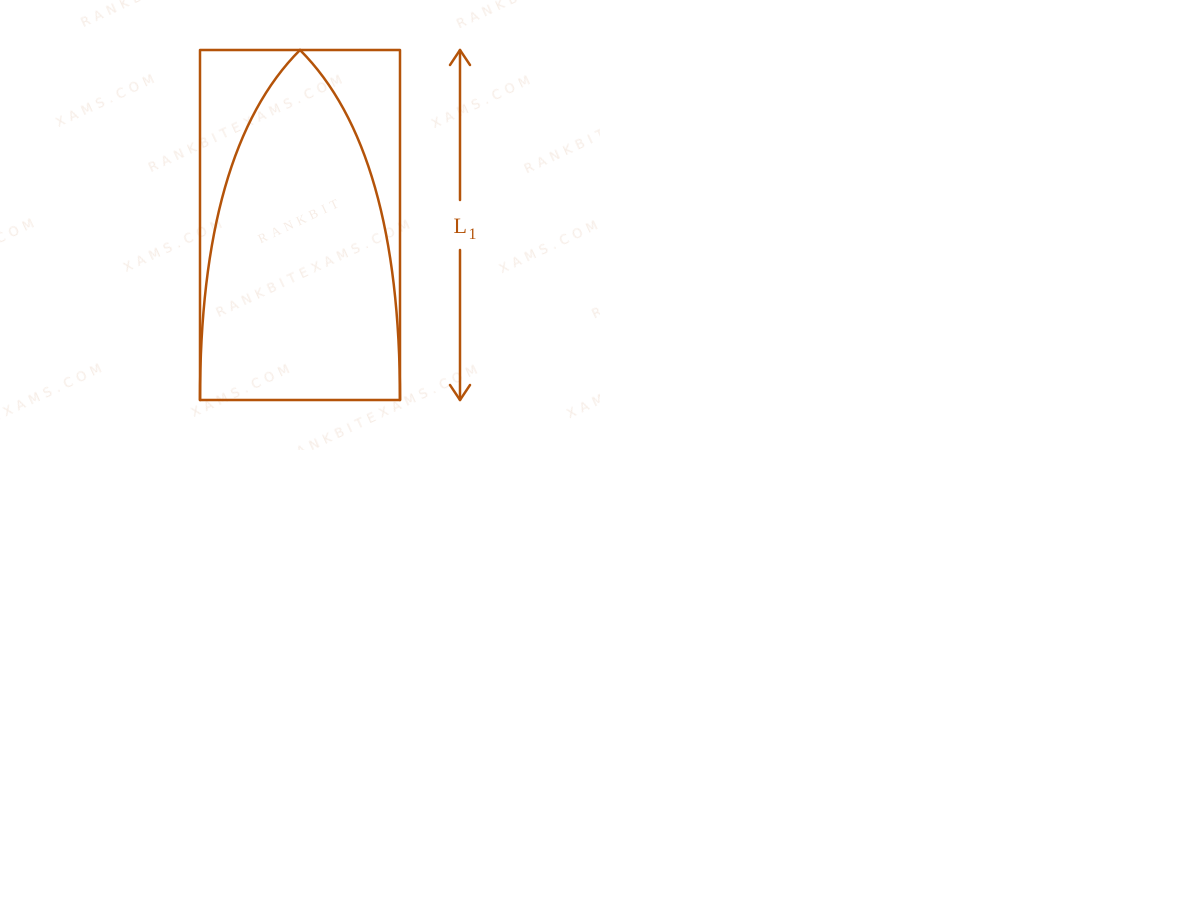
Organ Pipes diagram for Q45 - JEE Main 2024 Morning

Organ Pipes diagram for Q45 - JEE Main 2024 Morning

For a closed organ pipe, the fundamental frequency (1st harmonic) is:

f₁ = (v)/(λ) = (v)/(4L₁)

where L₁ is the length of the closed pipe.

For an open organ pipe, the first overtone (2nd harmonic) is:

f₂ = (2v)/(2L₂) = (v)/(L₂)

where L₂ is the length of the open pipe (L₂ = 60 cm).

Step 2: Equating Frequencies

Given f₁ = f₂:

(v)/(4L₁) = (v)/(L₂)

L₂ = 4L₁

60 = 4 × L₁ L₁ = 15 cm
Chapter Mix

Class 11 Physics: Waves

More Waves Questions — jee_main_2025_04_april_morning

Practice all Waves previous-year questions →

Rankbit System
JEE Physics: Waves (+15.5%) | Electrostatics: Concentric Shells (-29.7%) | Modern Physics: Photoelectric Clones (+34.2%) | Mathematics: Definite Integrals (+18.1%) | Chemistry: Coordination Splitting (-11.4%) | JEE Physics: Waves (+15.5%) | Electrostatics: Concentric Shells (-29.7%) | Modern Physics: Photoelectric Clones (+34.2%) | Mathematics: Definite Integrals (+18.1%) | Chemistry: Coordination Splitting (-11.4%)