JEE Main · Physics → Steady

System of Particles and Rotational Motion appeared 58 times across 3 years — 6.7% of Physics. This question is from Torque and Angular Momentum.

Year 2026 2025 2024 Total
Questions 20 27 11 58

Which of the following are correct expressions for torque acting on a body? A. τ = r × L B. τ = (d)/(dt)( r × p) C. τ = r × d pdt D. τ = I α E. τ = r × F ( r = position vector; p = linear momentum; L = angular momentum; α = angular acceleration; I = moment of inertia; F = force; t = time) Choose the correct answer from the options given below:

Solution & Explanation

Related Formula

Fundamental mathematical definition of torque:

τ = r × F

Rotational analogue of Newton's second law:

τ = d Ldt = I α

Linear momentum relations:

L = r × p τ = (d)/(dt)( r × p)
Core Logic

Let's check each expression sequentially:

  • A. τ = I × L is dimensionally incorrect (Moment of inertia I is primarily treated as a tensor or scalar placeholder, not crossed directly like this).
  • B. τ = d Ldt = (d)/(dt)( r × p) is fundamentally correct.
  • C. τ = r × F = r × d pdt is correct since F = d pdt.
  • D. τ = I α is the standard scalar component/fixed axis formulation.
  • E. τ = r × F is the true physical vector definition.
  • Thus, statements B, C, D, and E are universally correct representations.

Pattern Recognition

Torque can be represented either through geometric structural parameters (position and force cross products) or via kinematic response properties (rate of change of angular momentum or product of rotational inertia and acceleration).

Chapter Mix

Class 11 Physics: System of Particles and Rotational Motion

More System of Particles and Rotational Motion Previous-Year Questions — Page 10

Q17 jee_main_2025_28_jan_evening Torque and Equilibrium
A uniform rod of mass 250g having length 100cm is balanced on a sharp edge at 40cm mark[cite: 150, 151]. A mass of 400g is suspended at 10cm mark. To maintain the balance of the rod, the mass to be suspended at 90cm mark, is [cite: 154, 156]
  • A. 300g
  • B. 190g
  • C. 200g
  • D. 290g

Solution

Related Formula

For rotational equilibrium, the \sum of all counter-clockwise torques about the pivot point must exactly balance the \sum of all clockwise torques:

Σ τpivot = 0 Σ (mᵢ · g · xᵢ) = 0
Core Logic

The rod is uniform, meaning its mass (250 g) acts exactly at its geometric center of mass, the 50 cm mark[cite: 150, 151]. Let the pivot point be the sharp edge at the 40 cm mark .

Calculate the relative lever arms from the pivot [cite: 775, 776, 777]:

  • 400 g mass at 10 cm mark: lever arm = 40 - 10 = 30 cm (counter-clockwise)
  • 250 g rod mass at 50 cm mark: lever arm = 50 - 40 = 10 cm (clockwise)
  • Unknown mass M at 90 cm mark: lever arm = 90 - 40 = 50 cm (clockwise)
  • Setting up the torque balance equation:

400 × 30 = (250 × 10) + (M × 50) 12000 = 2500 + 50M 50M = 9500 M = (9500)/(50) = 190 g
Step 1: Visual Context

The structural layout of forces acting on the balanced rod system is shown below:
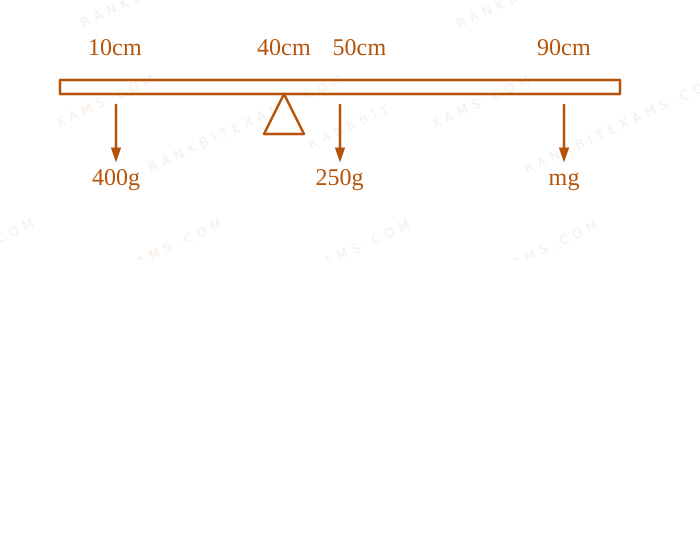
Torque and Equilibrium balancing diagram for Q17

Pattern Recognition

Never forget to include the weight of a uniform rod itself in equilibrium equations. It is a common oversight to omit the rod's mass, which always acts at its geometric center.

Chapter Mix

Class 11 Physics: System of Particles and Rotational Motion
Q jee_main_2025_29_jan_morning Torque
The coordinates of a particle with respect to origin in a given reference frame is (1, 1, 1) meters. If a force of F = i - j + k acts on the particle, then the magnitude of torque (with respect to origin) in z -direction is
Numerical Answer. Answer: 2 to 2

Solution

Related Formula
τ = r × F
Core Logic

Given position vector r = i + j + k and force F = i - j + k:

τ = | arrayccc i & j & k 1 & 1 & 1 1 & -1 & 1 array |
Step 1: Isolate z-component
τz = k(1(-1) - 1(1)) = -2 k

The absolute magnitude of the torque component in the z-direction equals 2 ~N · m.

Chapter Mix

Class 11 Physics: System of Particles and Rotational Motion

Q jee_main_2024_01_february_morning Centre of Mass
The identical spheres each of mass 2M are placed at the corners of a right angled triangle with mutually perpendicular sides equal to 4~m each. Taking point of intersection of these two sides as origin, the magnitude of position vector of the centre of mass of the system is 4√(2)x, where the value of x is ______.
Numerical Answer. Answer: 3 to 3

Solution

Related Formula

Position vector of the Centre of Mass (COM):

rCOM = m₁ r₁ + m₂ r₂ + m₃ r₃m₁ + m₂ + m₃
Core Logic

Assign coordinates to the three masses (m₁=m₂=m₃=2M):

  • Origin mass: r₁ = 0 i + 0 j
  • X-axis mass: r₂ = 4 i + 0 j
  • Y-axis mass: r₃ = 0 i + 4 j
  • Substitute these into the COM formula:

rCOM = 2M(0) + 2M(4 i) + 2M(4 j)2M + 2M + 2M = 8M i + 8M j6M = (4)/(3) i + (4)/(3) j
Step 1: Calculate Position Vector Magnitude
| rCOM| = √(((4)/(3))² + ((4)/(3))²) = 4√(2)3

Matching this directly with the given template 4√(2)x shows that x = 3.

Pattern Recognition

Since the mass layout is completely symmetric along both right-angle legs, the COM coordinates are identical (xCOM = yCOM).

Chapter Mix

Class 11 Physics: System of Particles and Rotational Motion

Q60 jee_main_2024_29_january_evening Angular Momentum of a Particle
A body of mass 5 kg moving with a uniform speed 3√(2) ms⁻¹ in X–Y plane along the line y = x + 4. The angular momentum of the particle about the origin will be ______ kg m²s⁻¹.
Numerical Answer. Answer: 60 to 60

Solution

Related Formula

The magnitude of the angular momentum L of a particle of mass m moving with velocity v is:

L = m v d

where:

  • d is the perpendicular distance from the axis of rotation (origin) to the line of motion of the particle.
Core Logic

Given parameters:

  • Mass, m = 5 kg
  • Velocity, v = 3√(2) ms⁻¹
  • Line of motion: y = x + 4 x - y + 4 = 0
Step 1: Calculate Perpendicular Distance

The perpendicular distance d from the origin (0,0) to the line Ax + By + C = 0 is:

d = |A(0) + B(0) + C|√(A² + B²)

For the line x - y + 4 = 0:

d = |4|√(1² + (-1)²) = 4√(2) = 2√(2) m
Step 2: Calculate Angular Momentum

Substitute the values into the angular momentum formula:

L = m v d

L = 5 kg × (3√(2) ms⁻¹) × (2√(2) m) L = 5 × 3 × 4 = 60 kg m²s⁻¹

Thus, the angular momentum of the particle about the origin is 60 kg m²s⁻¹.

Pattern Recognition

Instead of complicated vector cross products, find the perpendicular distance of the straight line from the origin using standard coordinate geometry. L = mvd is extremely fast and reliable.

Chapter Mix

Class 11 Physics: System of Particles and Rotational Motion

Q jee_main_2024_27_jan_morning Moment of Inertia
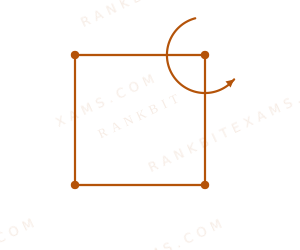
Four particles each of mass 1 kg are placed at four corners of a square of side 2 m. The moment of inertia of the system about an axis perpendicular to its plane and passing through one of its vertices is ______ kg ². {{IMG}}
Moment of Inertia
Moment of Inertia
Numerical Answer. Answer: 16 to 16

Solution

Related Formula
I = Σ mᵢ rᵢ²
Core Logic

Let the axis pass through vertex 1. Evaluate distances (r) for each corner particle:

  • Particle at vertex 1: r₁ = 0
  • Particle at adjacent vertex 2: r₂ = a
  • Particle at adjacent vertex 4: r₄ = a
  • Particle at diagonally opposite vertex 3: r₃ = √(2)a
Step 1: Set up substitution formula
I = m(0)² + m(a)² + m(a)² + m(√(2)a)² I = ma² + ma² + 2ma² = 4ma²
Step 2: Numeric Evaluation

Substitute m = 1 kg and side length a = 2 m:

I = 4 × 1 × (2)² = 4 × 4 = 16 kg ²
Pattern Recognition

For a standard planar configuration system, total orthogonal moment components map predictably via basic summation configurations matching 4ma² exactly.

Chapter Mix

Class 11 Physics: System of Particles and Rotational Motion

More System of Particles and Rotational Motion Questions — jee_main_2025_04_april_morning

Practice all System of Particles and Rotational Motion previous-year questions →

Rankbit System
JEE Physics: Waves (+15.5%) | Electrostatics: Concentric Shells (-29.7%) | Modern Physics: Photoelectric Clones (+34.2%) | Mathematics: Definite Integrals (+18.1%) | Chemistry: Coordination Splitting (-11.4%) | JEE Physics: Waves (+15.5%) | Electrostatics: Concentric Shells (-29.7%) | Modern Physics: Photoelectric Clones (+34.2%) | Mathematics: Definite Integrals (+18.1%) | Chemistry: Coordination Splitting (-11.4%)