System of Particles and Rotational Motion appeared 58 times across 3 years — 6.7% of Physics.
This question is from Uniform Circular Motion and Dynamics.
If L$\vec{L}$ and P$\vec{P}$ represent the angular momentum and linear momentum respectively of a particle of mass 'm$m$' having position vector r = a( i ω t + j ω t)$\vec{r} = a(\hat{i}\cos\omega t + \hat{j}\sin\omega t)$. The direction of force is
A.Opposite to the direction of r$\vec{r}$
B.Opposite to the direction of L$\vec{L}$
C.Opposite to the direction of P$\vec{P}$
D.Opposite to the direction of L × P$\vec{L} \times \vec{P}$
Solution & Explanation
Related Formula
Acceleration vector equation via secondary derivation:
a = d² rdt²$$\vec{a} = \frac{d^2\vec{r}}{dt^2}$$
Force equation:
F = m a$$\vec{F} = m\vec{a}$$
Core Logic
Given position tracking trace:
r = a( i ω t + j ω t)$$\vec{r} = a(\hat{i}\cos\omega t + \hat{j}\sin\omega t)$$
Velocity vector v$\vec{v}$:
v = d rdt = aω(- i ω t + j ω t)$$\vec{v} = \frac{d\vec{r}}{dt} = a\omega(-\hat{i}\sin\omega t + \hat{j}\cos\omega t)$$
Step 1: Differentiate to find Acceleration
a = d vdt = aω²(- i ω t - j ω t)$$\vec{a} = \frac{d\vec{v}}{dt} = a\omega^2(-\hat{i}\cos\omega t - \hat{j}\sin\omega t)$$a = -ω² [ a( i ω t + j ω t) ] = -ω² r$$\vec{a} = -\omega^2 \left[ a(\hat{i}\cos\omega t + \hat{j}\sin\omega t) \right] = -\omega^2\vec{r}$$
Step 2: Establish Force Direction
F = m a = -mω² r$$\vec{F} = m\vec{a} = -m\omega^2\vec{r}$$
The minus sign indicates the net centripetal pulling force aligns explicitly opposite to the direction of r$\vec{r}$.
Pattern Recognition
The expression describes a standard uniform circular motion profile. In circular configurations, acceleration and centripetal forces point radially inward, directly opposing the outbound position tracker vector.
Chapter Mix
Class 11 Physics: Kinematics
Class 11 Physics: System of Particles and Rotational Motion
More System of Particles and Rotational Motion Previous-Year Questions — Page 3
Two small balls with masses m and 2m are attached to both ends of a rigid rod of length d and negligible mass. If angular momentum of this system is L about an axis (A) passing through its centre of mass and perpendicular to the rod then angular velocity of the system about A is:
Sees: "two point masses" + "rotation about COM" → Quickly use reduced mass μ$\mu$ moment of inertia shortcut: Icm = μ d² = ((m · 2m)/(3m))d² = (2)/(3)md²$I_{\text{cm}} = \mu d^{2} = (\frac{m \cdot 2m}{3m})d^2 = \frac{2}{3}md^2$ to save time.
Chapter Mix
Class 11 Physics: Systems of Particles and Rotational Motion
Q27jee_main_2026_23_january_eveningConservation of Momentum
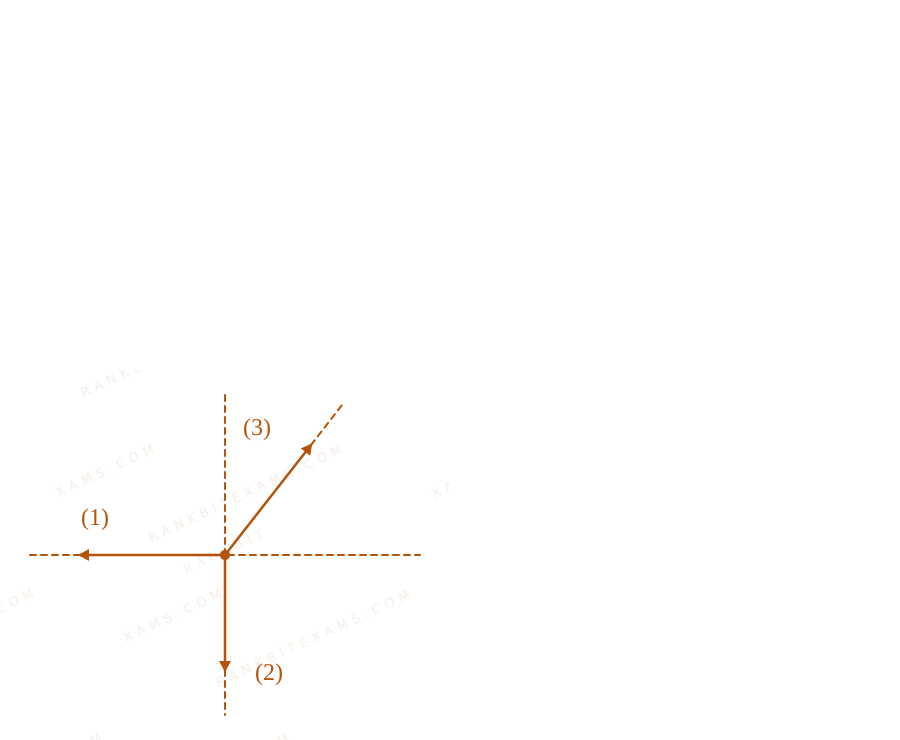
A body of mass 14 kg initially at rest explodes and breaks into three fragments of masses in the ratio 2 : 2 : 3. The two pieces of equal masses fly off perpendicular to each other with a speed of 18 m/s each. The velocity of the heavier fragment is ____m/s.
Vector diagram illustrating the trajectories of the explosive fragments.
Since M₁$M_1$ and M₂$M_2$ fly off perpendicular to each other, let their velocity vectors be along the x and y axes. Because the total momentum must be zero, we align the fragments opposite to the final 3rd fragment's direction for simplicity, or just use standard axes.
Let V₁ = -18 i$\vec{V}_1 = -18\hat{i}$ and V₂ = -18 j$\vec{V}_2 = -18\hat{j}$. Note that the solution simplifies the mass ratio directly to 2, 2, 3$2, 2, 3$ as relative masses for the momentum equation:
In a 3-part explosion from rest, the momentum of the third piece must be equal and opposite to the vector sum of the other two pieces. You can use the ratio of masses directly in the momentum conservation equation instead of absolute masses to save time.
Chapter Mix
Class 11 Physics: Center of Mass and Collisions
Q49jee_main_2026_23_january_eveningMoment of Inertia
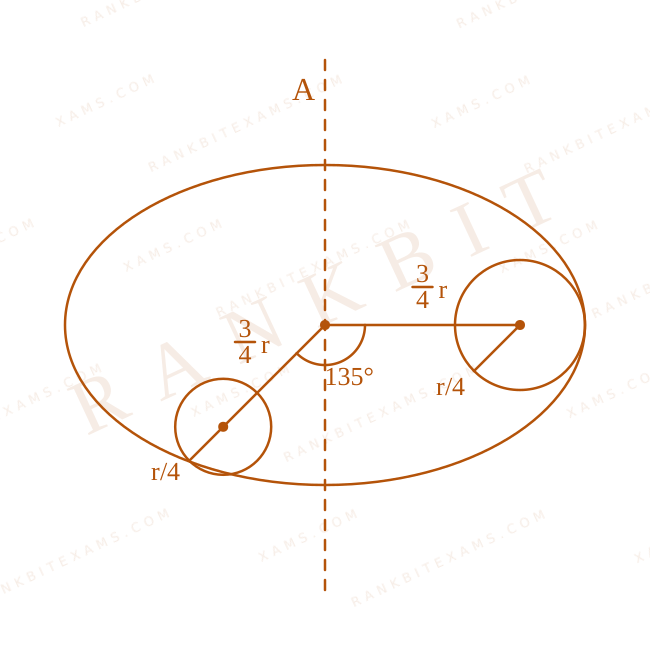
Suppose there is a uniform circular disc of mass M kg and radius r m shown in figure. The shaded regions are cut out from the disc. The moment of inertia of the remainder about the axis A of the disc is given by (x)/(256)$\frac{x}{256}$ Mr ²$^{2}$ . The value of x is ____.
Diagram showing a large circular disc with two smaller circular sections removed.
Total mass of original disc is M = σ π r²$M = \sigma \pi r^2$.
Two identical smaller discs are removed. From the diagram, each small cut-out disc has radius r' = (r)/(4)$r' = \frac{r}{4}$.
The center of each cut-out disc is at distance d = (3)/(4)r$d = \frac{3}{4}r$ from the main axis A.
Mass of each cut-out disc:
Iremaining = (1)/(2) M r² - (19)/(256) M r²$$I_{\text{remaining}} = \frac{1}{2} M r^2 - \frac{19}{256} M r^2$$Iremaining = (128 - 19)/(256) M r² = (109)/(256) M r²$$I_{\text{remaining}} = \frac{128 - 19}{256} M r^2 = \frac{109}{256} M r^2$$
Thus, x = 109$x = 109$.
Pattern Recognition
In cavity problems, mass is strictly proportional to area (R²$R^2$). Use parallel axis theorem perfectly on the 'negative mass' segments and subtract.
Chapter Mix
Class 11 Physics: System of Particles and Rotational Motion
Q41jee_main_2026_24_january_morningDynamics of Rotational Motion
Two masses 400 g and 350 g are suspended from the ends of a light string passing over a heavy pulley of radius 2 cm. When released from rest the heavier mass is observed to fall 81 cm in 9 s. The rotational inertia of the pulley is ____ kg ²$\text{kg}\cdot\text{m}^{2}$.
(g = 9.8 m/s²$9.8 \text{ m/s}^{2}$)
A.9.5 × 10⁻³$9.5 \times 10^{-3}$
B.4.75 × 10⁻³$4.75 \times 10^{-3}$
C.1.86 × 10⁻²$1.86 \times 10^{-2}$
D.8.3 × 10⁻³$8.3 \times 10^{-3}$
Solution
Related Formula
s = ut + (1)/(2)at²$$s = ut + \frac{1}{2}at^2$$a = ((m₁ - m₂)g)/(m₁ + m₂ + (I)/(R²))$$a = \frac{(m_1 - m_2)g}{m_1 + m_2 + \frac{I}{R^2}}$$
Core Logic
Atwood machine with a massive pulley
First, calculate the acceleration of the system using kinematics:
s = ut + (1)/(2)at²$$s = ut + \frac{1}{2}at^2$$0.81 = 0 + (1)/(2) a (9)²$$0.81 = 0 + \frac{1}{2} a (9)^2$$a = (2 × 0.81)/(81) = 0.02 m/s²$$a = \frac{2 \times 0.81}{81} = 0.02 \text{ m/s}^2$$
Applying Newton's second law for masses and rotation:
m₁ g - T₁ = m₁ a$$m_1 g - T_1 = m_1 a$$T₂ - m₂ g = m₂ a$$T_2 - m_2 g = m_2 a$$(T₁ - T₂)R = I · α = I ((a)/(R))$$(T_1 - T_2)R = I \cdot \alpha = I \left(\frac{a}{R}\right)$$
This leads to the standard Atwood machine acceleration with massive pulley:
For massive pulley problems, the "effective mass" of the system increases by the pulley's equivalent translating mass I/R²$I/R^2$. Simply use a = Fₙₑₜ / Meffective$a = F_{\text{net}} / M_{\text{effective}}$.
Chapter Mix
Class 11 Physics: System of Particles and Rotational Motion

Class 11 Physics: Laws of Motion
Q31jee_main_2026_24_january_eveningRigid Body Rotation and Energy Conservation
A thin uniform rod (X) of mass M and length L is pivoted at a height ((L)/(3))$\left(\frac{L}{3}\right)$ as shown in the figure. The rod is allowed to fall from a vertical position and lie horizontally on the table. The angular velocity of this rod when it hits the table top, is ____. (g = gravitational acceleration)
A uniform rod is pivoted at a distance of L/3 from the table surface and falls from a vertical position to horizontal.
The rod falls such that its center of mass lowers by a distance.
The rod is pivoted at (L)/(3)$\frac{L}{3}$ from the bottom, meaning the distance from the pivot to the center of mass (which is at (L)/(2)$\frac{L}{2}$ from either end) is:
For a hinged rod falling from a vertical orientation to horizontal, always track the displacement of the center of mass and calculate rotational inertia strictly about the hinge using Ipivot = Icm + md²$I_{\text{pivot}} = I_{\text{cm}} + md^2$.
Chapter Mix
Class 11 Physics: System of Particles and Rotational Motion
More System of Particles and Rotational Motion Questions — jee_main_2025_04_april_morning
Practice past-year questions one chapter at a time. Pick an exam → subject → chapter and get every PYQ for that topic — pulled together from all past papers — with the chapter's key formulas alongside.