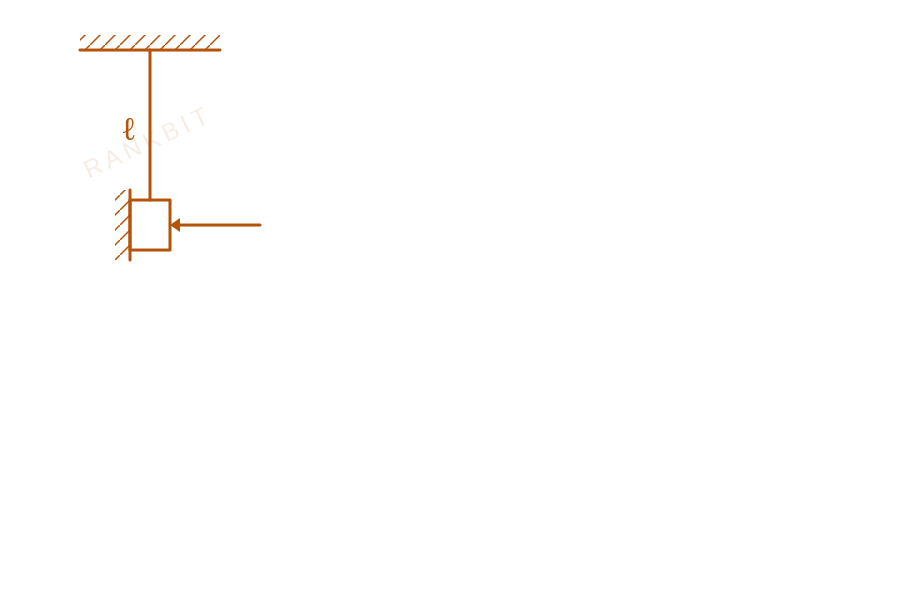
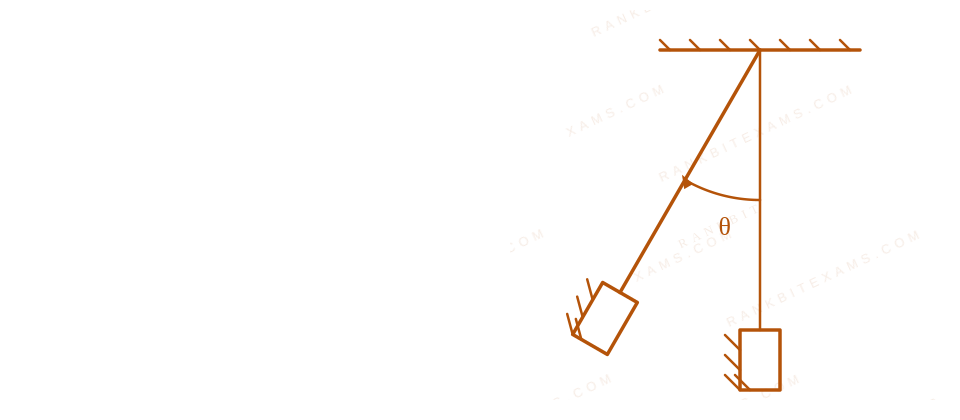
A small mirror of mass m$m$ is suspended by a massless thread of length l$l$. Then the small angle through which the thread will be deflected when a short pulse of laser of energy E$E$ falls normal on the mirror (c =$c = $ speed of light in vacuum and g =$g = $ acceleration due to gravity)
For small angles (θ)/(2) ≈ (θ)/(2)$\sin\frac{\theta}{2} \approx \frac{\theta}{2}$.
Core Logic
Assuming perfect normal reflection from the mirror surface, the pulse imparts a momentum impulse of (2E)/(c)$\frac{2E}{c}$ to the mass. This provides an initial velocity v$v$ to the mirror. The mirror then swings up to a maximum angle θ$\theta$ where kinetic energy converts entirely to gravitational potential energy.
Deflection of suspended mirror via laser pulse diagram for Q2 - JEE Main 2025 Morning
Step 1: Calculate Initial Velocity
From momentum change:
m(v - 0) = (2E)/(c) v = (2E)/(mc)$$m(v - 0) = \frac{2E}{c} \implies v = \frac{2E}{mc}$$
Deflection of suspended mirror via laser pulse diagram for Q2 - JEE Main 2025 Morning
This is a standard ballistic pendulum problem where the impulse is delivered by radiation pressure. Perfect reflection means momentum transfer is double the incident momentum (2· (E)/(c))$\left(2\cdot \frac{E}{c}\right)$.
Chapter Mix
Class 12 Physics: Dual Nature of Radiation and Matter
Class 11 Physics: System of Particles and Rotational Motion
More Dual Nature of Radiation and Matter Previous-Year Questions — Page 5
Which of the following phenomena can not be explained by wave theory of light? [cite: 52-53]
A. Reflection of light
B. Diffraction of light
C. Refraction of light
D. Compton effect
Solution
Core Logic
Reflection, Refraction, and Diffraction can all be fully explained using Huygens' principle and wave theory paths [cite: 54, 47, 66].
Compton effect involves the scattering of an X-ray photon by an electron, demonstrating explicit momentum conversion. This process requires treating light strictly as localized particle packets (photons) and cannot be captured by continuous classical wave formulations.
Step 1: Conclusion
Hence, the Compton effect is the correct answer as it relies entirely on the particle nature of electromagnetic waves.
Pattern Recognition
Phenomena such as the Photoelectric Effect, Compton Scattering, and Blackbody Radiation serve as absolute foundational evidence for the particle/quantum layout of radiation, while Interference, Diffraction, and Polarization confirm wave configurations.
Chapter Mix
Class 12 Physics: Dual Nature of Radiation and Matter
Qjee_main_2025_29_jan_morningPhotoelectric Effect
Given below are two statements : one is labelled as Assertion (A) and the other is labelled as Reason (R).
Assertion (A) : Emission of electrons in photoelectric effect can be suppressed by applying a sufficiently negative electron potential to the photoemissive substance.
Reason (R): A negative electric potential, which stops the emission of electrons from the surface of a photoemissive substance, varies linearly with frequency of incident radiation.
In the light of the above statements, choose the most appropriate answer from the options given below:
A.(A) is false but (R) is true.$\text{(A) is false but (R) is true.}$
B.(A) is true but (R) is false.$\text{(A) is true but (R) is false.}$
C.Both (A) and (R) are true and (R) is the correct explanation of (A).$\text{Both (A) and (R) are true and (R) is the correct explanation of (A).}$
D.Both (A) and (R) are true but (R) is not the correct explanation of (A).$\text{Both (A) and (R) are true but (R) is not the correct explanation of (A).}$
Solution
Related Formula
eV₀ = hν - φ₀$$eV_0 = h\nu - \phi_0$$
Core Logic
Assertion (A) is true because applying a negative stopping potential decelerates the emitted photoelectrons and drops the output current down to zero.
Reason (R) is true because the stopping potential V₀ = ((h)/(e))ν - (φ₀)/(e)$V_0 = \left(\frac{h}{e}\right)\nu - \frac{\phi_0}{e}$ is linear with frequency ν$\nu$. However, the linearity of V₀$V_0$ vs frequency does not explain the physical mechanism behind why a negative potential stops electron emission.
Chapter Mix
Class 12 Physics: Dual Nature of Radiation and Matter
If λ$\lambda$ and K are de Broglie Wavelength and kinetic energy, respectively, of a particle with constant mass. The correct graphical representation for the particle will be :-
Rearranging the de Broglie equation displays a parabolic relationship when evaluating squared attributes or corresponding axes coordinates. Given standard λ$\lambda$ vs 1√(K)$\frac{1}{\sqrt{K}}$ layout tracking, it exhibits an upward facing parabolic behavior matching option (2) layout.
Chapter Mix
Class 12 Physics: Dual Nature of Radiation and Matter
The de Broglie wavelengths of a proton and an α$\alpha$ particle are λ$\lambda$ and 2λ$2\lambda$ respectively. The ratio of the velocities of proton and α$\alpha$ particle will be:
A. 1 : 8
B. 1 : 2
C. 4 : 1
D. 8 : 1
Solution
Related Formula
de Broglie wavelength relationship to velocity:
λ = (h)/(p) = (h)/(mv) v = (h)/(mλ)$$\lambda = \frac{h}{p} = \frac{h}{mv} \implies v = \frac{h}{m\lambda}$$
Core Logic
Let mass of proton be mₚ$m_p$ and mass of α$\alpha$ particle be m_α = 4mₚ$m_\alpha = 4m_p$.
Given wavelengths: λₚ = λ$\lambda_p = \lambda$, λ_α = 2λ$\lambda_\alpha = 2\lambda$.
Class 12 Physics: Dual Nature of Radiation and Matter
Q31jee_main_2024_29_january_eveningPhoton Theory of Light
Two sources of light emit with a power of 200 W$200\text{ W}$. The ratio of number of photons of visible light emitted by each source having wavelengths 300 nm$300\text{ nm}$ and 500 nm$500\text{ nm}$ respectively, will be:
A.1:5$1:5$
B.1:3$1:3$
C.5:3$5:3$
D.3:5$3:5$
Solution
Related Formula
The power P$P$ of a light source emitting n$n$ photons per second of wavelength λ$\lambda$ is given by:
P = n · (hc)/(λ)$$P = n \cdot \frac{hc}{\lambda}$$
where:
h$h$ is Planck's constant
c$c$ is the speed of light
Core Logic
Since both light sources emit with the same power (P = 200 W$P = 200\text{ W}$), we can relate the number of photons emitted per second for each wavelength:
Practice past-year questions one chapter at a time. Pick an exam → subject → chapter and get every PYQ for that topic — pulled together from all past papers — with the chapter's key formulas alongside.