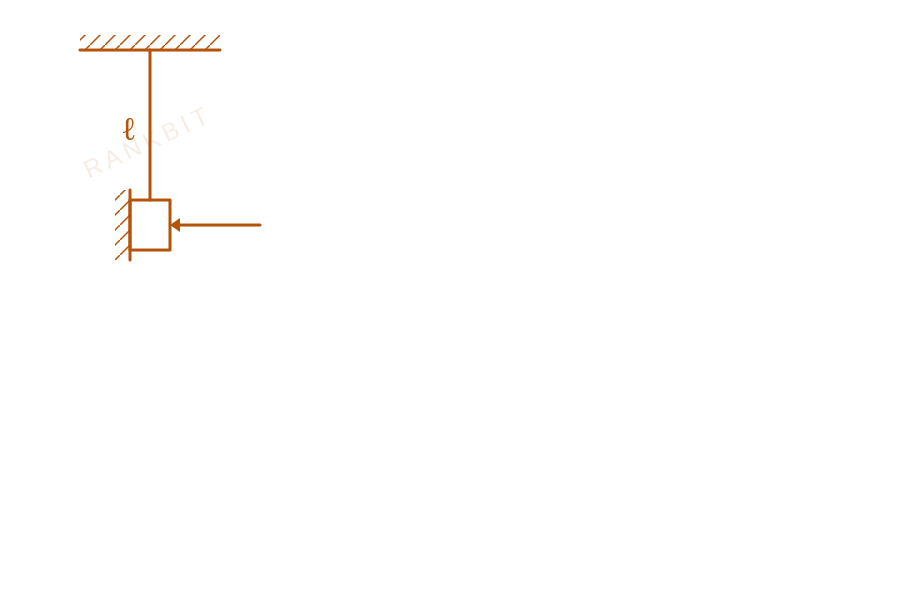
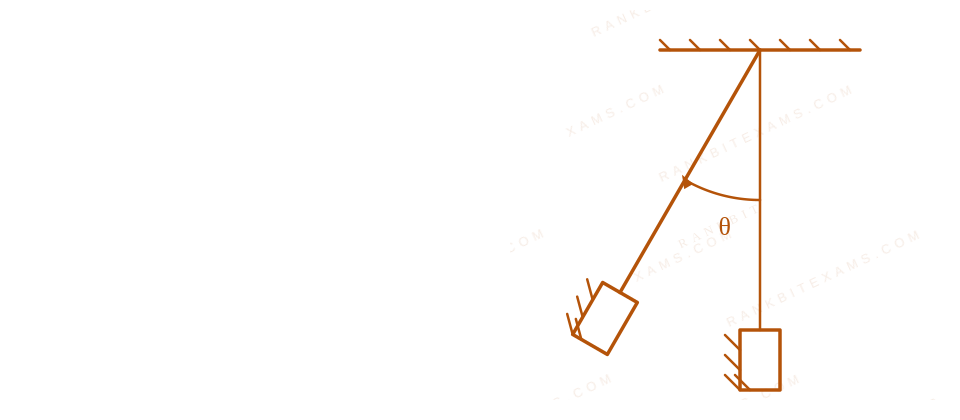
A small mirror of mass m$m$ is suspended by a massless thread of length l$l$. Then the small angle through which the thread will be deflected when a short pulse of laser of energy E$E$ falls normal on the mirror (c =$c = $ speed of light in vacuum and g =$g = $ acceleration due to gravity)
For small angles (θ)/(2) ≈ (θ)/(2)$\sin\frac{\theta}{2} \approx \frac{\theta}{2}$.
Core Logic
Assuming perfect normal reflection from the mirror surface, the pulse imparts a momentum impulse of (2E)/(c)$\frac{2E}{c}$ to the mass. This provides an initial velocity v$v$ to the mirror. The mirror then swings up to a maximum angle θ$\theta$ where kinetic energy converts entirely to gravitational potential energy.
Deflection of suspended mirror via laser pulse diagram for Q2 - JEE Main 2025 Morning
Step 1: Calculate Initial Velocity
From momentum change:
m(v - 0) = (2E)/(c) v = (2E)/(mc)$$m(v - 0) = \frac{2E}{c} \implies v = \frac{2E}{mc}$$
Deflection of suspended mirror via laser pulse diagram for Q2 - JEE Main 2025 Morning
This is a standard ballistic pendulum problem where the impulse is delivered by radiation pressure. Perfect reflection means momentum transfer is double the incident momentum (2· (E)/(c))$\left(2\cdot \frac{E}{c}\right)$.
Chapter Mix
Class 12 Physics: Dual Nature of Radiation and Matter
Class 11 Physics: System of Particles and Rotational Motion
More Dual Nature of Radiation and Matter Previous-Year Questions — Page 4
Q5jee_main_2025_07_april_eveningDe Broglie Wavelength of Electron
A photo-emissive substance is illuminated with a radiation of wavelength λᵢ$\lambda_{i}$ so that it releases electrons with de-Broglie wavelength λc$\lambda_{c}$ The longest wavelength of radiation that can emit photoelectron is λ₀$\lambda_{0}$.
Expression for de-Broglie wavelength is given by:
(m: mass of the electron, h: Planck's constant and c: speed of light) [cite: 39, 41]
λₑ = h 2mK.E, E = hcλᵢ, W = hcλ₀$$\lambda_{e} = \frac{h}{\sqrt{2m\text{K.E}}}, \quad E = \frac{hc}{\lambda_{i}}, \quad W = \frac{hc}{\lambda_{0}}$$ [cite: 682]
Core Logic
From the de-Broglie wavelength relationship, squaring both sides yields: [cite: 682]
Einstein's photoelectric equation relates kinetic energy linearly to (1)/(λ)$\frac{1}{\lambda}$ parameters[cite: 681, 682]. Combining this directly into the momentum term √(2mK)$\sqrt{2mK}$ under the Planck constant yields the standard reciprocal root difference layout[cite: 682].
Chapter Mix
Class 12 Physics: Dual Nature of Radiation and Matter
In photoelectric effect, the stopping potential (V₀$V_{0}$) v/s frequency (u$
u$) curve is plotted. (h$h$ is the Planck's constant and φ₀$\phi_0$ is work function of metal)
(A) V₀$V_{0}$ v/s u$
u$ is linear
(B) The slope of V₀$V_{0}$ v/s u$
u$ curve = φ₀h$\frac{\phi_{0}}{h}$
(C) h$h$ constant is related to the slope of V₀$V_{0}$ v/s u$
u$ line
(D) The value of electric charge of electron is not required to determine h$h$ using the V₀$V_{0}$ v/s u$
u$ curve.
(E) The work function can be estimated without knowing the value of h$h$.
Choose the correct answer from the options given below :
A. (A), (B) and (C) only
B. (C) and (D) only
C. (A), (C) and (E) only
D. (D) and (E) only
Solution
Related Formula
h u = φ₀ + K = φ₀ + eV₀$$h
u = \phi_0 + K_{\text{\max}} = \phi_0 + eV_0$$
V₀ = ((h)/(e)) u - (φ₀)/(e)$$V_0 = \left(\frac{h}{e}\right)
u - \frac{\phi_0}{e}$$
Core Logic
Analyzing each statement:
(A) V₀ v/s
u$V_0 \text{ v/s }
u$
is a straight line equation (y = mx + c$y = mx + c$). True.
(B) Slope is (h)/(e)$\frac{h}{e}$, not (φ₀)/(h)$\frac{\phi_0}{h}$. False.
(C) The slope involves Planck's constant h$h$. True.
(D) To find h$h$ from the slope (m = h/e$m = h/e$), you must multiply the slope by the electronic charge e$e$. Thus, e$e$ is required. False.
(E) The
u$
u$
-intercept occurs when V₀ = 0 uth = (φ₀)/(h)$V_0 = 0 \implies
u_{\text{th}} = \frac{\phi_0}{h}$. The y$y$-intercept is -φ₀/e$-\phi_0/e$. Therefore, we can find φ₀$\phi_0$ from the intercepts knowing only e$e$ or by looking at the scale parameters carefully, without explicitly knowing h$h$. True.
Hence, statements (A), (C), and (E) are correct.
Pattern Recognition
Einstein's photoelectric equation yields a straight-line plot for V₀$V_0$ vs u$
u$ where slope is universally (h)/(e)$\frac{h}{e}$ for all metals.
Chapter Mix
Class 12 Physics: Dual Nature of Radiation and Matter
The energy E and momentum p of a moving body of mass m are related by some equation. Given that c represents the speed of light, identify the correct equation.
Rest energy square term, [m²c⁴] = M² · (L¹ T⁻¹)⁴ = M² L⁴ T⁻⁴$[m^2c^4] = M^2 \cdot (L^1 T^{-1})^4 = M^2 L^4 T^{-4}$
Since all terms share identical dimensions, this relativistic identity is structurally valid. The matching option is (4).
Pattern Recognition
This is Einstein's famous energy-momentum relation of special relativity, fundamental to high-energy modern physics contexts.
Chapter Mix
Class 12 Physics: Dual Nature of Radiation and Matter
Q23jee_main_2025_24_jan_eveningPhoton Theory of Light
The ratio of the power of a light source S₁$S_{1}$ to that the light source S₂$S_{2}$ is 2. S₁$S_{1}$ is emitting 2 × 10¹⁵$2 \times 10^{15}$ photons per second at 600 nm. If the wavelength of the source S₂$S_{2}$ is 300 nm, then the number of photons per second emitted by S₂$S_{2}$ is ____ × 10¹⁴$\times 10^{14}$ .
Numerical Answer.Answer: 5 to 5
Solution
Related Formula
Power of a light source:
P = n Ephoton = n ((hc)/(λ))$$P = n E_{\text{photon}} = n \left(\frac{hc}{\lambda}\right)$$
where n$n$ is the number of photons emitted per second.
Core Logic
Taking the ratio of power for source 1 and source 2:
The question asks for the value multiplying 10¹⁴$10^{14}$, which is 5.
Pattern Recognition
Power relies on both the delivery rate and individual photon packet energy. Lower wavelength means more energetic packets, requiring fewer photons to emit the same power.
Chapter Mix
Class 12 Physics: Dual Nature of Radiation and Matter
Qjee_main_2025_24_jan_morningde Broglie Wavelength of an Electron
An electron of mass 'm' with an initial velocity v=v₀ i(v₀>0)$\vec{v}=v_{0}\hat{i}(v_{0}>0)$ enters an electric field E=-E₀ k$\vec{E}=-E_{0}\hat{k}$ If the initial de Broglie wavelength is λ₀$\lambda_{0}$, the value after time t would be :-
The perpendicular field increases the particle's overall velocity and momentum. Since wavelength is inversely proportional to momentum, it must decrease, which rules out options with a plus sign in the numerator.
Chapter Mix
Class 12 Physics: Dual Nature of Radiation and Matter
More Dual Nature of Radiation and Matter Questions — jee_main_2025_04_april_morning
Practice past-year questions one chapter at a time. Pick an exam → subject → chapter and get every PYQ for that topic — pulled together from all past papers — with the chapter's key formulas alongside.