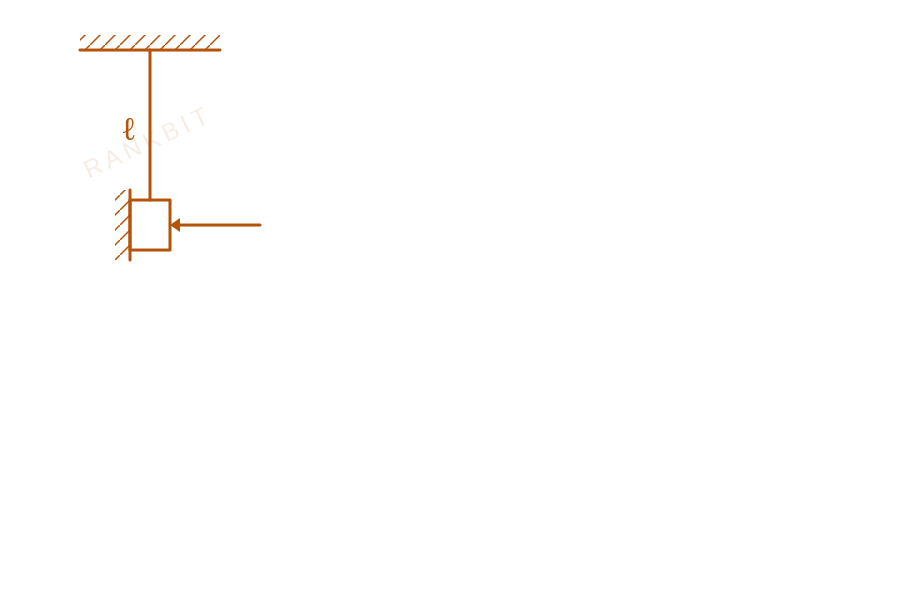
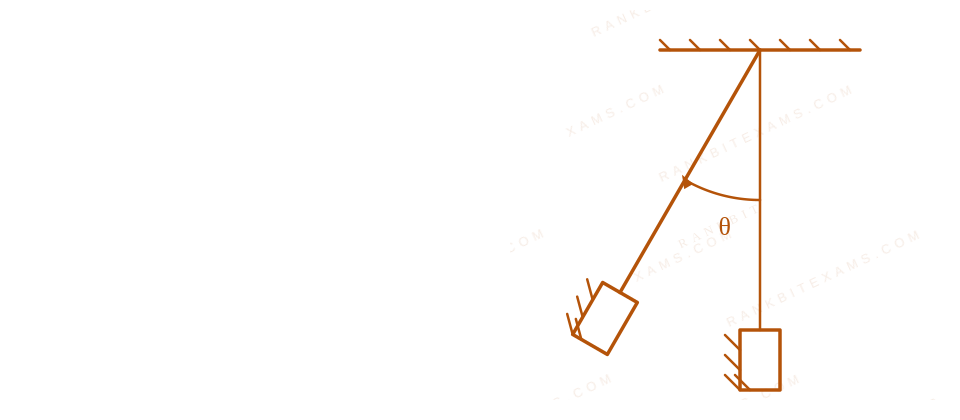
A small mirror of mass m$m$ is suspended by a massless thread of length l$l$. Then the small angle through which the thread will be deflected when a short pulse of laser of energy E$E$ falls normal on the mirror (c =$c = $ speed of light in vacuum and g =$g = $ acceleration due to gravity)
For small angles (θ)/(2) ≈ (θ)/(2)$\sin\frac{\theta}{2} \approx \frac{\theta}{2}$.
Core Logic
Assuming perfect normal reflection from the mirror surface, the pulse imparts a momentum impulse of (2E)/(c)$\frac{2E}{c}$ to the mass. This provides an initial velocity v$v$ to the mirror. The mirror then swings up to a maximum angle θ$\theta$ where kinetic energy converts entirely to gravitational potential energy.
Deflection of suspended mirror via laser pulse diagram for Q2 - JEE Main 2025 Morning
Step 1: Calculate Initial Velocity
From momentum change:
m(v - 0) = (2E)/(c) v = (2E)/(mc)$$m(v - 0) = \frac{2E}{c} \implies v = \frac{2E}{mc}$$
Deflection of suspended mirror via laser pulse diagram for Q2 - JEE Main 2025 Morning
This is a standard ballistic pendulum problem where the impulse is delivered by radiation pressure. Perfect reflection means momentum transfer is double the incident momentum (2· (E)/(c))$\left(2\cdot \frac{E}{c}\right)$.
Chapter Mix
Class 12 Physics: Dual Nature of Radiation and Matter
Class 11 Physics: System of Particles and Rotational Motion
More Dual Nature of Radiation and Matter Previous-Year Questions — Page 6
A convex lens of focal length 40 cm$40\text{ cm}$ forms an image of an extended source of light on a photoelectric cell. A current I$I$ is produced. The lens is replaced by another convex lens having the same diameter but focal length 20 cm$20\text{ cm}$. The photoelectric current now is:
A.(I)/(2)$\frac{I}{2}$
B.4I$4I$
C.2I$2I$
D.I$I$
Solution
Core Logic
Photoelectric current is directly proportional to the intensity of incident light, which depends on the amount of light energy intercepted. The amount of light energy collected by a lens depends strictly on its aperture diameter.
Since both lenses share the exact same diameter, they gather the same total light flux from the source and direct it onto the active photoelectric cell matrix. Thus, the total incident power is invariant.
Step 1: Conclusion
Since the incident energy flux remains constant, the rate of emission of photoelectrons remains identical, meaning the current stays exactly I$I$.
Pattern Recognition
Focal length alters spatial image sizing metrics, but raw aperture dimensions rule total power intercept profiles in optical flux systems.
Chapter Mix
Class 12 Physics: Dual Nature of Radiation and Matter, Ray Optics
The de-Broglie wavelength of an electron is the same as that of a photon. If velocity of electron is 25%$25\%$ of the velocity of light, then the ratio of K.E. of electron and K.E. of photon will be:
A.(1)/(1)$\frac{1}{1}$
B.(1)/(8)$\frac{1}{8}$
C.(8)/(1)$\frac{8}{1}$
D.(1)/(4)$\frac{1}{4}$
Solution
Related Formula
For a photon, the energy (which is its kinetic energy) is:
A direct comparison between massive particle kinetic energy (K = (p²)/(2m) = (p v)/(2)$K = \frac{p^2}{2m} = \frac{p v}{2}$) and photon energy (E = p c$E = p c$) when they share the same momentum p$p$ (same wavelength) yields a simple universally applicable rule: KparticleEphoton = (v)/(2c)$\frac{K_{\text{particle}}}{E_{\text{photon}}} = \frac{v}{2c}$.
Chapter Mix
Class 12 Physics: Dual Nature of Radiation and Matter
For the photoelectric effect, the maximum kinetic energy (Ek)$\left(\mathrm{E}_{\mathrm{k}}\right)$ of the photoelectrons is plotted against the frequency (ν$\nu$) of the incident photons as shown in figure. The slope of the graph gives
A linear graph of maximum kinetic energy E_k versus frequency nu, intersecting the x-axis, with angle theta indicating the slope.
A.Ratio of Planck's constant to electric charge$\text{Ratio of Planck's constant to electric charge}$
B.Work function of the metal$\text{Work function of the metal}$
From Einstein's photoelectric equation, the maximum kinetic energy of emitted photoelectrons is given by Ek = hν - φ$E_k = h\nu - \phi$, where h$h$ is Planck's constant, ν$\nu$ is the incident frequency, and φ$\phi$ is the work function.
This represents a straight line equation of the form y = mx + c$y = mx + c$, where y = Ek$y = E_k$ and x = ν$x = \nu$.
Step 1: Identify the Slope
Comparing Ek = hν - φ$E_k = h\nu - \phi$ with y = mx + c$y = mx + c$, we get the slope:
If the y-axis is K.E.$K.E.$, the slope is h$h$. If the y-axis is Stopping Potential V₀$V_0$, the equation is eV₀ = hν - φ V₀ = (h/e)ν - (φ/e)$eV_0 = h\nu - \phi \implies V_0 = (h/e)\nu - (\phi/e)$, and the slope would be h/e$h/e$.
Chapter Mix
Class 12 Physics: Dual Nature of Radiation and Matter
Q35jee_main_2024_30_jan_morningPhotoelectric Effect and Threshold Wavelength
The work function of a substance is 3.0 ~eV$3.0 \mathrm{~eV}$. The longest wavelength of light that can cause the emission of photoelectrons from this substance is approximately:
A.215 ~nm$215 \mathrm{~nm}$
B.414 ~nm$414 \mathrm{~nm}$
C.400 ~nm$400 \mathrm{~nm}$
D.200 ~nm$200 \mathrm{~nm}$
Solution
Related Formula
E = (hc)/(λ)$$E = \frac{hc}{\lambda}$$λth = 1240 eV Φ$$\lambda_{th} = \frac{1240 \text{ eV}\cdot\text{nm}}{\Phi}$$
Core Logic
For photoelectric emission to occur, the incident energy must be greater than or equal to the work function (Wₑ$W_e$ or Φ$\Phi$).
The longest wavelength corresponds to the minimum energy required, which is exactly the work function.
λ ≤ (hc)/(Wₑ)$$\lambda \le \frac{hc}{W_e}$$
Step 1: Calculate Wavelength
Substitute the given values using the convenient constant hc ≈ 1240 ~eV · nm$hc \approx 1240 \mathrm{~eV \cdot nm}$:
The standard shortcut E(eV) = 1240 / λ(nm)$E(\text{eV}) = 1240 / \lambda(\text{nm})$ rapidly converts work function to threshold wavelength without dealing with standard SI unit conversions.
Chapter Mix
Class 12 Physics: Dual Nature of Radiation and Matter
In a photoelectric effect experiment a light of frequency 1.5 times the threshold frequency is made to fall on the surface of photosensitive material. Now if the frequency is halved and intensity is doubled, the number of photo electrons emitted will be:
A. Doubled
B. Quadrulated
C. Zero
D. Halved
Solution
Related Formula
For photoelectric emission to occur:
f ≥ f₀$f \ge f_0$
where f$f$ is incident frequency and f₀$f_0$ is the threshold frequency.
Core Logic
Initially, the frequency is f₁ = 1.5 f₀$f_1 = 1.5 f_0$. Since f₁ > f₀$f_1 > f_0$, emission happens.
Then, the frequency is halved: f₂ = (1.5 f₀)/(2) = 0.75 f₀$f_2 = \frac{1.5 f_0}{2} = 0.75 f_0$.
Step 1: Check Threshold Condition
Since f₂ = 0.75 f₀$f_2 = 0.75 f_0$, we see that f₂ < f₀$f_2 < f_0$.
The incident light no longer has enough energy per photon to overcome the work function, regardless of how intense the light is.
Step 2: Conclusion
Because the threshold condition fails, emission completely stops. The number of photoelectrons emitted is zero.
Pattern Recognition
Always check the frequency threshold first in photoelectric questions. Intensity adjustments are irrelevant traps if f < f₀$f < f_0$. No emission occurs below threshold frequency.
Chapter Mix
Class 12 Physics: Dual Nature of Radiation and Matter
More Dual Nature of Radiation and Matter Questions — jee_main_2025_04_april_morning
Practice past-year questions one chapter at a time. Pick an exam → subject → chapter and get every PYQ for that topic — pulled together from all past papers — with the chapter's key formulas alongside.