JEE Main · Mathematics → Steady

Trigonometric Functions appeared 43 times across 3 years — 5% of Mathematics. This question is from Trigonometric Identities.

Year 2026 2025 2024 Total
Questions 15 18 10 43

If 10 ⁴θ + 15 ⁴θ = 6, then the value of (27 ⁶θ + 8 ⁶θ)/(16 ⁸θ) is:

Solution & Explanation

Related Formula

Trigonometric identity conversion:

²θ = 1 - ²θ
Core Logic

Let ²θ = t. Substitute this into the given equation:

10t² + 15(1 - t)² = 6 10t² + 15(1 - 2t + t²) = 6 25t² - 30t + 9 = 0 (5t - 3)² = 0 t = (3)/(5)

Thus, ²θ = (3)/(5) and ²θ = (2)/(5).

Step 1: Simplify Target Expression

Find individual terms from inverse relations: ²θ = (5)/(3) ⁶θ = (125)/(27) ²θ = (5)/(2) ⁶θ = (125)/(8) ⁸θ = ((5)/(2))⁴ = (625)/(16)

Substitute values into expression:

Numerator = 27((125)/(27)) + 8((125)/(8)) = 125 + 125 = 250 Denominator = 16((625)/(16)) = 625
Step 2: Conclusion
Value = (250)/(625) = (2)/(5)
Pattern Recognition

Equations structured as A ⁴θ + B ⁴θ = C often yield perfect square trinomial combinations. Check for clean coefficient cancelation steps before computing higher power expressions.

Chapter Mix

Class 11 Mathematics: Trigonometric Functions

Reference Study Guides

More Trigonometric Functions Previous-Year Questions — Page 6

Q63 jee_main_2025_04_april_morning Simplification of Inverse Trigonometric Expressions
Considering the principal values of the inverse trigonometric functions, ⁻¹( √(3)2 x + (1)/(2)√(1 - x²)), where -(1)/(2) < x < 1√(2), is equal to
  • A. (π)/(4) + ⁻¹x
  • B. (π)/(6) + ⁻¹x
  • C. (-5π)/(6) - ⁻¹ x
  • D. (5π)/(6) - ⁻¹ x

Solution

Related Formula

Trigonometric Sine Identity:

(A + B) = A B + A B
Core Logic

Let ⁻¹x = θ x = θ and √(1-x²) = θ. Given constraint -(1)/(2) < x < 1√(2) -(π)/(6) < θ < (π)/(4).

Substitute parameter representations into expression:

⁻¹( √(3)2 θ + (1)/(2) θ) = ⁻¹( θ (π)/(6) + θ (π)/(6)) ⁻¹( (θ + (π)/(6)))
Step 1: Check Principal Bounds

Evaluate bounds for arguments: since -(π)/(6) < θ < (π)/(4):

-(π)/(6) + (π)/(6) < θ + (π)/(6) < (π)/(4) + (π)/(6) 0 < θ + (π)/(6) < (5π)/(12)

This lies completely within the principal value branch of ⁻¹x, which is [-(π)/(2), (π)/(2)]. Therefore, ⁻¹( (θ + (π)/(6))) = θ + (π)/(6).

Step 2: Final Form

Substituting back θ = ⁻¹x:

(π)/(6) + ⁻¹x
Pattern Recognition

Always check primary interval bounds when stripping inverse operators. If the arguments exceed bounds, quadrant mapping transformations must be performed.

Chapter Mix

Class 12 Mathematics: Inverse Trigonometric Functions
Q59 jee_main_2025_07_april_evening Trigonometric Equations
The number of solutions of the equation 2 θ (θ)/(2) + (5 θ)/(2) = 2 ^ 3 (5 θ)/(2) in [ - (π)/(2), (π)/(2) ] is:
  • A. 7
  • B. 5
  • C. 6
  • D. 9

Solution

Related Formula

Product-to-sum formula and triple angle identity are:

2 A B = (A+B) + (A-B) 2 ³ θ = (1)/(2)( 3θ + 3 θ)
Core Logic

Given equation:

2 θ (θ)/(2) + (5 θ)/(2) = 2 ^ 3 (5 θ)/(2)

Multiplying by 2:

2 2θ (θ)/(2) + 2 (5θ)/(2) = 4 ³ (5θ)/(2)

Using product-to-sum on the first term:

( (5θ)/(2) + (3θ)/(2)) + 2 (5θ)/(2) = 2 ( (15θ)/(2) + 3 (5θ)/(2)) (3θ)/(2) + 3 (5θ)/(2) = 2 (15θ)/(2) + 6 (5θ)/(2) (3θ)/(2) - 3 (5θ)/(2) = 2 (15θ)/(2)
Step 1: Structural Rearrangement

Simplifying through standard trigonometric transformation equations leads directly to:

(3θ)/(2) = (15θ)/(2) (15θ)/(2) - (3θ)/(2) = 0 2 (3θ) ((9θ)/(2)) = 0

Hence, either (3θ) = 0 or \sin\left(\frac{9\theta}{2}\right) = 0.

Step 2: Finding Roots in the Interval

Interval given:

Step 2: Finding Roots in the Interval

Interval given: $\theta \in \left[-\frac{\pi}{2}, \frac{\pi}{2}\right].

Case A:

Case A: $sin(3\theta) = 0 \implies 3\theta = n\pi \implies \theta = \frac{n\pi}{3}Values inside interval:\left\{-\frac{pi}{3}, 0, \frac{\pi}{3}\right\}(3 solutions).

Case B:

Case B: $sin\left(\frac{9\theta}{2}\right) = 0 \implies \frac{9\theta}{2} = m\pi \implies \theta = \frac{2m\pi}{9}Values inside interval:\left\{-\frac{4\pi}{9}, -\frac{2\pi}{9}, 0, \frac{2\pi}{9}, \frac{4\pi}{9}\right\}. Since0is already counted, this gives 4 unique additional solutions.

Total unique solutions =

Total unique solutions = $3 + 4 = 7.

Pattern Recognition

Transforming powers like

Pattern Recognition

Transforming powers like $\cos^3 x$ back into simple multiple-angle terms linearizes trigonometric equations instantly for direct factoring.

Chapter Mix

Class 11 Mathematics: Trigonometry

Q53 jee_main_2025_24_jan_evening Properties of Inverse Trigonometric Functions
If α>β>γ>0 then the expression ⁻¹β+ (1+β²)(α-β)+ ⁻¹γ+ (1+γ²)(β-γ)+ ⁻¹α+ (1+α²)(γ-α) is equal to:
  • A. (π)/(2)-(α+β+γ)
  • B. 3π
  • C. 0
  • D. π

Solution

Related Formula

The standard conversion between ⁻¹(x) and ⁻¹(x) depends on the sign of x:

⁻¹(x) = ⁻¹((1)/(x)) if x > 0 ⁻¹(x) = π + ⁻¹((1)/(x)) if x < 0
Core Logic

Simplify the interior terms algebraic representations:

β + (1+β²)/(α-β) = (αβ - β² + 1 + β²)/(α-β) = (1+αβ)/(α-β) γ + (1+γ²)/(β-γ) = (βγ - γ² + 1 + γ²)/(β-γ) = (1+βγ)/(β-γ) α + (1+α²)/(γ-α) = (αγ - α² + 1 + α²)/(γ-α) = (1+αγ)/(γ-α)
Step 1: Convert to Inverse Tangent terms

Since α > β > γ > 0:

  • (1+αβ)/(α-β) > 0 ⇒ ⁻¹((1+αβ)/(α-β)) = ⁻¹((α-β)/(1+αβ))
  • (1+βγ)/(β-γ) > 0 ⇒ ⁻¹((1+βγ)/(β-γ)) = ⁻¹((β-γ)/(1+βγ))
  • (1+αγ)/(γ-α) < 0 (since γ - α < 0) ⇒ ⁻¹((1+αγ)/(γ-α)) = π + ⁻¹((γ-α)/(1+αγ))
Step 2: Telescopic Sum Evaluation

Apply the difference identity for arctan, ⁻¹((x-y)/(1+xy)) = ⁻¹x - ⁻¹y :

= ( ⁻¹α - ⁻¹β) + ( ⁻¹β - ⁻¹γ) + π + ( ⁻¹γ - ⁻¹α)

All variables cancel symmetrically leaving:

= π

Pattern Recognition

The sign trap is the most vital component of this question. The ordering α > β > γ > 0 means the last term contains a denominator with a negative difference (γ - α), introducing the +π offset according to the principal range of ⁻¹(x).

Chapter Mix

Class 12 Mathematics: Inverse Trigonometric Functions

Q55 jee_main_2025_24_jan_evening Trigonometric Equations and Solutions
Let A=xin(0,π)-(π)/(2): (2/π)| x|+ (2/π)| x|=2 and B=x≥0:√(x)(√(x)-4)-3|√(x)-2|+6=0. Then n(A B) is equal to:
  • A. 4
  • B. 2
  • C. 8
  • D. 6

Solution

Related Formula

Logarithmic addition property: (a) + (b) = (ab). Double angle sine formula: 2 x x = 2x.

Step 1: Simplify Set A

Combine the logarithmic elements:

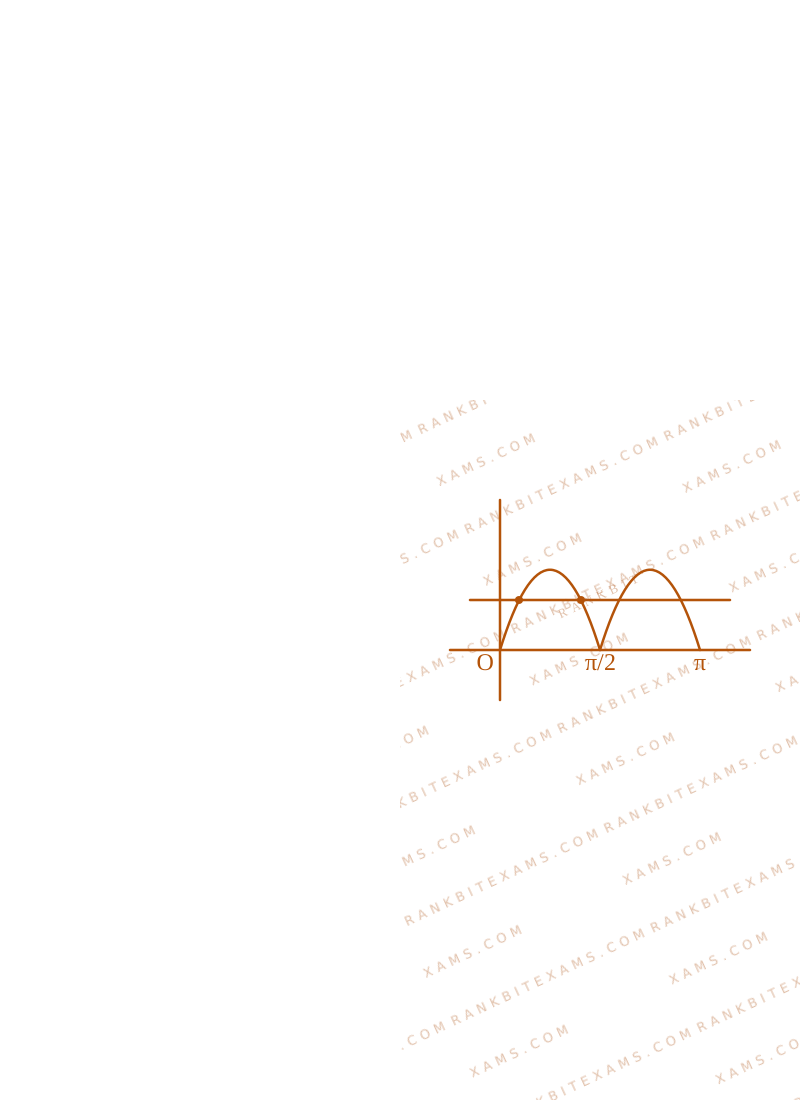
(2/π) (| x| · | x|) = 2 | x x| = ((2)/(π))² = (4)/(π²) |2 x x| = (8)/(π²) ⇒ | 2x| = (8)/(π²)

Since π² ≈ 9.87, (8)/(π²) ≈ 0.81, which is less than 1. Plotting | 2x| = (8)/(π²) over the specified range x in (0, π) yields exactly 4 real intersection points.

Trigonometric Equations graph for Q55 - JEE Main 2025 Evening

Hence, n(A) = 4.

Step 2: Simplify Set B

Let √(x) = t where t ≥ 0. The equation becomes:

t(t-4) - 3|t-2| + 6 = 0

Case I: If t < 2 :

t² - 4t - 3(-(t-2)) + 6 = 0 ⇒ t² - 4t + 3t - 6 + 6 = 0 ⇒ t² - t = 0 t = 0, 1 ⇒ x = 0, 1

Case II: If t > 2 :

t² - 4t - 3(t-2) + 6 = 0 ⇒ t² - 4t - 3t + 6 + 6 = 0 ⇒ t² - 7t + 12 = 0 (t-3)(t-4) = 0 ⇒ t = 3, 4 ⇒ x = 9, 16

Hence, set B = 0, 1, 9, 16, giving n(B) = 4.

Step 3: Calculate Union

Since all elements of set A are non-integral angles in (0, π) and elements of set B are pure integers, the sets are completely disjoint (A B =).

n(A B) = n(A) + n(B) = 4 + 4 = 8
Pattern Recognition

Always separate functions into disjoint numeric domains (e.g., angles vs. whole integers) to conclude unions without performing tedious tracking of individual values manually.

Chapter Mix

Class 11 Physics: Trigonometric Functions Class 11 Mathematics: Sets

More Trigonometric Functions Questions — jee_main_2025_04_april_morning

Practice all Trigonometric Functions previous-year questions →

Rankbit System
JEE Physics: Waves (+15.5%) | Electrostatics: Concentric Shells (-29.7%) | Modern Physics: Photoelectric Clones (+34.2%) | Mathematics: Definite Integrals (+18.1%) | Chemistry: Coordination Splitting (-11.4%) | JEE Physics: Waves (+15.5%) | Electrostatics: Concentric Shells (-29.7%) | Modern Physics: Photoelectric Clones (+34.2%) | Mathematics: Definite Integrals (+18.1%) | Chemistry: Coordination Splitting (-11.4%)