JEE Main · Chemistry → Steady

Solutions appeared 45 times across 3 years — 5.2% of Chemistry. This question is from Reverse Osmosis.

Year 2026 2025 2024 Total
Questions 14 20 11 45

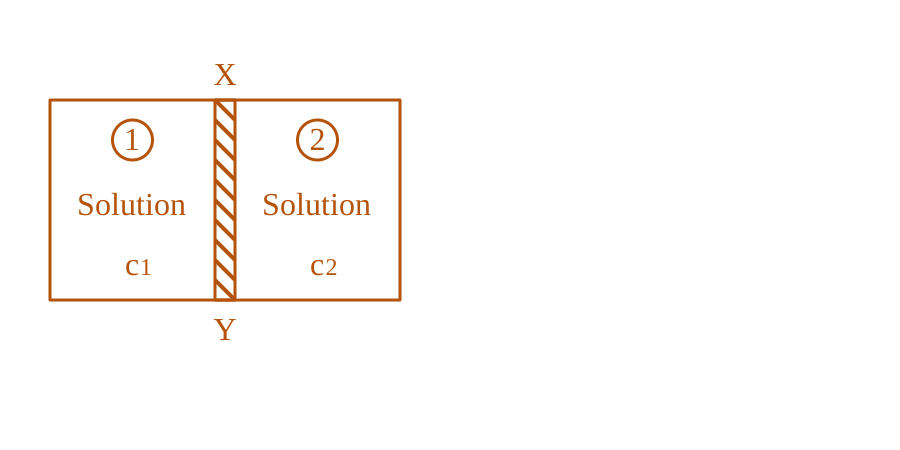
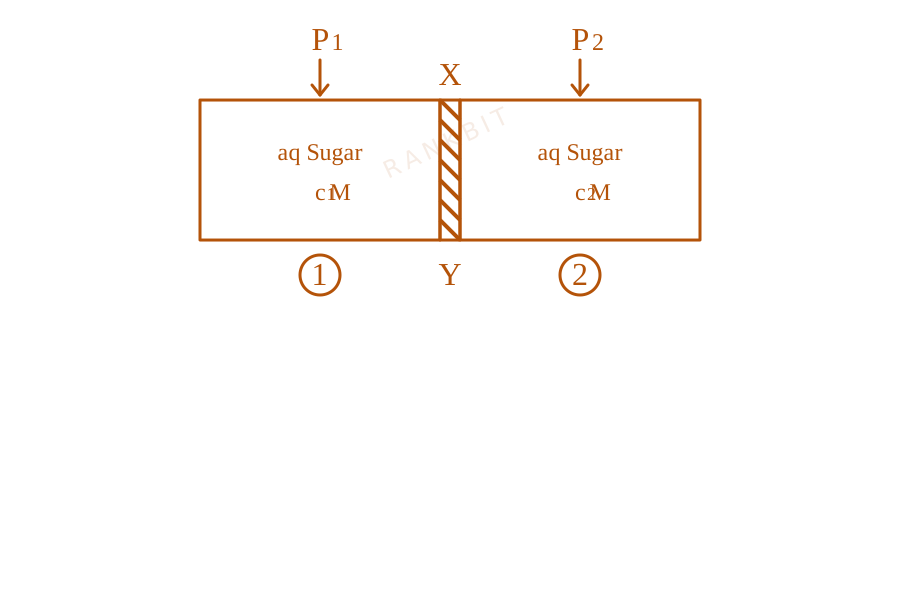
XY is the membrane / partition between two chambers 1 and 2 containing sugar solutions of concentration c₁ and c₂ (c₁ > c₂) mol~L⁻¹. For the reverse osmosis to take place identify the correct condition (Here p₁ and p₂ are pressures applied on chamber 1 and 2):
Reverse Osmosis cell partition diagram for Q26 - JEE Main 2025 Morning
The diagram illustrates two chambers separated by a membrane XY containing sugar solutions of concentrations c1 and c2.

Solution & Explanation

Related Formula

π = c R T

where π is the osmotic pressure of the solution.

Core Logic

Given that c₁ > c₂, chamber 1 has a higher concentration of solute than chamber 2. Under normal conditions, solvent molecules spontaneously flow from lower concentration (chamber 2) to higher concentration (chamber 1) via osmosis.

To achieve reverse osmosis, the solvent must flow in the opposite direction—from chamber 1 to chamber 2. This requires applying an external pressure on the higher concentration side (chamber 1) that exceeds its osmotic pressure π.

Condition for Reverse Osmosis: p₁ > π

Cellophane and parchment paper both act as suitable semi-permeable membranes for this setup. Thus, statements (A) and (C) are correct.

Pattern Recognition

Reverse osmosis always requires external pressure applied on the concentrated solution side (chigh) such that Papplied > π.

Chapter Mix

Class 12 Chemistry: Solutions

Reverse osmosis pressure distribution diagram for Q26
The diagram illustrates two chambers separated by a membrane XY containing sugar solutions of concentrations c1 and c2.

Reference Study Guides

More Solutions Previous-Year Questions — Page 3

Q54 jee_main_2026_24_january_evening Vapour Pressure of Liquid Solutions
Two liquids A and B form an ideal solution at temperature T K. At T K, the vapour pressures of pure A and B are 55 and 15kNm⁻² respectively. What is the mole fraction of A in solution of A and B in equilibrium with a vapour in which the mole fraction of A is 0.8?
  • A. 0.5217
  • B. 0.480
  • C. 0.663
  • D. 0.340

Solution

Related Formula
YAYB = PA⁰PB⁰ · XAXB

Where Y indicates mole fraction in vapour phase and X indicates mole fraction in liquid phase.

Core Logic

Given data: PA⁰ = 55 ~kNm⁻² PB⁰ = 15 ~kNm⁻² YA = 0.8 YB = 1 - 0.8 = 0.2

Applying the ratio form of Raoult's and Dalton's laws:

(0.8)/(0.2) = (55)/(15) × XAXB 4 = (11)/(3) × XAXB XAXB = (12)/(11)
Step 1: Calculate Mole Fraction in Liquid

Since XA + XB = 1, we can express XA as:

XA = (XA / XB)/(1 + XA / XB) XA = (12/11)/(1 + 12/11) = (12)/(23) XA 0.5217
Pattern Recognition

When dealing with equilibrium between liquid and vapour states, taking the ratio (YA)/(YB) = (PA)/(PB) bypasses finding the total pressure Ptotal directly and simplifies fraction algebra.

Chapter Mix

Class 12 Chemistry: Solutions

Q68 jee_main_2026_24_january_evening Henry's Law
At 298 K, the mole percentage of N₂(g) in air is 80%. Water is in equilibrium with air at a pressure of 10 atm. What is the mole fraction of N₂(g) in water at 298 K? ( KH for N₂ is 6.5 × 10⁷ mm Hg)
  • A. 1.23 × 10⁻⁷
  • B. 1.17 × 10⁻⁴
  • C. 9.35 × 10⁵
  • D. 9.35 × 10⁻⁵

Solution

Related Formula
Pgas = KH · Xgas
Core Logic

Given data: Total pressure of air = 10 atm Mole percentage of N₂ in air = 80% PN₂ = (mole fraction in air) × Ptotal = 0.8 × 10 = 8 atm

Convert partial pressure to mm Hg because KH is given in mm Hg: PN₂ = 8 × 760 mm Hg

Step 1: Apply Henry's Law
PN₂ = KH · XN₂ 8 × 760 = 6.5 × 10⁷ × XN₂ XN₂ = (8 × 760)/(6.5 × 10⁷) XN₂ = (6080)/(6.5 × 10⁷) 935.38 × 10⁻⁷ XN₂ = 9.35 × 10⁻⁵
Pattern Recognition

Always align the pressure units. Since KH dictates the unit ecosystem, convert Pgas to match KH (e.g., atm to mm Hg via × 760).

Chapter Mix

Class 12 Chemistry: Solutions

Q53 jee_main_2026_28_january_morning Raoults Law for Binary Mixtures
At T(K), 2 moles of liquid A and 3 moles of liquid B are mixed. The vapour pressure of ideal solution formed is 320~mm~Hg. At this stage, one mole of A and one mole of B are added to the solution. The vapour pressure is now measured as 328.6~mm~Hg. The vapour pressure (in mm~Hg) of A and B are respectively:
  • A. 300, 200
  • B. 600, 400
  • C. 400, 300
  • D. 500, 200

Solution

Related Formula
PS = XA PA^° + XB PB^°
Step 1: First Condition

2 moles of A + 3 moles of B (Total 5 moles)\nXA = (2)/(5), XB = (3)/(5)\n320 = PA^° ((2)/(5)) + PB^° ((3)/(5))\n2 PA^° + 3 PB^° = 1600 (I)

Step 2: Second Condition

Add 1 mole of A & 1 mole of B (Total 7 moles)\nXA^ = (3)/(7), XB^ = (4)/(7)\n328.6 = PA^° ((3)/(7)) + PB^° ((4)/(7))\n3 PA^° + 4 PB^° = 2300.2 (II)

Step 3: Solve the Linear Equations

Multiply eq (I) by 3 and eq (II) by 2:\n6 PA^° + 9 PB^° = 4800\n6 PA^° + 8 PB^° = 4600.4\nSubtracting the two yields:\nPB^° = 199.6 200~mm~Hg\nSubstitute PB^° back into (I):\n2 PA^° + 3(200) = 1600 2 PA^° = 1000 PA^° 500~mm~Hg

Pattern Recognition

Formulating two linear equations based on Raoult's Law mole fractions provides a fast algebraic elimination route to find pure vapour pressures.

Chapter Mix

Class 12 Chemistry: Solutions

Q64 jee_main_2026_28_january_evening Colligative Properties
Consider the following aqueous solutions. I. 2.2 g Glucose in 125 mL of solution. II. 1.9 g Calcium chloride in 250 mL of solution. III. 9.0 g Urea in 500 mL of solution. IV. 20.5 g Aluminium sulphate in 750 mL of solution. The correct increasing order of boiling point of these solutions will be: [Given: Molar mass in g mol⁻¹: H=1, C=12, N=14, O=16, Cl=35.5, Ca=40, Al=27 and S=32]
  • A. (1) I < II < III < IV
  • B. (2) III < I < II < IV
  • C. (3) II < III < I < IV
  • D. (4) II < III < IV < I

Solution

Related Formula
Δ Tb = i · Kb · m

For dilute solutions, Molarity (M) ≈ Molality (m). Thus, Δ Tb ∝ i × M

Core Logic

SolutionMolarity (M = (W)/(Mw) × (1000)/(V))Effective Concentration (i × M)
(I) Glucose (i=1)(2.2)/(180) × (1000)/(125) = 0.098 M1 × 0.098 = 0.098
(II) CaCl₂ (i=3)(1.9)/(111) × (1000)/(250) = 0.068 M3 × 0.068 = 0.204
(III) Urea (i=1)(9)/(60) × (1000)/(500) = 0.3 M1 × 0.3 = 0.300
(IV) Al₂(SO₄)₃ (i=5)(20.5)/(342) × (1000)/(750) = 0.080 M5 × 0.080 = 0.400

Step 1: Compare Effective Concentrations

Comparing the values of i × M: 0.098 < 0.204 < 0.300 < 0.400 ⇒ Glucose (I) < CaCl₂ (II) < Urea (III) < Al₂(SO₄)₃ (IV)

Step 2: Final Conclusion

Order of boiling points corresponds directly to effective concentration. Thus: I < II < III < IV.

Pattern Recognition

For multiple salt mixtures, always multiply molarity by the Van't Hoff factor (i). Do not compare just raw mass or raw molarity.

Chapter Mix

Class 12 Chemistry: Solutions

Q37 jee_main_2025_02_april_evening Molarity and Temperature Dependency
'x' g of NaCl is added to water in a beaker with a lid. The temperature of the system is raised from 1°C to 25°C. Which out of the following plots, is best suited for the change in the molarity (M) of the solution with respect to temperature? [Consider the solubility of NaCl remains unchanged over the temperature range]
  • A. Plot (1)
  • B. Plot (2)
  • C. Plot (3)
  • D. Plot (4)

Solution

Related Formula
Molarity (M) = nsoluteVsolution (L)
Core Logic

Since solubility of NaCl remains unchanged, the number of dissolved moles of NaCl solute (nsolute) remains strictly constant. Thus, molarity M is strictly dependent on the volume of water (solvent) as temperature changes:

M ∝ 1Vsolution
Step 1: Understand Water's Anomalous Expansion

Water exhibits unique anomalous density behavior near freezing:

  • From 1°C to 4°C, the density of water increases to a maximum. This contraction means the volume (V) of water decreases.
  • From 4°C to 25°C, the density of water decreases due to standard thermal expansion. Consequently, the volume (V) increases.
Step 2: Relate Volume to Molarity

Because volume is in the denominator of the molarity equation:

  • From 1°C to 4°C: Volume decreases Molarity increases.
  • At 4°C: Volume is minimum Molarity reaches a maximum.
  • From 4°C to 25°C: Volume increases Molarity decreases.
  • This behavior is perfectly represented by Plot (2), which features a distinct peak around 4°C.

Pattern Recognition

Water is at its densest (and occupies minimum volume) at exactly 3.98^ (4^). Any concentration unit based on volume (such as Molarity or Normality) will reach a corresponding maximum at this temperature.

Chapter Mix

Class 12 Chemistry: Solutions

More Solutions Questions — jee_main_2025_04_april_morning

Practice all Solutions previous-year questions →

Rankbit System
JEE Physics: Waves (+15.5%) | Electrostatics: Concentric Shells (-29.7%) | Modern Physics: Photoelectric Clones (+34.2%) | Mathematics: Definite Integrals (+18.1%) | Chemistry: Coordination Splitting (-11.4%) | JEE Physics: Waves (+15.5%) | Electrostatics: Concentric Shells (-29.7%) | Modern Physics: Photoelectric Clones (+34.2%) | Mathematics: Definite Integrals (+18.1%) | Chemistry: Coordination Splitting (-11.4%)