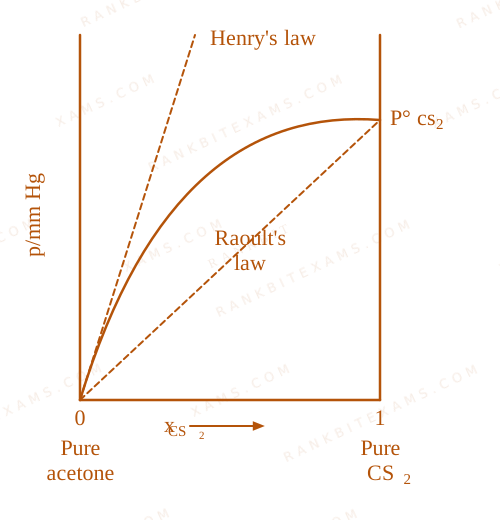
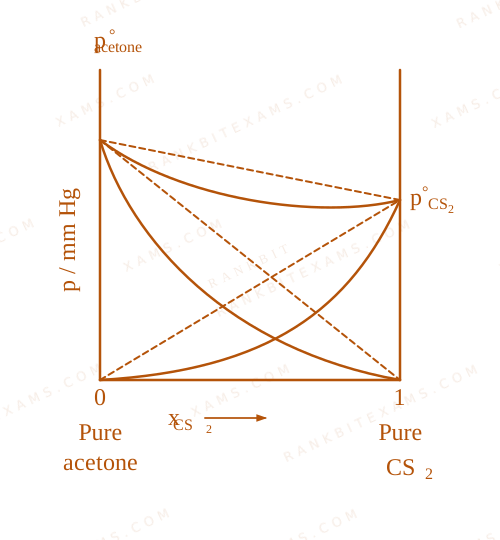
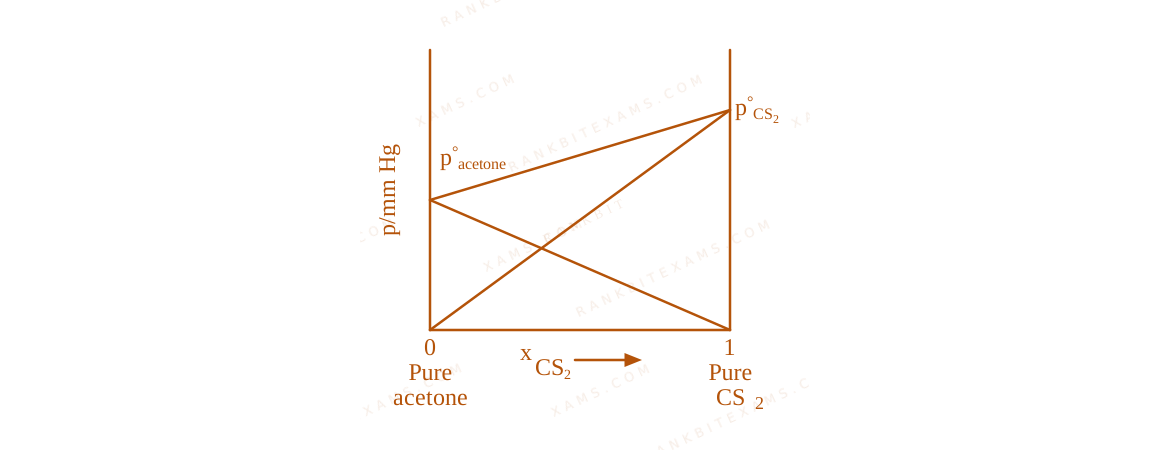
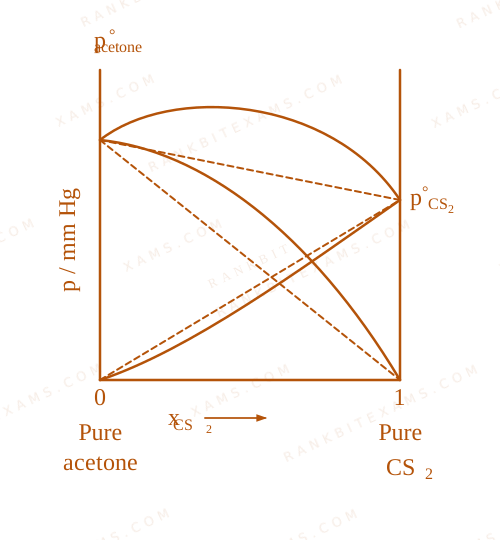
Which one of the following graphs accurately represents the plot of partial pressure of CS_2 vs its mole fraction in a mixture of acetone and CS_2 at constant temperature?

Solution & Explanation

### Related Formula P_CS_2 > P_CS_2^circ cdot X_CS_2 ### Core Logic A mixture of carbon disulfide (CS_2) and acetone (CH_3-CO-CH_3) shows a positive deviation from Raoult's Law. This happens because the dipole-dipole interactions between acetone and CS_2 are weaker than the attractive interactions between the pure molecules themselves. ### Step 1: Graph Interpretation Due to positive deviation, the actual partial pressure curve will bulge upwards (convex) relative to the ideal straight line (Raoult's Law). The first graph precisely depicts this upward curve starting from zero and reaching P^circ_CS_2. ### Pattern Recognition Acetone + Carbon disulfide = Positive Deviation. Positive deviation means vapor pressure is higher than expected, so the curve sags upwards above the straight-line prediction. ### Evaluation Rubric / Model Answer null ### Chapter Mix Class 12 Chemistry: Solutions

Reference Study Guides

More Solutions Previous-Year Questions

Q59 jee_main_2026_21_jan_morning Elevation of Boiling Point
Elements P and Q form two types of non-volatile, non-ionizable compounds PQ and PQ_2. When 1 g of PQ is dissolved in 50 g of solvent ‘A’. Delta T_b was 1.176 K while when 1 g of PQ_2 is dissolved in 50 g of solvent ‘A’, Delta T_b was 0.689 K. (K_b of ‘A’ = 5text K kg mol^-1). The molar masses of elements P and Q (in textg mol^-1) respectively, are :
  • A. 70, 110
  • B. 65, 145
  • C. 60, 25
  • D. 25, 60

Solution

### Related Formula Delta T_b = K_b times m m = fractextWeight of solute (g)textMolar mass of solute times frac1000textWeight of solvent (g) ### Core Logic For compound PQ: (Delta mathrmT_b)_mathrmPQ = mathrmK_b cdot m 1.176 = 5 times frac1mathrmM_1 times frac100050 mathrmM_1 = frac5 times 201.176 = 85.03 text g/mol For compound PQ_2: (Delta mathrmT_b)_mathrmPQ_2 = 5 times frac1mathrmM_2 times frac100050 = 0.689 mathrmM_2 = frac5 times 200.689 = 145.13 text g/mol Let molar mass of P & Q be mathrmM_P and mathrmM_Q respectively: mathrmM_P + mathrmM_Q = 85.03 quad text--- (1) mathrmM_P + 2mathrmM_Q = 145.13 quad text--- (2) Subtracting (1) from (2): mathrmM_Q = 145.13 - 85.03 = 60.1 approx 60 text g/mol Substituting back into (1): mathrmM_P + 60.1 = 85.03 implies mathrmM_P = 24.93 approx 25 text g/mol ### Evaluation Rubric / Model Answer null ### Chapter Mix Class 12 Chemistry: Solutions

Q72 jee_main_2026_21_jan_evening Osmotic Pressure and Isotonic Solutions
The osmotic pressure of a living cell is 12 atm at 300 K. The strength of sodium chloride solution that is isotonic with the living cell at this temperature is \_\_\_\_ text g L^-1. (Nearest integer) Given: R = 0.08 text L atm K^-1 text mol^-1 Assume complete dissociation of textNaCl (Given: Molar mass of Na and Cl are 23 and 35.5 text g mol^-1 respectively.)
Numerical Answer. Answer: 15 to 15

Solution

### Related Formula pi = i C R T ### Core Logic Given: - pi = 12 text atm - T = 300 text K - i = 2 (for complete dissociation of textNaCl) - R = 0.08 text L atm K^-1 text mol^-1 12 = 2 times C times 0.08 times 300 implies 12 = 48C implies C = 0.25 text mol/L ### Step 1: Calculating Strength Molar mass of textNaCl = 23 + 35.5 = 58.5 text g/mol. Strength = 0.25 times 58.5 = 14.625 text g/L approx 15 text g/L. ### Pattern Recognition Sees: osmotic pressure calculation for isotonic solutions with electrolyte dissociation. Trap: Forgetting Van 't Hoff factor i = 2 for textNaCl. ### Chapter Mix Class 12 Chemistry: Solutions
Q73 jee_main_2026_21_jan_evening Elevation in Boiling Point and Vapour Pressure Lowering
A substance 'X' (1.5 g) dissolved in 150 g of a solvent 'Y' (molar mass = 300 text g mol^-1) led to an elevation of the boiling point by 0.5 K. The relative lowering in the vapour pressure of the solvent 'Y' is \_\_\_\_ times 10^-2. (Nearest integer) [Given: K_b of the solvent = 5.0 text K kg mol^-1] Assume the solution to be dilute and no association or dissociation of X takes place in solution.
Numerical Answer. Answer: 3 to 3

Solution

### Related Formula Delta T_b = K_b cdot m, quad fracP^circ - P_sP^circ = chi_textsolute ### Core Logic Using boiling point elevation: Delta T_b = K_b times m implies 0.5 = 5.0 times m implies m = 0.1 text mol/kg Moles of solvent Y = frac150300 = 0.5 text mol. Moles of solute X = 0.1 times 0.150 = 0.015 text mol. Relative lowering of vapour pressure = chi_textsolute = frac0.0150.015 + 0.5 approx frac0.0150.5 = 0.03 = 3 times 10^-2. ### Step 1: Final Calculation Thus, the nearest integer value is 3. ### Pattern Recognition Sees: boiling point elevation combined with relative lowering of vapour pressure calculation. Trap: Confusing solvent mass with solution mass when calculating mole fraction. ### Chapter Mix Class 12 Chemistry: Solutions
Q57 jee_main_2026_22_january_morning Henrys Law
Consider a solution of CO_2(g) dissolved in water in a closed container. Which one of the following plots correctly represents variation of log (partial pressure of CO_2 in vapour phase above water) [y-axis] with log (mole fraction of CO_2 in water) [x-axis] at 25^circC?
  • A. textGraph 1
  • B. textGraph 2
  • C. textGraph 3
  • D. textGraph 4

Solution

### Related Formula P = K_H cdot X Taking logarithm on both sides: log P = log K_H + log X ### Core Logic From Henry's Law: log P(g) = log X(g) + log K_H This equation represents a straight line of the form y = mx + c, where: y = log P(g) x = log X(g) Slope (m) = +1 y-intercept (c) = log K_H (which is positive). The plot of log P versus log X is a straight line with a positive slope and a positive intercept on the y-axis. ### Step 1: Conclusion Graph 3 corresponds to a straight line with a positive slope and a positive y-intercept. ### Pattern Recognition When variables are multiplied (P = K_H X), their log plot is always a straight line with a slope of +1 and an intercept equal to the log of the constant. ### Evaluation Rubric / Model Answer null ### Chapter Mix Class 12 Chemistry: Solutions
Q70 jee_main_2026_22_january_morning Henrys Law
Given below are two statements: Statement I: The Henry's law constant K_H is constant with respect to variations in solution's concentration over the range for which the solutions is ideally dilute. Statement II: K_H does not differ for the same solute in different solvents. In the light of the above statements, choose the correct answer from the options.
  • A. textStatement I is false but Statement II is true.
  • B. textStatement I is true but Statement II is false.
  • C. textBoth Statement I and Statement II are true.
  • D. textBoth Statement I and Statement II are false.

Solution

### Core Logic Statement I: K_H is independent of concentration as long as the solution behaves ideally (is very dilute). This matches the physical definition of Henry's Law constant. (True) Statement II: Henry's Law constant (K_H) depends on the nature of the gas, the nature of the solvent, and the temperature. Therefore, it absolutely differs for the same gas dissolved in different solvents. (False) ### Step 1: Final Conclusion Statement I is true but Statement II is false. ### Pattern Recognition The constants for solubility laws (like K_H) are fundamentally tied to the intermolecular interactions between the specific solute and the specific solvent. ### Evaluation Rubric / Model Answer null ### Chapter Mix Class 12 Chemistry: Solutions

More Solutions Questions — jee_main_2026_23_january_morning

Practice all Solutions previous-year questions →

Rankbit System
JEE Physics: Waves (+15.5%) | Electrostatics: Concentric Shells (-29.7%) | Modern Physics: Photoelectric Clones (+34.2%) | Mathematics: Definite Integrals (+18.1%) | Chemistry: Coordination Splitting (-11.4%) | JEE Physics: Waves (+15.5%) | Electrostatics: Concentric Shells (-29.7%) | Modern Physics: Photoelectric Clones (+34.2%) | Mathematics: Definite Integrals (+18.1%) | Chemistry: Coordination Splitting (-11.4%)