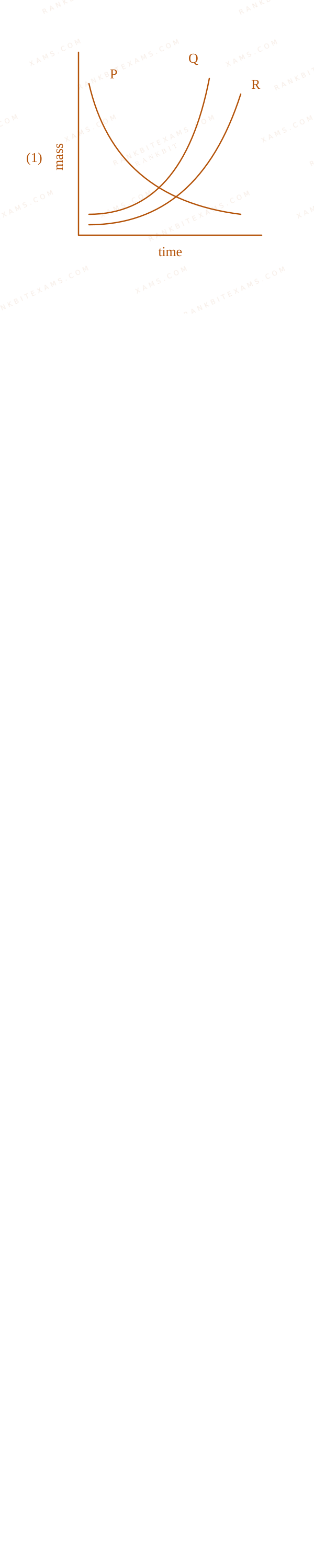
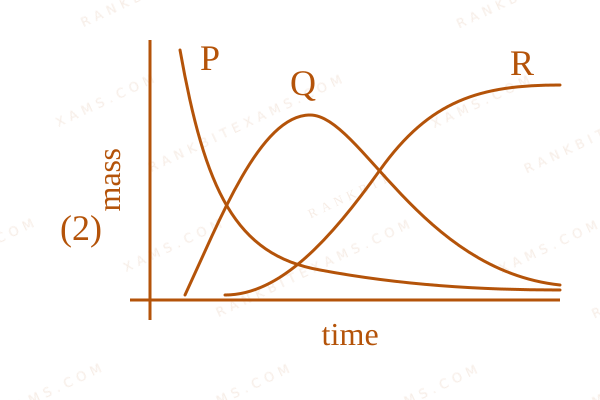
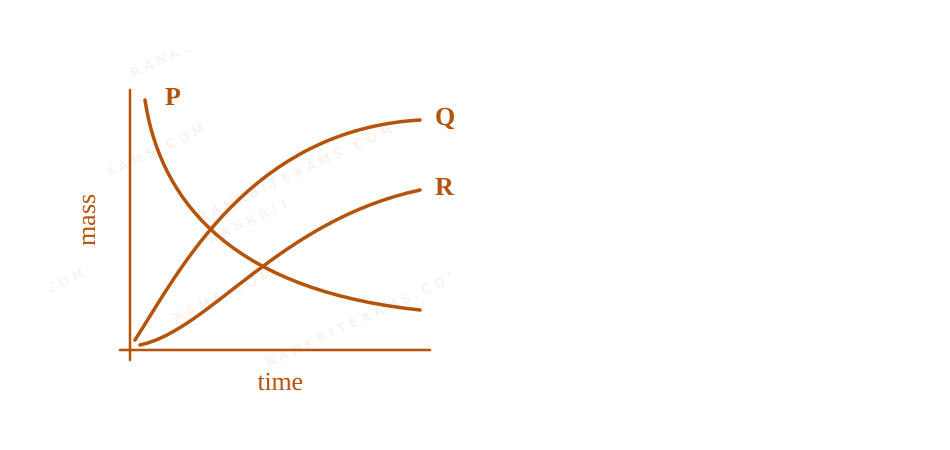




A radioactive material P first decays into Q and then Q decays to non-radioactive material R. Which of the following figure represents time dependent mass of P, Q and R?

Solution & Explanation

Related Formula
N = N₀ e-λ t

where λ is the decay constant.

Core Logic

Initially, only material P is present, so its mass decreases exponentially from a maximum value to zero. Material Q is formed from P and then decays into R, so its mass initially increases from zero, reaches a maximum, and then decreases to zero. Material R is stable and accumulated over time, so its mass increases continuously from zero and levels off at a maximum value equal to the initial mass of P.

Step 1: Graphical Identification

Looking at the options, option (2) correctly depicts the exponential decay of P, the transient rise and fall of Q, and the continuous growth of R to a stable value.

Radioactive decay curves for P, Q, and R

Pattern Recognition

For sequential decay P arrow Q arrow R, parent P always starts at max and drops to 0. Intermediate Q starts at 0, peaks, and returns to 0. Final stable product R starts at 0 and grows asymptotically to max value.

Chapter Mix

Class 12 Physics: Nuclei

Radioactive decay curves for P, Q, and R

Reference Study Guides

More Nuclei Previous-Year Questions — Page 2

Q36 jee_main_2026_24_january_evening Binding Energy and Stability
The binding energy for the following nuclear reactions are expressed in MeV. ₂He³ + ₀n¹ arrow ₂He⁴ + 20 MeV ₂He⁴ + ₀n¹ arrow ₂He⁵ - 0.9 MeV If X₃, X₄, X₅ denote the stability of ₂He³, ₂He⁴ and ₂He⁵ , respectively, then the correct order is:
  • A. X₄ > X₅ > X₃
  • B. X₄ = X₅ = X₃
  • C. X₄ > X₅ < X₃
  • D. X₄ < X₅ < X₃

Solution

Related Formula
Δ Q = BEproducts - BEreactants
Core Logic

Reaction 1 releases energy (+20 MeV), meaning the product is more stable:

BEHe⁴ - BEHe³ = 20 MeV (1)

Reaction 2 absorbs energy (-0.9 MeV), meaning the product has less total binding energy change but is relatively close:

BEHe⁵ - BEHe⁴ = -0.9 MeV (2)
Step 1: Compare Stabilities

From (1): BEHe⁴ is significantly larger than BEHe³. From (2): BEHe⁵ = BEHe⁴ - 0.9 MeV, which implies BEHe⁵ is slightly less than BEHe⁴.

Thus, BEHe⁴ > BEHe⁵ > BEHe³. The stability directly corresponds to the total binding energy here (and BE per nucleon leads to a similar ranking given small mass differences), so: X₄ > X₅ > X₃

Pattern Recognition

Positive Q-value means the products are structurally tighter (more stable). Negative Q-value means you lost stability. Simply tracking algebraic differences gives the hierarchical ranking.

Chapter Mix

Class 12 Physics: Nuclei

Q31 jee_main_2026_28_january_morning Nuclear Size and Density
An atom ⁸₃X is bombarded by shower of fundamental particles and in 10 s this atom absorbed 10 electrons, 10 protons and 9 neutrons. The percentage growth in the surface area of the nucleons is recorded by:
  • A. 250%
  • B. 150%
  • C. 225%
  • D. 900%

Solution

Related Formula

R = R₀ A1/3 Surface area S ∝ R² ∝ A2/3

Core Logic

Nucleons consist of protons and neutrons. Calculate the initial and final total nucleon number A to determine the ratio of surface areas. Note: Electrons are not nucleons and do not contribute to the nuclear surface area.

Step 1: Initial State

Initial number of nucleons Aᵢ = 8. Initial surface area Sᵢ ∝ (Aᵢ)2/3 = 82/3 = 4K (where K is a constant of proportionality).

Step 2: Final State

The atom absorbs 10 protons and 9 neutrons. Final number of nucleons Af = 8 + 10 + 9 = 27. Final surface area Sf ∝ (Af)2/3 = 272/3 = 9K.

Step 3: Percentage Growth

Percentage increase in surface area:

% increase = (Sf - Sᵢ)/(Sᵢ) × 100 = (9K - 4K)/(4K) × 100 = (5)/(4) × 100 = 125%
Step 4: Final Conclusion

The calculated percentage growth is 125%, which is not in the options. Our Ans. (BONUS) NTA Ans. (3) which is 225% (This would imply (9K)/(4K) = 2.25 or 225% as the ratio Sf/Sᵢ, not the growth).

Pattern Recognition

Radius scales as A1/3, Volume scales as A, Surface Area scales as A2/3. Watch out for wording like 'growth' vs 'final ratio' which exam bodies sometimes confuse.

Chapter Mix

Class 12 Physics: Nuclei

Q26 jee_main_2026_28_january_evening Nuclear Size
A nucleus has mass number α and radius Rα . Another nucleus has mass number β and radius Rβ . If β = 8α then Rα/Rβ is:
  • A. 2
  • B. 8
  • C. 1
  • D. 0.5

Solution

Related Formula
R = R₀A1/3

where, R = radius of nucleus A = mass number R₀ = empirical constant

Core Logic

For the first nucleus:

Rα = R₀α1/3

For the second nucleus:

Rβ = R₀β1/3
Step 1: Taking the Ratio
RαRβ = ((α)/(β))1/3

Given that β = 8α, we substitute this value:

RαRβ = ((α)/(8α))1/3 = ((1)/(8))1/3 = (1)/(2) = 0.5
Pattern Recognition

Radius scales as the cube root of the mass number. If mass becomes 8 times, radius becomes 3√(8) = 2 times. Hence the ratio is 1/2 or 0.5.

Chapter Mix

Class 12 Physics: Nuclei

Q12 jee_main_2025_02_april_evening Nuclear Fusion and Binding Energy
Energy released when two deuterons (₁H²) fuse to form a helium nucleus (₂He⁴) is: (Given: Binding energy per nucleon of ₁H² = 1.1 MeV and binding energy per nucleon of ₂He⁴ = 7.0 MeV)
  • A. 8.1 MeV
  • B. 5.9 MeV
  • C. 23.6 MeV
  • D. 26.8 MeV

Solution

Related Formula
  • Fusion reaction:
₁H² + ₁H² ₂He⁴
  • Q-value (Energy Released) of a nuclear reaction:
Q = Total Binding Energy (Products) - Total Binding Energy (Reactants)
Core Logic

Let's compute the total binding energies:

  • Reactants: Two deuterons (₁H²).
  • Number of nucleons in each deuteron = 2
  • Binding energy per nucleon = 1.1 MeV
  • Total Binding Energy of reactants:
BEreactants = 2 × [2 × 1.1 MeV] = 4.4 MeV
  • Products: One helium nucleus (₂He⁴).
  • Number of nucleons = 4
  • Binding energy per nucleon = 7.0 MeV
  • Total Binding Energy of products:
BEproducts = 4 × 7.0 MeV = 28.0 MeV
Step 1: Calculate energy released

The energy released (Q) in the fusion process is:

Q = BEproducts - BEreactants Q = 28.0 MeV - 4.4 MeV = 23.6 MeV

Thus, the energy released is 23.6 MeV.

Pattern Recognition

Sees: Q-value of fusion from binding energy per nucleon. Trap: Confusing "Binding Energy per nucleon" with the total binding energy of the nucleus. Always multiply by the mass number A first! Shortcut: Q = (Afinal × BEfinal) - (Ainitial × BEinitial) = (4 × 7.0) - (2 × 2 × 1.1) = 28 - 4.4 = 23.6 MeV.

Chapter Mix

Class 12 Physics: Nuclei

Q15 jee_main_2025_02_april_morning Bohr's Atomic Model
Considering Bohr's atomic model for hydrogen atom: (A) the energy of H atom in ground state is same as energy of He^+ ion in its first excited state. (B) the energy of H atom in ground state is same as that for Li⁺⁺ ion in its second excited state. (C) the energy of H atom in its ground state is same as that of He^+ ion for its ground state. (D) the energy of He^+ ion in its first excited state is same as that for Li⁺⁺ in its ground state Choose the correct answer from the options given below:
  • A. (B), (D) only
  • B. (A), (B) only
  • C. (A), (D) only
  • D. (A), (C) only

Solution

Related Formula
Eₙ = -13.6 (Z²)/(n²)~eV

where Z is the atomic number and n is the principal quantum number.

Core Logic

Let's check each statement by calculating energy values:

  • H atom ground state (Z = 1, n = 1):
EH = -13.6 (1²)/(1²) = -13.6~eV
  • Statement (A): He^+ ion in its first excited state (Z = 2, n = 2):
EHe^+, n=2 = -13.6 (2²)/(2²) = -13.6~eV

This is equal to EH. Thus, Statement (A) is correct.

  • Statement (B): Li⁺⁺ ion in its second excited state (Z = 3, n = 3):
ELi⁺⁺, n=3 = -13.6 (3²)/(3²) = -13.6~eV

This is equal to EH. Thus, Statement (B) is correct.

  • Statement (C): He^+ ion in its ground state (Z = 2, n = 1):
EHe^+, n=1 = -13.6 (2²)/(1²) = -54.4~eV ≠ EH

Thus, Statement (C) is incorrect.

  • Statement (D): He^+ in first excited state (Z=2, n=2) versus Li⁺⁺ in ground state (Z=3, n=1):
ELi⁺⁺, n=1 = -13.6 (3²)/(1²) = -122.4~eV ≠ -13.6~eV

Thus, Statement (D) is incorrect.

Step 1: Final Conclusion

Statements (A) and (B) are the only correct statements.

Pattern Recognition

Bohr energy is proportional to (Z²)/(n²). If the ratio of (Z)/(n) is the same for two systems, their quantum state energy levels will be identical.

Chapter Mix

Class 12 Physics: Atoms

More Nuclei Questions — jee_main_2025_04_april_evening

Practice all Nuclei previous-year questions →

Rankbit System
JEE Physics: Waves (+15.5%) | Electrostatics: Concentric Shells (-29.7%) | Modern Physics: Photoelectric Clones (+34.2%) | Mathematics: Definite Integrals (+18.1%) | Chemistry: Coordination Splitting (-11.4%) | JEE Physics: Waves (+15.5%) | Electrostatics: Concentric Shells (-29.7%) | Modern Physics: Photoelectric Clones (+34.2%) | Mathematics: Definite Integrals (+18.1%) | Chemistry: Coordination Splitting (-11.4%)