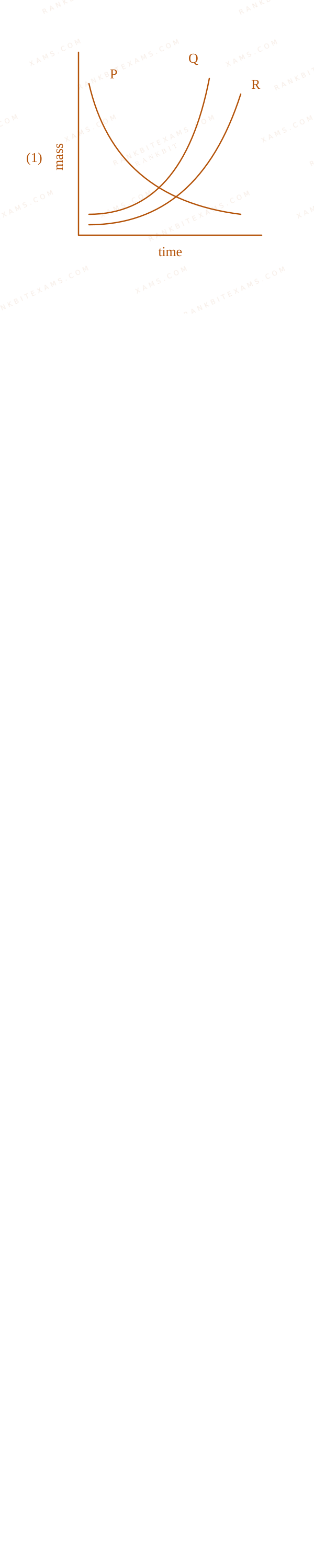
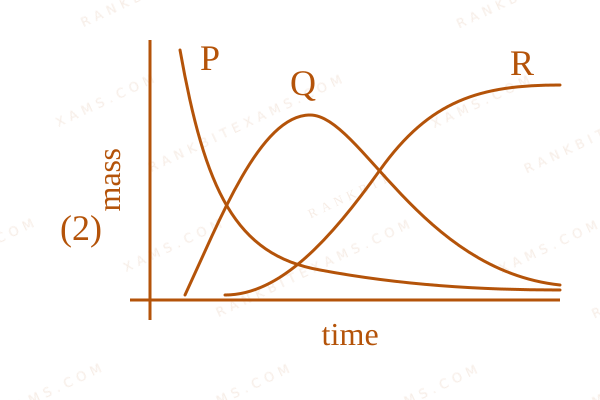
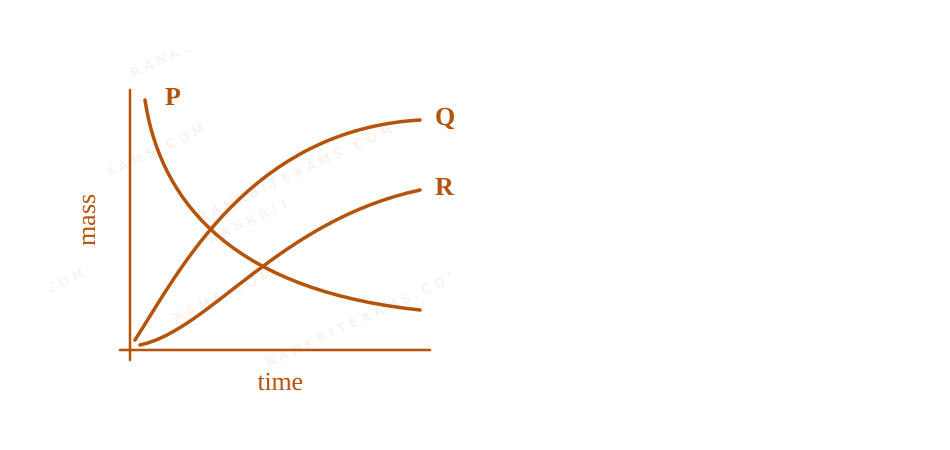




A radioactive material P first decays into Q and then Q decays to non-radioactive material R. Which of the following figure represents time dependent mass of P, Q and R?

Solution & Explanation

Related Formula
N = N₀ e-λ t

where λ is the decay constant.

Core Logic

Initially, only material P is present, so its mass decreases exponentially from a maximum value to zero. Material Q is formed from P and then decays into R, so its mass initially increases from zero, reaches a maximum, and then decreases to zero. Material R is stable and accumulated over time, so its mass increases continuously from zero and levels off at a maximum value equal to the initial mass of P.

Step 1: Graphical Identification

Looking at the options, option (2) correctly depicts the exponential decay of P, the transient rise and fall of Q, and the continuous growth of R to a stable value.

Radioactive decay curves for P, Q, and R

Pattern Recognition

For sequential decay P arrow Q arrow R, parent P always starts at max and drops to 0. Intermediate Q starts at 0, peaks, and returns to 0. Final stable product R starts at 0 and grows asymptotically to max value.

Chapter Mix

Class 12 Physics: Nuclei

Radioactive decay curves for P, Q, and R

Reference Study Guides

More Nuclei Previous-Year Questions

Q27 jee_main_2026_22_january_morning Nuclear Size and Distance of Closest Approach
7.9 MeV α-particle scatters from a target material of atomic number 79. From the given data the estimated diameter of nuclei of the target material is (approximately) \_\_\_\_ m. [ 14π ε₀ = 9 × 10⁹ Nm² / C² and electron charge = 1.6 × 10⁻¹⁹ C]
  • A. 5.76 × 10⁻¹⁴
  • B. 1.44 × 10⁻¹³
  • C. 2.88 × 10⁻¹⁴
  • D. 1.69 × 10⁻¹²

Solution

Related Formula
r₀ = (1)/(4πε₀) (q₁ q₂)/(K)
Core Logic

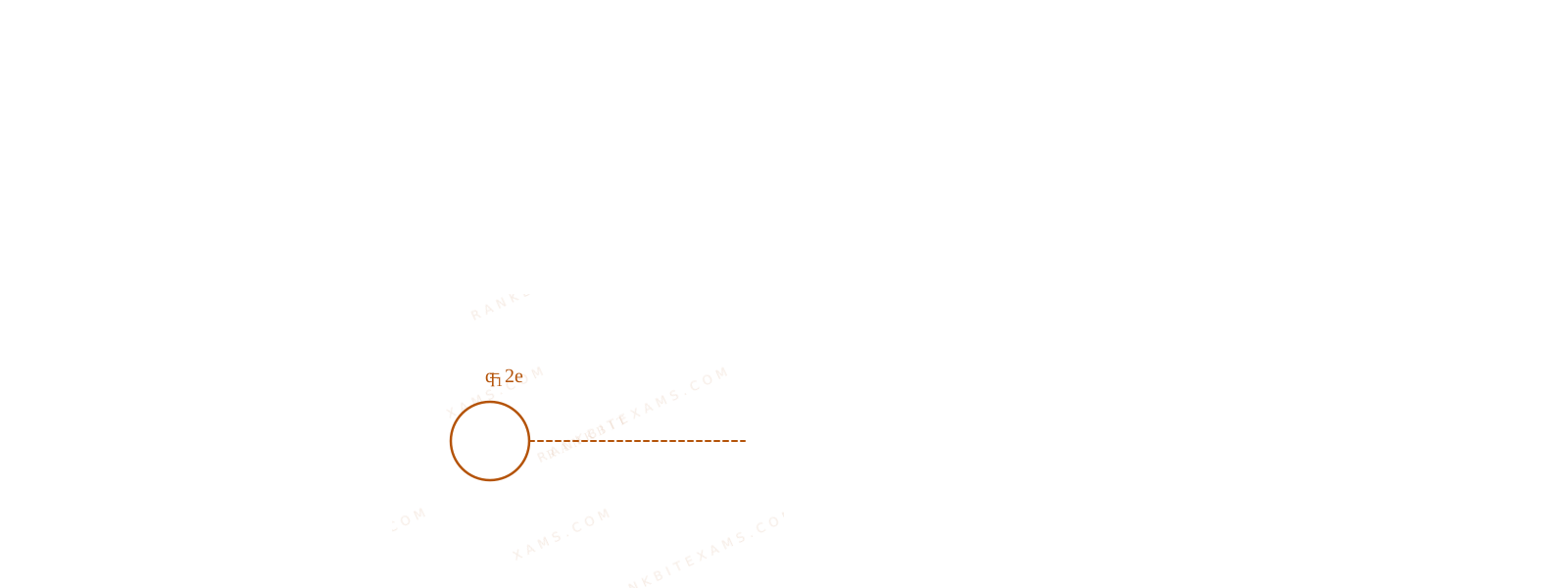
Nuclear scattering setup diagram for Q27 - JEE Main 2026 Morning

Using mechanical energy conservation:

PEᵢ + KEᵢ = PEf + KEf 0 + 7.9 × 10⁶ × 1.6 × 10⁻¹⁹ = (k(2e)(Ze))/(r) + 0 r = 9 × 10⁹ × 2 × (1.6 × 10⁻¹⁹)² × 797.9 × 10⁶ × 1.6 × 10⁻¹⁹ = 2.88 × 10⁻¹⁴ m

For diameter:

D = 2r = 5.76 × 10⁻¹⁴ m
Pattern Recognition

Sees: Alpha particle scattering + atomic number + kinetic energy. Shortcut: Equate initial kinetic energy to electrostatic potential energy at closest approach distance r, then double for diameter D = 2r. Check: Results align with option (1). ✓

Chapter Mix

Class 12 Physics: Atoms and Nuclei

Q36 jee_main_2026_22_january_morning Nuclear Binding Energy
The minimum frequency of photon required to break a particle of mass 15.348 amu into 4α particles is \_\_\_\_ kHz. [mass of He nucleus = 4.002 amu, 1 amu = 1.66 × 10⁻²⁷ kg, h = 6.6 × 10⁻³⁴ J.s and c = 3 × 10⁸ m/s]
  • A. 9 × 10¹⁹
  • B. 9 × 10²⁰
  • C. 14.94 × 10²⁰
  • D. 14.94 × 10¹⁹

Solution

Related Formula
hν = Δ m · c²
Core Logic

Mass defect calculation:

hν = (4 × 4.002 - 15.348) × 1.66 × 10⁻²⁷ × (3 × 10⁸)² ν = 14.94 × 10¹⁹ kHz
Pattern Recognition

Sees: Minimum photon frequency required for nuclear breakup. Shortcut: Compute mass defect Δ m, convert to energy via E=Δ m c², and equate to hν. Check: Matches option (4). ✓

Chapter Mix

Class 12 Physics: Atoms and Nuclei

Q37 jee_main_2026_23_january_evening Isobars and Isotopes
Which of the following pair of nuclei are isobars of the element?
  • A. ²₁H and ³₁H
  • B. ²³⁶₉₂U and ²³⁸₉₂U
  • C. ¹⁹⁸₈₀Hg and ¹⁹⁷₇₉Au
  • D. ³₁H and ³₂He

Solution

Related Formula

Definition: Isobars are nuclei that possess the same mass number (A) but different atomic numbers (Z).

Core Logic

Checking the mass numbers for each pair: (1) Hydrogen-2 and Hydrogen-3 -> Isotopes (2) Uranium-236 and Uranium-238 -> Isotopes (3) Mercury-198 and Gold-197 -> Neither isobars nor isotopes (4) Hydrogen-3 (³₁H) and Helium-3 (³₂He) -> Both have mass number 3.

Step 1: Final Conclusion

Since ³₁H and ³₂He share the same mass number, they are isobars.

Pattern Recognition

Isobars = same top number. Isotopes = same bottom number. Isotones = same difference (neutrons).

Chapter Mix

Class 12 Physics: Nuclei

Q46 jee_main_2026_23_january_evening Nuclear Fission
The average energy released per fission for the nucleus of ²³⁵₉₂U is 190 MeV. When all the atoms of 47 g pure ²³⁵₉₂U undergo fission process, the energy released is α × 10²³ MeV. The value of α is ____. (Avogadro Number = 6 × 10²³ per mole)
Numerical Answer. Answer: 228 to 228

Solution

Related Formula
Number of Moles = Given MassMolar Mass N = Moles × NA Etotal = N × Eperfission
Core Logic

Given mass of U-235 = 47 g. Molar mass of U-235 = 235 g/mol. Number of moles = (47)/(235) = (1)/(5) moles.

Step 1: Calculate Total Atoms

Total number of U-235 atoms (N):

N = (1)/(5) × 6 × 10²³ = 1.2 × 10²³ atoms
Step 2: Calculate Total Energy
Etotal = 1.2 × 10²³ × 190 MeV Etotal = 228 × 10²³ MeV

Comparing with α × 10²³ MeV, we get α = 228.

Pattern Recognition

Direct stoichiometry-like energy yield. Mass / Molar Mass -> Atoms -> Total Energy.

Chapter Mix

Class 12 Physics: Nuclei

Q38 jee_main_2026_24_january_morning Binding Energy
Given below are two statements: Statement I : For all elements, greater the mass of the nucleus, greater is the binding energy per nucleon. Statement II : For all elements, nuclei with less binding energy per nucleon transforms to nuclei with greater binding energy per nucleon. In the light of the above statements, choose the correct answer from the options given below:
  • A. Both Statement I and Statement II are true
  • B. Statement I is true but Statement II is false
  • C. Both Statement I and Statement II are false
  • D. Statement I is false but Statement II is true

Solution

Core Logic

Statement I: The binding energy per nucleon does not monotonically increase with mass. It reaches a maximum around iron (A ≈ 56) and then gradually decreases for heavier nuclei. Hence, Statement I is false.

Statement II: Nuclei inherently tend toward states of greater stability. Thus, nuclei with lower binding energy per nucleon undergo reactions (fission or fusion) to form nuclei with higher binding energy per nucleon. Hence, Statement II is true.

Step 1: Final Conclusion

Statement I is false but Statement II is true. Therefore, option (4) is correct.

Pattern Recognition

The binding energy curve is a classic plateau curve peaking at Iron-56. Statements claiming monotonic trends across all masses in nuclear physics are generally false.

Chapter Mix

Class 12 Physics: Nuclei

More Nuclei Questions — jee_main_2025_04_april_evening

Practice all Nuclei previous-year questions →

Rankbit System
JEE Physics: Waves (+15.5%) | Electrostatics: Concentric Shells (-29.7%) | Modern Physics: Photoelectric Clones (+34.2%) | Mathematics: Definite Integrals (+18.1%) | Chemistry: Coordination Splitting (-11.4%) | JEE Physics: Waves (+15.5%) | Electrostatics: Concentric Shells (-29.7%) | Modern Physics: Photoelectric Clones (+34.2%) | Mathematics: Definite Integrals (+18.1%) | Chemistry: Coordination Splitting (-11.4%)