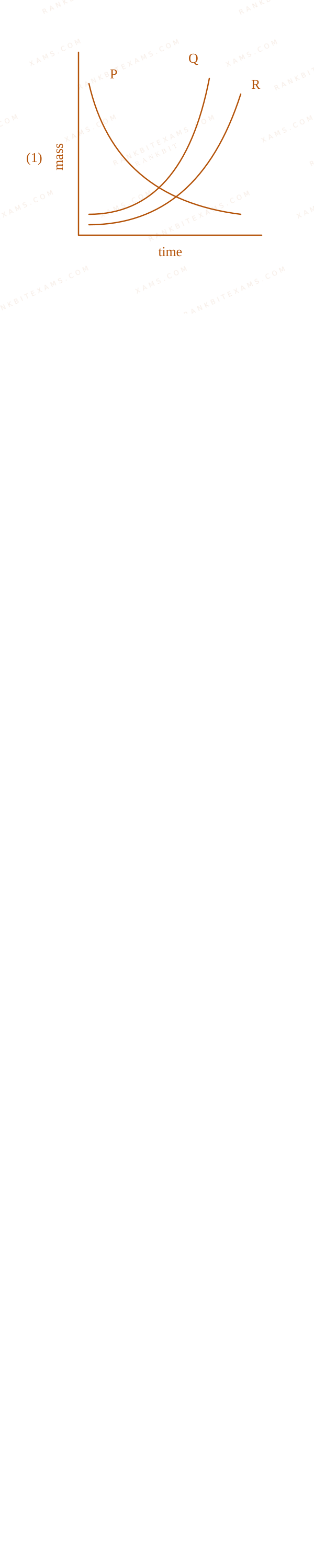
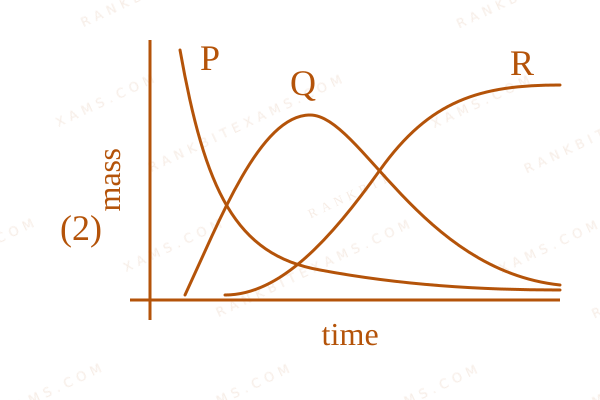
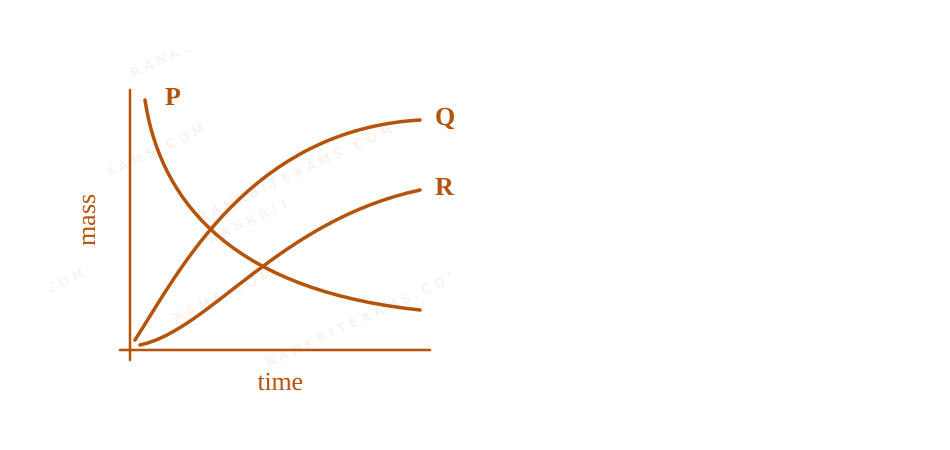




A radioactive material P first decays into Q and then Q decays to non-radioactive material R. Which of the following figure represents time dependent mass of P, Q and R?

Solution & Explanation

### Related Formula N = N_0 e^-lambda t where lambda is the decay constant. ### Core Logic Initially, only material P is present, so its mass decreases exponentially from a maximum value to zero. Material Q is formed from P and then decays into R, so its mass initially increases from zero, reaches a maximum, and then decreases to zero. Material R is stable and accumulated over time, so its mass increases continuously from zero and levels off at a maximum value equal to the initial mass of P. ### Step 1: Graphical Identification Looking at the options, option (2) correctly depicts the exponential decay of P, the transient rise and fall of Q, and the continuous growth of R to a stable value.
Radioactive decay curves for P, Q, and R
### Pattern Recognition For sequential decay P rightarrow Q rightarrow R, parent P always starts at max and drops to 0. Intermediate Q starts at 0, peaks, and returns to 0. Final stable product R starts at 0 and grows asymptotically to max value. ### Evaluation Rubric / Model Answer null ### Chapter Mix Class 12 Physics: Nuclei
Radioactive decay curves for P, Q, and R

Reference Study Guides

More Nuclei Previous-Year Questions — Page 3

Q60 jee_main_2024_31_jan_evening Nuclear Size and Density
A nucleus has mass number A_1 and volume V_1. Another nucleus has mass number A_2 and volume V_2. If relation between mass number is A_2 = 4A_1, then fracV_2V_1 = ________.
Numerical Answer. Answer: 4 to 4

Solution

### Related Formula R = R_0 A^1/3 V = frac43pi R^3 ### Core Logic Since radius R is proportional to A^1/3, the volume V (which depends on R^3) will be directly proportional to the mass number A. ### Step 1: Show Proportionality V = frac43pi (R_0 A^1/3)^3 = frac43pi R_0^3 A This proves that V propto A. ### Step 2: Calculate Ratio fracV_2V_1 = fracA_2A_1 Given that A_2 = 4A_1: fracV_2V_1 = frac4A_1A_1 = 4 ### Pattern Recognition Nuclear density is constant for all nuclei. Therefore, Mass propto Volume. Since Mass number (A) represents mass, Volume is strictly linearly proportional to Mass number. ### Evaluation Rubric / Model Answer null ### Chapter Mix Class 12 Physics: Nuclei
Q60 jee_main_2024_31_jan_morning Mass Defect And Energy
The mass defect in a particular reaction is 0.4mathrm\ g. The amount of energy liberated is n times 10^7mathrm\ kWh where n = _______. (speed of light = 3 times 10^8mathrm\ m/s)
Numerical Answer. Answer: 1 to 1

Solution

### Related Formula E = Delta m c^2 1 text kWh = 3.6 times 10^6 text J ### Core Logic Given the mass defect: Delta m = 0.4mathrm\,g = 0.4 times 10^-3mathrm\,kg The total energy liberated in Joules is: E = (0.4 times 10^-3) times (3 times 10^8)^2 E = 0.4 times 10^-3 times 9 times 10^16 E = 3.6 times 10^13mathrm\,J ### Step 2: Conversion to kWh We need the answer in mathrmkWh. Since 1mathrm\,kWh = 1000mathrm\,W times 3600mathrm\,s = 3.6 times 10^6mathrm\,J: E = frac3.6 times 10^133.6 times 10^6mathrm\,kWh E = 10^7mathrm\,kWh Comparing this to n times 10^7mathrm\,kWh, we get: n = 1 ### Evaluation Rubric / Model Answer null ### Chapter Mix Class 12 Physics: Nuclei

More Nuclei Questions — jee_main_2025_04_april_evening

Practice all Nuclei previous-year questions →

Rankbit System
JEE Physics: Waves (+15.5%) | Electrostatics: Concentric Shells (-29.7%) | Modern Physics: Photoelectric Clones (+34.2%) | Mathematics: Definite Integrals (+18.1%) | Chemistry: Coordination Splitting (-11.4%) | JEE Physics: Waves (+15.5%) | Electrostatics: Concentric Shells (-29.7%) | Modern Physics: Photoelectric Clones (+34.2%) | Mathematics: Definite Integrals (+18.1%) | Chemistry: Coordination Splitting (-11.4%)
