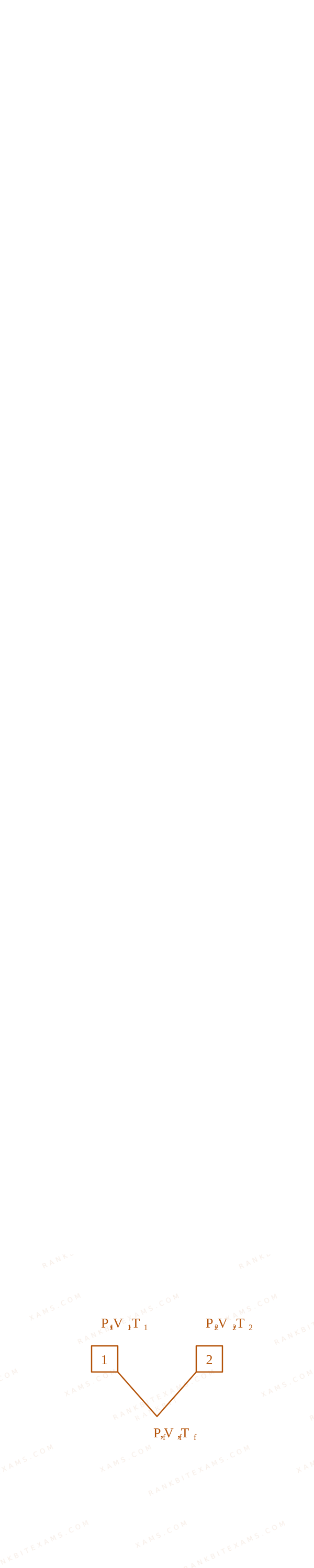
There are two vessels filled with an ideal gas where volume of one is double the volume of other. The large vessel contains the gas at 8 kPa at 1000 K while the smaller vessel contains the gas at 7 kPa at 500 K. If the vessels are connected to each other by a thin tube allowing the gas to flow and the temperature of both vessels is maintained at 600 K, at steady state the pressure in the vessels will be (in kPa).

Solution & Explanation

Related Formula

Ideal Gas Law:

n = (PV)/(RT)

Conservation of moles: n₁ + n₂ = nf

Core Logic

Let the volume of the smaller vessel be V₁ = V, then the volume of the larger vessel is V₂ = 2V. Initial moles in large vessel:

n₂ = (8 × 2V)/(R × 1000) = (16V)/(1000R)

Initial moles in small vessel:

n₁ = (7 × V)/(R × 500) = (14V)/(1000R)

Total total initial moles:

ntotal = n₁ + n₂ = (30V)/(1000R)
Step 1: Connect Vessels to Dynamic Equilibrium

When connected, the total final volume is Vf = V + 2V = 3V. The final temperature is Tf = 600 K. Using mole conservation:

(30V)/(1000R) = (Pf (3V))/(R × 600) (30)/(1000) = (3Pf)/(600) (30)/(1000) = (Pf)/(200)

Pf = (30 × 200)/(1000) = 6 kPa

Dual vessel gas flow schema

Pattern Recognition

Connecting chambers preserves the net mass/moles (Σ nᵢ = constant). Keep everything relative to a common volume multiplier V to easily cancel terms.

Chapter Mix

Class 11 Physics: Kinetic Theory

Reference Study Guides

More Kinetic Theory Previous-Year Questions — Page 2

Q29 jee_main_2026_28_january_evening Mean Free Path
The mean free path of a molecule of diameter 5 × 10⁻¹⁰ m at the temperature 41°C and pressure 1.38 × 10⁵ Pa, is given as ____ m. ( Given~kB = 1.38× 10⁻²³ J / K).
  • A. 2√(2) × 10⁻¹⁰
  • B. 10√(2) × 10⁻⁸
  • C. 2√(2) × 10⁻⁸
  • D. 2 × 10⁻⁸

Solution

Related Formula
λ = kB T√(2) π σ² P

where, λ = mean free path kB = Boltzmann constant T = absolute temperature in Kelvin σ = diameter of the molecule P = pressure of the gas

Step 1: Extract and Convert Given Data

d = σ = 5 × 10⁻¹⁰ m T = 41^ = 273 + 41 = 314 K P = 1.38 × 10⁵ Pa kB = 1.38 × 10⁻²³ J/K

Step 2: Substitution and Calculation
λ = 1.38 × 10⁻²³ × 314√(2) × π × (5 × 10⁻¹⁰)² × 1.38 × 10⁵

Cancel out 1.38 from numerator and denominator:

λ = 10⁻²³ × 314√(2) × 3.14 × 25 × 10⁻²⁰ × 10⁵ λ = 314 × 10⁻²³√(2) × 3.14 × 25 × 10⁻¹⁵ λ = 100 × 10⁻²³√(2) × 25 × 10⁻¹⁵ λ = 4 × 10⁻⁸√(2) = 2√(2) × 10⁻⁸ m
Pattern Recognition

The temperature 314 K and π ≈ 3.14 are intentionally matched to cancel out and give a factor of 100. 1.38 cancels completely. The rest is simply handling powers of 10.

Chapter Mix

Class 11 Physics: Kinetic Theory

Q22 jee_main_2025_02_april_evening Internal Energy of Gas
The internal energy of air in 4m× 4m× 3m sized room at 1 atmospheric pressure will be _ × 10⁶J. (Consider air as diatomic molecule)
Numerical Answer. Answer: 12 to 12

Solution

Related Formula
  • Ideal Gas Law:
  • P V = n R T

  • Internal Energy (U) of a diatomic gas (f = 5 degrees of freedom):
U = n Cv T = n ((5)/(2) R) T = (5)/(2) P V
Core Logic

Given parameters:

  • Dimensions of the room = 4 m × 4 m × 3 m
  • Volume of air in the room V = 4 × 4 × 3 = 48 m³
  • Room pressure P = 1 atm = 10⁵ N/m²
Step 1: Calculate internal energy

Using the thermodynamic relationship:

U = (5)/(2) P V

Substitute the volume and pressure parameters:

U = (5)/(2) × 10⁵ N/m² × 48 m³ U = 5 × 10⁵ × 24 = 120 × 10⁵ J = 12 × 10⁶ J

Thus, the internal energy is 12 × 10⁶ ~J.

Pattern Recognition

Sees: Internal energy of diatomic gas occupying a macroscopic room volume. Trap: Attempting to calculate thermodynamic variables like temperature or density explicitly. Internal energy is completely determined by pressure and volume via degrees of freedom (U = (f)/(2)PV). Shortcut: A diatomic gas has f=5, so U = 2.5 PV. Putting in numbers, U = 2.5 × 10⁵ × 48 = 120 × 10⁵ = 12 × 10⁶ ~J, leaving a coefficient of 12.

Chapter Mix

Class 11 Physics: Kinetic Theory of Gases

Q24 jee_main_2025_02_april_morning Specific Heat Capacities of Gases
γA is the specific heat ratio of monoatomic gas A having 3 translational degrees of freedom. γB is the specific heat ratio of polyatomic gas B having 3 translational, 3 rotational degrees of freedom and 1 vibrational mode. If (γA)/(γB) = (1 + (1)/(n)) then the value of n is
Numerical Answer. Answer: 3 to 3

Solution

Related Formula
γ = 1 + (2)/(f)
Core Logic

Let's find the specific heat ratio for each gas based on degrees of freedom:

  • Monoatomic gas A:
  • Degrees of freedom, fA = 3 (translational only)
γA = 1 + (2)/(3) = (5)/(3)
  • Polyatomic gas B:
  • Translational degrees of freedom = 3
  • Rotational degrees of freedom = 3
  • Vibrational modes = 1.
  • Note: Each active vibrational mode has 2 degrees of freedom (kinetic + potential energy terms). This contributes 2 × 1 = 2 degrees of freedom.

  • Therefore, the total active degrees of freedom is:
fB = 3 + 3 + 2 = 8

The specific heat ratio of B is:

γB = 1 + (2)/(fB) = 1 + (2)/(8) = 1 + (1)/(4) = (5)/(4)

Now, find the ratio of specific heat capacities:

(γA)/(γB) = (5/3)/(5/4) = (4)/(3)

We are given:

(γA)/(γB) = 1 + (1)/(n) (4)/(3) = 1 + (1)/(n) (1)/(n) = (1)/(3) n = 3
Step 1: Final Conclusion

The value of n is 3.

Pattern Recognition

Always remember that each vibrational mode contributes exactly 2 degrees of freedom because it holds both kinetic and potential energy components (fvib = 2 × modes).

Chapter Mix

Class 11 Physics: Kinetic Theory of Gases Class 11 Physics: Thermodynamics

Q17 jee_main_2025_03_april_evening Gas Laws and Temperature Dependency
Pressure of an ideal gas, contained in a closed vessel, is increased by 0.4% when heated by 1°C. Its initial temperature must be :
  • A. 25°C
  • B. 2500 K
  • C. 250 K
  • D. 250°C

Solution

Related Formula

For an ideal gas in a closed container, the volume V remains constant (isochoric process). By Gay-Lussac's Law:

P ∝ T ⇒ (Δ P)/(P) = (Δ T)/(T)

where T must be in Kelvin.

Core Logic

Given parameters:

  • Percent increase in pressure: (Δ P)/(P) × 100 = 0.4% ⇒ (Δ P)/(P) = 0.004
  • Increase in temperature Δ T = 1°C = 1~K
Step 1: Calculate initial temperature (T)

Substitute the values into Gay-Lussac's fractional variance formula:

0.004 = (1)/(T) T = (1)/(0.004) = 250~K
Pattern Recognition

A standard percentage-increase layout. A change of 0.4% means (1)/(250) of the original quantity. Hence, a 1~K rise corresponds to an initial temperature of 250~K directly.

Chapter Mix

Class 11 Physics: Kinetic Theory of Gases

Q jee_main_2025_07_april_morning Specific Heat Capacity
Match the List-I with List-II
List-IList-II
A. Triatomic rigid gasI. CPCV=(5)/(3)
B. Diatomic non-rigid gasII. CPCV=(7)/(5)
C. Monoatomic gasIII. CPCV=(4)/(3)
D. Diatomic rigid gasIV. CPCV=(9)/(7)
Choose the correct answer from the options given below:
  • A. A-III, B-IV, C-I, D-II
  • B. A-III, B-II, C-IV, D-I
  • C. A-II, B-IV, C-I, D-III
  • D. A-IV, B-II, C-III, D-I

Solution

Related Formula

The ratio of specific heats γ is related to degrees of freedom f by:

γ = (CP)/(CV) = 1 + (2)/(f)
Core Logic

Determine the degrees of freedom

Core Logic

Determine the degrees of freedom $ffor each type of gas:

  • Monoatomic gas: Translational only
$
γ = 1 + (2)/(3) = (5)/(3) (Matches C-I)
  • Diatomic rigid gas: Translational (3) + Rotational (2)
$
γ = 1 + (2)/(5) = (7)/(5) (Matches D-II)
Step 1: Check Remaining Categories
  • Diatomic non-rigid gas: Translational (3) + Rotational (2) + Vibrational (2)
$
γ = 1 + (2)/(7) = (9)/(7) (Matches B-IV)
  • Triatomic rigid gas: Translational (3) + Rotational (3)
$
γ = 1 + (2)/(6) = 1 + (1)/(3) = (4)/(3) (Matches A-III)

This yields the matching order: A-III, B-IV, C-I, D-II.

Pattern Recognition

Sees: Degrees of freedom and

This yields the matching order: A-III, B-IV, C-I, D-II.

Pattern Recognition

Sees: Degrees of freedom and $\gammavalues. Shortcut: Lower degrees of freedom result in higher\gammavalues. Order of degrees of freedom: Monoatomic (3) < Diatomic rigid (5) < Triatomic rigid (6) < Diatomic non-rigid (7). Corresponding\gamma:\frac{5}{3} > \frac{7}{5} > \frac{4}{3} > \frac{9}{7}$.

Chapter Mix

Class 11 Physics: Kinetic Theory

More Kinetic Theory Questions — jee_main_2025_04_april_evening

Practice all Kinetic Theory previous-year questions →

Rankbit System
JEE Physics: Waves (+15.5%) | Electrostatics: Concentric Shells (-29.7%) | Modern Physics: Photoelectric Clones (+34.2%) | Mathematics: Definite Integrals (+18.1%) | Chemistry: Coordination Splitting (-11.4%) | JEE Physics: Waves (+15.5%) | Electrostatics: Concentric Shells (-29.7%) | Modern Physics: Photoelectric Clones (+34.2%) | Mathematics: Definite Integrals (+18.1%) | Chemistry: Coordination Splitting (-11.4%)