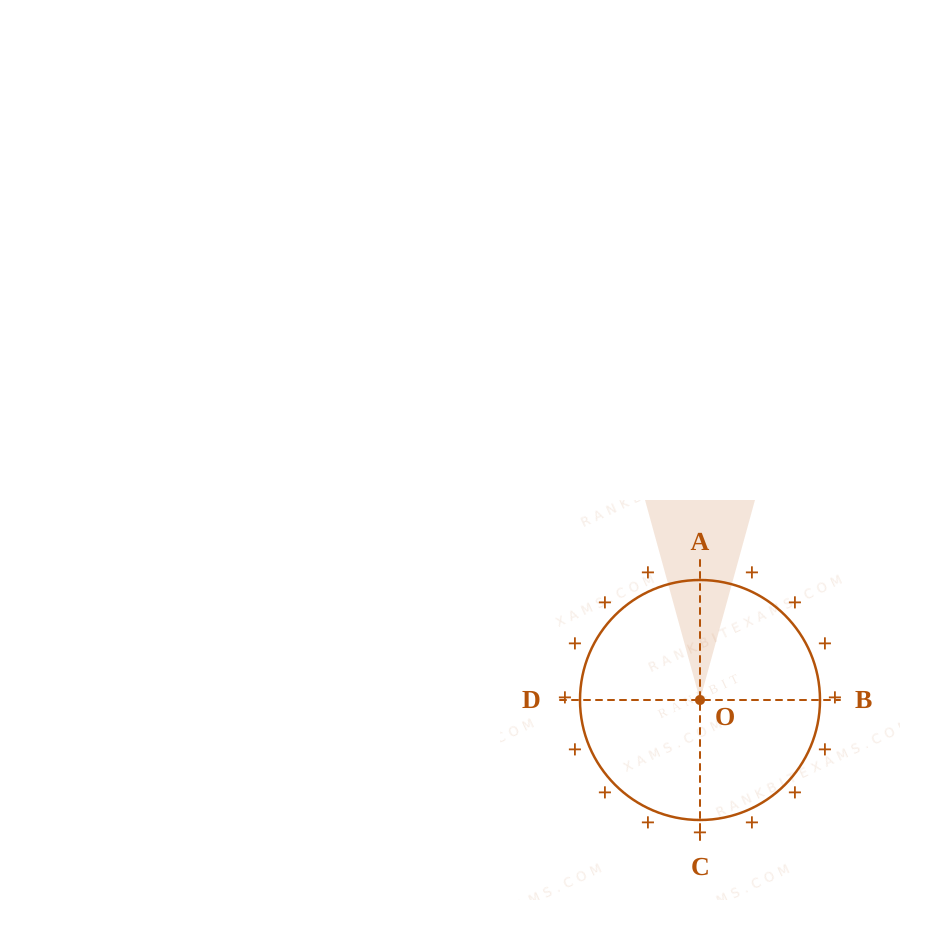
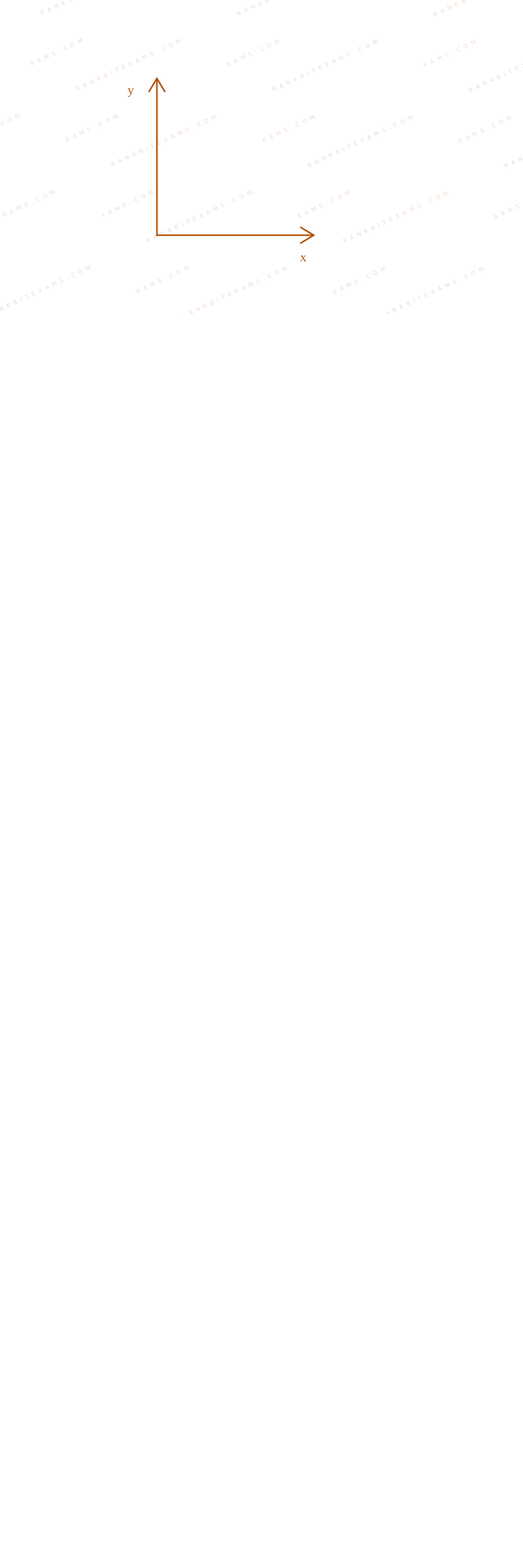
A metallic ring is uniformly charged as shown in figure. AC and BD are two mutually perpendicular diameters. Electric field due to arc AB to 'O' is 'E' is magnitude. What would be the magnitude of electric field at 'O' due to arc ABC? A circle showing perpendicular axes AC and BD dividing it into quadrants.
A.2E$2E$
B.√(2)E$\sqrt{2}E$
C.E/2$E/2$
D.Zero
Solution & Explanation
Related Formula
The electric field due to a circular arc subtending an angle φ$\phi$ at the center is given by:
Arc AB subtends 90^°$90^\circ$ (one quadrant) at the center. The electric field due to it is given as E$E$.
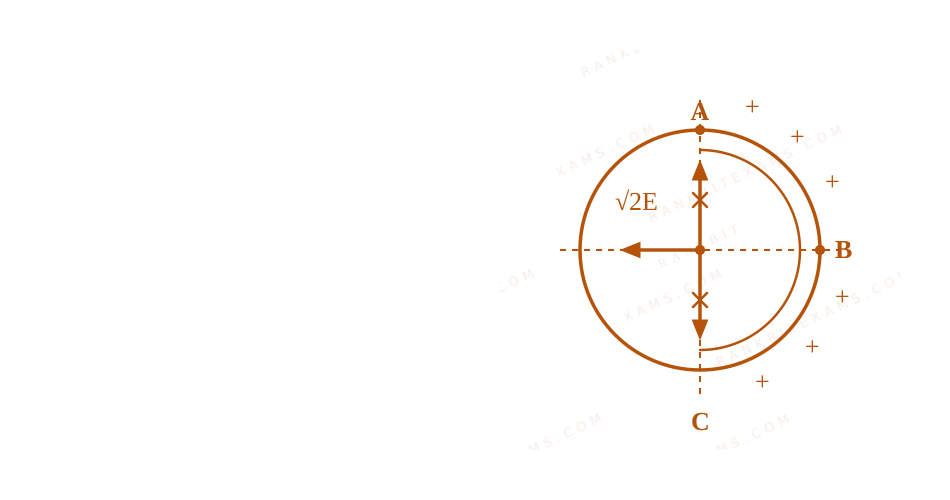
Arc ABC consists of two independent quadrants: arc AB and arc BC.
Each quadrant independently creates an electric field of magnitude E$E$ pointing along the bisector of that specific quadrant.
Step 1: Vector Addition
The electric field EAB$\vec{E}_{AB}$ is directed at 45^°$45^\circ$ away from both axes into the third quadrant.
The electric field EBC$\vec{E}_{BC}$ is directed at 45^°$45^\circ$ towards the matching opposite quadrant.
Since EAB$\vec{E}_{AB}$ and EBC$\vec{E}_{BC}$ are perpendicular to each other, their resultant magnitude is:
Eₙₑₜ = √(E² + E²) = √(2)E$$E_{\text{net}} = \sqrt{E^2 + E^2} = \sqrt{2}E$$A circle showing perpendicular axes AC and BD dividing it into quadrants.A circle showing perpendicular axes AC and BD dividing it into quadrants.
Pattern Recognition
Symmetric components of a ring create orthogonal vector fields. Each 90^°$90^\circ$ arc produces a field of magnitude E$E$ directed along its angular bisector. Two adjacent quadrants have bisectors separated by 90^°$90^\circ$, hence use orthogonal vector addition.
Keywords:#metallic ring is uniformly charged as shown#JEE Main 2025 Evening Q7#Electrostatics JEE Main 2025#Electric Field JEE Main 2025#metallic ring#charged arc#electric field vector
More Electrostatics Previous-Year Questions — Page 9
Q1jee_main_2025_28_jan_morningEnergy Stored in a Capacitor
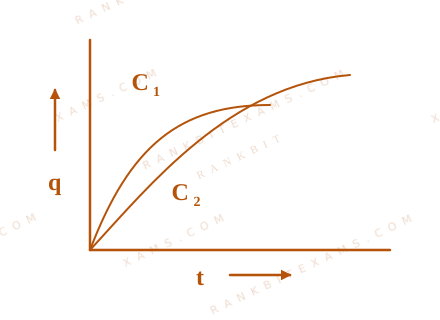
Two capacitors C₁$C_1$ and C₂$C_2$ are connected in parallel to a battery. Charge-time graph is shown below for the two capacitors. The energy stored with them are U₁$U_1$ and U₂$U_2$ , respectively. Which of the given statements is true?
The graph shows the variation of charge with time for two different capacitors connected in parallel.
Since both capacitors are connected in parallel across the same battery, their potential difference V$\mathrm{V}$ is identical.
From the given charge-time graph, at any specific instant of time, the charge accumulated on the second capacitor is greater than that on the first:
q₂ > q₁$$\mathrm{q}_2 > \mathrm{q}_1$$
Using the relation q = CV$\mathrm{q} = \mathrm{C}\mathrm{V}$, since V$\mathrm{V}$ is identical, we get:
C₂ > C₁$$\mathrm{C}_2 > \mathrm{C}_1$$
Now, the electrostatic energy stored in a capacitor is given by:
U = (1)/(2) CV²$$\mathrm{U} = \frac{1}{2} \mathrm{C}\mathrm{V}^2$$
Since C₂ > C₁$\mathrm{C}_2 > \mathrm{C}_1$ and V$\mathrm{V}$ is constant, the stored energy satisfies:
U₂ > U₁$$\mathrm{U}_2 > \mathrm{U}_1$$
Step 1: Final Conclusion
Thus, the correct relationships are C₂ > C₁$\mathrm{C}_2 > \mathrm{C}_1$ and U₂ > U₁$\mathrm{U}_2 > \mathrm{U}_1$.
Pattern Recognition
Sees parallel connection → Immediately lock potential difference V$\mathrm{V}$ as constant. This simplifies q ∝ C$\mathrm{q} \propto \mathrm{C}$ and U ∝ C$\mathrm{U} \propto \mathrm{C}$, creating a direct linear bridge from graph height to energy capacity.
Chapter Mix
Class 12 Physics: Electrostatic Potential and Capacitance
Class 12 Physics: Electrostatic Potential and Capacitance
Q17jee_main_2025_28_jan_morningMotion of a Charged Particle in an Electric Field
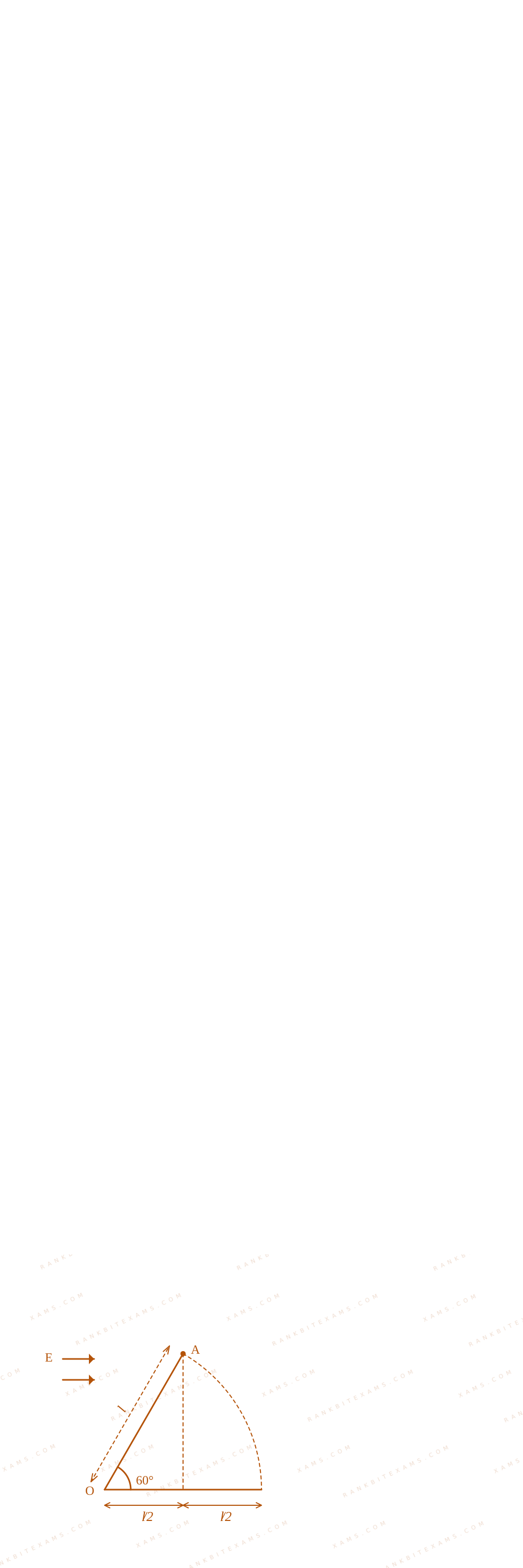
A particle of mass m$\mathrm{m}$ and charge q$\mathrm{q}$ is fastened to one end A$\mathrm{A}$ of a massless string having equilibrium length $\ell$ , whose other end is fixed at point O$\mathrm{O}$ . The whole system is placed on a frictionless horizontal plane and is initially at rest. If uniform electric field is switched on along the direction as shown in figure, then the speed of the particle when it crosses the x-axis is
A charge constraint tracking loop under electrostatic vector field forces on a horizontal surface.A charge constraint tracking loop under electrostatic vector field forces on a horizontal surface.
A charge constraint tracking loop under electrostatic vector field forces on a horizontal surface.
The displacement parallel to the uniform electric field lines equals ( )/(2)$\frac{\ell}{2}$. Therefore, computing the work done by the electrostatic field:
qE ( )/(2) = (1)/(2) m v² - 0$$\mathrm{qE} \frac{\ell}{2} = \frac{1}{2} \mathrm{m v}^2 - 0$$
Step 1: Final Expression
v = qE m$$\mathrm{v} = \sqrt{\frac{\mathrm{qE}\ell}{\mathrm{m}}}$$
This matches option (3).
Pattern Recognition
Keep your focus on displacement along the field lines. Work relies entirely on the parallel displacement component (dₓ = 60°$d_x = \ell \cos 60^{\circ}$), completely ignoring any vertical movement components.
Chapter Mix
Class 12 Physics: Electric Charges and Fields
Qjee_main_2025_03_april_morningCapacitor with Multiple Dielectrics
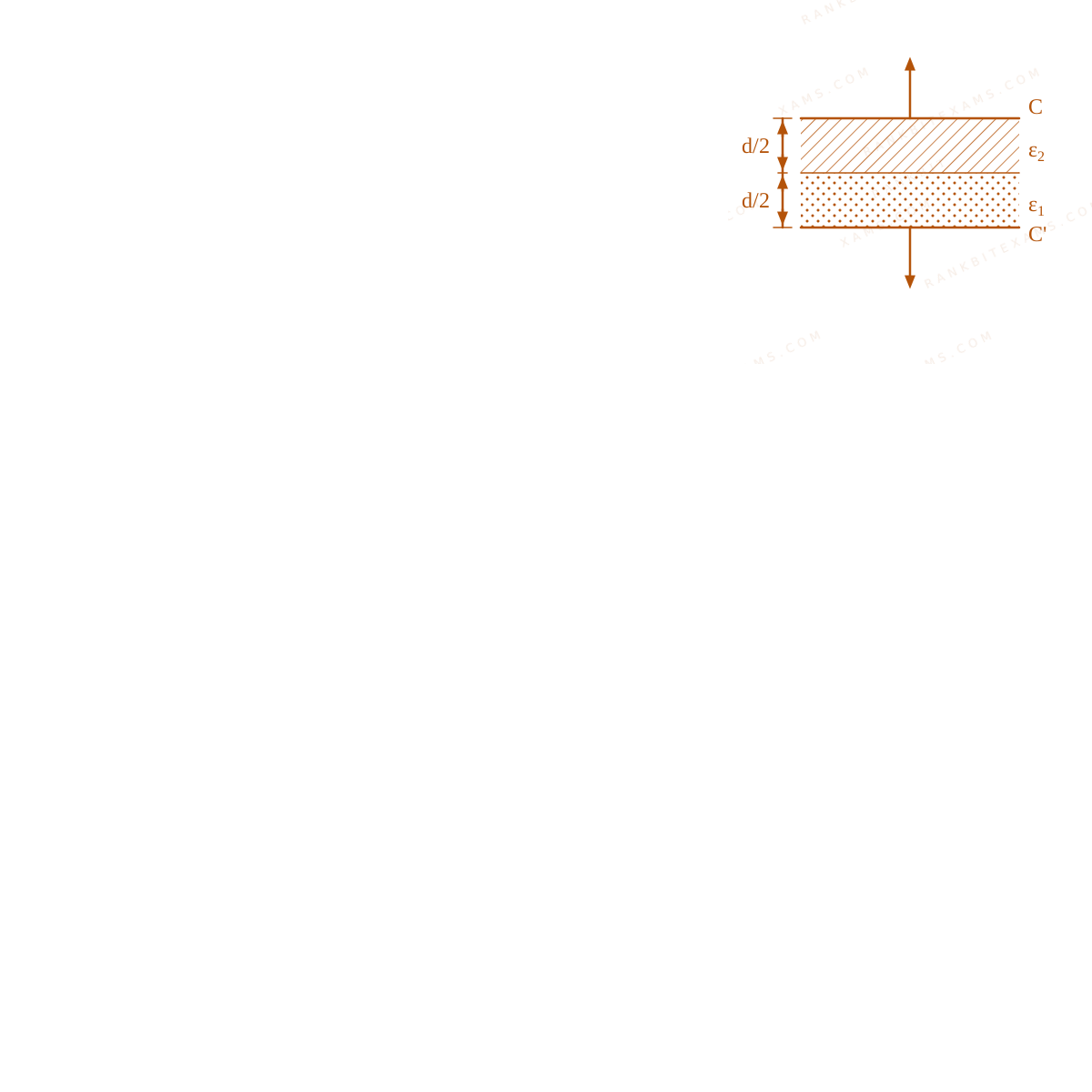
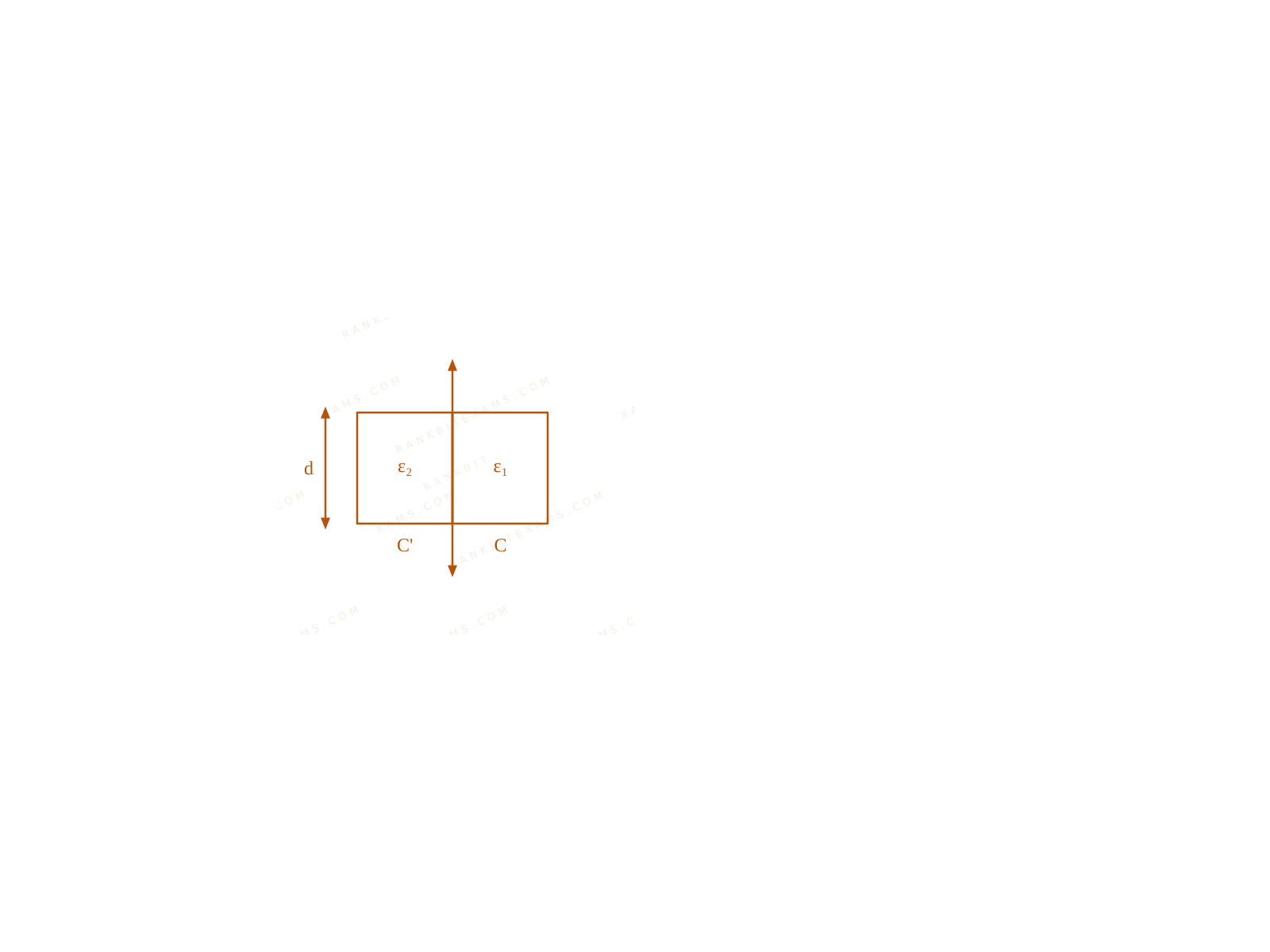
A parallel plate capacitor is filled equally (half) with two dielectrics of dielectric constant ε₁$\varepsilon_1$ and ε₂$\varepsilon_2$, as shown in figures. The distance between the plates is d$d$ and area of each plate is A$A$. If capacitance in first configuration and second configuration are C₁$C_1$ and C₂$C_2$ respectively, then (C₁)/(C₂)$\frac{C_1}{C_2}$ is:
Illustrates two parallel plate configurations: stacked horizontally (series) and stacked vertically (parallel).
For dielectric-filled capacitors: splitting the gap (d/2$d/2$) leads to a series combination, while splitting the plate area (A/2$A/2$) leads to a parallel combination.
Shortcut: Cₛₑᵣᵢₑₛ = harmonic mean$C_{\text{series}} = \text{harmonic mean}$, Cparallel = arithmetic mean$C_{\text{parallel}} = \text{arithmetic mean}$. The ratio (C₁)/(C₂)$\frac{C_1}{C_2}$ is always the ratio of the harmonic mean of the dielectric constants to their arithmetic mean!
Chapter Mix
Class 12 Physics: Electrostatic Potential and Capacitance
Q14jee_main_2025_03_april_morningPotential of a Charged Spherical Shell
The electrostatic potential on the surface of uniformly charged spherical shell of radius R = 10~cm$R = 10\mathrm{~cm}$ is 120~V$120\mathrm{~V}$. The potential at the centre of shell, at a distance r = 5~cm$r = 5\mathrm{~cm}$ from centre, and at a distance r = 15~cm$r = 15\mathrm{~cm}$ from the centre of the shell respectively, are:
Therefore, the potentials are 120~V$120\mathrm{~V}$, 120~V$120\mathrm{~V}$, and 80~V$80\mathrm{~V}$ respectively.
Pattern Recognition
The electric field inside a uniformly charged conducting spherical shell is zero, meaning that no work is done moving a charge inside it. Consequently, the potential remains absolutely uniform/constant from the surface all the way to the center!
Chapter Mix
Class 12 Physics: Electrostatic Potential and Capacitance
More Electrostatics Questions — jee_main_2025_04_april_evening
Practice past-year questions one chapter at a time. Pick an exam → subject → chapter and get every PYQ for that topic — pulled together from all past papers — with the chapter's key formulas alongside.


.svg "dielectric capacitor, series parallel capacitor, dielectric constant ratio")