Consider the following plots of log of rate constant k (log k) vs frac1mathrmT$\frac{1}{\mathrm{T}}$ for three different reactions. The correct order of activation energies of these reactions is
The graph depicts three linear curves with distinct negative slopes showing the temperature dependence of rate constants.
The graph depicts three linear curves with distinct negative slopes showing the temperature dependence of rate constants.
### Related Formula
log k = log A - fracE_a2.303 R T$$\log k = \log A - \frac{E_a}{2.303 R T}$$textSlope of the line = -fracE_a2.303 R implies |textSlope| propto E_a$$\text{Slope of the line} = -\frac{E_a}{2.303 R} \implies |\text{Slope}| \propto E_a$$
### Core Logic
From the given graph, we look at the steepness (magnitude of the negative slope) of lines 1, 2, and 3:
- Line 2 is the steepest, meaning it has the largest slope magnitude.
- Line 1 has an intermediate slope.
- Line 3 is the flattest, indicating the smallest slope magnitude.
Since the activation energy E_a$E_a$ is directly proportional to the magnitude of this slope:
|textSlope_2| > |textSlope_1| > |textSlope_3| implies E_a2 > E_a1 > E_a3$$|\text{Slope}_2| > |\text{Slope}_1| > |\text{Slope}_3| \implies E_{a2} > E_{a1} > E_{a3}$$
### Pattern Recognition
In Arrhenius coordinates, steepness equals barriers. A steeper line means the reaction rate is highly sensitive to temperature because it has a higher activation energy (E_a$E_a$).
### Evaluation Rubric / Model Answer
null
### Chapter Mix
Class 12 Chemistry: Chemical Kinetics
Keywords:#Arrhenius equation#activation energy slope#logarithmic plot
More Chemical Kinetics Previous-Year Questions — Page 5
Q40jee_main_2025_28_jan_eveningFirst Order Kinetics
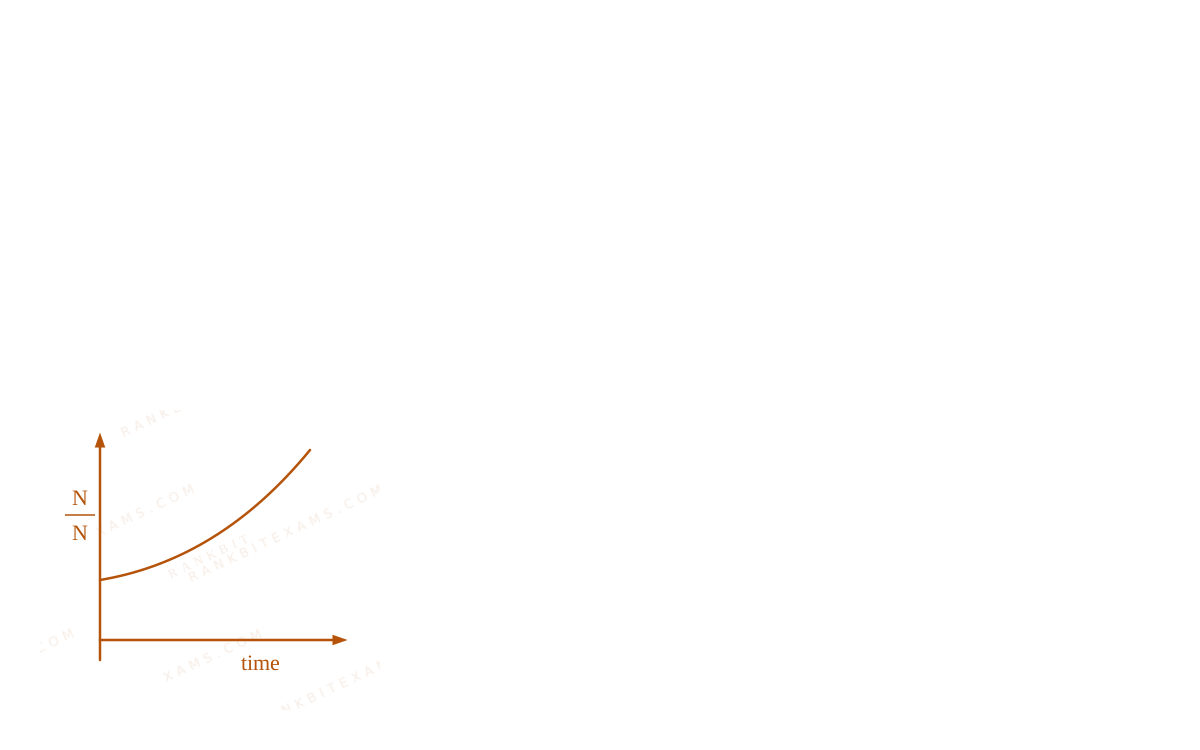
For bacterial growth in a cell culture, growth law is very similar to the law of radioactive decay. Which of the following graphs is most suitable to represent bacterial colony growth?
A. (1)
B. (2)
C. (3)
D. (4)
Solution
### Related Formula
Exponential growth equation model:
N = N_0 e^Kt$N = N_0 e^{Kt}$
Normalized configuration formula:
fracNN_0 = e^Kt$$\frac{N}{N_0} = e^{Kt}$$
### Core Logic
Radioactive decay follows a decreasing exponential path (N = N_0 e^-lambda t$N = N_0 e^{-\lambda t}$).
Conversely, cell culture growth functions via an *increasing* exponential pattern because the rate of growth is directly proportional to the current population size (dN/dt = KN$dN/dt = KN$). This results in an exponential curve that starts at fracNN_0 = 1$\frac{N}{N_0} = 1$ when t = 0$t = 0$ and curves sharply upward over time.
### Step 1: Finding the Matching Curve
Plotting fracNN_0$\frac{N}{N_0}$ against time shows an upward-clinging exponential profile starting from 1$1$, which perfectly matches the curve in option (4).
Exponential growth profile plot for Q40
### Pattern Recognition
The expression e^Kt$e^{Kt}$ dictates an exponential increase. Ensure the curve starts from a non-zero value (1$1$) at t=0$t=0$, as fracN_0N_0 = 1$\frac{N_0}{N_0} = 1$, rather than starting from the origin (0$0$).
### Evaluation Rubric / Model Answer
null
### Chapter Mix
Class 12 Chemistry: Chemical Kinetics
Qjee_main_2025_29_jan_morningReaction Mechanism and Rate Law
The reaction A_2 + B_2 rightarrow 2 AB$A_2 + B_2 \rightarrow 2 AB$ follows the mechanism:
A_2 undersetk_-1oversetk_1rightleftharpoons A + A quad (textfast)$$A_2 \underset{k_{-1}}{\overset{k_1}{\rightleftharpoons}} A + A \quad (\text{fast})$$A + B_2 xrightarrowk_2 AB + B quad (textslow)$$A + B_2 \xrightarrow{k_2} AB + B \quad (\text{slow})$$A + B rightarrow AB quad (textfast)$$A + B \rightarrow AB \quad (\text{fast})$$
The overall order of the reaction is :
A. 1.5
B. 3
C. 2.5
D. 2
Solution
### Related Formula
textRate = k cdot [textReactants]^textorder$$\text{Rate} = k \cdot [\text{Reactants}]^{\text{order}}$$
### Core Logic
The slowest elementary step controls the net kinetic pathway rate law :
textRate = k_2[mathrmA][mathrmB2] quad dots textEquation (1)$$\text{Rate} = k_2[\mathrm{A}][\mathrm{B}2] \quad \dots \text{Equation (1)}$$
Since [mathrmA]$[\mathrm{A}]$ behaves as a transient intermediate species, replace it using the prior fast equilibrium step :
frack_1k-1 = frac[mathrmA]^2[mathrmA2] implies [mathrmA]^2 = left(frack_1k-1right) [mathrmA2]$$\frac{k_1}{k{-1}} = \frac{[\mathrm{A}]^2}{[\mathrm{A}2]} \implies [\mathrm{A}]^2 = \left(\frac{k_1}{k{-1}}\right) [\mathrm{A}2]$$[mathrmA] = sqrtfrack_1k-1 cdot [mathrmA2]^1/2$$[\mathrm{A}] = \sqrt{\frac{k_1}{k{-1}}} \cdot [\mathrm{A}2]^{1/2}$$
Substitute [mathrmA]$[\mathrm{A}]$ back into Equation (1) :
textRate = k_2 sqrtfrack_1k-1 cdot [mathrmA2]^1/2[mathrmB2]$$\text{Rate} = k_2 \sqrt{\frac{k_1}{k{-1}}} \cdot [\mathrm{A}2]^{1/2}[\mathrm{B}2]$$
Sum of powers determining overall order:
textOrder = frac12 + 1 = 1.5$$\text{Order} = \frac{1}{2} + 1 = 1.5$$
Hence, Option (1) is correct.
### Pattern Recognition
Whenever a fast initial step dissociates a molecule into matching independent halves, it always injects a fractional order component of 0.5$0.5$ relative to that parent species.
Q84jee_main_2024_01_february_morningKinetics of Radioactive Decay
The ratio of frac^14mathrmC^12mathrmC$\frac{^{14}\mathrm{C}}{^{12}\mathrm{C}}$ in a piece of wood is frac18$\frac{1}{8}$ part that of atmosphere. If half life of ^14mathrmC$^{14}\mathrm{C}$ is 5730 years, the age of wood sample is .... years.
Numerical Answer.Answer: 17190 to 17190
Solution
### Related Formula
N = fracN_02^n$$N = \frac{N_0}{2^n}$$
where n = fractt_1/2$n = \frac{t}{t_{1/2}}$ (number of half-lives).
Alternatively, using the first-order decay formula:
t = frac2.303lambda log left( fracN_0N_t right)$$t = \frac{2.303}{\lambda} \log \left( \frac{N_0}{N_t} \right)$$
where lambda = frac0.693t_1/2$\lambda = \frac{0.693}{t_{1/2}}$.
### Core Logic
The atmospheric ratio of ^14mathrmC/^12mathrmC$^{14}\mathrm{C}/^{12}\mathrm{C}$ acts as the initial activity or amount (N_0$N_0$) when the tree was alive.
The current ratio in the wood represents the amount left at time t$t$ (N_t$N_t$).
Given that N_t = frac18 N_0$N_t = \frac{1}{8} N_0$.
### Step 1: Calculate Half-lives
fracN_tN_0 = frac18$$\frac{N_t}{N_0} = \frac{1}{8}$$ left(frac12right)^n = frac18 = left(frac12right)^3$$ \left(\frac{1}{2}\right)^n = \frac{1}{8} = \left(\frac{1}{2}\right)^3$$
So, the number of half-lives passed, n = 3$n = 3$.
### Step 2: Calculate Age
t = n times t_1/2$$t = n \times t_{1/2}$$t = 3 times 5730 text years$$t = 3 \times 5730 \text{ years}$$t = 17190 text years$$t = 17190 \text{ years}$$
### Pattern Recognition
Whenever the remaining fraction is a perfect power of 1/2$1/2$ (like 1/2, 1/4, 1/8, 1/16$1/2, 1/4, 1/8, 1/16$), just find the exponent n$n$ and multiply by t_1/2$t_{1/2}$. Here, 1/8 = (1/2)^3 rightarrow 3$1/8 = (1/2)^3 \rightarrow 3$ half-lives.
### Evaluation Rubric / Model Answer
null
### Chapter Mix
Class 12 Chemistry: Chemical Kinetics
Q87jee_main_2024_29_january_eveningFirst Order Kinetics and Half Life
The half-life of radioisotopic bromine - 82 is 36 hours. The fraction which remains after one day is ________ times 10^-2$\times 10^{-2}$. (Given antilog 0.2006 = 1.587)
Numerical Answer.Answer: 63 to 63
Solution
### Related Formula
k = frac0.693,
t_1/2 quad textand quad t = frac2.303,
k log_10 left(fraca,
a-xright)$$k = \frac{0.693},
{t_{1/2}} \quad \text{and} \quad t = \frac{2.303},
{k} \log_{10} \left(\frac{a},
{a-x}\right)$$
### Core Logic
Given t_1/2 = 36text hours$t_{1/2} = 36\text{ hours}$, calculate the decay constant (k$k$):
k = frac0.693,
36 = 0.01925text hr^-1$$k = \frac{0.693},
{36} = 0.01925\text{ hr}^{-1}$$
We want to find the fraction remaining after 1text day = 24text hours$1\text{ day} = 24\text{ hours}$:
log_10 left(fraca,
a-xright) = frack times t,
2.303 = frac0.01925 times 24,
2.303 = 0.2006$$\log_{10} \left(\frac{a},
{a-x}\right) = \frac{k \times t},
{2.303} = \frac{0.01925 \times 24},
{2.303} = 0.2006$$
### Step 1: Antilog Application
Taking the antilog on both sides:
fraca,
a-x = 1.587 implies textFraction remaining left(fraca-x,
aright) = frac1,
1.587 approx 0.6301$$\frac{a},
{a-x} = 1.587 \implies \text{Fraction remaining } \left(\frac{a-x},
{a}\right) = \frac{1},
{1.587} \approx 0.6301$$
Expressing the remaining fraction in the requested format:
0.6301 = 63 times 10^-2$$0.6301 = 63 \times 10^{-2}$$
Thus, the required integer value is **63**.
### Pattern Recognition
Ensure all time variables are in matching units (hours) before substituting values into first-order kinetic equations.
### Evaluation Rubric / Model Answer
null
### Chapter Mix
Class 12 Chemistry: Chemical Kinetics
Q82jee_main_2024_27_jan_morningDetermination of Order of Reaction
Consider the following data for the given reaction:
2textHI_(g) rightarrow textH_2(g) + textI_2(g)$$2\text{HI}_{(g)} \rightarrow \text{H}_{2(g)} + \text{I}_{2(g)}$$
Experiment
[textHI] text (mol L^-1text)$[\text{HI}] \text{ (mol L}^{-1}\text{)}$
The order of the reaction is textquadquad$\text{\quad\quad}$.
Numerical Answer.Answer: 2 to 2
Solution
### Related Formula
Rate law relation expression:
R = k[textHI]^n$$R = k[\text{HI}]^n$$
where n$n$ represents the overall reaction order indicator.
### Step 1: Set up ratios using data subsets
Comparing data from experiment 1 and experiment 2:
fracR_2R_1 = frac3.0 times 10^-37.5 times 10^-4 = left(frac0.010.005right)^n$$\frac{R_2}{R_1} = \frac{3.0 \times 10^{-3}}{7.5 \times 10^{-4}} = \left(\frac{0.01}{0.005}\right)^n$$4 = (2)^n$4 = (2)^n$2^2 = 2^n implies n = 2$$2^2 = 2^n \implies n = 2$$
### Pattern Recognition
Doubling concentration (0.005 rightarrow 0.01$0.005 \rightarrow 0.01$) increases the reaction rate by 4 times (7.5 times 10^-4 rightarrow 3.0 times 10^-3$7.5 \times 10^{-4} \rightarrow 3.0 \times 10^{-3}$). Hence, it is a clear second-order (2^2 = 4$2^2 = 4$) dynamic pattern.
### Chapter Mix
Class 12 Chemistry: Chemical Kinetics
We Map Every Repeating Question in Competitive Exams.
Say goodbye to generic mock test fatigue. RankBit uses smart analysis to group past exam questions into their foundational Repeating Question Types. Find chapter weightage, track repeating questions, and score higher with targeted practice.
Select Your Target Exam
Choose an exam track below to find formulas per chapter and patterns.
Syncing Exam Intelligence
Mapping formulas and patterns across all tracks…
PATH A — FULL LENGTH PRACTICE
Full Mock Test Hub
Simulate real NTA exam conditions with fully tracked mocks. Time yourself against past papers.
Practice past-year questions one chapter at a time. Pick an exam → subject → chapter and get every PYQ for that topic — pulled together from all past papers — with the chapter's key formulas alongside.

.svg "Arrhenius equation, activation energy slope, logarithmic plot")