A particle is released from height S$S$ above the surface of the earth. At certain height its kinetic energy is three times its potential energy. The height from the surface of the earth and the speed of the particle at that instant are respectively.
Etotal = K + U = constant$$E_{\text{total}} = K + U = \text{constant}$$
At the initial height S$S$ (velocity v = 0$v = 0$):
Etotal = mgS$$E_{\text{total}} = mgS$$
At any height x$x$ above the ground:
U = mgx and K = (1)/(2)mv²$$U = mgx \quad \text{and} \quad K = \frac{1}{2}mv^2$$
Core Logic
Let the height of the particle at that instant be x$x$.
We are given:
K = 3U$K = 3U$
Substitute the energy terms:
(1)/(2)mv² = 3mgx$$\frac{1}{2}mv^2 = 3mgx$$
By energy conservation:
K + U = Etotal$$K + U = E_{\text{total}}$$3U + U = mgS 4U = mgS$$3U + U = mgS \implies 4U = mgS$$4(mgx) = mgS x = (S)/(4)$$4(mgx) = mgS \implies x = \frac{S}{4}$$
Step 1: Calculating the Speed
Now find the speed v$v$ at this height x = S/4$x = S/4$.
Since K = 3U$K = 3U$:
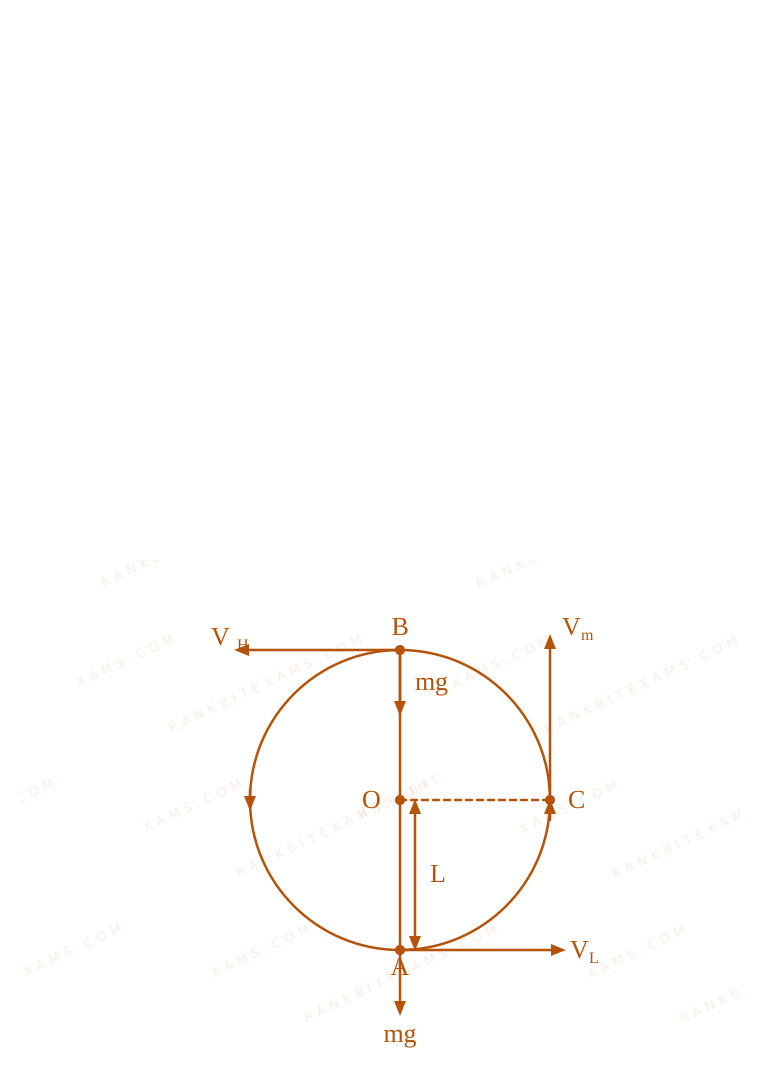
A bob of mass 'm$m$' is suspended by a light string of length 'L$L$'. It is imparted a minimum horizontal velocity at the lowest point A$A$ such that it just completes half circle reaching the top most position B$B$. The ratio of kinetic energies (K.E.)A(K.E.)B$\frac{(\mathrm{K.E.})_{\mathrm{A}}}{(\mathrm{K.E.})_{\mathrm{B}}}$ is:
The diagram displays a bob of mass m in vertical circular motion with velocity indicators at points A, B, and C.
A.3:2$3:2$
B.5:1$5:1$
C.2:5$2:5$
D.1:5$1:5$
Solution
Related Formula
For a body to just complete a vertical loop of radius L$L$:
Speed at the lowest point A$A$: vA = √(5gL)$v_A = \sqrt{5gL}$
Speed at the highest point B$B$: vB = √(gL)$v_B = \sqrt{gL}$
Since K.E. ∝ v²$\text{K.E.} \propto v^2$, the ratio of kinetic energies is simply the ratio of the squares of the critical velocities at the bottom and top of the vertical loop: (√(5gL))² : (√(gL))² = 5:1$(\sqrt{5gL})^2 : (\sqrt{gL})^2 = 5:1$.
Chapter Mix
Class 11 Physics: Work, Energy and Power
Q39jee_main_2024_27_jan_morningKinetic Energy and Momentum
Two bodies of mass 4 g$4\text{ g}$ and 25 g$25\text{ g}$ are moving with equal kinetic energies. The ratio of the magnitude of their linear momentum is:
A.3:5$3:5$
B.5:4$5:4$
C.2:5$2:5$
D.4:5$4:5$
Solution
Related Formula
K = (P²)/(2m) P = √(2mK)$$K = \frac{P^2}{2m} \implies P = \sqrt{2mK}$$
Where P$P$ is linear momentum, m$m$ is mass, and K$K$ is kinetic energy.
Core Logic
Given K₁ = K₂$K_1 = K_2$, the momentum ratio simplifies directly to the square root of their masses:
For constant kinetic energy tracking profiles, momentum maps proportionally to √(m)$\sqrt{m}$.
Chapter Mix
Class 11 Physics: Work, Energy and Power
Q37jee_main_2024_29_jan_morningPotential Energy and Force Relationship
The potential energy function (in J) of a particle in a region of space is given as U = (2x² + 3y³ + 2z)$U = (2x^2 + 3y^3 + 2z)$. Here x, y and z are in meter. The magnitude of x - component of force (in N) acting on the particle at point P (1, 2, 3) m is:
A. 2
B. 6
C. 4
D. 8
Solution
Related Formula
The force vector F$\vec{F}$ is related to the potential energy U$U$ by the negative gradient of potential energy:
F = - ∇ U = -( (∂ U)/(∂ x) i + (∂ U)/(∂ y) j + (∂ U)/(∂ z) k )$$\vec{F} = -\vec{\nabla} U = -\left( \frac{\partial U}{\partial x}\hat{i} + \frac{\partial U}{\partial y}\hat{j} + \frac{\partial U}{\partial z}\hat{k} \right)$$
When asked for a specific component (like x-component), only differentiate partially with respect to that specific variable. The remaining coordinates (y, z$y, z$) act purely as constants and vanish.
Chapter Mix
Class 11 Physics: Work, Energy and Power
Q37jee_main_2024_30_jan_morningConservation of Mechanical Energy
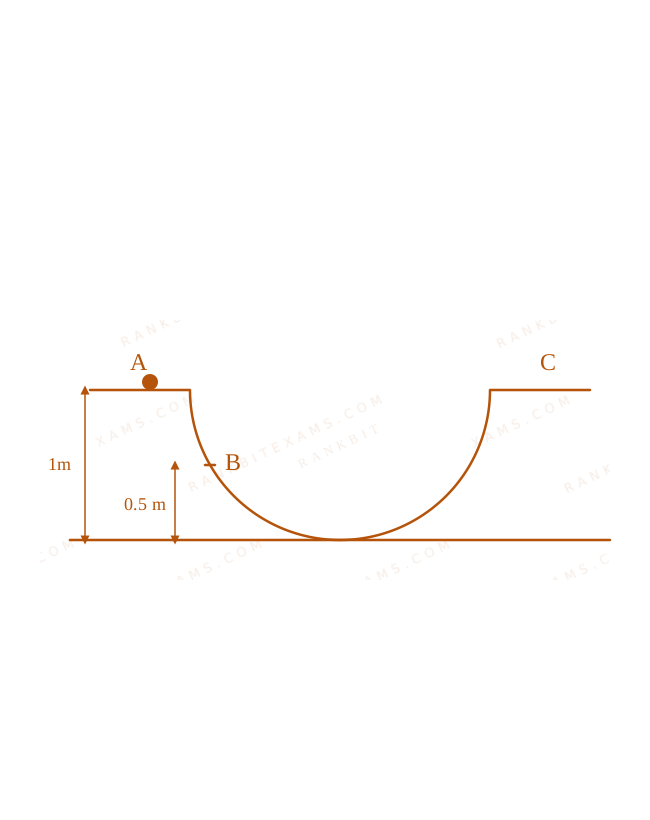
A particle is placed at the point A of a frictionless track ABC as shown in figure. It is gently pushed toward right. The speed of the particle when it reaches the point B is: (Take g = 10 ~m/s²$g = 10 \mathrm{~m/s^2}$).
A particle on a frictionless track moving from height 1m at point A to 0.5m at point B.
A.20 ~m / s$20 \mathrm{~m / s}$
B.√(10) ~m / s$\sqrt{10} \mathrm{~m / s}$
C.2 √(10) ~m / s$2 \sqrt{10} \mathrm{~m / s}$
D.10 ~m / s$10 \mathrm{~m / s}$
Solution
Related Formula
Kᵢ + Uᵢ = Kf + Uf$$K_i + U_i = K_f + U_f$$(1)/(2) m u² + mghᵢ = (1)/(2) m v² + mghf$$\frac{1}{2} m u^2 + mgh_i = \frac{1}{2} m v^2 + mgh_f$$
Core Logic
Since the track is frictionless, mechanical energy is conserved. We can apply the Principle of Conservation of Mechanical Energy (COME) between point A and point B.
Step 1: Apply Conservation of Energy
At point A (initially pushed gently, u ≈ 0$u \approx 0$):
For a mass sliding down a frictionless slope, its speed relies only on the vertical height dropped: v = √(2gΔ h)$v = \sqrt{2g\Delta h}$.
Chapter Mix
Class 11 Physics: Work, Energy and Power
Q48jee_main_2024_31_jan_eveningPower by a Variable Force
A body of mass 2 kg$2 \text{ kg}$ begins to move under the action of a time dependent force given by F = (6t i + 6t² j)N$\vec{F} = (6t\hat{i} + 6t^2\hat{j})\text{N}$. The power developed by the force at the time t$t$ is given by:
A.(6t⁴ + 9t⁵)W$(6t^4 + 9t^5)\text{W}$
B.(3t³ + 6t⁵)W$(3t^3 + 6t^5)\text{W}$
C.(9t⁵ + 6t³)W$(9t^5 + 6t^3)\text{W}$
D.(9t³ + 6t⁵)W$(9t^3 + 6t^5)\text{W}$
Solution
Related Formula
F = m a$$\vec{F} = m\vec{a}$$a = d vdt v = ∫ a dt$$\vec{a} = \frac{d\vec{v}}{dt} \implies \vec{v} = \int \vec{a} dt$$P = F · v$$P = \vec{F} \cdot \vec{v}$$
Core Logic
First find acceleration from force and mass. Then integrate acceleration to find the velocity vector at time t$t$ (starting from rest). Finally, compute the dot product of Force and Velocity to get instantaneous power.
Step 1: Calculate Acceleration
Given F = (6t i + 6t² j) N$\vec{F} = (6t\hat{i} + 6t^2\hat{j}) \text{ N}$ and m = 2 kg$m = 2 \text{ kg}$.
a = Fm = 6t i + 6t² j2$$\vec{a} = \frac{\vec{F}}{m} = \frac{6t\hat{i} + 6t^2\hat{j}}{2}$$a = (3t i + 3t² j) m/s²$$\vec{a} = (3t\hat{i} + 3t^2\hat{j}) \text{ m/s}^2$$
Step 2: Calculate Velocity
Assuming the body begins to move from rest (at t=0, v=0$t=0, v=0$):
When force varies as a polynomial in time tⁿ$t^n$, acceleration does too. Velocity jumps to tⁿ⁺¹$t^{n+1}$. Power (F · v$F \cdot v$) will result in terms behaving as t²ⁿ⁺¹$t^{2n+1}$. Here t → t³$t \to t^3$ and t² → t⁵$t^2 \to t^5$.
Chapter Mix
Class 11 Physics: Work, Energy and Power
Class 11 Physics: Motion in a Plane
More Work, Energy and Power Questions — jee_main_2025_03_april_morning
Practice past-year questions one chapter at a time. Pick an exam → subject → chapter and get every PYQ for that topic — pulled together from all past papers — with the chapter's key formulas alongside.