JEE Main · Physics ↓ Falling

Work, Energy and Power appeared 31 times across 3 years — 3.6% of Physics. This question is from Conservation of Mechanical Energy.

Year 2026 2025 2024 Total
Questions 8 15 8 31

A particle is released from height S above the surface of the earth. At certain height its kinetic energy is three times its potential energy. The height from the surface of the earth and the speed of the particle at that instant are respectively.

Solution & Explanation

Related Formula

Conservation of Mechanical Energy:

Etotal = K + U = constant

At the initial height S (velocity v = 0):

Etotal = mgS

At any height x above the ground:

U = mgx and K = (1)/(2)mv²
Core Logic

Let the height of the particle at that instant be x. We are given: K = 3U

Substitute the energy terms:

(1)/(2)mv² = 3mgx

By energy conservation:

K + U = Etotal 3U + U = mgS 4U = mgS 4(mgx) = mgS x = (S)/(4)
Step 1: Calculating the Speed

Now find the speed v at this height x = S/4. Since K = 3U:

(1)/(2)mv² = 3mgx (1)/(2)mv² = 3mg((S)/(4)) v² = (6gS)/(4) = (3gS)/(2) v = √((3gS)/(2))
Pattern Recognition

Standard ratio trick: If K = n U, then by energy conservation (n+1)U = Etotal. This immediately yields:

x = (S)/(n+1)

Here n = 3, so x = S/4. This rapid shortcut lets you find the height in a split second!

Chapter Mix

Class 11 Physics: Work, Energy and Power
Reference Study Guides

More Work, Energy and Power Previous-Year Questions — Page 3

Q19 jee_main_2025_03_april_evening Work-Energy Theorem with Variable Force
A block of mass 1 kg, moving along x with speed vᵢ=10~m/s enters a rough region ranging from x=0.1~m to x=1.9~m. The retarding force acting on the block in this range is Fᵣ=-kx~N with k=10~N/m. Then the final speed of the block as it crosses rough region is :
  • A. 10~m/s
  • B. 4~m/s
  • C. 6~m/s
  • D. 8~m/s

Solution

Related Formula

By the Work-Energy Theorem, the work done by the retarding force equals the change in kinetic energy:

W = Δ K = Kf - Kᵢ W = ∫xᵢxf Fᵣ(x) dx = (1)/(2) m vf² - (1)/(2) m vᵢ²
Core Logic

Given parameters:

  • Mass m = 1~kg
  • Initial velocity vᵢ = 10~m/s
  • Region bounds: xᵢ = 0.1~m, xf = 1.9~m
  • Retarding force Fᵣ = -kx = -10x~N
Step 1: Calculate Work Done by the Retarding Force (W)
W = ∫0.11.9 (-10x) dx = -10 [ (x²)/(2) ]0.11.9 = -5 [ (1.9)² - (0.1)² ]

Using the algebraic identity a² - b² = (a-b)(a+b):

(1.9)² - (0.1)² = (1.9 - 0.1)(1.9 + 0.1) = (1.8)(2.0) = 3.6 W = -5 × 3.6 = -18~J
Step 2: Solve for final velocity (vf)

Apply the Work-Energy Theorem:

-18 = (1)/(2) (1) vf² - (1)/(2) (1) (10²) -18 = 0.5 vf² - 50 0.5 vf² = 50 - 18 = 32 vf² = 64 ⇒ vf = 8~m/s
Pattern Recognition

Notice that integrating a linear force

Pattern Recognition

Notice that integrating a linear force $F = -kxyields a potential-energy-like term\frac{1}{2}k(x_f^2 - x_i^2). Combining this with the Work-Energy theorem gives\frac{1}{2} m v_f^2 + \frac{1}{2} k x_f^2 = \frac{1}{2} m v_i^2 + \frac{1}{2} k x_i^2$, which is identical to conservation of mechanical energy.

Chapter Mix

Class 11 Physics: Work, Energy and Power

Q18 jee_main_2025_07_april_morning Power
An object of mass 1000 g experiences a time dependent force F = (2t i + 3t² j)N . The power generated by the force at time t is:
  • A. (2t² + 3t³)W
  • B. (2t² + 18t³)W
  • C. (3t³ + 5t⁵)W
  • D. (2t³ + 3t⁵)W

Solution

Related Formula

Instantaneous power P generated by a force is given by:

P = F · v

Newton's second law:

a = Fm = d vdt v = ∫ a dt
Core Logic

Convert mass to SI units:

m = 1000 ~g = 1 ~kg

Calculate acceleration:

a = 2t i + 3t² j1 = 2t i + 3t² j
Step 1: Determine Velocity Vector

Assuming the object starts from rest at t = 0:

v = ∫₀t (2t i + 3t² j) dt = t² i + t³ j
Step 2: Calculate Power

Compute the dot product of force and velocity:

P = F · v = (2t i + 3t² j) · (t² i + t³ j) P = (2t)(t²) + (3t²)(t³) = 2t³ + 3t⁵ ~W
Pattern Recognition

Sees: Time-dependent force

Pattern Recognition

Sees: Time-dependent force $\vec{F} \propto t^non a 1 kg mass. Shortcut: Form=1kg, velocity is the integral of the force components. Power is the dot product of the force vector and its integral. Since\int at^n \mathrm{d}t = \frac{a}{n+1} t^{n+1}, power component becomes\frac{a^2}{n+1} t^{2n+1}. Here,2^2/2 t^3 + 3^2/3 t^5 = 2t^3 + 3t^5 \mathrm{~W}$.

Chapter Mix

Class 11 Physics: Work, Energy and Power
Q jee_main_2025_08_april_evening Conservation of Mechanical Energy
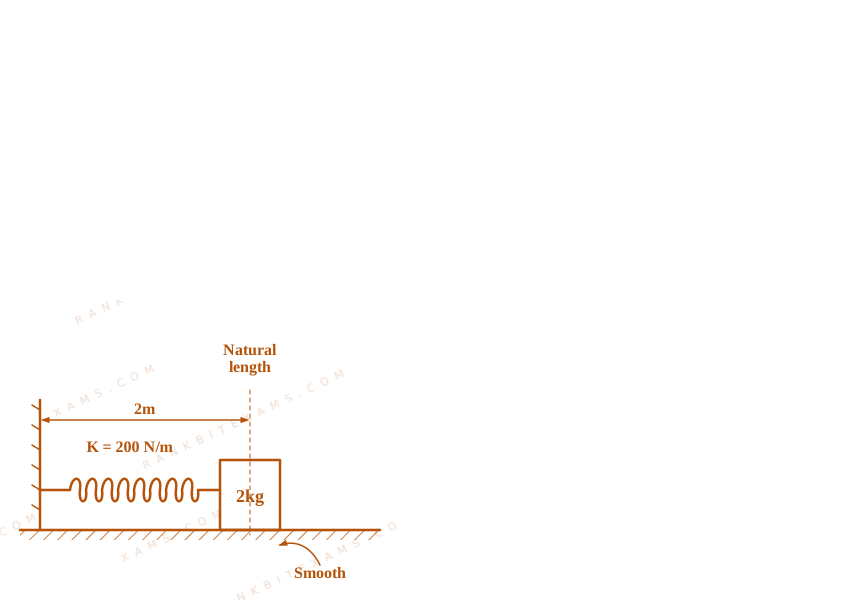
A block of mass 2~kg is attached to one end of a massless spring whose other end is fixed at a wall. The spring-mass system moves on a frictionless horizontal table. The spring's natural length is 2~m and spring constant is 200~N/m. The block is pushed such that the length of the spring becomes 1~m and then released. At distance x~m (x < 2) from the wall, the speed of the block will be:
  • A. 10[1 - (2 - x)]3/2~m/s
  • B. 10[1 - (2 - x)² ]1/2~m/s
  • C. 10[1 - (2 - x)²]~m/s
  • D. 10[1 - (2 - x)²]²~m/s

Solution

Related Formula
E = Kᵢ + Uᵢ = Kf + Uf U = (1)/(2) k y²

where, E = total mechanical energy K = (1)/(2) m v² = kinetic energy U = potential energy of spring with deformation y

Core Logic

Given parameters:

  • Mass, m = 2~kg
  • Natural length of spring, L₀ = 2~m
  • Spring constant, k = 200~N/m
  • Initial State (when block is pushed):

  • Length of spring is 1~m.
  • Deformation (compression), yᵢ = L₀ - 1 = 2 - 1 = 1~m.
  • Released from rest: vᵢ = 0 Kᵢ = 0.
  • Spring-mass conservation setup
    Spring-mass conservation setup
    Final State (at distance x from the wall):

  • Since the spring is attached to the wall, its length is x~m.
  • Deformation (compression) at this position, yf = L₀ - x = (2 - x)~m.
  • Kinetic energy Kf = (1)/(2) m v² = (1)/(2) (2) v² = v².
Step 1: Conservation of Energy Equation

Equate initial and final energies:

Kᵢ + Uᵢ = Kf + Uf 0 + (1)/(2) k yᵢ² = (1)/(2) m v² + (1)/(2) k yf²

Substitute the parameters:

(1)/(2) (200) (1)² = v² + (1)/(2) (200) (2 - x)² 100 = v² + 100 (2 - x)² v² = 100 [ 1 - (2 - x)² ] v = 10 [ 1 - (2 - x)² ]1/2~m/s
Pattern Recognition

Sees: Horizontal spring-mass energy conservation. Trap: The deformation is not x; it is the difference from natural length, i.e., (L₀ - x) = (2 - x). Shortcut: Writing out energy conservation directly allows mass to cancel beautifully, simplifying the algebra immediately. ✓

Chapter Mix

Class 11 Physics: Work, Energy and Power Class 11 Physics: Oscillations
Q11 jee_main_2025_29_jan_evening Elastic Collisions in One Dimension
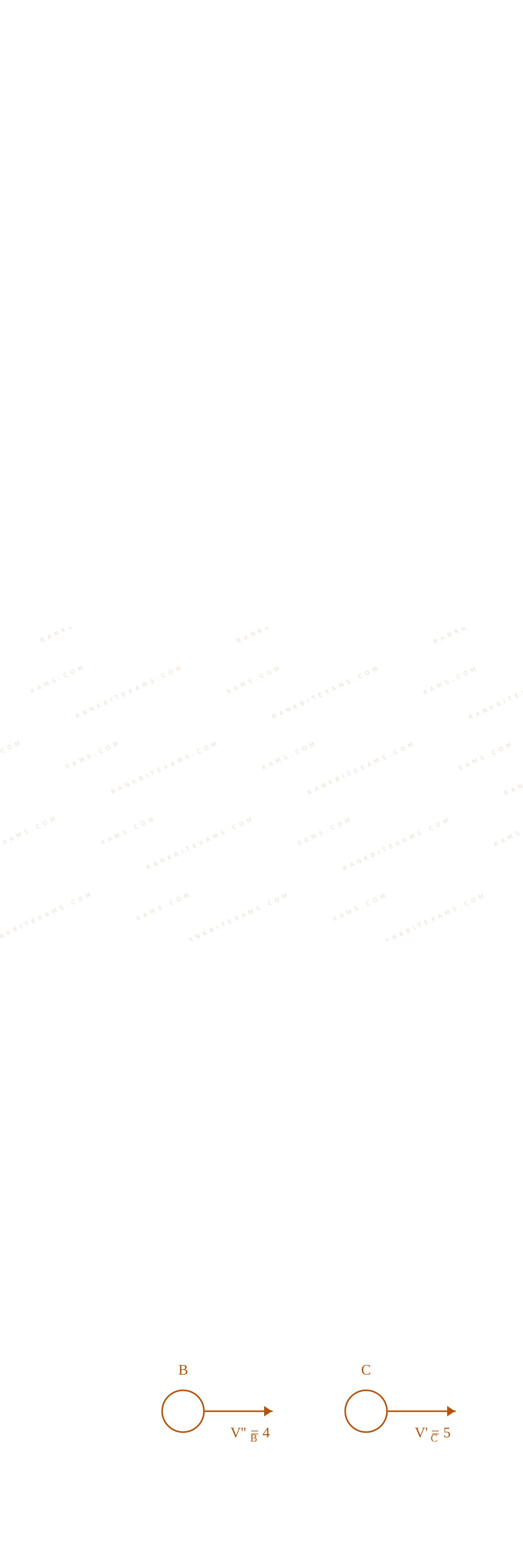
Given below are two statements. One is labelled as Assertion (A) and the other is labelled as Reason (R). Assertion (A): Three identical spheres of same mass undergo one dimensional motion as shown in figure with initial velocities vA = 5~m/s, vB = 2~m/s, vC = 4~m/s. If we wait sufficiently long for elastic collision to happen, then vA = 4~m/s, vB = 2~m/s, vC = 5~m/s will be the final velocities. Reason (R): In an elastic collision between identical masses, two objects exchange their velocities. In the light of the above statements, choose the correct answer from the options given below:
  • A. Both (A) and (R) are true but (R) is NOT the correct explanation of (A)
  • B. (A) is true but (R) is false
  • C. Both (A) and (R) are true and (R) is the correct explanation of (A)
  • D. (A) is false but (R) is true

Solution

Related Formula
v₁' = v₂ and v₂' = v₁

for perfectly elastic collision (e=1) when masses are identical (m₁ = m₂).

Core Logic

Reason (R) states that identical masses exchange their velocities during elastic collision, which is mathematically correct.

Let us trace the sequence of collisions chronologically:

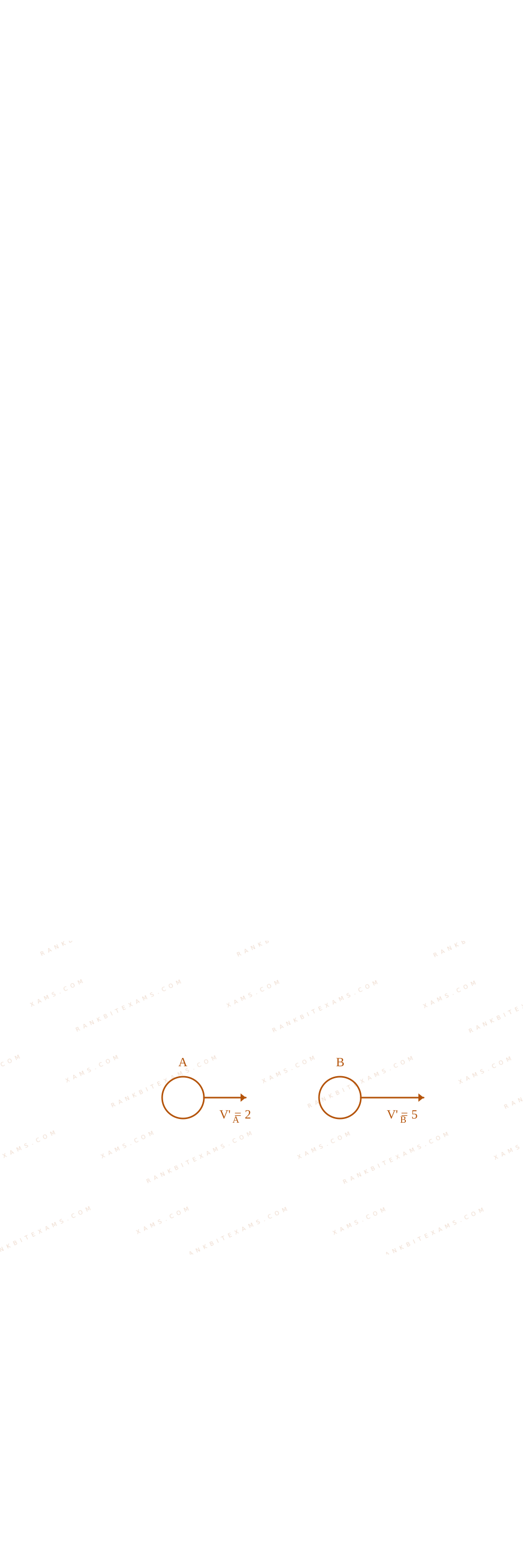
  • Since vA = 5~m/s and vB = 2~m/s, sphere A collides with sphere B. After this collision, they swap velocities:
vA' = 2~m/s, vB' = 5~m/s
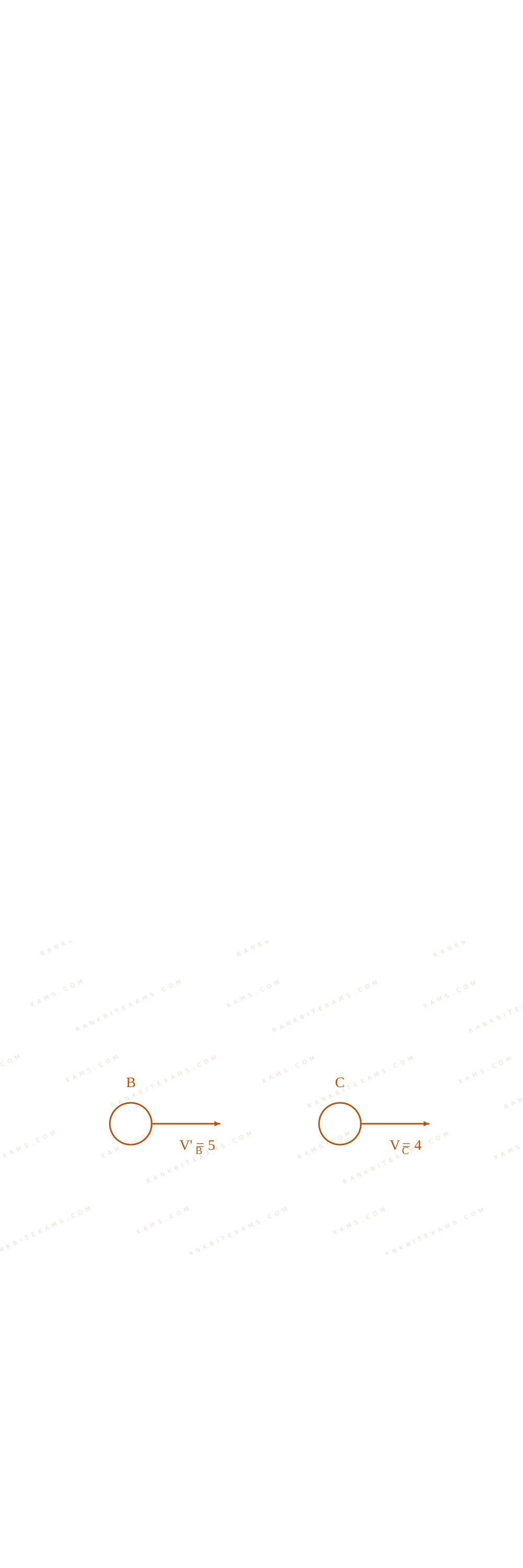
  • Now sphere B has velocity vB' = 5~m/s and sphere C has vC = 4~m/s. Sphere B will collide with C. After swapping:
vB'' = 4~m/s, vC' = 5~m/s
  • Looking at the values now: vA' = 2~m/s and vB'' = 4~m/s. No more collisions occur.
  • Therefore, the final velocities are vA = 2~m/s, vB = 4~m/s, vC = 5~m/s. The values given in Assertion (A) are wrong. Hence, (A) is false but (R) is true.

    Elastic Collisions Step 1 diagram for Q11 - JEE Main 2025 Evening
    Elastic Collisions Step 1 diagram for Q11 - JEE Main 2025 Evening
    Elastic Collisions Step 1 diagram for Q11 - JEE Main 2025 Evening
    Elastic Collisions Step 1 diagram for Q11 - JEE Main 2025 Evening
    Elastic Collisions Step 1 diagram for Q11 - JEE Main 2025 Evening
    Elastic Collisions Step 1 diagram for Q11 - JEE Main 2025 Evening
    Elastic Collisions Step 1 diagram for Q11 - JEE Main 2025 Evening
    Elastic Collisions Step 1 diagram for Q11 - JEE Main 2025 Evening

Pattern Recognition

Velocity exchange happens pairwise in sequential order. Do not try to solve simultaneous conservation laws across all three blocks at once; handle each collision step-by-step from left to right.

Chapter Mix

Class 11 Physics: Work, Energy and Power
Q jee_main_2025_28_jan_morning Conservation of Mechanical Energy
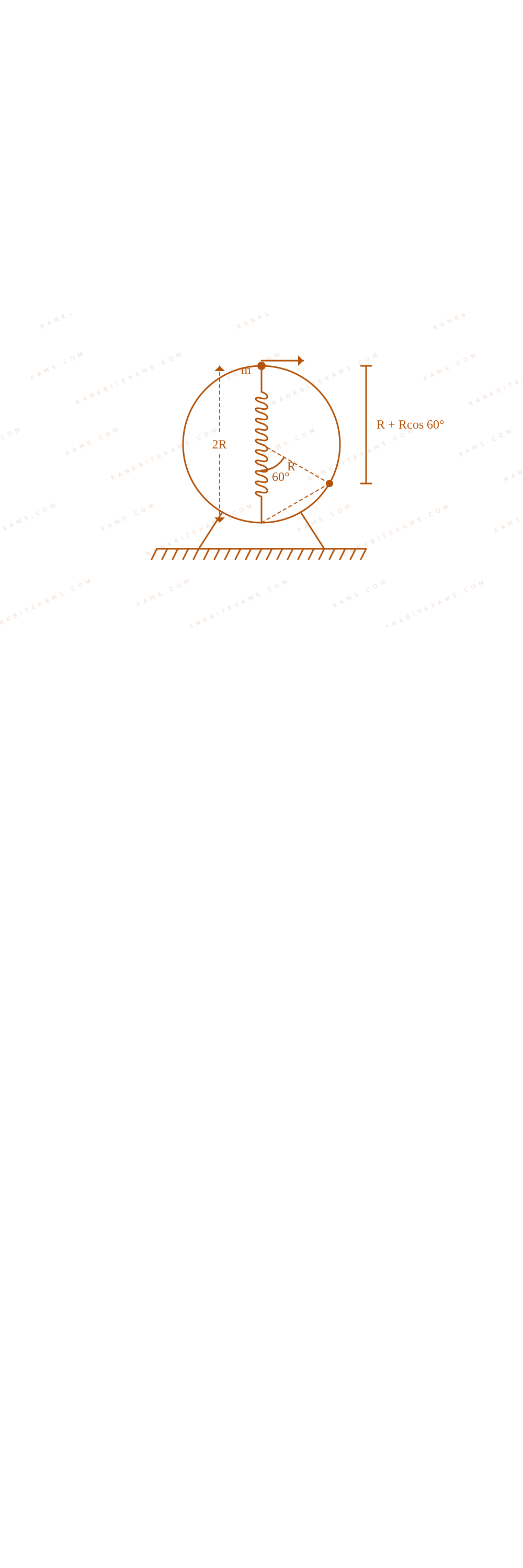
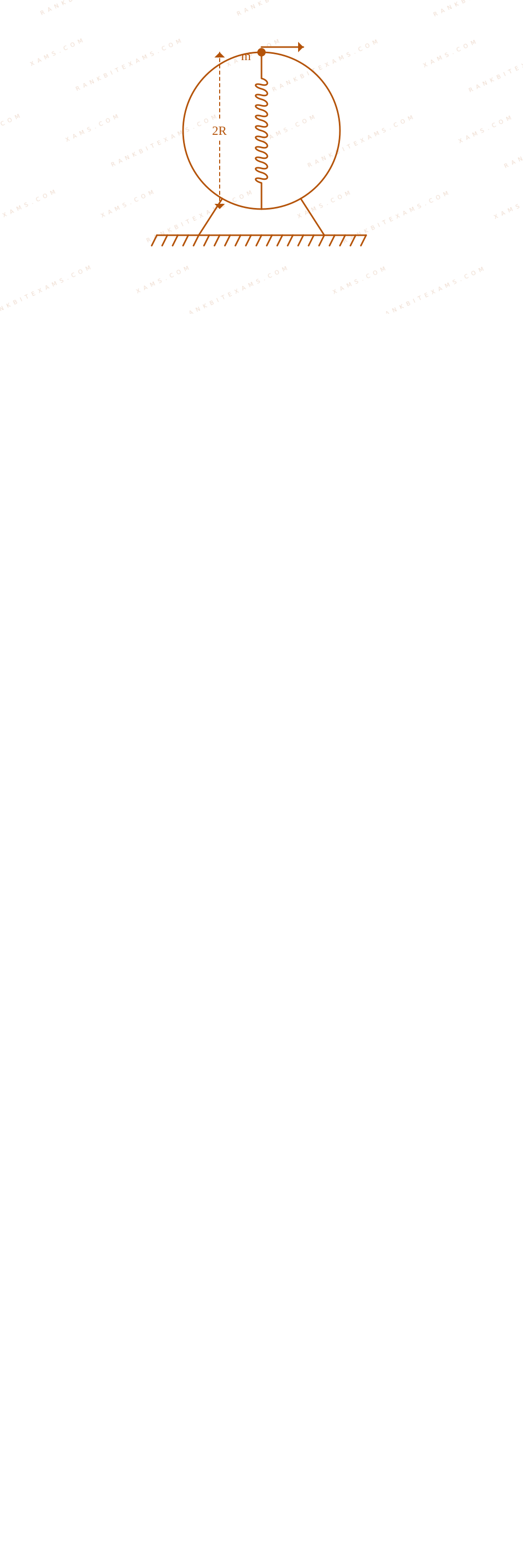
A bead of mass m slides without friction on the wall of a vertical circular hoop of radius R as shown in figure. The bead moves under the combined action of gravity and a massless spring (k) attached to the bottom of the hoop. The equilibrium length of the spring is R . If the bead is released from top of the hoop with (negligible) zero initial speed, velocity of bead, when the length of spring becomes R , would be (spring constant is k , g is acceleration due to gravity)
Conservation of Mechanical Energy diagram for Q10 - JEE Main 2025 Morning
A bead sliding along a vertical circular ring constrained by a tracking baseline spring system.
  • A. 2 gR + kR²m
  • B. 2 Rg + 4 kR²m
  • C. √(2Rg + (kR²)/(m))
  • D. √(3Rg + (kR²)/(m))

Solution

Core Logic

Let's apply the comprehensive Work-Energy theorem framework across key layout tracking nodes:

Geometric resolution angle resolution profile for Q10
A bead sliding along a vertical circular ring constrained by a tracking baseline spring system.

Wall = Δ K M g (R + R 60°) + (1)/(2) k (R² - 0²) = (1)/(2) m v²

Simplifying the gravitational shift and potential expansions:

M g 3R2 + kR²2 = (1)/(2) m v²
Step 1: Final Kinematic Value
v = 3gR + kR²m

Matches parameters specified by option (4).

Pattern Recognition

Isolate spring metrics at node points: Initial extension equals 2R - R = R. Final extension is 0 since spring length matching R satisfies unextended conditions.

Chapter Mix

Class 11 Physics: Work, Energy and Power
More Work, Energy and Power Questions — jee_main_2025_03_april_morning

Practice all Work, Energy and Power previous-year questions →

Rankbit System
JEE Physics: Waves (+15.5%) | Electrostatics: Concentric Shells (-29.7%) | Modern Physics: Photoelectric Clones (+34.2%) | Mathematics: Definite Integrals (+18.1%) | Chemistry: Coordination Splitting (-11.4%) | JEE Physics: Waves (+15.5%) | Electrostatics: Concentric Shells (-29.7%) | Modern Physics: Photoelectric Clones (+34.2%) | Mathematics: Definite Integrals (+18.1%) | Chemistry: Coordination Splitting (-11.4%)