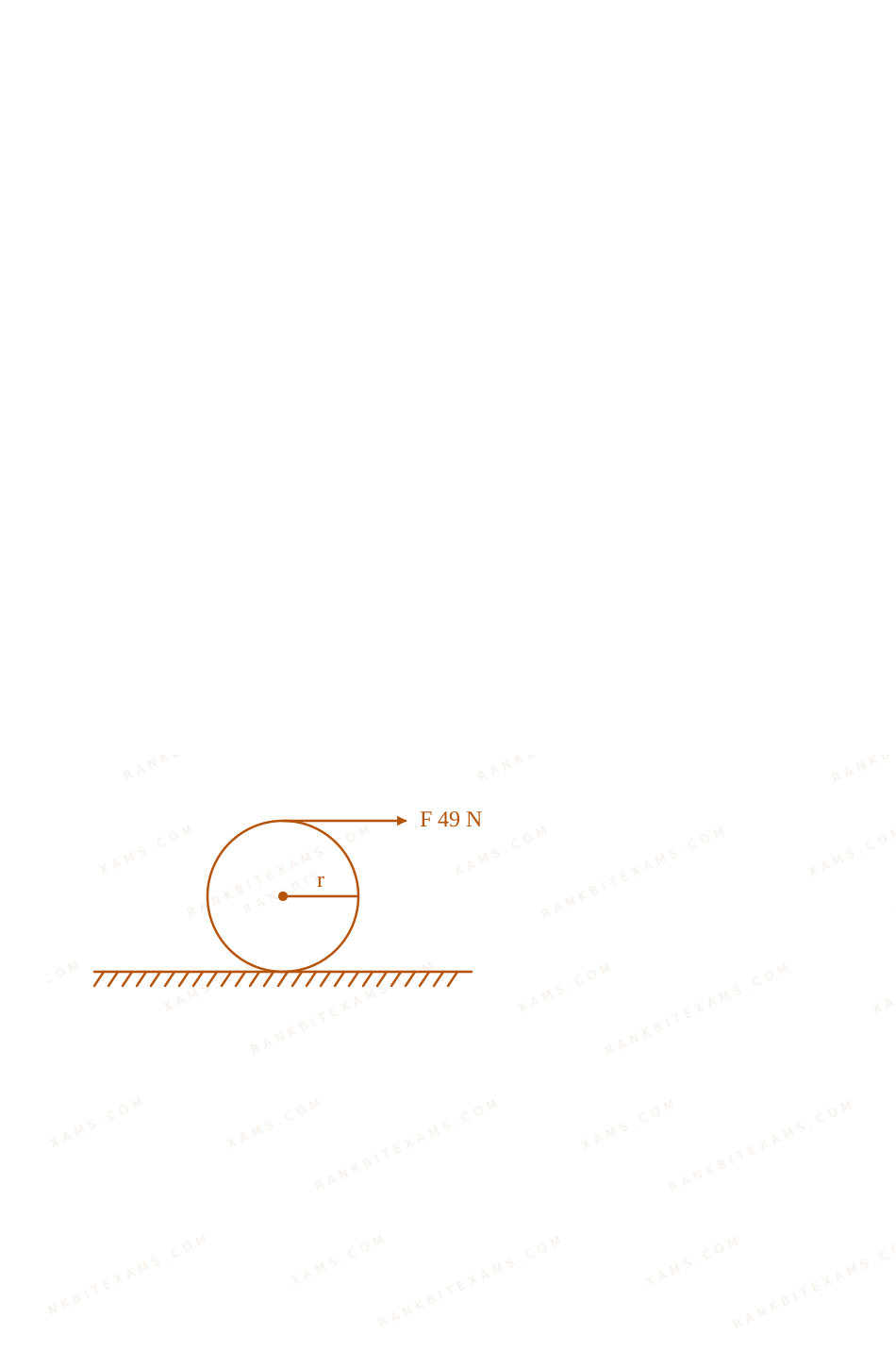
A force of 49~N acts tangentially at the highest point of a sphere (solid) of mass 20~kg, kept on a rough horizontal plane. If the sphere rolls without slipping, then the acceleration of the center of the sphere is:
Solid sphere with tangential force at top point for Q10
A schematic of a solid sphere of mass m resting on a horizontal plane with a force F pointing horizontally to the right at the highest point.

Solution & Explanation

Related Formula

Torque equation about the instantaneous center of zero velocity (bottom contact point P):

τP = IP α

For a solid sphere, the moment of inertia about the center is Ic = (2)/(5)MR². By the parallel axis theorem:

IP = Ic + MR² = (7)/(5)MR²
Core Logic

Since the sphere rolls without slipping, we can conveniently write the torque equation about the lowest point of contact P because static friction passes through this point and exerts zero torque.

  • Distance from point P to the top highest point is 2R.
  • Tangential force F = 49~N.
  • Mass of solid sphere, M = 20~kg.
τP = F × 2R

Substitute τP and IP into the torque equation:

F × 2R = ((7)/(5)MR²) α
Step 1: Solving for Linear Acceleration

For pure rolling, the acceleration of the center of mass a is related to angular acceleration α by a = Rα:

2F R = (7)/(5)MR² ((a)/(R)) 2F = (7)/(5) M a a = (10F)/(7M)

Substitute the numerical values (F = 49~N and M = 20~kg):

a = (10 × 49)/(7 × 20) = (490)/(140) = 3.5~m/s²
Step 2: Analysis of Friction Force Direction

Let's write force equations to verify consistency: F + f = M a

49 + f = 20 × 3.5 = 70 f = 21~N

Since f is positive, static friction acts in the forward direction. Rolling without slipping is fully maintained since the required static friction coefficient is well within realistic limits.

Pattern Recognition

Calculating torque about the bottom contact point is a powerful shortcut for rolling-without-slipping questions! It completely bypasses having to guess or set up equations for the friction direction.

Chapter Mix

Class 11 Physics: System of Particles and Rotational Motion

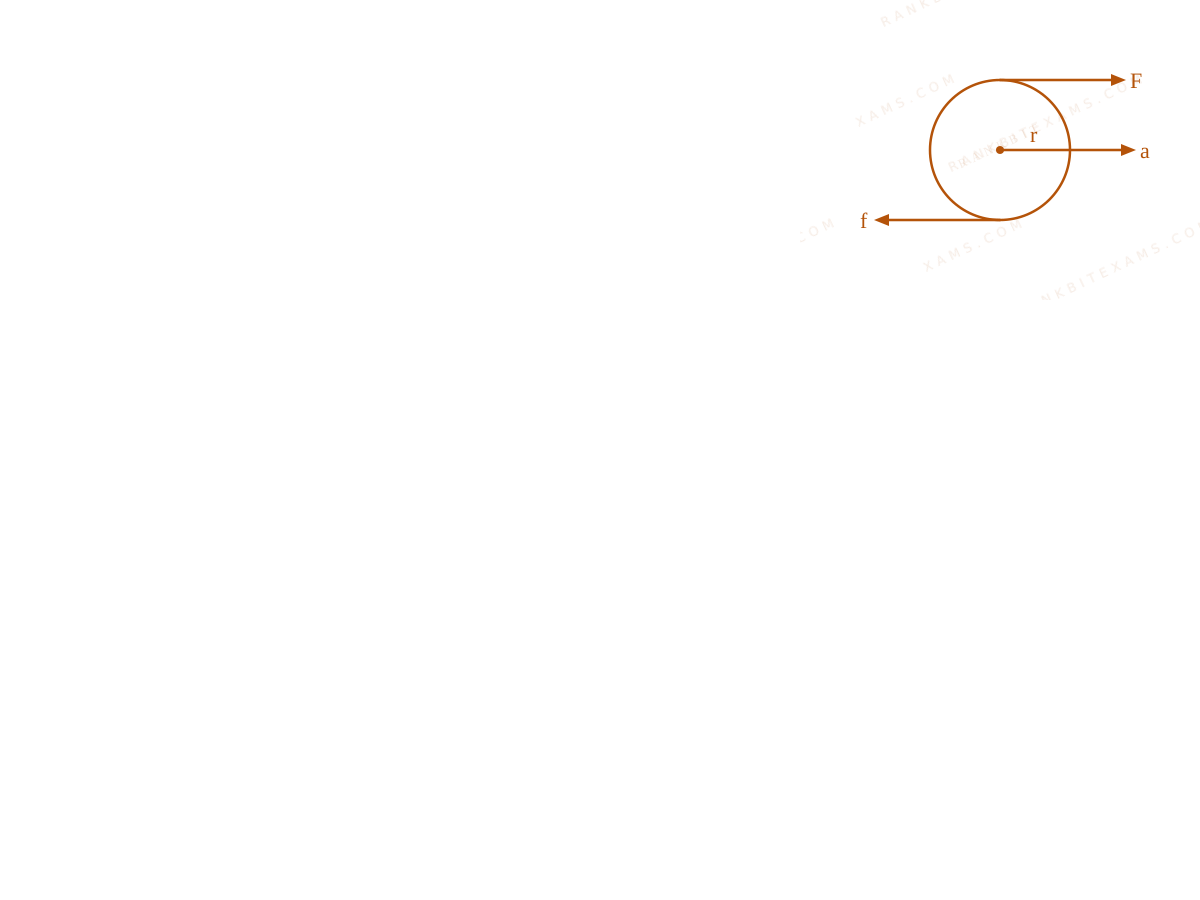
Free body diagram of solid sphere in pure rolling for Q10
A schematic of a solid sphere of mass m resting on a horizontal plane with a force F pointing horizontally to the right at the highest point.

Reference Study Guides

More Rotational Motion Previous-Year Questions — Page 3

Q42 jee_main_2026_23_january_morning Angular Momentum
Two small balls with masses m and 2m are attached to both ends of a rigid rod of length d and negligible mass. If angular momentum of this system is L about an axis (A) passing through its centre of mass and perpendicular to the rod then angular velocity of the system about A is:
  • A. (3)/(2) Lmd²
  • B. 2Lmd²
  • C. (4)/(3) Lmd²
  • D. 2L5md²

Solution

Related Formula
rcm = m₁r₁ + m₂r₂m₁ + m₂ Icm = μ d² = ( m₁m₂m₁ + m₂)d²

L = Iω

Step 1: Calculate Moment of Inertia about COM

Let mass m be at the origin. Position of 2m is d.

Xcm = (m(0) + 2m(d))/(m + 2m) = (2d)/(3)

Distance of mass m from COM is (2d)/(3). Distance of mass 2m from COM is d - (2d)/(3) = (d)/(3).

I = m((2d)/(3))² + 2m((d)/(3))² I = 4md²9 + 2md²9 = 6md²9 = 2md²3
Step 2: Calculate Angular Velocity

L = Iω

ω = (L)/(I) ω = L 2md²3 = 3L2md²
Pattern Recognition

Sees: "two point masses" + "rotation about COM" → Quickly use reduced mass μ moment of inertia shortcut: Icm = μ d² = ((m · 2m)/(3m))d² = (2)/(3)md² to save time.

Chapter Mix

Class 11 Physics: Systems of Particles and Rotational Motion

Q27 jee_main_2026_23_january_evening Conservation of Momentum
A body of mass 14 kg initially at rest explodes and breaks into three fragments of masses in the ratio 2 : 2 : 3. The two pieces of equal masses fly off perpendicular to each other with a speed of 18 m/s each. The velocity of the heavier fragment is ____m/s.
Conservation of Momentum diagram for Q27 - JEE Main 2026 Evening
Vector diagram illustrating the trajectories of the explosive fragments.
  • A. 10√(2)
  • B. 12√(2)
  • C. 12
  • D. 24√(2)

Solution

Related Formula
pinitial = pfinal M₁ V₁ + M₂ V₂ + M₃ V₃ = 0
Core Logic

Conservation of Momentum diagram for Q27 - JEE Main 2026 Evening
Vector diagram illustrating the trajectories of the explosive fragments.

The total mass is 14 kg and breaks in ratio 2:2:3. Let the masses be M₁, M₂, and M₃.

M₁ = (2)/(7) × 14 = 4 kg M₂ = (2)/(7) × 14 = 4 kg M₃ = (3)/(7) × 14 = 6 kg
Step 1: Setup Momentum Equations

Since M₁ and M₂ fly off perpendicular to each other, let their velocity vectors be along the x and y axes. Because the total momentum must be zero, we align the fragments opposite to the final 3rd fragment's direction for simplicity, or just use standard axes.

Let V₁ = -18 i and V₂ = -18 j. Note that the solution simplifies the mass ratio directly to 2, 2, 3 as relative masses for the momentum equation:

2(-18 i) + 2(-18 j) + 3 V₃ = 0
Step 2: Solve for Velocity
V₃ = 36 i + 36 j3 = 12 i + 12 j

Magnitude of V₃:

| V₃| = √(12² + 12²) = 12√(2) m/s
Pattern Recognition

In a 3-part explosion from rest, the momentum of the third piece must be equal and opposite to the vector sum of the other two pieces. You can use the ratio of masses directly in the momentum conservation equation instead of absolute masses to save time.

Chapter Mix

Class 11 Physics: Center of Mass and Collisions

Q49 jee_main_2026_23_january_evening Moment of Inertia
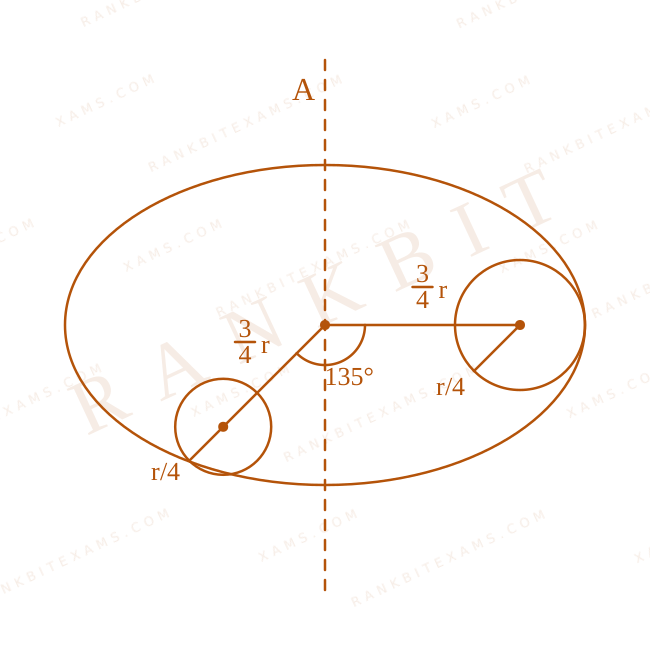
Suppose there is a uniform circular disc of mass M kg and radius r m shown in figure. The shaded regions are cut out from the disc. The moment of inertia of the remainder about the axis A of the disc is given by (x)/(256) Mr ² . The value of x is ____.
Moment of Inertia diagram for Q49 - JEE Main 2026 Evening
Diagram showing a large circular disc with two smaller circular sections removed.
Numerical Answer. Answer: 109 to 109

Solution

Related Formula
Iremaining = Itotal - Σ Icut

Parallel axis theorem: I = Icm + md²

Core Logic

Total mass of original disc is M = σ π r². Two identical smaller discs are removed. From the diagram, each small cut-out disc has radius r' = (r)/(4). The center of each cut-out disc is at distance d = (3)/(4)r from the main axis A. Mass of each cut-out disc:

m = σ π ((r)/(4))² = (σ π r²)/(16) = (M)/(16)
Step 1: Moment of Inertia of Total Disc

For the main solid disc about its central axis A:

Itotal = (1)/(2) M r²
Step 2: Moment of Inertia of Cut-out Discs

Using parallel axis theorem for one cut-out disc about axis A:

Icut = (1)/(2) m (r')² + m d² Icut = (1)/(2) m ((r)/(4))² + m ((3)/(4)r)² Icut = (mr²)/(32) + (9mr²)/(16) = m r² ( (1 + 18)/(32) ) = (19)/(32) m r²

Since there are 2 cut-out discs, the total subtracted inertia is:

Iremoved = 2 × (19)/(32) m r² = (19)/(16) m r²
Step 3: Calculate Final Inertia in Terms of M

Substitute m = (M)/(16):

Iremoved = (19)/(16) ( (M)/(16) ) r² = (19)/(256) M r²

Now, subtract from total:

Iremaining = (1)/(2) M r² - (19)/(256) M r² Iremaining = (128 - 19)/(256) M r² = (109)/(256) M r²

Thus, x = 109.

Pattern Recognition

In cavity problems, mass is strictly proportional to area (R²). Use parallel axis theorem perfectly on the 'negative mass' segments and subtract.

Chapter Mix

Class 11 Physics: System of Particles and Rotational Motion

Q41 jee_main_2026_24_january_morning Dynamics of Rotational Motion
Two masses 400 g and 350 g are suspended from the ends of a light string passing over a heavy pulley of radius 2 cm. When released from rest the heavier mass is observed to fall 81 cm in 9 s. The rotational inertia of the pulley is ____ kg ². (g = 9.8 m/s²)
  • A. 9.5 × 10⁻³
  • B. 4.75 × 10⁻³
  • C. 1.86 × 10⁻²
  • D. 8.3 × 10⁻³

Solution

Related Formula
s = ut + (1)/(2)at² a = ((m₁ - m₂)g)/(m₁ + m₂ + (I)/(R²))
Core Logic

Atwood machine with a massive pulley

First, calculate the acceleration of the system using kinematics:

s = ut + (1)/(2)at² 0.81 = 0 + (1)/(2) a (9)² a = (2 × 0.81)/(81) = 0.02 m/s²

Applying Newton's second law for masses and rotation:

m₁ g - T₁ = m₁ a T₂ - m₂ g = m₂ a (T₁ - T₂)R = I · α = I ((a)/(R))

This leads to the standard Atwood machine acceleration with massive pulley:

a = ((m₁ - m₂)g)/(m₁ + m₂ + (I)/(R²))
Step 1: Calculate Moment of Inertia

Substitute known values (m₁=0.4 kg, m₂=0.35 kg, R=0.02 m):

0.02 = ((0.4 - 0.35) × 9.8)/((0.4 + 0.35) + (I)/(R²)) 0.02 = (0.05 × 9.8)/(0.75 + (I)/(R²)) 0.75 + (I)/(R²) = (0.49)/(0.02) = 24.5 (I)/(R²) = 24.5 - 0.75 = 23.75 I = 23.75 × (0.02)² = 23.75 × 4 × 10⁻⁴ I = 95 × 10⁻⁴ = 9.5 × 10⁻³ kg ²
Pattern Recognition

For massive pulley problems, the "effective mass" of the system increases by the pulley's equivalent translating mass I/R². Simply use a = Fₙₑₜ / Meffective.

Chapter Mix

Class 11 Physics: System of Particles and Rotational Motion Class 11 Physics: Laws of Motion

Q31 jee_main_2026_24_january_evening Rigid Body Rotation and Energy Conservation
A thin uniform rod (X) of mass M and length L is pivoted at a height ((L)/(3)) as shown in the figure. The rod is allowed to fall from a vertical position and lie horizontally on the table. The angular velocity of this rod when it hits the table top, is ____. (g = gravitational acceleration)
Rigid Body Rotation and Energy Conservation diagram for Q31 - JEE Main 2026 Evening
A uniform rod is pivoted at a distance of L/3 from the table surface and falls from a vertical position to horizontal.
  • A. (3)/(2) gL
  • B. 3√(2) gL
  • C. 1√(2) gL
  • D. 3gL

Solution

Related Formula
Δ K.E. = Δ P.E. mg Δ hcom = (1)/(2) I ω²
Core Logic

The rod falls such that its center of mass lowers by a distance. The rod is pivoted at (L)/(3) from the bottom, meaning the distance from the pivot to the center of mass (which is at (L)/(2) from either end) is:

hcom = (L)/(2) - (L)/(3) = (L)/(6)
Step 1: Moment of Inertia

Using the parallel axis theorem, the moment of inertia about the pivot is:

I = Icom + m d² I = (mL²)/(12) + m((L)/(6))² = (mL²)/(12) + (mL²)/(36) = (mL²)/(9)
Step 2: Energy Conservation

Equating the loss in potential energy to the gain in rotational kinetic energy:

mg (L)/(6) = (1)/(2) ((mL²)/(9)) ω² mg (L)/(6) = (mL²)/(18) ω² ω² = (3g)/(L) ω = √((3g)/(L))
Pattern Recognition

For a hinged rod falling from a vertical orientation to horizontal, always track the displacement of the center of mass and calculate rotational inertia strictly about the hinge using Ipivot = Icm + md².

Chapter Mix

Class 11 Physics: System of Particles and Rotational Motion

More Rotational Motion Questions — jee_main_2025_03_april_morning

Practice all Rotational Motion previous-year questions →

Rankbit System
JEE Physics: Waves (+15.5%) | Electrostatics: Concentric Shells (-29.7%) | Modern Physics: Photoelectric Clones (+34.2%) | Mathematics: Definite Integrals (+18.1%) | Chemistry: Coordination Splitting (-11.4%) | JEE Physics: Waves (+15.5%) | Electrostatics: Concentric Shells (-29.7%) | Modern Physics: Photoelectric Clones (+34.2%) | Mathematics: Definite Integrals (+18.1%) | Chemistry: Coordination Splitting (-11.4%)