Rankbit System
JEE Physics: Waves (+15.5%) | Electrostatics: Concentric Shells (-29.7%) | Modern Physics: Photoelectric Clones (+34.2%) | Mathematics: Definite Integrals (+18.1%) | Chemistry: Coordination Splitting (-11.4%) | JEE Physics: Waves (+15.5%) | Electrostatics: Concentric Shells (-29.7%) | Modern Physics: Photoelectric Clones (+34.2%) | Mathematics: Definite Integrals (+18.1%) | Chemistry: Coordination Splitting (-11.4%)

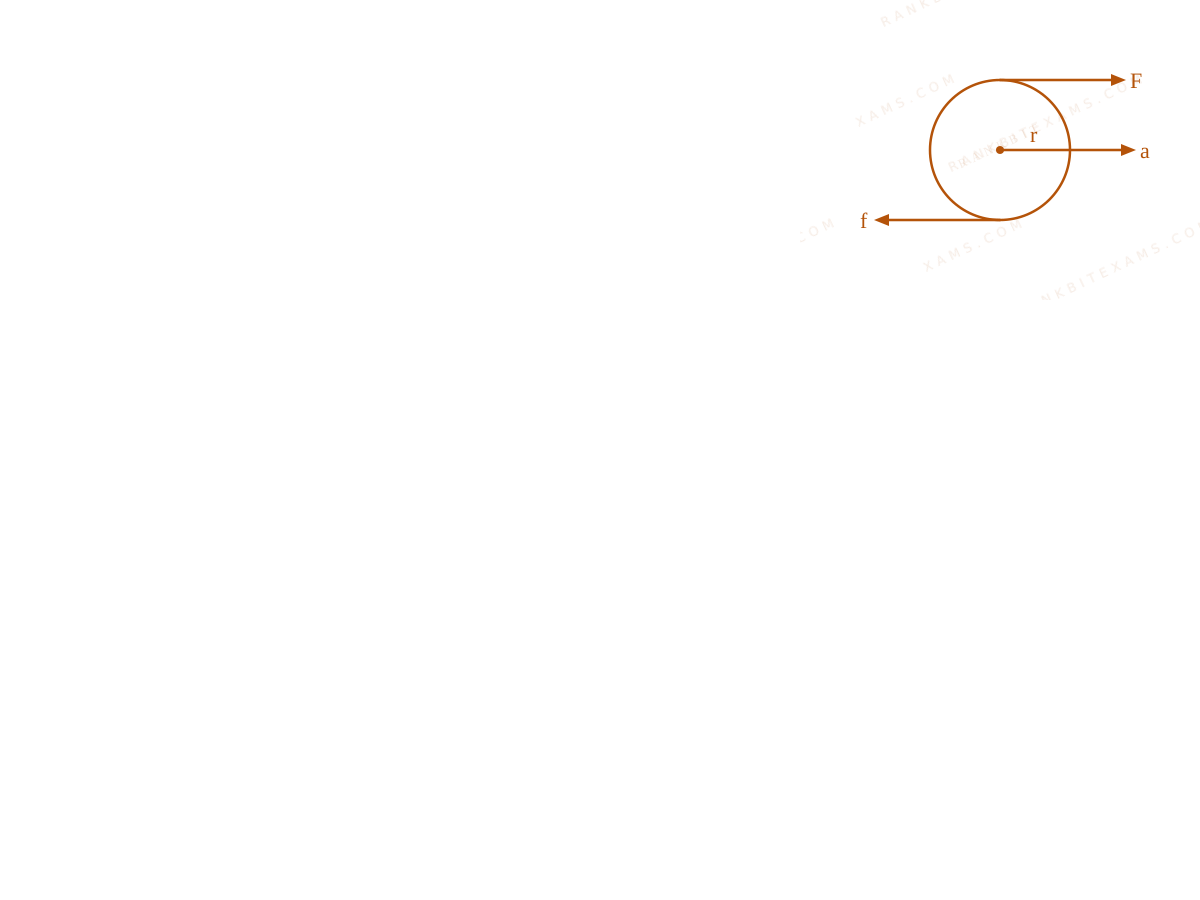
A force of 49mathrm~N acts tangentially at the highest point of a sphere (solid) of mass 20mathrm~kg, kept on a rough horizontal plane. If the sphere rolls without slipping, then the acceleration of the center of the sphere is:
Solid sphere with tangential force at top point for Q10
A schematic of a solid sphere of mass m resting on a horizontal plane with a force F pointing horizontally to the right at the highest point.

Solution & Explanation

### Related Formula Torque equation about the instantaneous center of zero velocity (bottom contact point P): tau_P = I_P alpha For a solid sphere, the moment of inertia about the center is I_c = frac25MR^2. By the parallel axis theorem: I_P = I_c + MR^2 = frac75MR^2 ### Core Logic Since the sphere rolls without slipping, we can conveniently write the torque equation about the lowest point of contact P because static friction passes through this point and exerts zero torque. - Distance from point P to the top highest point is 2R. - Tangential force F = 49mathrm~N. - Mass of solid sphere, M = 20mathrm~kg. tau_P = F times 2R Substitute tau_P and I_P into the torque equation: F times 2R = left(frac75MR^2right) alpha ### Step 1: Solving for Linear Acceleration For pure rolling, the acceleration of the center of mass a is related to angular acceleration alpha by a = Ralpha: 2F R = frac75MR^2 left(fracaRright) 2F = frac75 M a implies a = frac10F7M Substitute the numerical values (F = 49mathrm~N and M = 20mathrm~kg): a = frac10 times 497 times 20 = frac490140 = 3.5mathrm~m/s^2 ### Step 2: Analysis of Friction Force Direction Let's write force equations to verify consistency: F + f = M a 49 + f = 20 times 3.5 = 70 implies f = 21mathrm~N Since f is positive, static friction acts in the forward direction. Rolling without slipping is fully maintained since the required static friction coefficient is well within realistic limits. ### Pattern Recognition Calculating torque about the bottom contact point is a powerful shortcut for rolling-without-slipping questions! It completely bypasses having to guess or set up equations for the friction direction. ### Evaluation Rubric / Model Answer null ### Chapter Mix Class 11 Physics: System of Particles and Rotational Motion
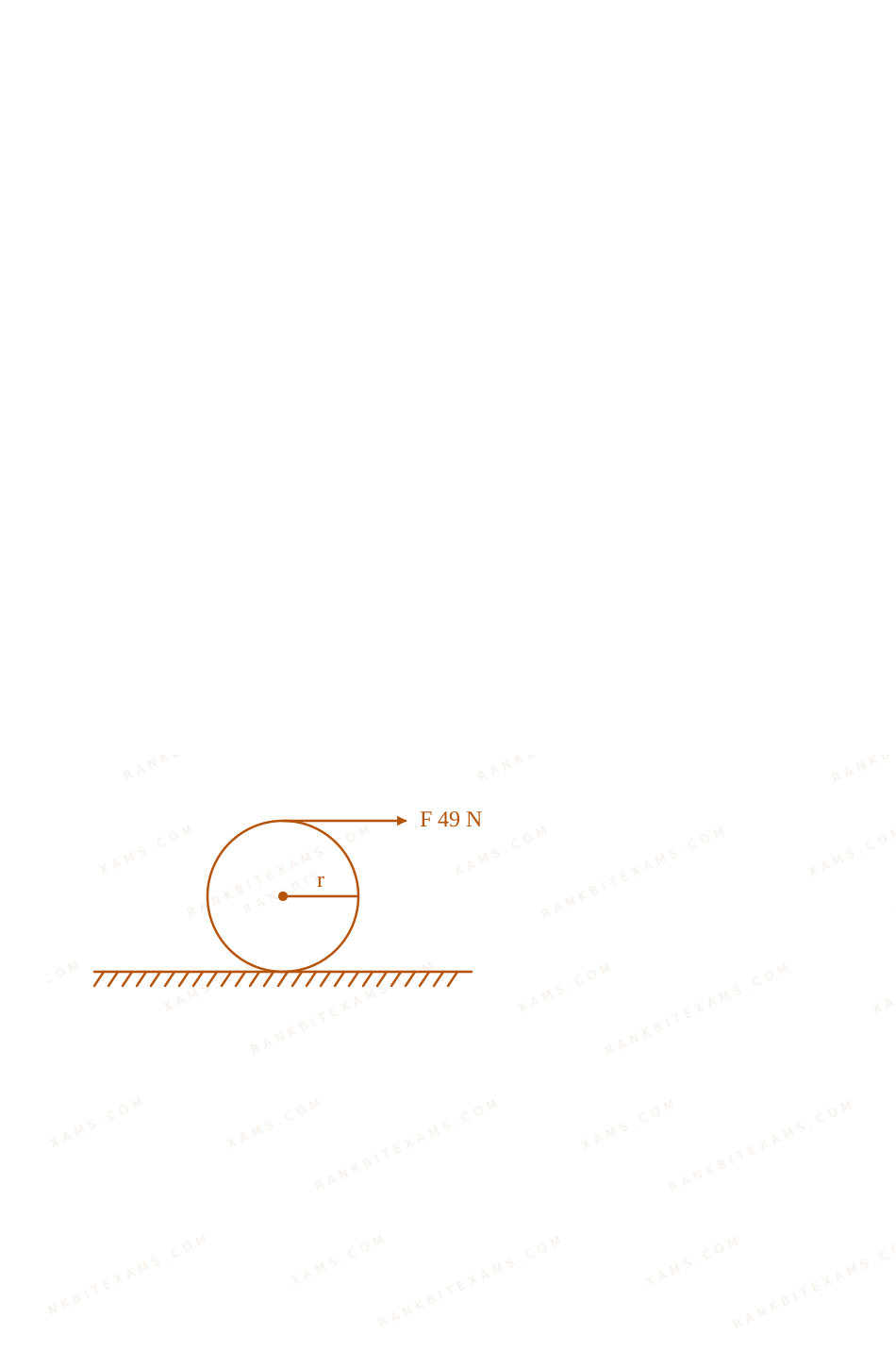
Free body diagram of solid sphere in pure rolling for Q10
A schematic of a solid sphere of mass m resting on a horizontal plane with a force F pointing horizontally to the right at the highest point.

Reference Study Guides

More Rotational Motion Previous-Year Questions — Page 2

Q25 2025 Torque and Equilibrium
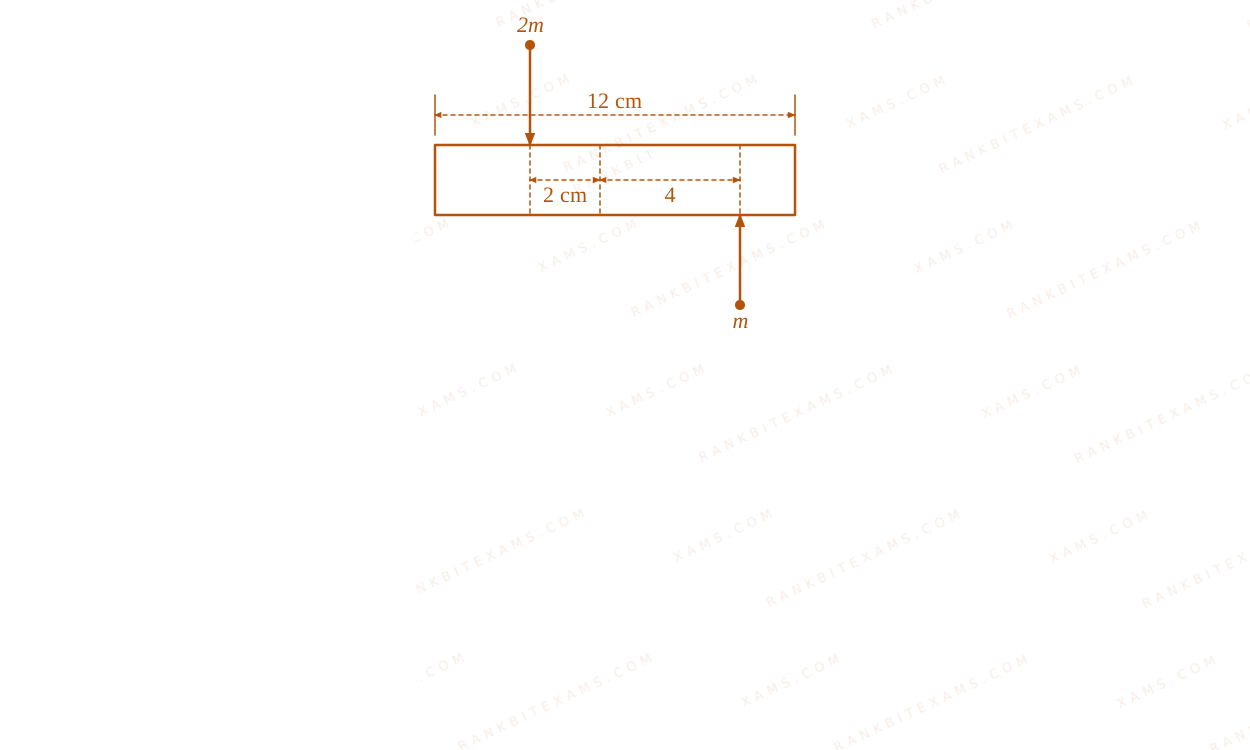
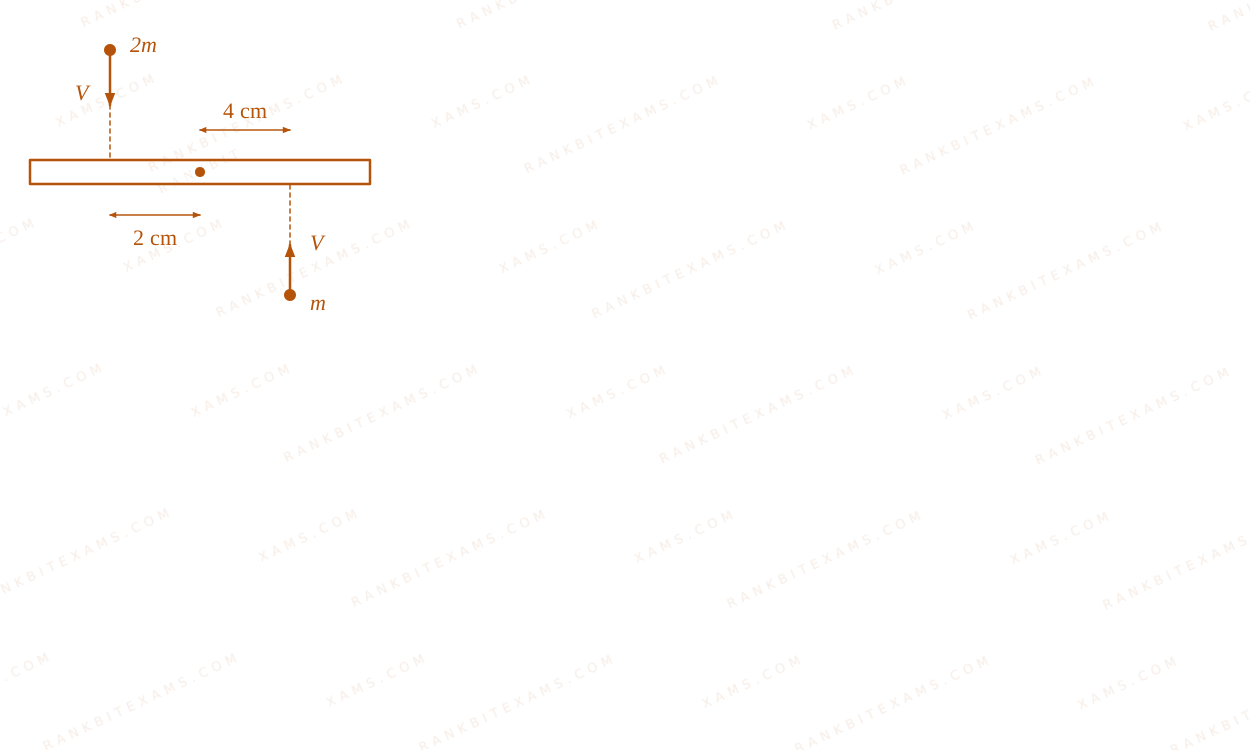
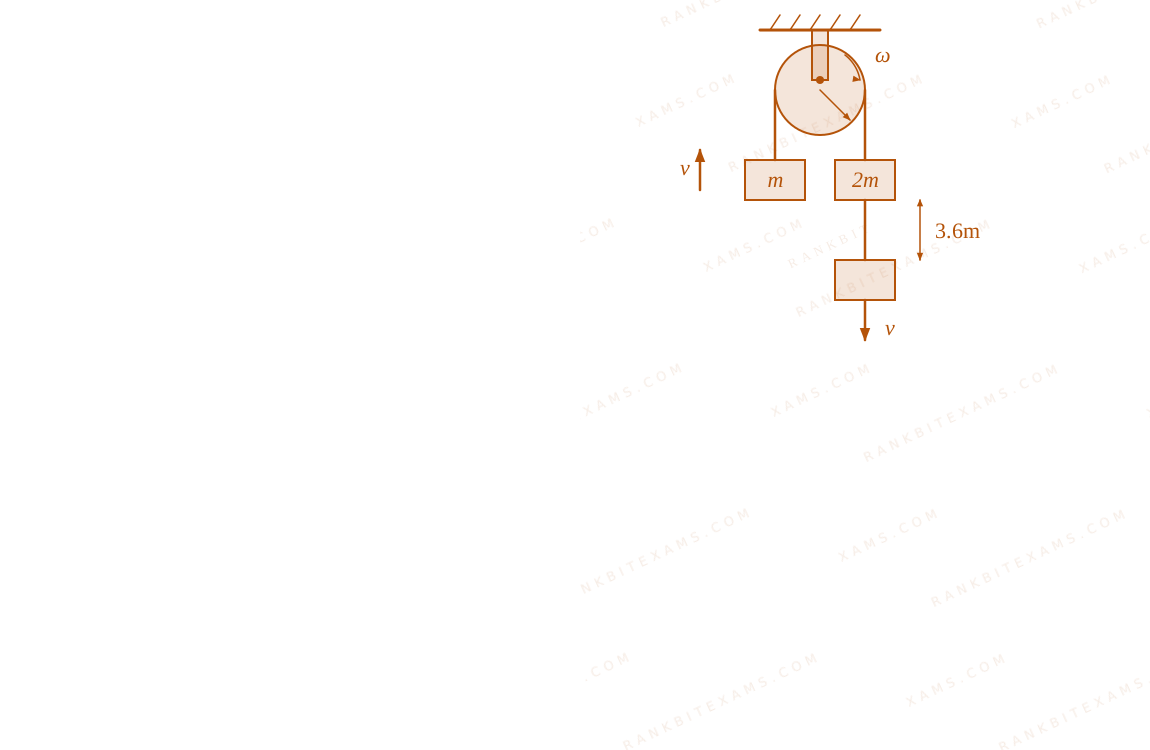
A cube having a side of 10mathrm~cm with unknown mass and 200mathrm~gm mass were hung at two ends of an uniform rigid rod of 27mathrm~cm long. The rod along with masses was placed on a wedge keeping the distance between wedge point and 200mathrm~gm weight as 25mathrm~cm. Initially the masses were not at balance. A beaker is placed beneath the unknown mass and water is added slowly to it. At given point the masses were in balance and half volume of the unknown mass was inside the water. (Take the density of unknown mass is more than that of the water, the mass did not absorb water and water density is 1mathrm~g/cm^3.) The unknown mass is ________ mathrmkg.
Numerical Answer. Answer: 3 to 3

Solution

### Related Formula sum tau = 0 quad text(Rotational Equilibrium) F_textnet = m g - F_B F_B = rho_textwater V_textsubmerged g where, tau = torque about the wedge point F_B = buoyancy force ### Core Logic Let's list the geometric parameters from the setup: - Length of uniform rigid rod, L = 27mathrm~cm. - Wedge is positioned such that the distance to the 200mathrm~g (0.2mathrm~kg) weight is d_1 = 25mathrm~cm. - Therefore, the distance to the unknown mass M at the other end is d_2 = 27 - 25 = 2mathrm~cm. Calculate the volume of the cube: - Side of the cube, a = 10mathrm~cm = 0.1mathrm~m. - Volume, V = a^3 = 1000mathrm~cm^3 = 10^-3mathrm~m^3. When the system is balanced, half the volume of the cube is submerged in water: - Submerged volume, V_textsub = fracV2 = 500mathrm~cm^3 = 5 times 10^-4mathrm~m^3. - Buoyancy force: F_B = rho_w V_textsub g = 1000mathrm~kg/m^3 times left(5 times 10^-4mathrm~m^3right) times g = 0.5 gmathrm~N ### Step 1: Torque Balance Equation For rotational equilibrium, balance the torques about the wedge point O: - Torque on the left (unknown mass branch): tau_textleft = left(M g - F_Bright) times d_2 = (M g - 0.5 g) times 2 - Torque on the right (200mathrm~g mass branch): tau_textright = 0.2 g times d_1 = 0.2 g times 25 tau_textleft = tau_textright (M g - 0.5 g) times 2 = 0.2 g times 25 2 (M - 0.5) = 5 M - 0.5 = 2.5 implies M = 3mathrm~kg Thus, the unknown mass is 3mathrm~kg. ### Pattern Recognition Sees: Rod torque balance + buoyancy force on one end. Trap: Ensure you measure the distances from the pivot point (the wedge). The unknown mass is at 27 - 25 = 2mathrm~cm from the wedge. Shortcut: Since g appears in both gravity and buoyancy terms, it cancels out immediately. Balancing torque simplifies directly to resolving mass differences: 2(M - 0.5) = 0.2 times 25 = 5. This yields M = 3 instantly! ✓ ### Evaluation Rubric / Model Answer null ### Chapter Mix Class 11 Physics: Rotational Motion Class 11 Physics: Mechanical Properties of Fluids
Q12 2025 Rolling Motion
A wheel is rolling on a plane surface. The speed of a particle on the highest point of the rim is 8 m/s. The speed of the particle on the rim of the wheel at the same level as the centre of wheel, will be:
  • A. 4sqrt2text m/s
  • B. 8text m/s
  • C. 4text m/s
  • D. 8sqrt2text m/s

Solution

### Related Formula Velocity of a point on a rolling wheel at angular position theta from the lowest point: v = 2 v_textcm sinleft(fractheta2right) ### Core Logic At the highest point, theta = 180^circ, so: v_texttop = 2v_textcm = 8text m/s implies v_textcm = 4text m/s For a particle on the rim at the same horizontal level as the center, the angle from the lowest point is theta = 90^circ. ### Step 1: Compute Speed at Mid-Height Substituting theta = 90^circ into our velocity relation: v_textmid = 2v_textcm sin(45^circ) = 2 times 4 times frac1sqrt2 = 4sqrt2text m/s
Instantaneous center of rotation on rolling wheel
### Pattern Recognition The contact point with the ground is the Instantaneous Center of Rotation (ICR). Distance to top point is 2R, distance to mid-level point is sqrtR^2+R^2 = sqrt2R. Velocity scales linearly with distance from ICR. ### Evaluation Rubric / Model Answer null ### Chapter Mix Class 11 Physics: Rotational Motion
Q22 2025 Conservation of Angular Momentum
A solid sphere with uniform density and radius R is rotating initially with constant angular velocity (omega_1) about its diameter. After some time during the rotation its starts loosing mass at a uniform rate, with no change in its shape. The angular velocity of the sphere when its radius becomes R / 2 is xomega_1. The value of x is ________.
Numerical Answer. Answer: 32 to 32

Solution

### Related Formula Conservation of Angular Momentum (since no external torque acts): I_1 omega_1 = I_2 omega_2 For a solid sphere, moment of inertia is: I = frac25MR^2 Mass scales with volume: M propto R^3 ### Core Logic When the radius reduces to R_2 = fracR2, the mass scales cubically: M_2 = M_1 left(fracR/2Rright)^3 = fracM_18 Now, compute the new moment of inertia I_2: I_2 = frac25 M_2 R_2^2 = frac25 left(fracM_18right) left(fracR2right)^2 = frac25 M_1 R^2 times frac132 = fracI_132 ### Step 1: Compute Final Angular Velocity Using conservation of angular momentum: I_1 omega_1 = left(fracI_132right) omega_2 implies omega_2 = 32 omega_1 Hence, the value of x is **32**. ### Pattern Recognition Since inertia of a solid sphere scales with M R^2 and M propto R^3, the net moment of inertia scales with R^5. Shrinking the radius by half (1/2) cuts down inertia by a factor of (1/2)^5 = 1/32. Velocity must scale up by 32 to conserve momentum. ### Evaluation Rubric / Model Answer null ### Chapter Mix Class 11 Physics: Rotational Motion

More Rotational Motion Questions — jee_main_2025_03_april_morning

Practice all Rotational Motion previous-year questions →

YOUR FIRST PREP STEP STARTS HERE

We Map Every Repeating Question in Competitive Exams.

Say goodbye to generic mock test fatigue. RankBit uses smart analysis to group past exam questions into their foundational Repeating Question Types. Find chapter weightage, track repeating questions, and score higher with targeted practice.

Select Your Target Exam

Choose an exam track below to find formulas per chapter and patterns.

Syncing Exam Intelligence

Mapping formulas and patterns across all tracks…

PATH A — FULL LENGTH PRACTICE

Full Mock Test Hub

Simulate real NTA exam conditions with fully tracked mocks. Time yourself against past papers.

Under Development
PATH B — TARGETED PRACTICE

Topic-wise Practice Hub

Practice past-year questions one chapter at a time. Pick an exam → subject → chapter and get every PYQ for that topic — pulled together from all past papers — with the chapter's key formulas alongside.

Loading Questions... Browse Topics
Latest from the Blog
View all →

Loading articles...