
JEE Main · Physics ↓ Falling

Kinematics appeared 38 times across 3 years — 4.4% of Physics. This question is from One-Dimensional Motion Curves.

Year 2026 2025 2024 Total
Questions 8 16 14 38

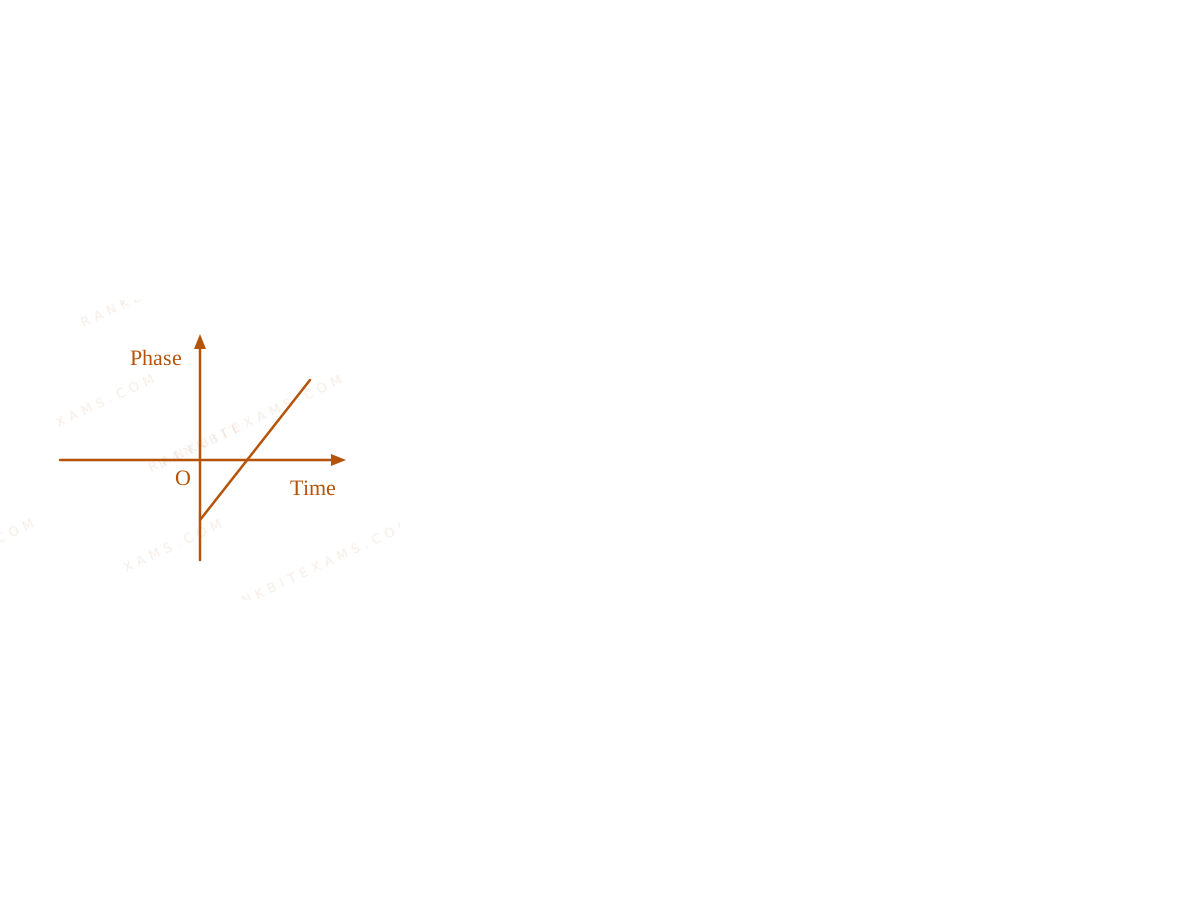
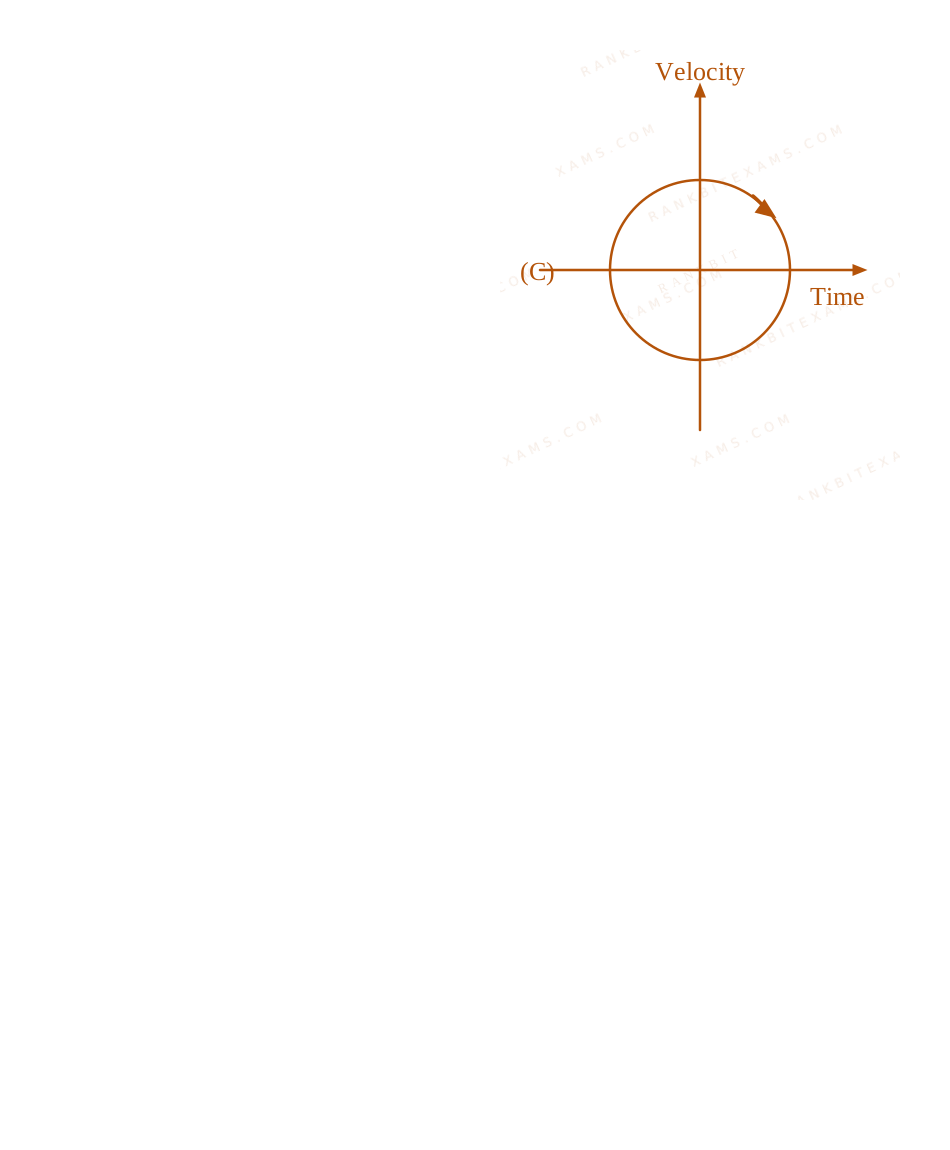
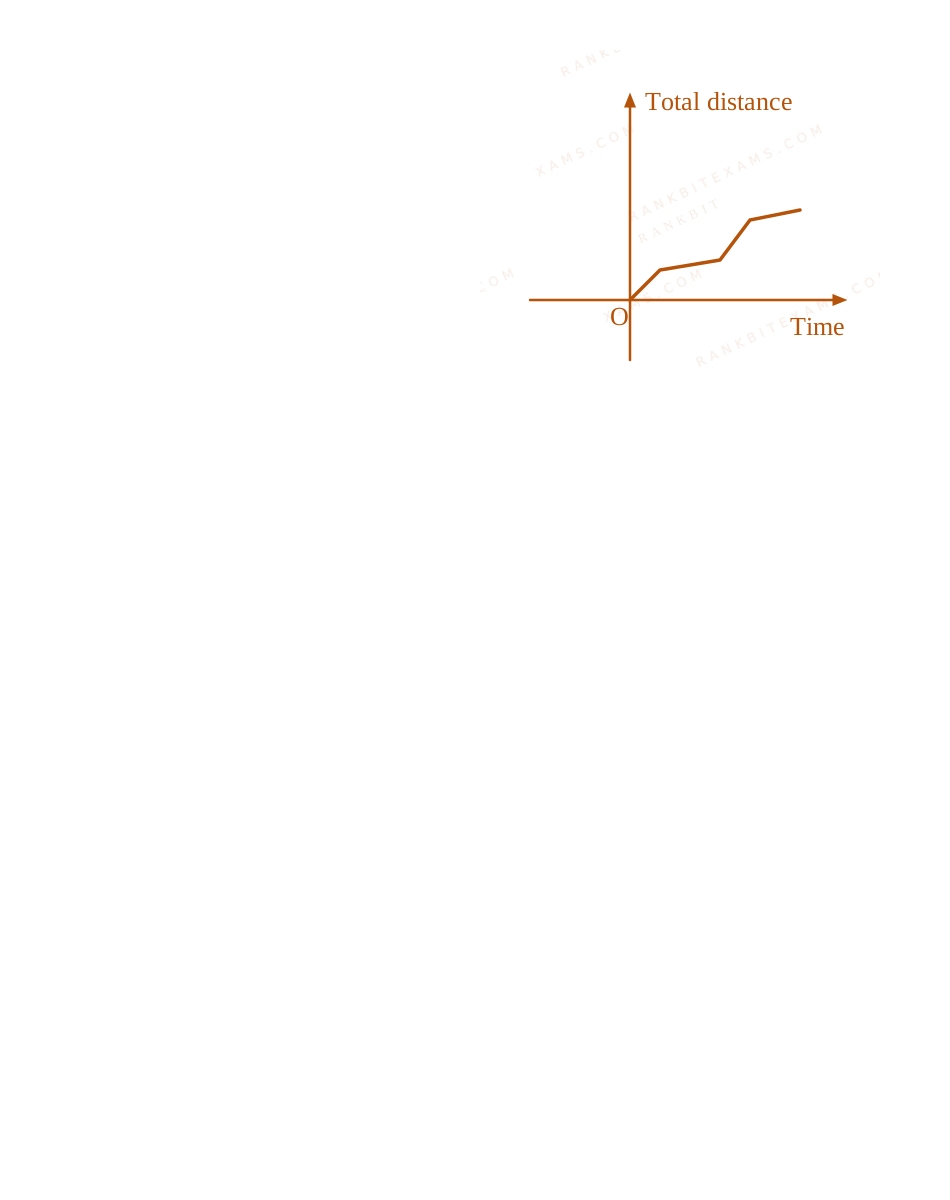
Which of the following curves possibly represent one-dimensional motion of a particle? (A)
Phase vs time plot for Q7 (A)
Displays graph A showing phase varying over time, graph B showing velocity versus displacement, graph C showing velocity versus negative time, and graph D showing distance versus time.
(B)
Phase vs time plot for Q7 (A)
Displays graph A showing phase varying over time, graph B showing velocity versus displacement, graph C showing velocity versus negative time, and graph D showing distance versus time.
(C)
Phase vs time plot for Q7 (A)
Displays graph A showing phase varying over time, graph B showing velocity versus displacement, graph C showing velocity versus negative time, and graph D showing distance versus time.
(D)
Phase vs time plot for Q7 (A)
Displays graph A showing phase varying over time, graph B showing velocity versus displacement, graph C showing velocity versus negative time, and graph D showing distance versus time.
Choose the correct answer from the options given below:

Solution & Explanation

Related Formula

For realistic physical motion in one dimension:

  • Time t can never be negative during a normal positive time sequence, and cannot flow backwards.
  • Total distance covered can never decrease over time.
  • A particle cannot have two different values of position or velocity at the exact same instant of time.
Core Logic

Let us analyze each curve:

  • Curve (A) (Phase φ vs Time t): Represents φ = kt + C, which is a valid linear relationship of phase over time (e.g., in Simple Harmonic Motion x = A (kt + C)). (Valid)
  • Curve (B) (Velocity v vs Displacement x): A closed loop, which represents symmetric harmonic-type oscillation. For example, v² + ω² x² = const (ellipse) is a perfectly physically valid 1D SHM velocity-displacement phase portrait. (Valid)
  • Curve (C) (Velocity vs Time): The curve enters into the negative time quadrant. Time cannot go backwards or exist in negative values relative to starting sequence in standard physical scenarios. (Invalid)
  • Curve (D) (Total Distance vs Time): Represents total distance increasing over time. Total distance is a non-decreasing function of time (d(d)/dt ≥ 0). Thus, this curve is physically valid. (Valid)
Step 1: Conclusion

Therefore, curves A, B, and D possibly represent physical one-dimensional motion. The correct option is (1).

Pattern Recognition

Quick check for graph validity:

  • Time cannot run backwards (ruling out C).
  • Total distance can never decrease (D is valid because it strictly goes upwards).
  • v vs x can be circular/elliptical in SHM (B is valid).
Chapter Mix

Class 11 Physics: Motion in a Straight Line

More Kinematics Previous-Year Questions — Page 3

Q25 jee_main_2025_02_april_morning Motion in a Straight Line
A person travelling on a straight line moves with a uniform velocity v₁ for a distance x and with a uniform velocity v₂ for the next (3)/(2)x distance. The average velocity in this motion is (50)/(7)~m/s. If v₁ is 5~m/s then v₂ = ____ m/s.
Numerical Answer. Answer: 10 to 10

Solution

Related Formula
vavg = Total DistanceTotal Time
Core Logic

Let's find the time taken for each section of the motion:

  • First section of distance x with velocity v₁ = 5~m/s:
t₁ = (x)/(v₁) = (x)/(5)
  • Second section of distance (3)/(2)x with velocity v₂:
t₂ = (3x/2)/(v₂) = (3x)/(2v₂)

Total distance is:

dtotal = x + (3)/(2)x = (5)/(2)x

Average velocity is:

vavg = dtotalt₁ + t₂ = ((5)/(2)x)/((x)/(5) + (3x)/(2v₂))

We are given vavg = (50)/(7)~m/s. Equating the two values (noting x cancels out):

(50)/(7) = ((5)/(2))/((1)/(5) + (3)/(2v₂))

Divide both sides by 5:

(10)/(7) = ((1)/(2))/((1)/(5) + (3)/(2v₂)) 10 ((1)/(5) + (3)/(2v₂)) = (7)/(2) 2 + (15)/(v₂) = 3.5 (15)/(v₂) = 1.5 v₂ = (15)/(1.5) = 10~m/s
Step 1: Final Conclusion

The velocity v₂ is 10~m/s.

Pattern Recognition

Never take simple arithmetic averages of velocities! Average velocity must always be calculated as Total DistanceTotal Time. Because total distance and time intervals are proportional to x, x cleanly cancels out.

Chapter Mix

Class 11 Physics: Kinematics

Q11 jee_main_2025_03_april_evening Projectile Motion
A particle is projected with velocity u so that its horizontal range is three times the maximum height attained by it. The horizontal range of the projectile is given as (nu²)/(25g) , where value of n is: (Given ' g' is the acceleration due to gravity).
  • A. 6
  • B. 18
  • C. 12
  • D. 24

Solution

Related Formula

For a projectile with launch speed u and angle θ:

  • Horizontal Range:
R = (u² (2θ))/(g) = (2 u² θ θ)/(g)
  • Maximum Height:
H = (u² ²θ)/(2g)

The general ratio linking range and maximum height is:

θ = (4H)/(R)
Core Logic

Given state:

R = 3H ⇒ (H)/(R) = (1)/(3)
Step 1: Determine the projection angle (θ)

Substitute the ratio into the relation:

θ = 4 ((H)/(R)) = 4 ((1)/(3)) = (4)/(3)

This is a standard Pythagorean triangle angle:

θ = (4)/(5), θ = (3)/(5)
Step 2: Compute the horizontal range (R)
R = (2 u² θ θ)/(g) R = (2 u² ((4)/(5)) ((3)/(5)))/(g) = (24 u²)/(25 g)

Comparing this with the given format (nu²)/(25g):

n = 24

Pattern Recognition

The relation θ = 4H/R is an essential identity in projectile dynamics. Whenever R = k H, then θ = 4/k. Recognizing standard angles like θ = 4/3 or 3/4 directly yields trigonometric values immediately.

Chapter Mix

Class 11 Physics: Motion in a Plane

Q14 jee_main_2025_03_april_evening Kinematics and Derivative Relations
A particle moves along the x-axis and has its displacement x varying with time t according to the equation x=c₀(t²-2)+c(t-2)² where c₀ and c are constants of appropriate dimensions. Then, which of the following statements is correct?
  • A. the acceleration of the particle is 2c₀
  • B. the acceleration of the particle is 2c
  • C. the initial velocity of the particle is 4c
  • D. the acceleration of the particle is 2(c+c₀)

Solution

Related Formula

In rectilinear kinematics:

  • Velocity:
v = (dx)/(dt)
  • Acceleration:
a = (dv)/(dt) = (d²x)/(dt²)
Core Logic

Given position-time function:

x(t) = c₀ (t² - 2) + c (t - 2)²
Step 1: Differentiate once to get velocity (
$
v = (dx)/(dt) = (d)/(dt)[c₀(t² - 2)] + (d)/(dt)[c(t-2)²]v = c₀ (2t) + c · 2(t-2) = 2 c₀ t + 2 c(t - 2)
Step 2: Differentiate again to get acceleration (
$
a = (dv)/(dt) = (d)/(dt)[2 c₀ t + 2 c(t - 2)]a = 2 c₀ + 2 c = 2(c + c₀)

This shows acceleration is constant and equals

This shows acceleration is constant and equals $2(c + c_0), matching Statement (4).

Pattern Recognition

Whenever a position function is a pure quadratic polynomial in

Pattern Recognition

Whenever a position function is a pure quadratic polynomial in $t, the acceleration is constant and equal to2 \timesthe coefficient of thet^2term. Rewritingx(t):

x(t) = (c₀ + c)t² - 4ct + (4c - 2c₀)

The coefficient of

The coefficient of $t^2is(c_0 + c). Thus, acceleration is2(c_0 + c)$ directly.

Chapter Mix

Class 11 Physics: Motion in a Straight Line

Q12 jee_main_2025_07_april_morning Projectile Motion
Two projectiles are fired from ground with same initial speeds from same point at angles (45° + α) and (45° - α) with horizontal direction. The ratio of their times of flights is
  • A. 1
  • B. (1 - α)/(1 + α)
  • C. (1 + 2α)/(1 - 2α)
  • D. (1 + α)/(1 - α)

Solution

Related Formula

The time of flight T of a projectile launched with speed u at an angle θ with the horizontal is:

T = (2u θ)/(g)
Core Logic

The launch angles of the two projectiles are:

θ₁ = 45^° + αθ₂ = 45^° - α

Since they have the same speed

Since they have the same speed $u:

(T₁)/(T₂) = ( (45^° + α))/( (45^° - α))
Step 1: Simplify Trigonometric Ratio

Using the angle sum and difference formulas:

(T₁)/(T₂) = ( 45^° α + 45^° α)/( 45^° α - 45^° α)(T₁)/(T₂) = 1√(2) α + 1√(2) α 1√(2) α - 1√(2) α = ( α + α)/( α - α)

Divide numerator and denominator by

Divide numerator and denominator by $\cos\alpha:

(T₁)/(T₂) = (1 + α)/(1 - α)$
Pattern Recognition

Sees: Projectile angles complementary to

Pattern Recognition

Sees: Projectile angles complementary to $45^\circ. Shortcut: Remember the identity\tan(45^\circ + \alpha) = \frac{1+\tan\alpha}{1-\tan\alpha}. Since complementary angles have sine ratios proportional to\sin(45^\circ + \alpha)/\sin(45^\circ - \alpha) = \tan(45^\circ + \alpha), the answer is directly\frac{1+\tan\alpha}{1-\tan\alpha}$.

Chapter Mix

Class 11 Physics: Motion in a Plane

Q16 jee_main_2025_08_april_evening Projectile Motion
Two balls with same mass and initial velocity, are projected at different angles in such a way that maximum height reached by first ball is 8 times higher than that of the second ball. T₁ and T₂ are the total flying times of first and second ball, respectively, then the ratio of T₁ and T₂ is:
  • A. 2√(2) : 1
  • B. 2 : 1
  • C. √(2) : 1
  • D. 4 : 1

Solution

Related Formula
H = (u² ²θ)/(2g) and T = (2u θ)/(g)

where, H = maximum height reached T = total time of flight u = initial projection velocity θ = angle of projection

Core Logic

From the formulas, we see that:

H ∝ ²θ and T ∝ θ

Thus, we can directly link time of flight to the square root of the maximum height:

T ∝ √(H) (T₁)/(T₂) = √((H₁)/(H₂))
Step 1: Compute Ratio

Given:

H₁ = 8 H₂ (H₁)/(H₂) = 8

Substitute this ratio:

(T₁)/(T₂) = √(8) = 2√(2)

Thus, the ratio is 2√(2) : 1.

Pattern Recognition

Sees: Projectile heights ratio → Time of flight ratio. Shortcut: Since H ∝ uy² and T ∝ uy, we have T ∝ √(H). If the height is 8 times larger, the flying time is √(8) = 2√(2) times larger. ✓

Chapter Mix

Class 11 Physics: Kinematics

More Kinematics Questions — jee_main_2025_03_april_morning

Practice all Kinematics previous-year questions →

Rankbit System
JEE Physics: Waves (+15.5%) | Electrostatics: Concentric Shells (-29.7%) | Modern Physics: Photoelectric Clones (+34.2%) | Mathematics: Definite Integrals (+18.1%) | Chemistry: Coordination Splitting (-11.4%) | JEE Physics: Waves (+15.5%) | Electrostatics: Concentric Shells (-29.7%) | Modern Physics: Photoelectric Clones (+34.2%) | Mathematics: Definite Integrals (+18.1%) | Chemistry: Coordination Splitting (-11.4%)