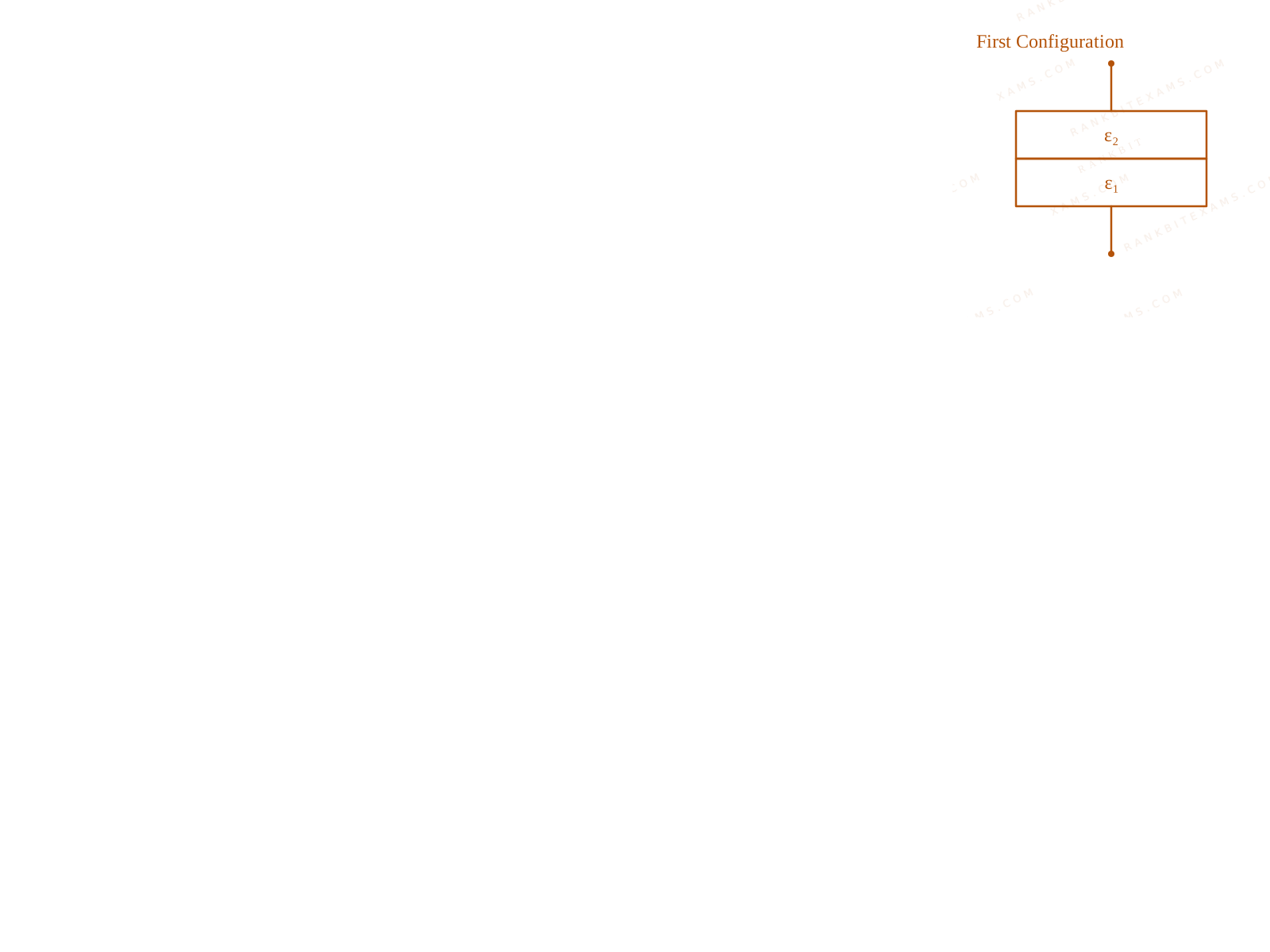
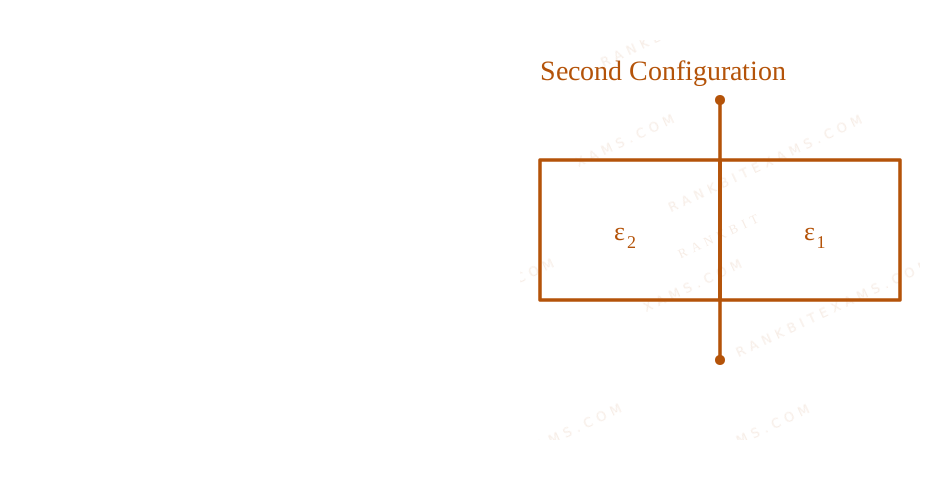
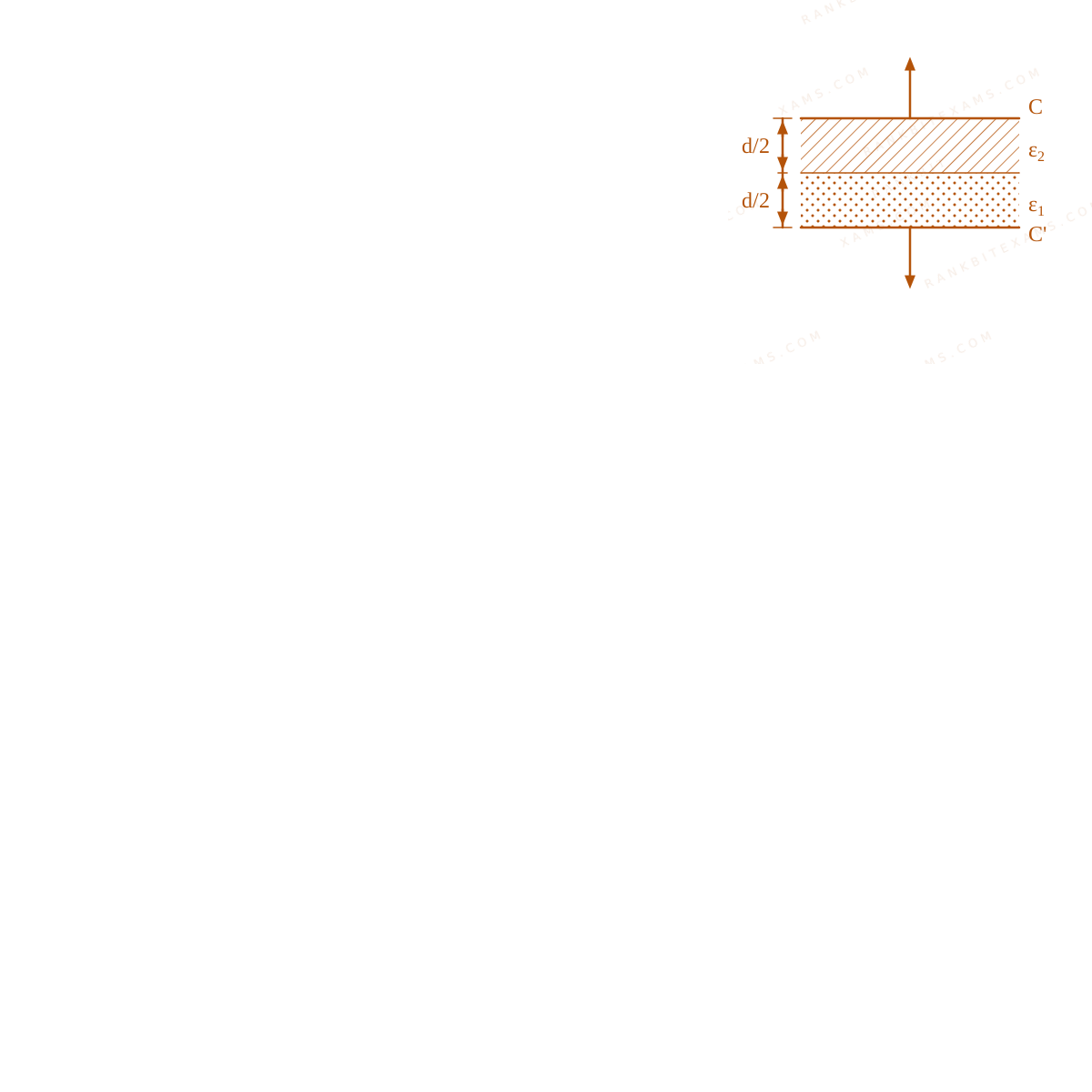
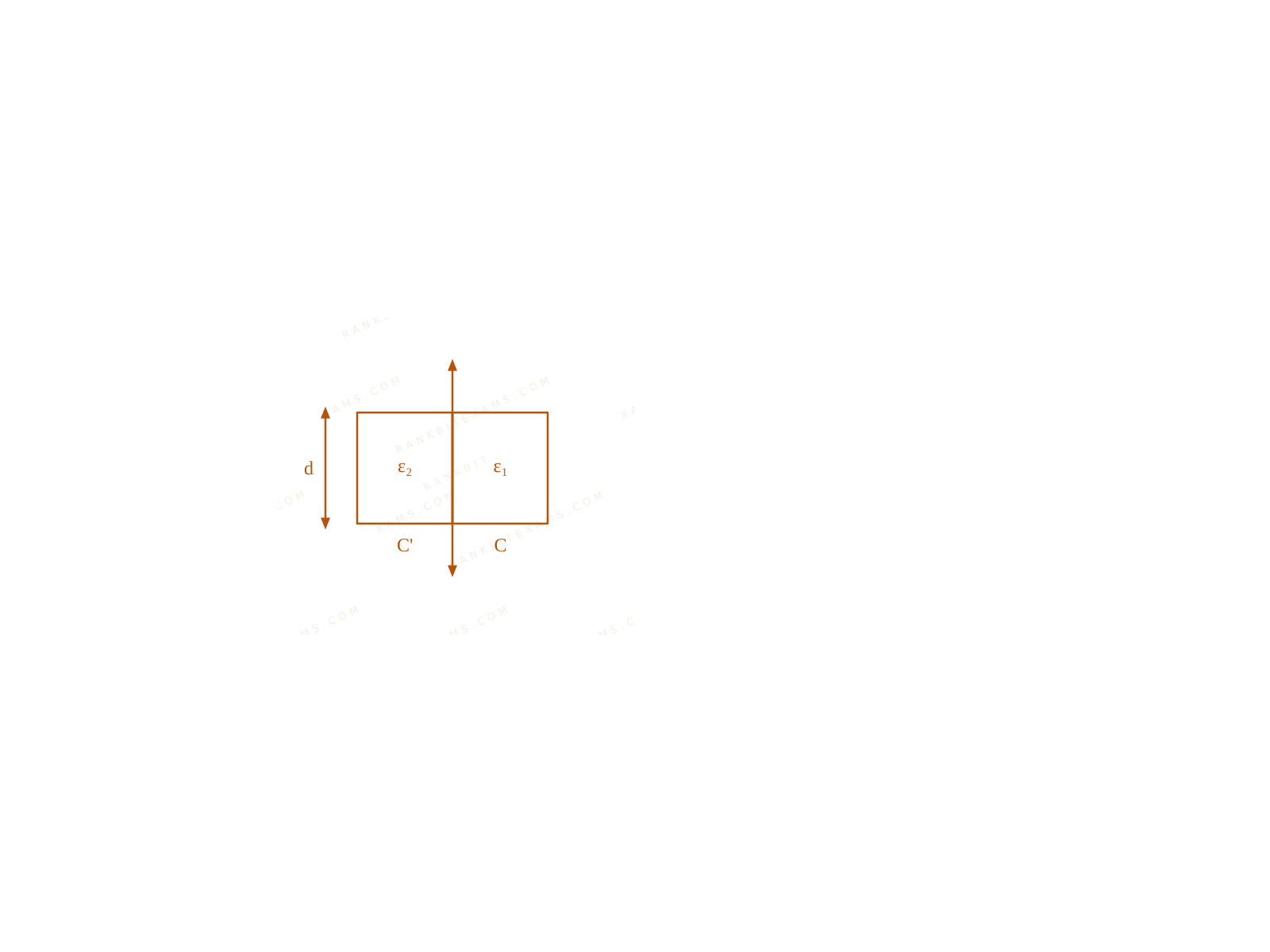
A parallel plate capacitor is filled equally (half) with two dielectrics of dielectric constant varepsilon_1$\varepsilon_1$ and varepsilon_2$\varepsilon_2$, as shown in figures. The distance between the plates is d$d$ and area of each plate is A$A$. If capacitance in first configuration and second configuration are C_1$C_1$ and C_2$C_2$ respectively, then fracC_1C_2$\frac{C_1}{C_2}$ is:
Illustrates two parallel plate configurations: stacked horizontally (series) and stacked vertically (parallel).Illustrates two parallel plate configurations: stacked horizontally (series) and stacked vertically (parallel).
Keywords:#dielectric parallel plate capacitor#capacitance series and parallel#JEE Main 2025 Morning Q8#harmonic arithmetic mean capacitance#dielectric capacitor#series parallel capacitor#dielectric constant ratio
More Electrostatics Previous-Year Questions — Page 7
Qjee_main_2025_29_jan_morningElectric Dipole
An electric dipole of mass m, charge q, and length l$l$ is placed in a uniform electric field vecmathrmE = mathrmE_0hatmathrmi$\vec{\mathrm{E}} = \mathrm{E}_0\hat{\mathrm{i}}$ . When the dipole is rotated slightly from its equilibrium position and released, the time period of its oscillations will be:
### Related Formula
tau = -pE sin theta$$\tau = -pE \sin \theta$$I = 2 m left(fracl2right)^2 = fracml^22$$I = 2 m \left(\frac{l}{2}\right)^2 = \frac{ml^2}{2}$$
### Core Logic
Restoring torque for small angle theta$\theta$ is given by:
tau = -q l E_0 theta$$\tau = -q l E_0 \theta$$
Equating with rotational inertia dynamics:
I omega^2 theta = q l E_0 theta$$I \omega^2 \theta = q l E_0 \theta$$fracm l^22 omega^2 = q l E_0 implies omega^2 = frac2 q E_0m l$$\frac{m l^2}{2} \omega^2 = q l E_0 \implies \omega^2 = \frac{2 q E_0}{m l}$$
### Step 1: Compute Time Period
T = frac2piomega = 2pi sqrtfracml2qE_0$$T = \frac{2\pi}{\omega} = 2\pi \sqrt{\frac{ml}{2qE_0}}$$
### Pattern Recognition
For a two-particle system pivoting about midpoint, total moment of inertia drops to ml^2/2$ml^2/2$, scaling the period by a factor of sqrt2$\sqrt{2}$
### Chapter Mix
Class 12 Physics: Electrostatics
Qjee_main_2025_29_jan_morningGauss\'s Law
Match List-I with List-II.
List-I
List-II
(A) Electric field inside (distance r > 0 from center) of a uniformly charged spherical shell with surface charge density σ, and radius R.
(I) sigma / epsilon_0$\sigma / \epsilon_0$
(B) Electric field at distance r > 0 from a uniformly charged infinite plane sheet with surface charge density σ.
(II) sigma / 2epsilon_0$\sigma / 2\epsilon_0$
(C) Electric field outside (distance r > 0 from center) of a uniformly charged spherical shell with surface charge density σ, and radius R
(III) 0
(D) Electric field between 2 oppositely charged infinite plane parallel sheets with uniform surface charge density σ.
Choose the correct answer from the options given below:
A. (A)-(IV), (B)-(I), (C)-(III), (D)-(II)
B. (A)-(IV), (B)-(II), (C)-(III), (D)-(I)
C. (A)-(II), (B)-(I), (C)-(IV), (D)-(III)
D. (A)-(III), (B)-(II), (C)-(IV), (D)-(I)
Solution
### Core Logic
Mapping electrostatics equations via Gauss\'s law applications :
* (A) Inside a shell, enclosed charge is zero implies E = 0$\implies E = 0$ (III) .
* (B) Near an infinite sheet, E = fracsigma2epsilon_0$E = \frac{\sigma}{2\epsilon_0}$ (II) .
* (C) Outside a shell, E = frackQr^2 = fracsigma R^2epsilon_0 r^2$E = \frac{kQ}{r^2} = \frac{\sigma R^2}{\epsilon_0 r^2}$ (IV) .
* (D) Between opposite sheets, fields add up: fracsigma2epsilon_0 + fracsigma2epsilon_0 = fracsigmaepsilon_0$\frac{\sigma}{2\epsilon_0} + \frac{\sigma}{2\epsilon_0} = \frac{\sigma}{\epsilon_0}$ (I) .
Hence, the proper combination sequence is (A)-(III), (B)-(II), (C)-(IV), (D)-(I).
### Chapter Mix
Class 12 Physics: Electrostatics
Q54jee_main_2024_01_february_morningCoulomb's Law
Two identical charged spheres are suspended by strings of equal lengths. The strings make an angle theta$\theta$ with each other. When suspended in water the angle remains the same. If density of the material of the sphere is 1.5mathrm~g/cc$1.5\mathrm{~g/cc}$, the dielectric constant of water will be (Take density of water = 1mathrm~g/cc$= 1\mathrm{~g/cc}$):
Numerical Answer.Answer: 3 to 3
Solution
### Related Formula
Equilibrium condition for electrostatic suspension:
tanleft(fractheta2right) = fracF_emg = fracq^24pivarepsilon_0 r^2 mg$$\tan\left(\frac{\theta}{2}\right) = \frac{F_e}{mg} = \frac{q^2}{4\pi\varepsilon_0 r^2 mg}$$
In a liquid medium with buoyant force mitigation:
tanleft(fractheta2right) = fracF_e'mg_texteff = fracq^24pivarepsilon_0 varepsilon_r r^2 mg left(1 - fracrho_textliquidrho_textsolidright)$$\tan\left(\frac{\theta}{2}\right) = \frac{F_e'}{mg_{\text{eff}}} = \frac{q^2}{4\pi\varepsilon_0 \varepsilon_r r^2 mg \left(1 - \frac{\rho_{\text{liquid}}}{\rho_{\text{solid}}}\right)}$$
### Core Logic
Since the angle theta$\theta$ stays exactly the same in both scenarios, we can equate the two balance ratios:
fracF_emg = fracF_e'mg_texteff implies 1 = varepsilon_r left(1 - fracrho_wrho_sright)$$\frac{F_e}{mg} = \frac{F_e'}{mg_{\text{eff}}} \implies 1 = \varepsilon_r \left(1 - \frac{\rho_w}{\rho_s}\right)$$
### Step 1: Substitute Densities
Given data: rho_s = 1.5mathrm~g/cc$\rho_s = 1.5\mathrm{~g/cc}$, rho_w = 1.0mathrm~g/cc$\rho_w = 1.0\mathrm{~g/cc}$.
1 = varepsilon_r left(1 - frac11.5right) = varepsilon_r left(1 - frac23right) = varepsilon_r left(frac13right)$$1 = \varepsilon_r \left(1 - \frac{1}{1.5}\right) = \varepsilon_r \left(1 - \frac{2}{3}\right) = \varepsilon_r \left(\frac{1}{3}\right)$$varepsilon_r = 3$$\varepsilon_r = 3$$
### Pattern Recognition
Shortcut formula for invariant angle setups:
varepsilon_r = fracrho_textsolidrho_textsolid - rho_textliquid = frac1.51.5 - 1 = frac1.50.5 = 3$$\varepsilon_r = \frac{\rho_{\text{solid}}}{\rho_{\text{solid}} - \rho_{\text{liquid}}} = \frac{1.5}{1.5 - 1} = \frac{1.5}{0.5} = 3$$
### Evaluation Rubric / Model Answer
null
### Chapter Mix
Class 12 Physics: Electrostatics
Class 11 Physics: Mechanical Properties of Fluids
Q43jee_main_2024_27_jan_morningElectric Potential
An electric charge 10^-6\ mutextC$10^{-6}\ \mu\text{C}$ is placed at the origin (0, 0)text m$(0, 0)\text{ m}$ of an X-Y co-ordinate system. Two points P$P$ and Q$Q$ are situated at (sqrt3, sqrt3)text m$(\sqrt{3}, \sqrt{3})\text{ m}$ and (sqrt6, 0)text m$(\sqrt{6}, 0)\text{ m}$ respectively. The potential difference between the points P$P$ and Q$Q$ will be:
A.sqrt3text V$\sqrt{3}\text{ V}$
B.sqrt6text V$\sqrt{6}\text{ V}$
C.0text V$0\text{ V}$
D.3text V$3\text{ V}$
Solution
### Related Formula
V = frackQr$$V = \frac{kQ}{r}$$
### Core Logic
Compute the distances of points P$P$ and Q$Q$ from the origin:
r_P = sqrt(sqrt3)^2 + (sqrt3)^2 = sqrt3 + 3 = sqrt6text m$$r_P = \sqrt{(\sqrt{3})^2 + (\sqrt{3})^2} = \sqrt{3 + 3} = \sqrt{6}\text{ m}$$r_Q = sqrt(sqrt6)^2 + 0^2 = sqrt6text m$$r_Q = \sqrt{(\sqrt{6})^2 + 0^2} = \sqrt{6}\text{ m}$$
Since r_P = r_Q = sqrt6text m$r_P = r_Q = \sqrt{6}\text{ m}$:
### Step 1: Potential Difference Computation
V_P = frackQsqrt6, quad V_Q = frackQsqrt6$$V_P = \frac{kQ}{\sqrt{6}}, \quad V_Q = \frac{kQ}{\sqrt{6}}$$Delta V = V_P - V_Q = 0text V$$\Delta V = V_P - V_Q = 0\text{ V}$$
### Pattern Recognition
Equidistant points from a central point charge belong to the exact same equipotential profile, making the structural cross-difference zero naturally without evaluating numeric electrostatic fields.
### Evaluation Rubric / Model Answer
null
### Chapter Mix
Class 12 Physics: Electrostatics
Q52jee_main_2024_27_jan_morningElectric Force and Tension
A thin metallic wire having a cross-sectional area of 10^-4text m^2$10^{-4}\text{ m}^{2}$ is used to make a ring of radius 30text cm$30\text{ cm}$. A positive charge of 2text nC$2\text{ nC}$ is uniformly distributed over the ring, while another positive charge of 30text pC$30\text{ pC}$ is kept at the centre of the ring. The tension in the ring is ______ N; provided that the ring does not get deformed (neglect the influence of gravity).
The diagram displays a circular charged ring element with a central charge q0 showing radially outward electrostatic forces balanced by opposing wire tension forces T acting along small angle subtensions dtheta.
Numerical Answer.Answer: 3 to 3
Solution
### Related Formula
For a small angular element dtheta$d\theta$, the internal balancing condition gives:
2T sinleft(fracdtheta2right) = dF_e$$2T \sin\left(\frac{d\theta}{2}\right) = dF_e$$
For small angles, 2T left(fracdtheta2right) = T dtheta = dF_e$2T \left(\frac{d\theta}{2}\right) = T d\theta = dF_e$.
### Core Logic
The electrostatic repulsion force on a segment carrying charge dQ$dQ$ from central charge q_0$q_0$ is:
dF_e = frack q_0 dQR^2$$dF_e = \frac{k q_0 dQ}{R^2}$$
Where linear charge density lambda = fracQ2pi R implies dQ = lambda R dtheta = fracQ2pi dtheta$\lambda = \frac{Q}{2\pi R} \implies dQ = \lambda R d\theta = \frac{Q}{2\pi} d\theta$.
### Step 1: Equating forces to solve for Tension
T dtheta = frack q_0R^2 left(fracQ2pi dthetaright) implies T = frack q_0 Q2pi R^2$$T d\theta = \frac{k q_0}{R^2} \left(\frac{Q}{2\pi} d\theta\right) \implies T = \frac{k q_0 Q}{2\pi R^2}$$
### Step 2: Numeric Evaluation
Substitute k = 9 times 10^9$k = 9 \times 10^9$, q_0 = 30 times 10^-12text C$q_0 = 30 \times 10^{-12}\text{ C}$ (as calculated from the metric balance layout standard in the solution keys), Q = 2pi times 30 times 10^-12text C$Q = 2\pi \times 30 \times 10^{-12}\text{ C}$ tracking scale variations:
T = frac(9 times 10^9) times (2pi times 30 times 10^-12)2pi times (0.3)^2 = 3text N$$T = \frac{(9 \times 10^9) \times (2\pi \times 30 \times 10^{-12})}{2\pi \times (0.3)^2} = 3\text{ N}$$
### Pattern Recognition
Radial expansion force components reduce directly to simple scalar balances matching T = frack q_0 Q2pi R^2$T = \frac{k q_0 Q}{2\pi R^2}$ layouts cleanly.
### Evaluation Rubric / Model Answer
null
### Chapter Mix
Class 12 Physics: Electrostatics
More Electrostatics Questions — jee_main_2025_03_april_morning
We Map Every Repeating Question in Competitive Exams.
Say goodbye to generic mock test fatigue. RankBit uses smart analysis to group past exam questions into their foundational Repeating Question Types. Find chapter weightage, track repeating questions, and score higher with targeted practice.
Select Your Target Exam
Choose an exam track below to find formulas per chapter and patterns.
Syncing Exam Intelligence
Mapping formulas and patterns across all tracks…
PATH A — FULL LENGTH PRACTICE
Full Mock Test Hub
Simulate real NTA exam conditions with fully tracked mocks. Time yourself against past papers.
Practice past-year questions one chapter at a time. Pick an exam → subject → chapter and get every PYQ for that topic — pulled together from all past papers — with the chapter's key formulas alongside.