Rankbit System
JEE Physics: Waves (+15.5%) | Electrostatics: Concentric Shells (-29.7%) | Modern Physics: Photoelectric Clones (+34.2%) | Mathematics: Definite Integrals (+18.1%) | Chemistry: Coordination Splitting (-11.4%) | JEE Physics: Waves (+15.5%) | Electrostatics: Concentric Shells (-29.7%) | Modern Physics: Photoelectric Clones (+34.2%) | Mathematics: Definite Integrals (+18.1%) | Chemistry: Coordination Splitting (-11.4%)

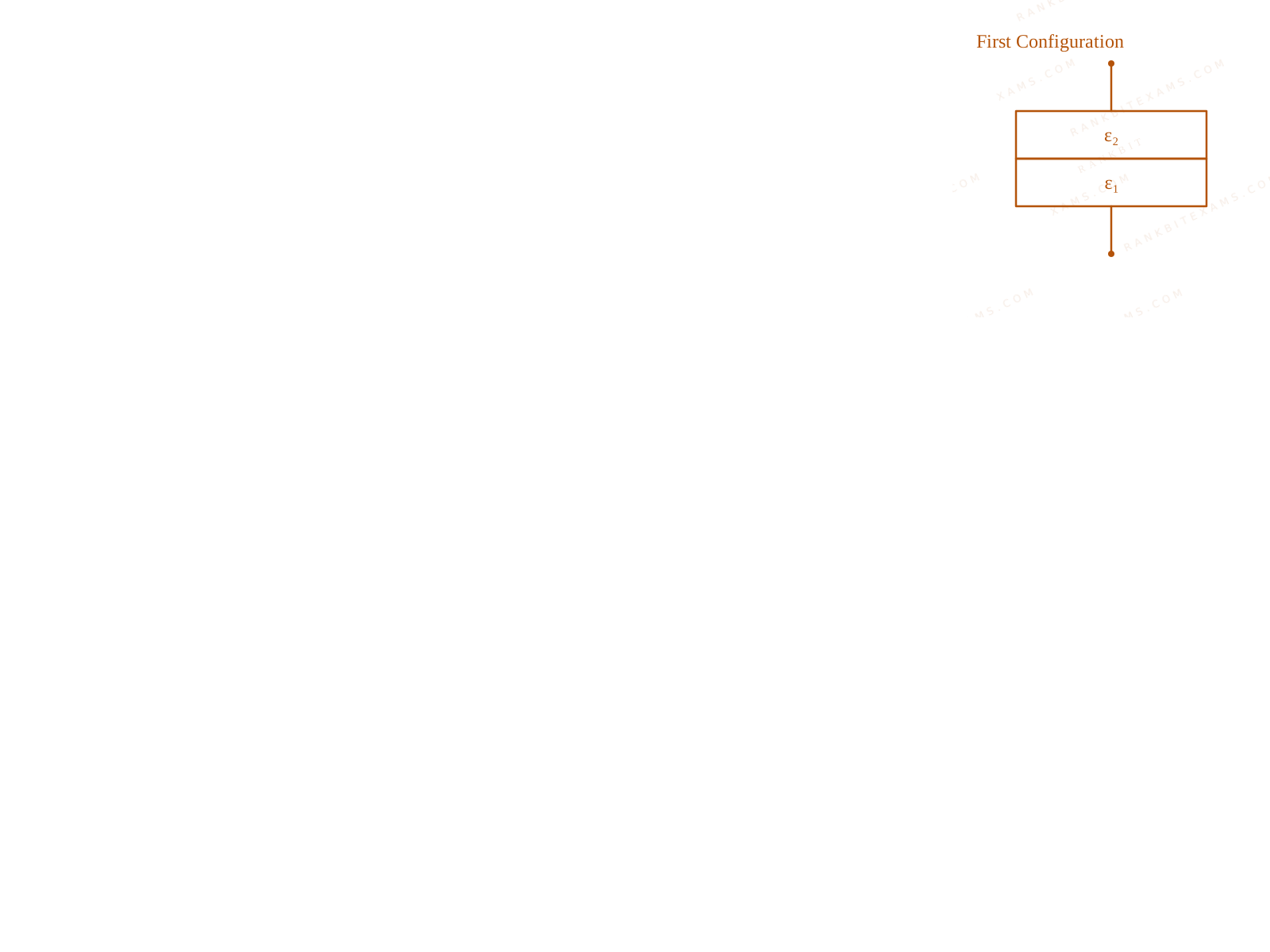
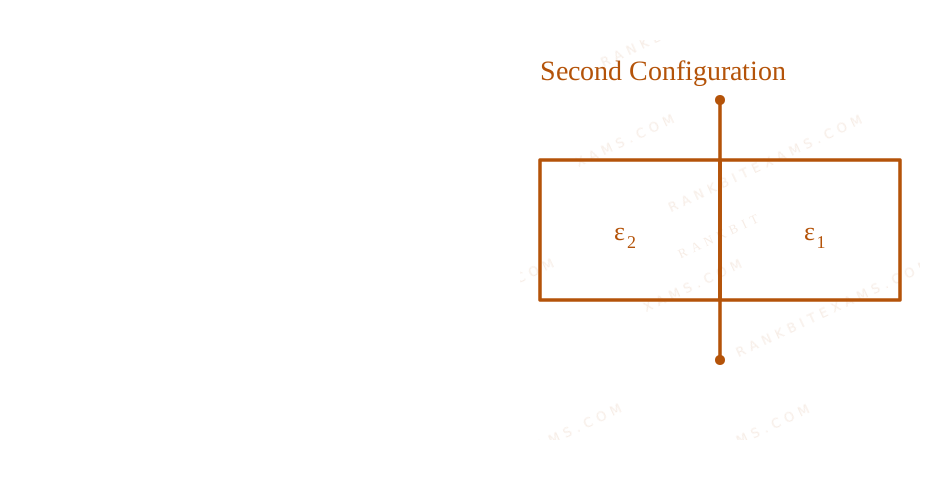
A parallel plate capacitor is filled equally (half) with two dielectrics of dielectric constant varepsilon_1 and varepsilon_2, as shown in figures. The distance between the plates is d and area of each plate is A. If capacitance in first configuration and second configuration are C_1 and C_2 respectively, then fracC_1C_2 is:
First configuration of dielectrics stacked vertically for Q8
Illustrates two parallel plate configurations: stacked horizontally (series) and stacked vertically (parallel).
First configuration of dielectrics stacked vertically for Q8
Illustrates two parallel plate configurations: stacked horizontally (series) and stacked vertically (parallel).

Solution & Explanation

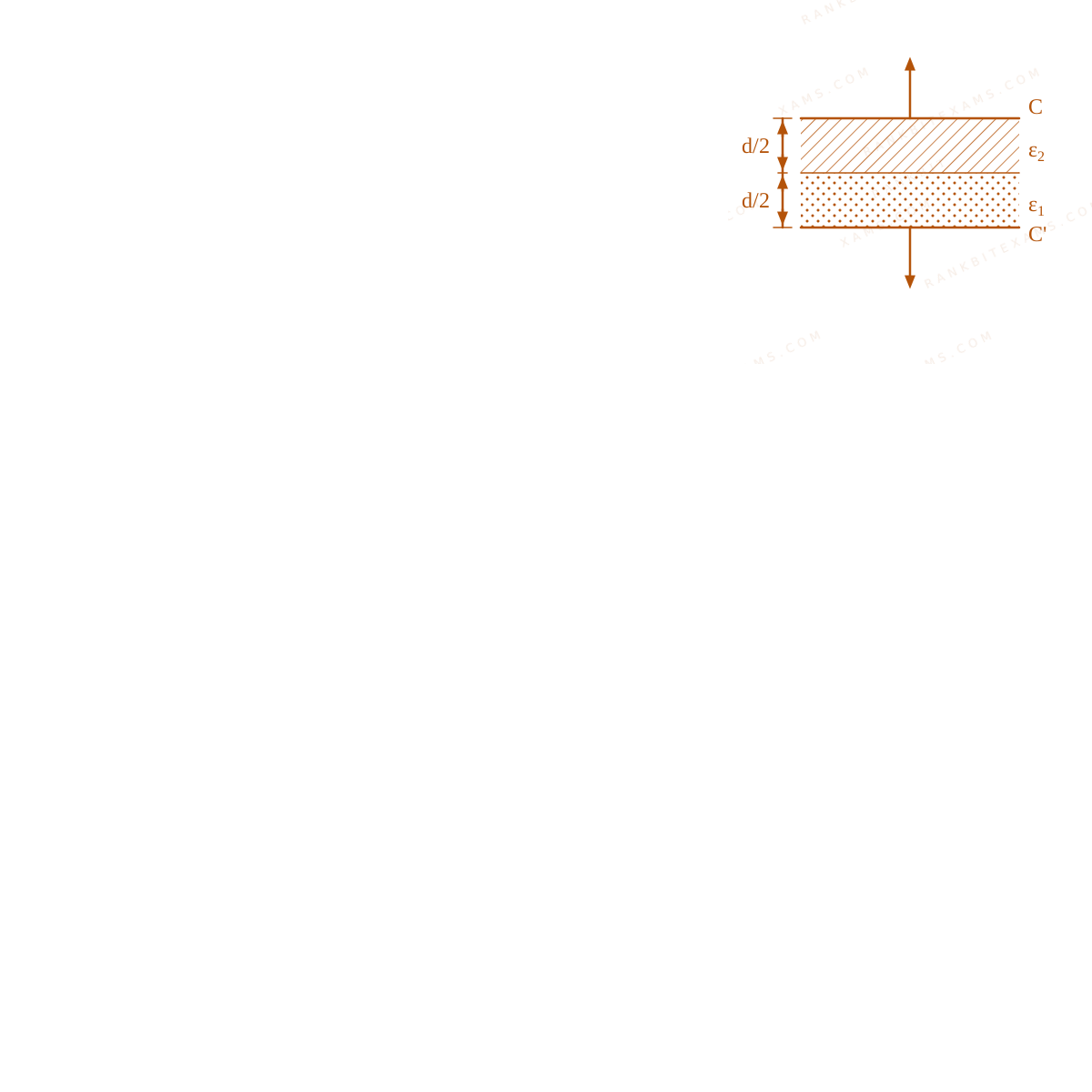
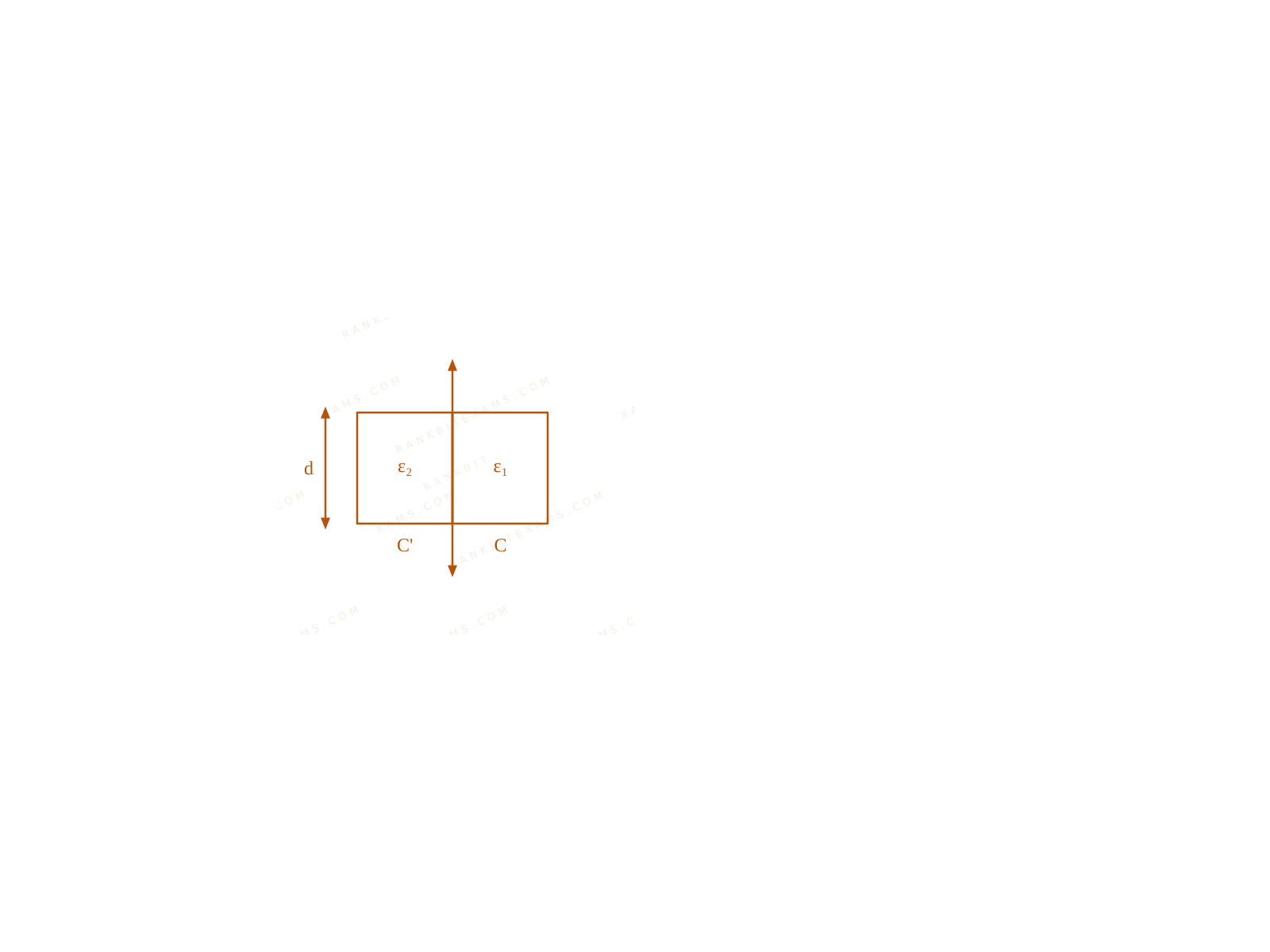
### Related Formula Capacitance with dielectric: C = fracvarepsilon_r varepsilon_0 Ad Series Capacitors: C_texteq = fracC_a C_bC_a + C_b Parallel Capacitors: C_texteq = C_a + C_b ### Core Logic Let C_0 = fracvarepsilon_0 Ad be the capacitance without any dielectric. - **First Configuration (Series connection)**: The dielectrics split the gap vertically, so the effective thickness of each slab is d/2, and the area remains A. C_a = fracvarepsilon_1 varepsilon_0 Ad/2 = 2varepsilon_1 C_0 C_b = fracvarepsilon_2 varepsilon_0 Ad/2 = 2varepsilon_2 C_0 Since they are in series: C_1 = fracC_a C_bC_a + C_b = frac(2varepsilon_1 C_0)(2varepsilon_2 C_0)2varepsilon_1 C_0 + 2varepsilon_2 C_0 = frac4varepsilon_1varepsilon_2 C_0^22C_0(varepsilon_1 + varepsilon_2) = frac2varepsilon_1varepsilon_2varepsilon_1 + varepsilon_2 C_0 - **Second Configuration (Parallel connection)**: The dielectrics split the area horizontally, so the effective area of each slab is A/2, and the distance remains d. C_c = fracvarepsilon_1 varepsilon_0 (A/2)d = fracvarepsilon_1 C_02 C_d = fracvarepsilon_2 varepsilon_0 (A/2)d = fracvarepsilon_2 C_02 Since they are in parallel: C_2 = C_c + C_d = (varepsilon_1 + varepsilon_2) fracC_02
Series equivalent circuit of dielectric capacitor for Q8
Illustrates two parallel plate configurations: stacked horizontally (series) and stacked vertically (parallel).
Series equivalent circuit of dielectric capacitor for Q8
Illustrates two parallel plate configurations: stacked horizontally (series) and stacked vertically (parallel).
### Step 1: Calculating the Ratio Now, compute fracC_1C_2: fracC_1C_2 = fracleft(frac2varepsilon_1varepsilon_2varepsilon_1 + varepsilon_2right) C_0left(fracvarepsilon_1 + varepsilon_22right) C_0 = frac4varepsilon_1varepsilon_2(varepsilon_1 + varepsilon_2)^2 ### Pattern Recognition For dielectric-filled capacitors: splitting the gap (d/2) leads to a series combination, while splitting the plate area (A/2) leads to a parallel combination. Shortcut: C_textseries = textharmonic mean, C_textparallel = textarithmetic mean. The ratio fracC_1C_2 is always the ratio of the harmonic mean of the dielectric constants to their arithmetic mean! ### Evaluation Rubric / Model Answer null ### Chapter Mix Class 12 Physics: Electrostatic Potential and Capacitance

Reference Study Guides

More Electrostatics Previous-Year Questions — Page 6

Q21 2025 Gauss's Law and Electric Flux
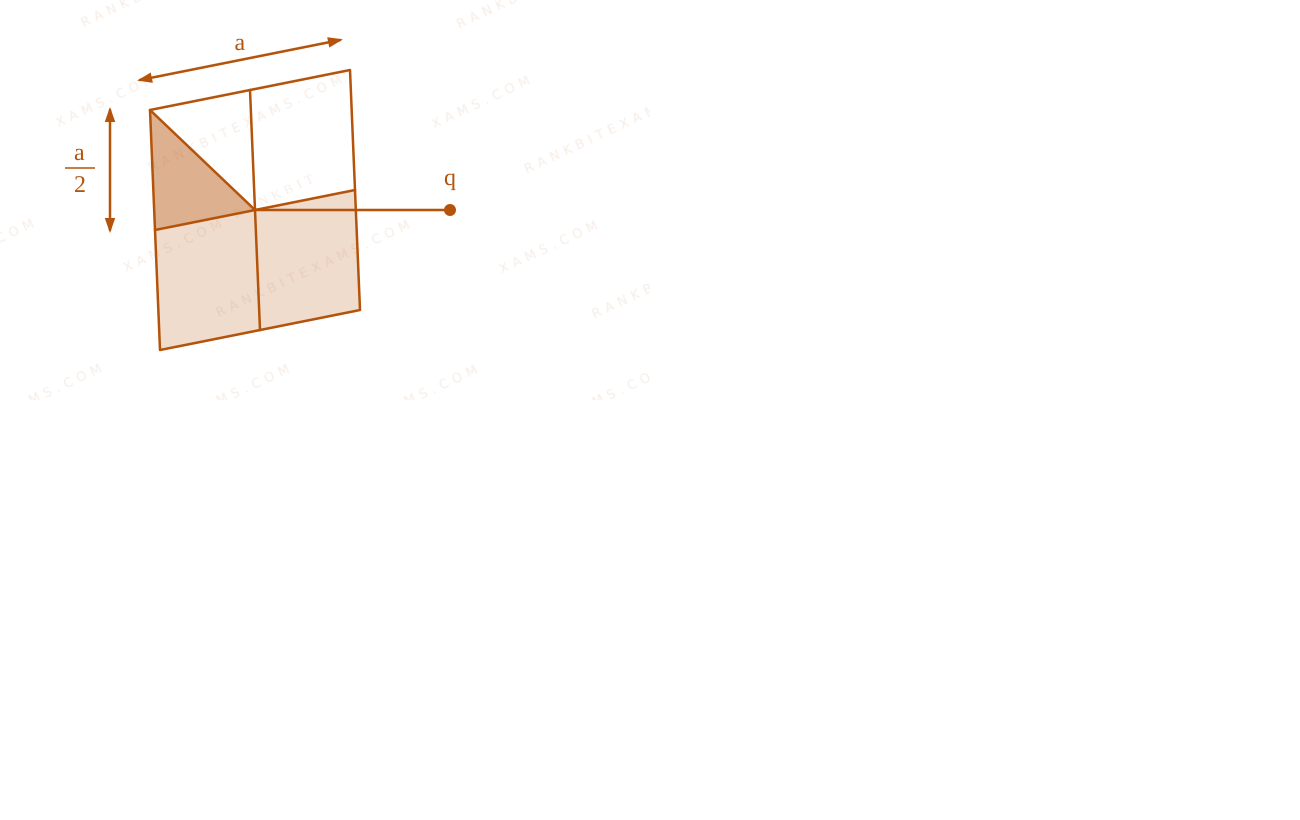
A square loop of sides a = 1 m is held normally in front of a point charge q = 1C The flux of the electric field through the shaded region is frac5p times frac1varepsilon_0 fracNm^2C , where the value of p is .
Gauss's Law and Electric Flux diagram for Q21 - JEE Main 2025 Morning
The diagram illustrates a square loop divided into 8 symmetric parts with a point charge positioned in front of its center.
Numerical Answer. Answer: 48 to 48

Solution

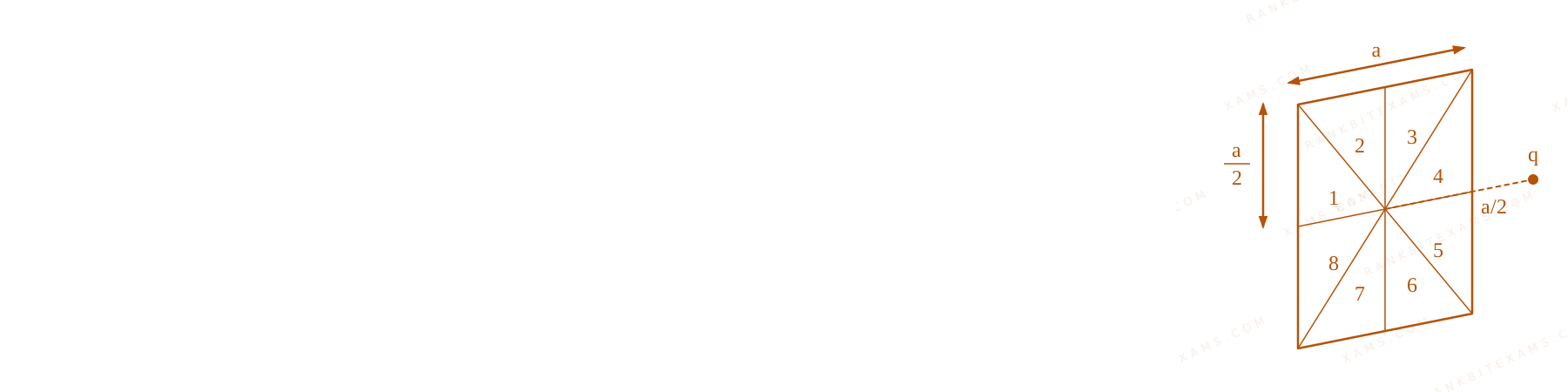
### Related Formula By Gauss's Law, the total flux emitted by a point charge q through a completely enclosing symmetric cube container surface is: Phitexttotal = fracqepsilon0 ### Core Logic Assuming the charge resides at a symmetric center distance fraca2 relative to the loop face [cite: 784, 786], this square loop represents one of the six identical faces of an enclosing cube system. Thus, the flux passing through the entire square loop face is[cite: 775, 776]: Phitextsquare = frac16 Phitexttotal = fracq6epsilon0 ### Step 1: Symmetric Partitioning As shown in the solution schematic
Gauss's Law and Electric Flux diagram for Q21 - JEE Main 2025 Morning
The diagram illustrates a square loop divided into 8 symmetric parts with a point charge positioned in front of its center.
, the square face can be divided into 8 identical symmetric right-angled triangle sections by drawing its diagonals and medians[cite: 771, 777]. Each individual part intercepts an equal portion of the flux field : Phitextpart = frac18 Phitextsquare = frac18 left(fracq6epsilon_0 ight) = fracq48epsilon_0 The shaded region covers exactly 5 of these individual triangle parts [cite: 779, 780]: Phi_textshaded = 5 times Phi_textpart = frac548 times fracqepsilon_0 Comparing this result with the given expression frac5p times frac1epsilon_0 , we find: p = 48 ### Pattern Recognition Exploit geometric symmetry to break solid angles down into equal fractions, avoiding complex surface integration. ### Evaluation Rubric / Model Answer null ### Chapter Mix Class 12 Physics: Electrostatics
Q2 2025 Energy Density in Capacitors
A parallel plate capacitor of capacitance 1mu mathrmF is charged to a potential difference of 20mathrmV. The distance between plates is 1mu mathrmm. The energy density between plates of capacitor is:
  • A. 1.8 times 10^3 \, mathrmJ/m^3
  • B. 2 times 10^-4 \, mathrmJ/m^3
  • C. 2 times 10^2 mathrm~J / mathrmm^3
  • D. 1.8 times 10^5 mathrm~J / mathrmm^3

Solution

### Related Formula The electric field E between the plates of a parallel plate capacitor is given by : E = fracVd The electrostatic energy density U in a medium is given by: U = frac12 epsilon_0 E^2 ### Core Logic Given values [cite: 662, 664, 665]: * Capacitance, C = 1 \ mutextF * Potential difference, V = 20 text V * Plate separation, d = 1 \ mutextm = 10^-6 text m First, calculate the electric field E : E = frac2010^-6 = 20 times 10^6 text V/m Now, calculate the energy density U using epsilon_0 approx 8.85 times 10^-12 text F/m : U = frac12 times (8.85 times 10^-12) times (20 times 10^6)^2 U = frac12 times 8.85 times 10^-12 times 400 times 10^12 U = 8.85 times 200 = 1770 text J/m^3 = 1.77 times 10^3 text J/m^3 Rounding to the nearest matching option gives 1.8 times 10^3 text J/m^3. ### Pattern Recognition Notice that energy density is completely independent of the total capacitance value C if the voltage and spacing are directly provided. Always check for redundant parameters included to distract candidates. ### Evaluation Rubric / Model Answer null ### Chapter Mix Class 12 Physics: Electrostatics
Q22 2025 Electric Dipole
An electric dipole of dipole moment 6 times 10^-6 mathrmCm is placed in uniform electric field of magnitude 10^6 mathrm~V/m. Initially, the dipole moment is \parallel to electric field. The work that needs to be done on the dipole to make its dipole moment opposite to the field, will be ______ J.
Numerical Answer. Answer: 12

Solution

### Related Formula The potential energy of an electric dipole aligned at an \angle theta inside a uniform electric field is given by: U = -p E cos theta The work done by an external agent to rotate the dipole equals its change in potential energy: W = Delta U = -pE (cos theta_f - cos theta_i) ### Core Logic Given parameters [cite: 805, 806]: * Dipole moment, p = 6 times 10^-6 text Cm * Electric field, E = 10^6 text V/m * Initial \angle (\parallel state), theta_i = 0^circ * Final \angle (opposite state), theta_f = 180^circ Substitute the values into the work equation [cite: 807, 808]: W = -pE (cos 180^circ - cos 0^circ) W = -pE (-1 - 1) = 2 p E quad text W = 2 times (6 times 10^-6) times 10^6 = 12 text J quad text ### Pattern Recognition Rotating a dipole from its most stable configuration (\parallel, theta=0^circ) to its most unstable position (anti-\parallel, theta=180^circ) always requires a maximum work value of exactly 2pE. ### Evaluation Rubric / Model Answer null ### Chapter Mix Class 12 Physics: Electrostatics

Q3 2025 Electric Dipole
An electric dipole of mass m, charge q, and length l is placed in a uniform electric field vecmathrmE = mathrmE_0hatmathrmi . When the dipole is rotated slightly from its equilibrium position and released, the time period of its oscillations will be: [cite: 1, 5]
  • A. frac12pisqrtfrac2mathrmmlmathrmqE_0
  • B. 2pi sqrtfracmathrmmlmathrmqE_0
  • C. frac12pi sqrtfracm l2 q E_0
  • D. 2pi sqrtfracmathrmml2mathrmqE_0

Solution

### Related Formula tau = -pE sin theta I = 2 m left(fracl2right)^2 = fracml^22 ### Core Logic Restoring torque for small angle theta is given by: tau = -q l E_0 theta Equating with rotational inertia dynamics: I omega^2 theta = q l E_0 theta fracm l^22 omega^2 = q l E_0 implies omega^2 = frac2 q E_0m l [cite: 618, 620] ### Step 1: Compute Time Period T = frac2piomega = 2pi sqrtfracml2qE_0 ### Pattern Recognition For a two-particle system pivoting about midpoint, total moment of inertia drops to ml^2/2, scaling the period by a factor of sqrt2[cite: 618, 622]. ### Chapter Mix Class 12 Physics: Electrostatics
Q18 2025 Gauss\'s Law
Match List-I with List-II.
List-IList-II
(A) Electric field inside (distance r > 0 from center) of a uniformly charged spherical shell with surface charge density σ, and radius R.(I) sigma / epsilon_0
(B) Electric field at distance r > 0 from a uniformly charged infinite plane sheet with surface charge density σ.(II) sigma / 2epsilon_0
(C) Electric field outside (distance r > 0 from center) of a uniformly charged spherical shell with surface charge density σ, and radius R(III) 0
(D) Electric field between 2 oppositely charged infinite plane parallel sheets with uniform surface charge density σ.(IV) sigma R^2 / epsilon_0 r^2
Choose the correct answer from the options given below: [cite: 1, 2]
  • A. (A)-(IV), (B)-(I), (C)-(III), (D)-(II)
  • B. (A)-(IV), (B)-(II), (C)-(III), (D)-(I)
  • C. (A)-(II), (B)-(I), (C)-(IV), (D)-(III)
  • D. (A)-(III), (B)-(II), (C)-(IV), (D)-(I)

Solution

### Core Logic Mapping electrostatics equations via Gauss\'s law applications : * (A) Inside a shell, enclosed charge is zero implies E = 0 (III) . * (B) Near an infinite sheet, E = fracsigma2epsilon_0 (II) . * (C) Outside a shell, E = frackQr^2 = fracsigma R^2epsilon_0 r^2 (IV) . * (D) Between opposite sheets, fields add up: fracsigma2epsilon_0 + fracsigma2epsilon_0 = fracsigmaepsilon_0 (I) . Hence, the proper combination sequence is (A)-(III), (B)-(II), (C)-(IV), (D)-(I). ### Chapter Mix Class 12 Physics: Electrostatics

More Electrostatics Questions — jee_main_2025_03_april_morning

Practice all Electrostatics previous-year questions →

YOUR FIRST PREP STEP STARTS HERE

We Map Every Repeating Question in Competitive Exams.

Say goodbye to generic mock test fatigue. RankBit uses smart analysis to group past exam questions into their foundational Repeating Question Types. Find chapter weightage, track repeating questions, and score higher with targeted practice.

Select Your Target Exam

Choose an exam track below to find formulas per chapter and patterns.

Syncing Exam Intelligence

Mapping formulas and patterns across all tracks…

PATH A — FULL LENGTH PRACTICE

Full Mock Test Hub

Simulate real NTA exam conditions with fully tracked mocks. Time yourself against past papers.

Under Development
PATH B — TARGETED PRACTICE

Topic-wise Practice Hub

Practice past-year questions one chapter at a time. Pick an exam → subject → chapter and get every PYQ for that topic — pulled together from all past papers — with the chapter's key formulas alongside.

Loading Questions... Browse Topics
Latest from the Blog
View all →

Loading articles...