Rankbit System
JEE Physics: Waves (+15.5%) | Electrostatics: Concentric Shells (-29.7%) | Modern Physics: Photoelectric Clones (+34.2%) | Mathematics: Definite Integrals (+18.1%) | Chemistry: Coordination Splitting (-11.4%) | JEE Physics: Waves (+15.5%) | Electrostatics: Concentric Shells (-29.7%) | Modern Physics: Photoelectric Clones (+34.2%) | Mathematics: Definite Integrals (+18.1%) | Chemistry: Coordination Splitting (-11.4%)

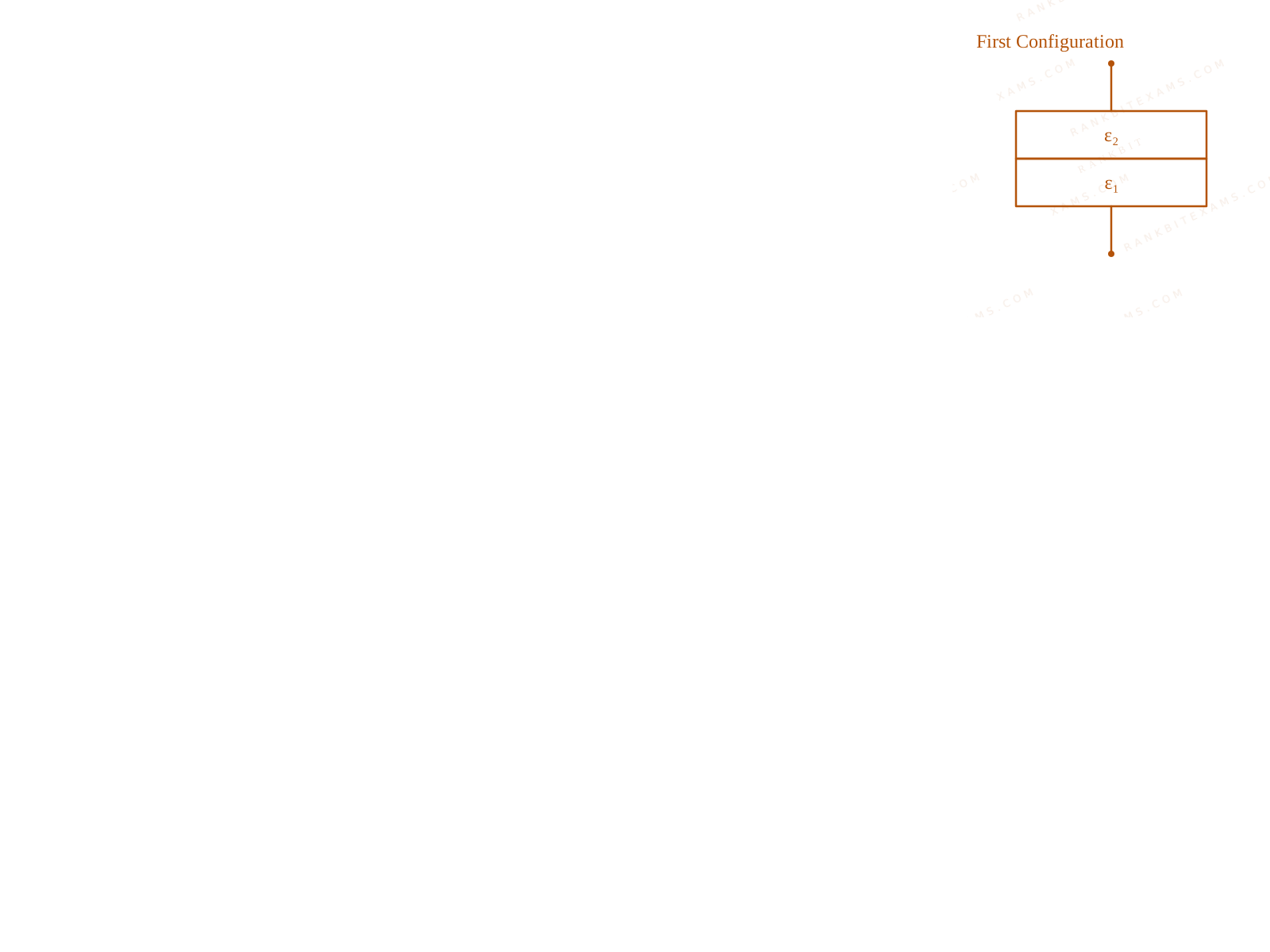
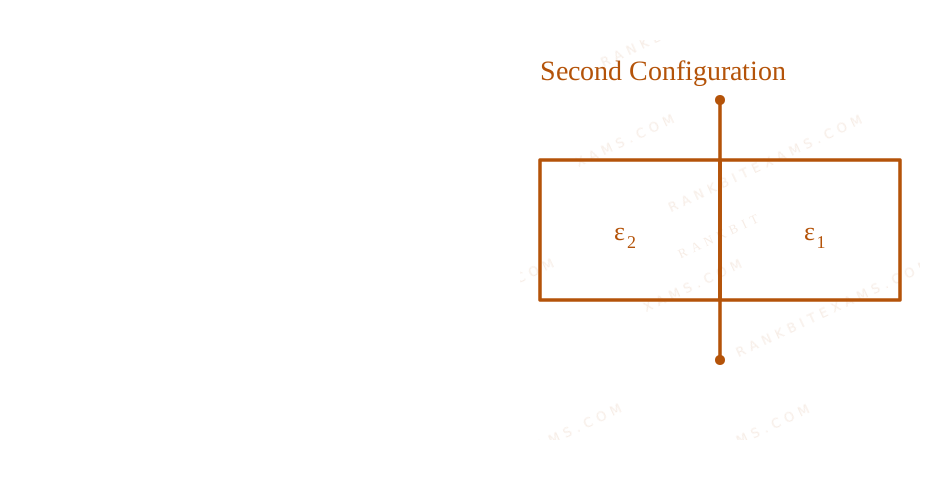
A parallel plate capacitor is filled equally (half) with two dielectrics of dielectric constant varepsilon_1 and varepsilon_2, as shown in figures. The distance between the plates is d and area of each plate is A. If capacitance in first configuration and second configuration are C_1 and C_2 respectively, then fracC_1C_2 is:
First configuration of dielectrics stacked vertically for Q8
Illustrates two parallel plate configurations: stacked horizontally (series) and stacked vertically (parallel).
First configuration of dielectrics stacked vertically for Q8
Illustrates two parallel plate configurations: stacked horizontally (series) and stacked vertically (parallel).

Solution & Explanation

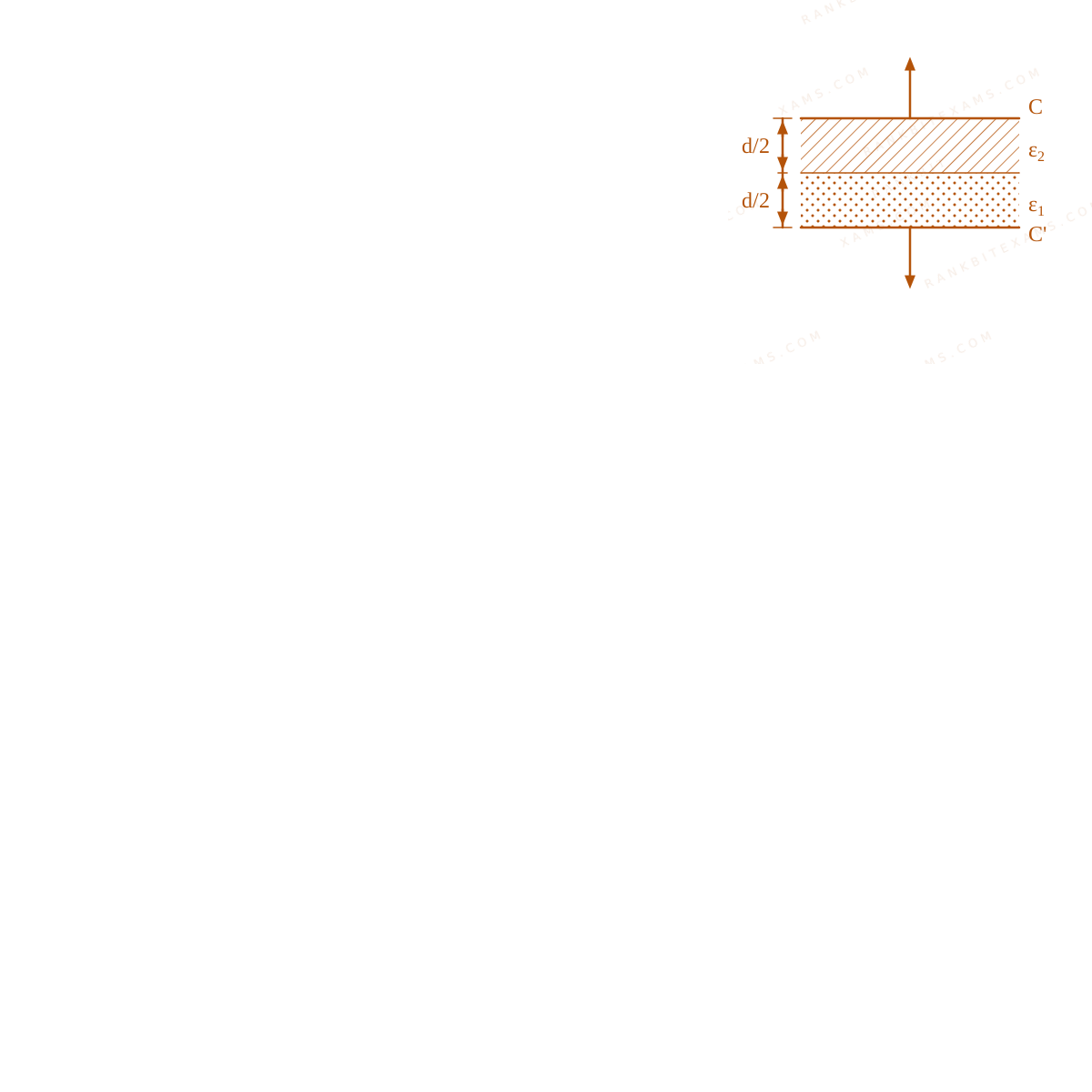
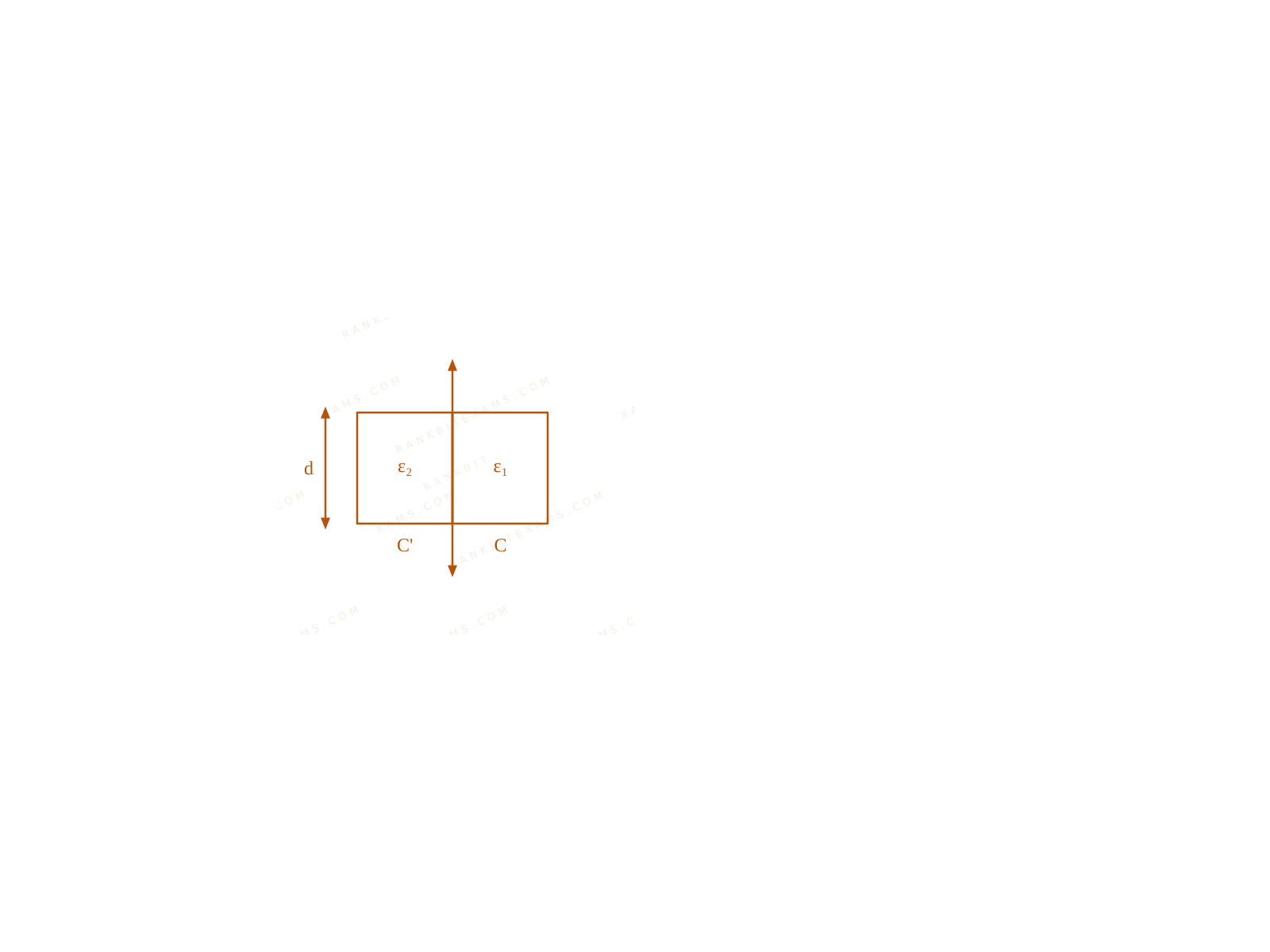
### Related Formula Capacitance with dielectric: C = fracvarepsilon_r varepsilon_0 Ad Series Capacitors: C_texteq = fracC_a C_bC_a + C_b Parallel Capacitors: C_texteq = C_a + C_b ### Core Logic Let C_0 = fracvarepsilon_0 Ad be the capacitance without any dielectric. - **First Configuration (Series connection)**: The dielectrics split the gap vertically, so the effective thickness of each slab is d/2, and the area remains A. C_a = fracvarepsilon_1 varepsilon_0 Ad/2 = 2varepsilon_1 C_0 C_b = fracvarepsilon_2 varepsilon_0 Ad/2 = 2varepsilon_2 C_0 Since they are in series: C_1 = fracC_a C_bC_a + C_b = frac(2varepsilon_1 C_0)(2varepsilon_2 C_0)2varepsilon_1 C_0 + 2varepsilon_2 C_0 = frac4varepsilon_1varepsilon_2 C_0^22C_0(varepsilon_1 + varepsilon_2) = frac2varepsilon_1varepsilon_2varepsilon_1 + varepsilon_2 C_0 - **Second Configuration (Parallel connection)**: The dielectrics split the area horizontally, so the effective area of each slab is A/2, and the distance remains d. C_c = fracvarepsilon_1 varepsilon_0 (A/2)d = fracvarepsilon_1 C_02 C_d = fracvarepsilon_2 varepsilon_0 (A/2)d = fracvarepsilon_2 C_02 Since they are in parallel: C_2 = C_c + C_d = (varepsilon_1 + varepsilon_2) fracC_02
Series equivalent circuit of dielectric capacitor for Q8
Illustrates two parallel plate configurations: stacked horizontally (series) and stacked vertically (parallel).
Series equivalent circuit of dielectric capacitor for Q8
Illustrates two parallel plate configurations: stacked horizontally (series) and stacked vertically (parallel).
### Step 1: Calculating the Ratio Now, compute fracC_1C_2: fracC_1C_2 = fracleft(frac2varepsilon_1varepsilon_2varepsilon_1 + varepsilon_2right) C_0left(fracvarepsilon_1 + varepsilon_22right) C_0 = frac4varepsilon_1varepsilon_2(varepsilon_1 + varepsilon_2)^2 ### Pattern Recognition For dielectric-filled capacitors: splitting the gap (d/2) leads to a series combination, while splitting the plate area (A/2) leads to a parallel combination. Shortcut: C_textseries = textharmonic mean, C_textparallel = textarithmetic mean. The ratio fracC_1C_2 is always the ratio of the harmonic mean of the dielectric constants to their arithmetic mean! ### Evaluation Rubric / Model Answer null ### Chapter Mix Class 12 Physics: Electrostatic Potential and Capacitance

Reference Study Guides

More Electrostatics Previous-Year Questions — Page 5

Q21 2025 Dielectrics and Capacitance
A parallel plate capacitor has charge 5times10^-6mathrm~C. A dielectric slab is inserted between the plates and almost fills the space between the plates. If the induced charge on one face of the slab is 4times10^-6mathrm~C then the dielectric constant of the slab is _______. [cite: 183, 184]
Numerical Answer. Answer: 5 to 5

Solution

### Related Formula Q_textind = Qleft(1 - frac1Kright) [cite: 813] ### Core Logic Substitute the values given for free surface charge Q = 5 times 10^-6\ textC and bound induced charge Q_textind = 4 times 10^-6\ textC into the equation: [cite: 183, 184, 814] 4 times 10^-6 = 5 times 10^-6 left(1 - frac1Kright) [cite: 814] frac45 = 1 - frac1K implies frac1K = 1 - frac45 = frac15 [cite: 815] K = 5 [cite: 815] ### Pattern Recognition The fraction of charge induced on the dielectric face scales structurally as fracK-1K[cite: 813, 815]. Observing a ratio of 4 parts out of 5 implies that the constant factor K must equal 5 directly[cite: 815]. ### Evaluation Rubric / Model Answer null ### Chapter Mix Class 12 Physics: Electrostatics
Q24 2025 Electric Flux
The electric field in a region is given by vecmathrmE = (2hatmathrmi + 4hatmathrmj + 6hatmathrmk) times 10^3mathrmN / mathrmC . The flux of the field through a rectangular surface parallel to x-z plane is 6.0mathrmNm^2mathrmC^-1 . The area of the surface is __________ mathrmcm^2 . [cite: 195, 196]
Numerical Answer. Answer: 15 to 15

Solution

### Related Formula phi = vecE cdot vecA [cite: 827] ### Core Logic A surface aligned parallel to the xtext-z plane possesses an area vector pointing completely orthogonal to it along the y-axis direction, meaning vecA = Ahatj[cite: 196, 827]. Performing the dot product: [cite: 827] phi = left[(2hati + 4hatj + 6hatk) times 10^3right] cdot (Ahatj) = 4 times 10^3 A [cite: 195, 827] Given that the net flux magnitude is 6.0\ textNm^2textC^-1 [cite: 196]: 6 = 4 times 10^3 A implies A = frac64 times 10^3 = 1.5 times 10^-3\ textm^2 [cite: 828, 829] Converting square meters to square centimeters (1\ textm^2 = 10^4\ textcm^2): [cite: 196, 830] A = 1.5 times 10^-3 times 10^4 = 15\ textcm^2 [cite: 830] ### Pattern Recognition Always focus exclusively on the specific field component matched to the surface orientation normal[cite: 827]. For an xtext-z plane match, only the hatj coefficient creates flux[cite: 196, 827]. Do not miss the metric scale unit transition at the end (m^2 rightarrow cm^2)[cite: 196, 830]. ### Evaluation Rubric / Model Answer null ### Chapter Mix Class 12 Physics: Electrostatics

Q18 2025 Coulomb's Law
A small uncharged conducting sphere is placed in contact with an identical sphere but having 4 times 10^-8 C charge and then removed to a distance such that the force of repulsion between them is 9 times 10^-3 N. The distance between them is (Take frac14pivarepsilon_0 as 9 times 10^9 in SI units)
  • A. 2 cm
  • B. 3 cm
  • C. 4 cm
  • D. 1 cm

Solution

### Related Formula F = frack q_1 q_2r^2 ### Core Logic When two identical conducting spheres are brought into contact, the total initial charge splits equally between them: q_1 = q_2 = frac4 times 10^-8\ mathrmC + 02 = 2 times 10^-8\ mathrmC Given repulsion force, F = 9 times 10^-3\ mathrmN: 9 times 10^-3 = frac9 times 10^9 times (2 times 10^-8) times (2 times 10^-8)r^2 9 times 10^-3 = frac36 times 10^-7r^2 implies r^2 = frac36 times 10^-79 times 10^-3 = 4 times 10^-4 r = 2 times 10^-2\ mathrmm = 2\ mathrmcm
Charge redistribution schematic for two spheres Q18
### Pattern Recognition Identical spheres in contact distribute net charge equally due to symmetric capacitance sharing: q' = Q_texttotal / 2. ### Evaluation Rubric / Model Answer null ### Chapter Mix Class 12 Physics: Electrostatics
Q1 2025 Energy Stored in a Capacitor
Consider a parallel plate capacitor of area A (of each plate) and separation 'd' between the plates. If E is the electric field and epsilon_0 is the permittivity of free space between the plates, then potential energy stored in the capacitor is :-
  • A. frac12epsilon_0E^2Ad
  • B. frac34epsilon_0E^2Ad
  • C. frac14epsilon_0E^2Ad
  • D. epsilon_0E^2Ad

Solution

### Related Formula The electrostatic energy density u stored in an electric field E is given by: u = frac12epsilon_0E^2 The total potential energy U stored in a volume V is: U = u cdot V ### Core Logic For a parallel plate capacitor, the volume between the plates where the electric field exists is the product of the plate area A and the plate separation d: V = Ad ### Step 1: Calculating Stored Energy Substitute the volume expression into the total energy equation: U = left(frac12epsilon_0E^2 ight)(Ad) U = frac12epsilon_0E^2Ad ### Pattern Recognition Energy density times volume is a universal relation for field fields. Remember that volume is simply cross-sectional area multiplied by distance (Ad). ### Evaluation Rubric / Model Answer null ### Chapter Mix Class 12 Physics: Electrostatics
Q18 2025 Capacitance of a Parallel Plate Capacitor
A parallel plate capacitor was made with two rectangular plates, each with a length of l = 3 cm and breath of b = 1 cm. The distance between the plates is 3mu m Out of the following, which are the ways to increase the capacitance by a factor of 10? A. l = 30 cm, b = 1 cm, d=1mu m B. l = 3 cm, b=1 cm, d=30~mu m C. l = 6 cm, b=5 cm, d=3~mu m D. l = 1 cm, b=1textcm, d=10~mu m E. l = 5text cm, b=2 cm, d=1mu m Choose the correct answer from the options given below :
  • A. C and E only
  • B. B and D only
  • C. A only
  • D. C only

Solution

### Related Formula The capacitance of a parallel plate system is given by : C = fracepsilon_0Ad = fracepsilon_0lbd where l is length, b is breadth, and d is separation distance. ### Core Logic Evaluate the initial capacitance base scaling parameter : C_0 = fracepsilon_0 times 3text cm times 1text cm3mutextm = 1 times epsilon_0text units We want to increase this initial baseline capacitance value by a factor of 10, meaning our target capacitance is 10epsilon_0. ### Step 1: Audit Options Let's check the capacitance for options C and E : * Option C: l=6text cm, b=5text cm, d=3mutextm . C_C = fracepsilon_0 times 6 times 53 = 10epsilon_0text units (Correct) * Option E: l=5text cm, b=2text cm, d=1mutextm . C_E = fracepsilon_0 times 5 times 21 = 10epsilon_0text units (Correct) ### Pattern Recognition Capacitance scales matching the geometric factor fracl cdot bd. Look for options where this ratio scales up to exactly 10 times the initial baseline value. ### Evaluation Rubric / Model Answer null ### Chapter Mix Class 12 Physics: Electrostatics

More Electrostatics Questions — jee_main_2025_03_april_morning

Practice all Electrostatics previous-year questions →

YOUR FIRST PREP STEP STARTS HERE

We Map Every Repeating Question in Competitive Exams.

Say goodbye to generic mock test fatigue. RankBit uses smart analysis to group past exam questions into their foundational Repeating Question Types. Find chapter weightage, track repeating questions, and score higher with targeted practice.

Select Your Target Exam

Choose an exam track below to find formulas per chapter and patterns.

Syncing Exam Intelligence

Mapping formulas and patterns across all tracks…

PATH A — FULL LENGTH PRACTICE

Full Mock Test Hub

Simulate real NTA exam conditions with fully tracked mocks. Time yourself against past papers.

Under Development
PATH B — TARGETED PRACTICE

Topic-wise Practice Hub

Practice past-year questions one chapter at a time. Pick an exam → subject → chapter and get every PYQ for that topic — pulled together from all past papers — with the chapter's key formulas alongside.

Loading Questions... Browse Topics
Latest from the Blog
View all →

Loading articles...