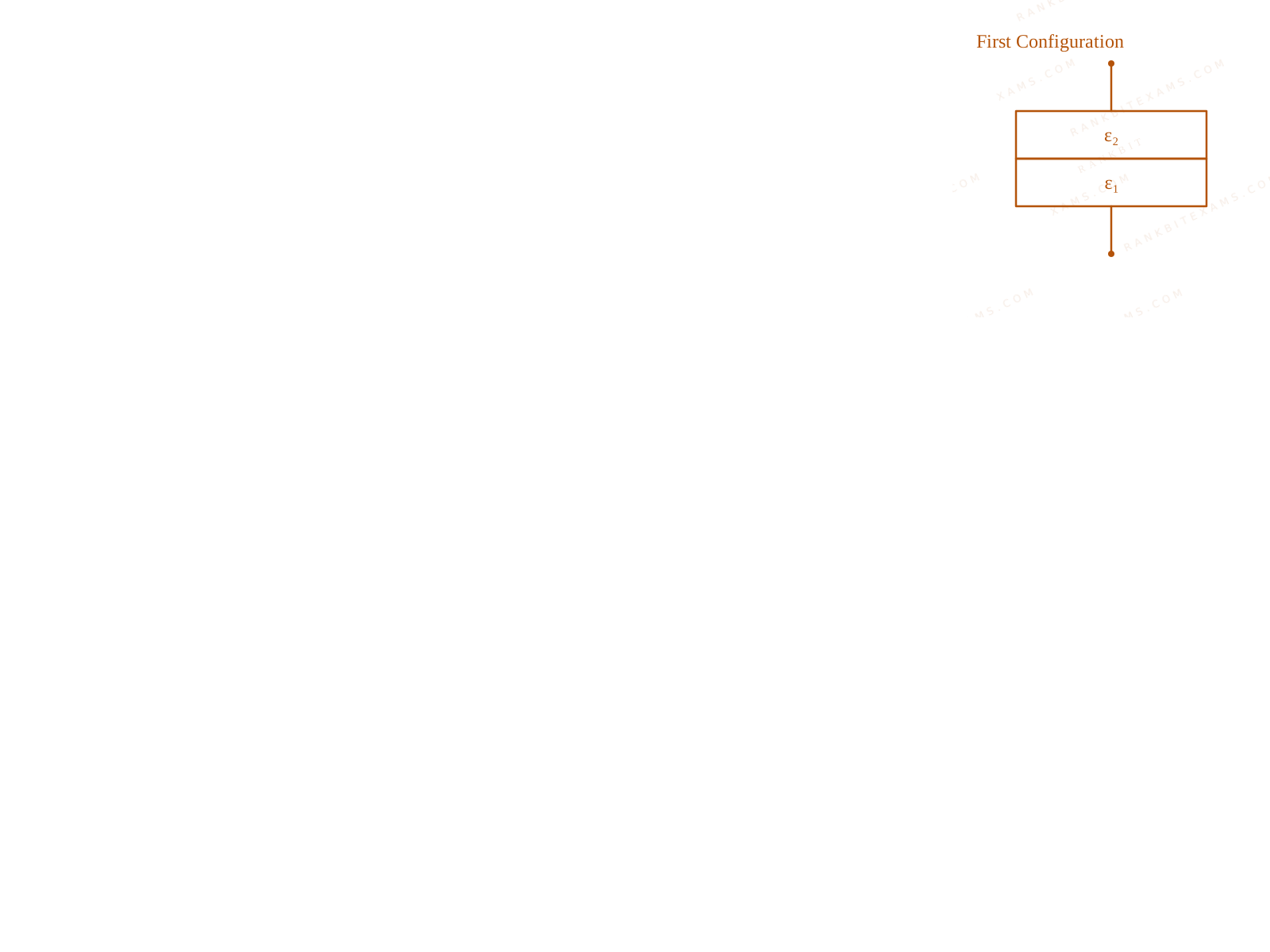
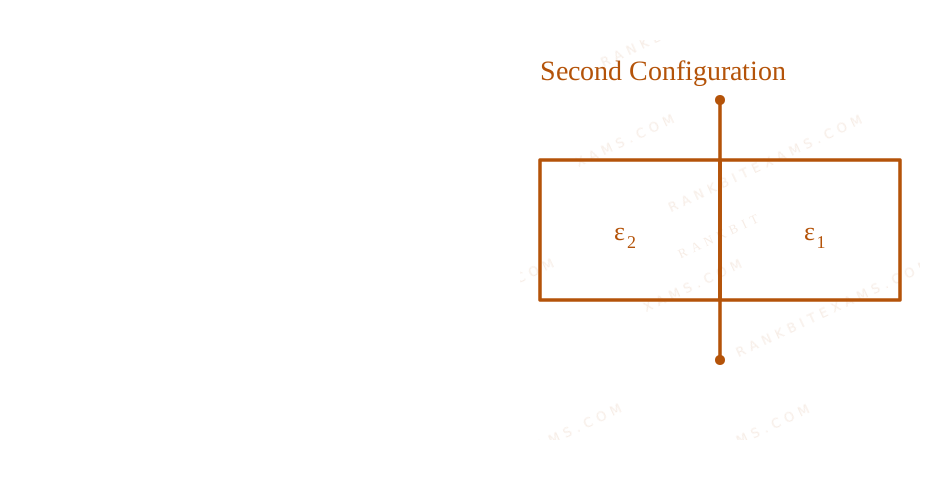
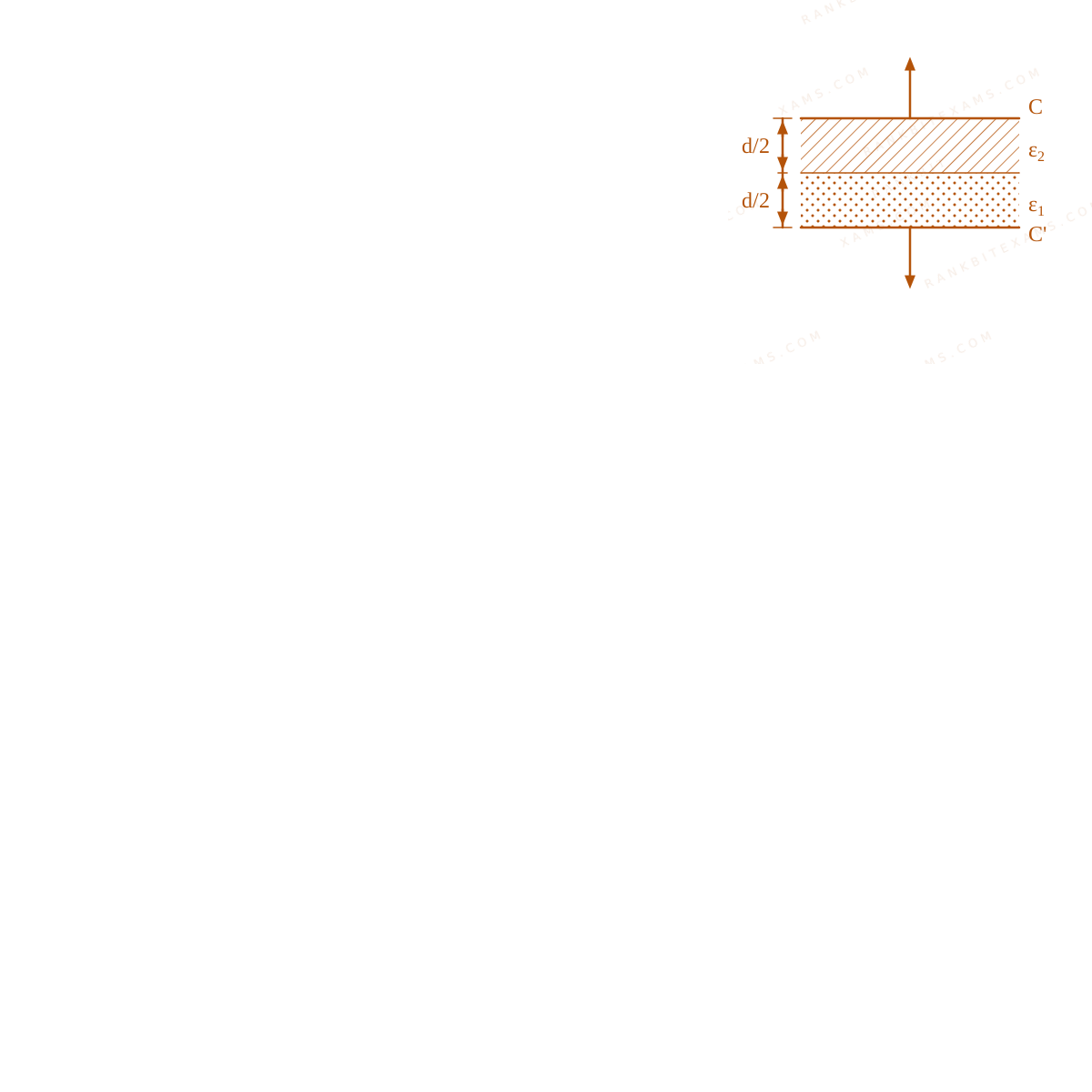
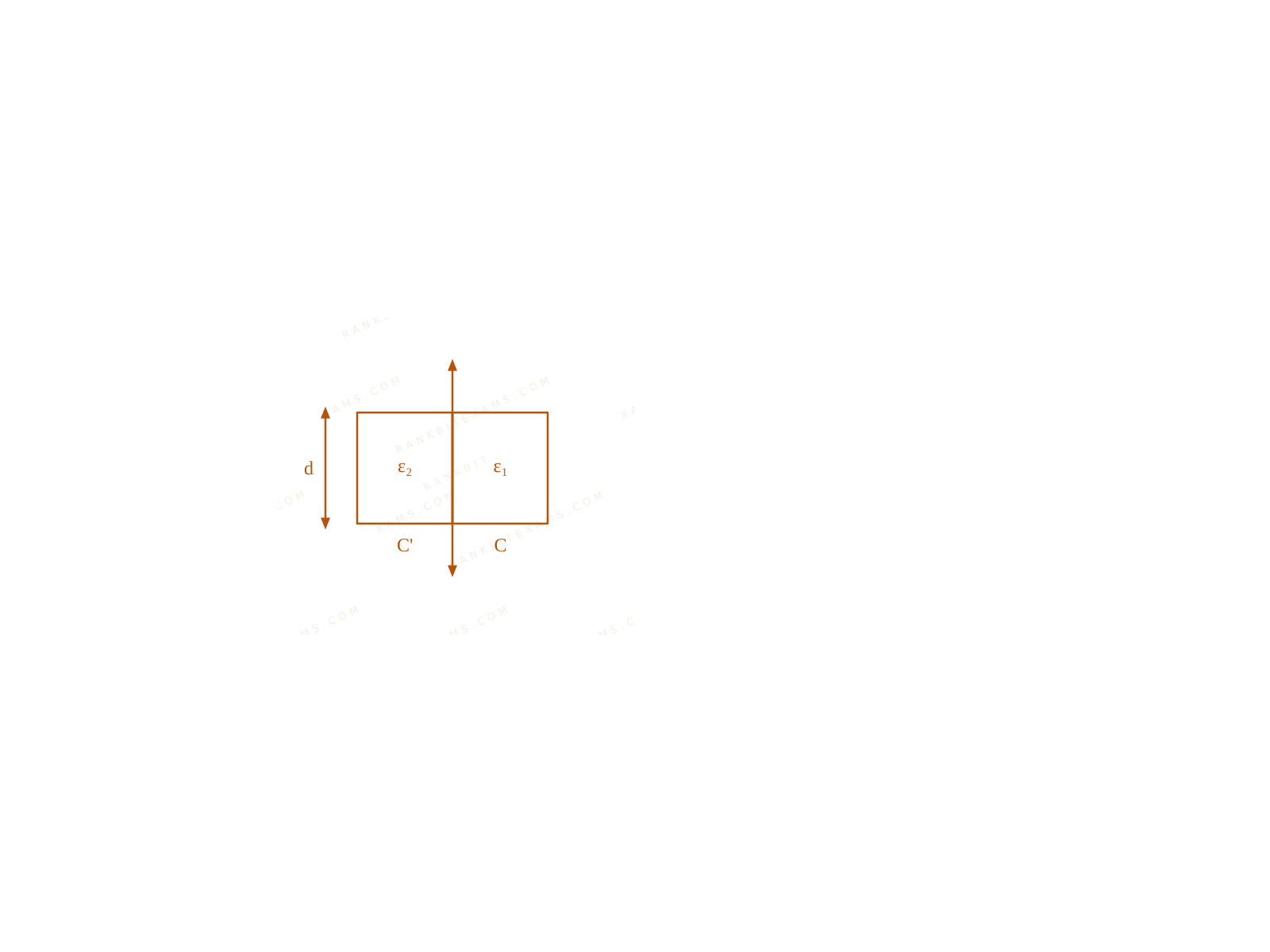
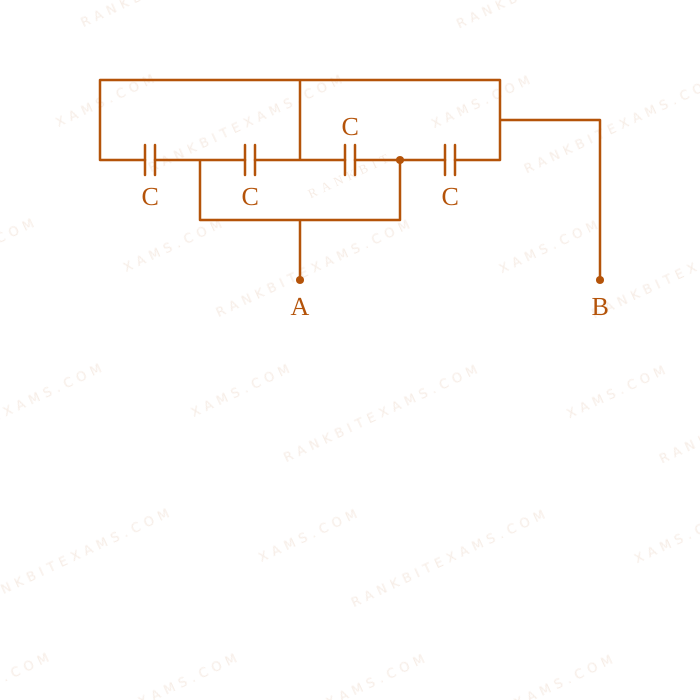
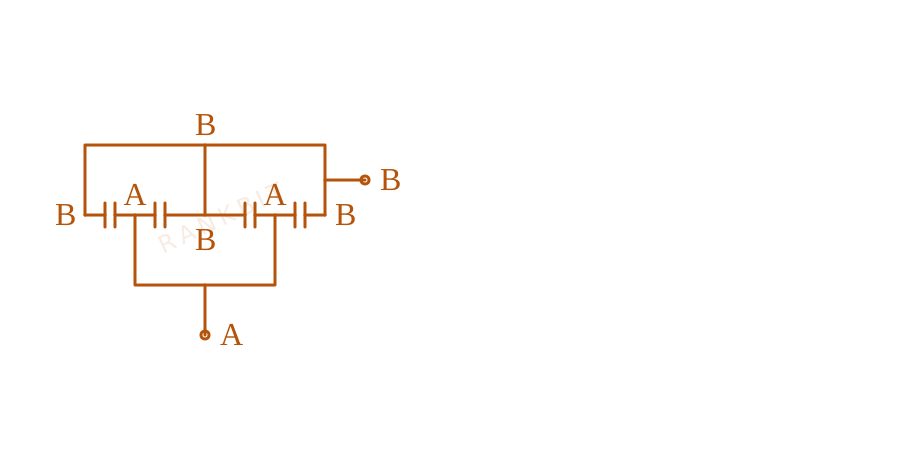
A parallel plate capacitor is filled equally (half) with two dielectrics of dielectric constant varepsilon_1$\varepsilon_1$ and varepsilon_2$\varepsilon_2$, as shown in figures. The distance between the plates is d$d$ and area of each plate is A$A$. If capacitance in first configuration and second configuration are C_1$C_1$ and C_2$C_2$ respectively, then fracC_1C_2$\frac{C_1}{C_2}$ is:
Illustrates two parallel plate configurations: stacked horizontally (series) and stacked vertically (parallel).Illustrates two parallel plate configurations: stacked horizontally (series) and stacked vertically (parallel).
Keywords:#dielectric parallel plate capacitor#capacitance series and parallel#JEE Main 2025 Morning Q8#harmonic arithmetic mean capacitance#dielectric capacitor#series parallel capacitor#dielectric constant ratio
More Electrostatics Previous-Year Questions — Page 4
Q7jee_main_2025_04_april_eveningElectric Field due to Continuous Charge Distribution
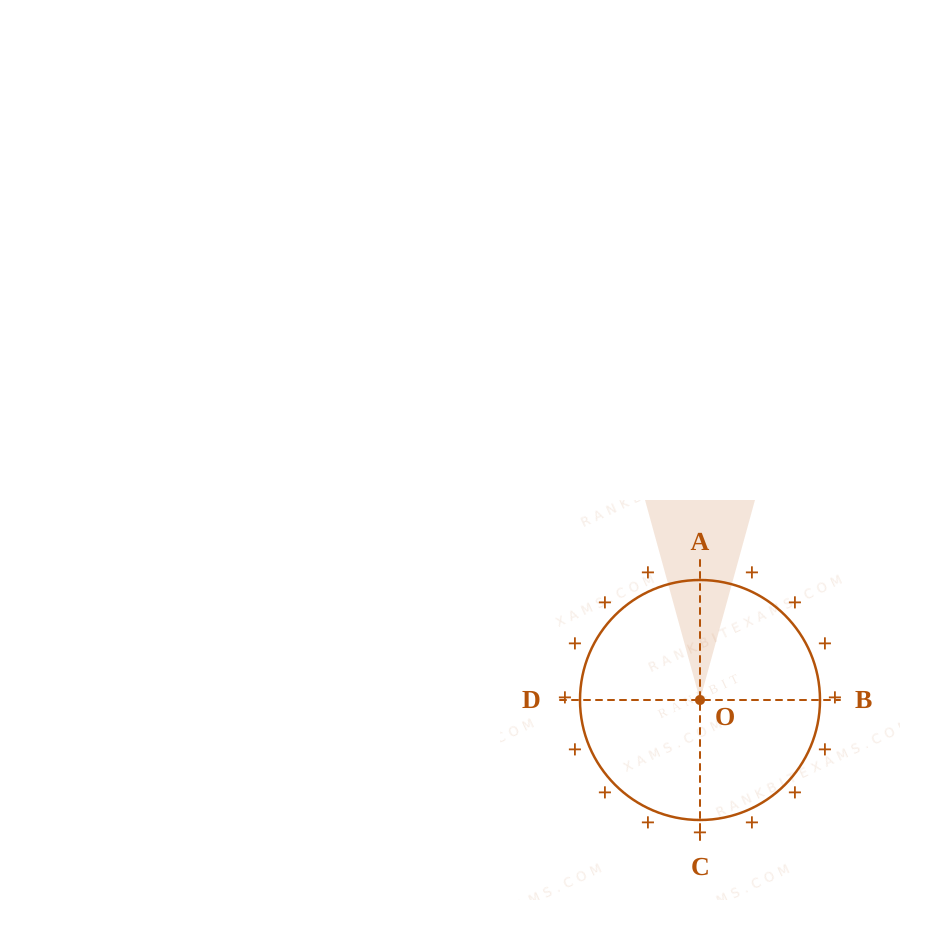
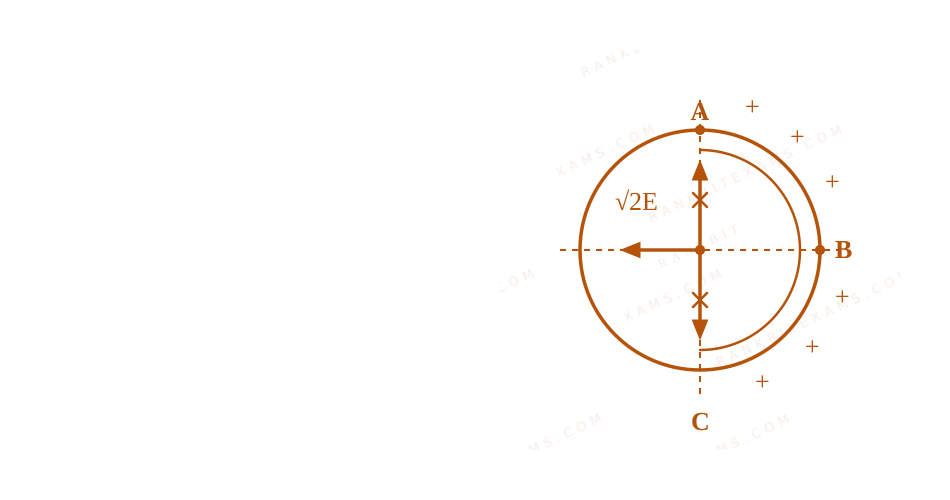
A metallic ring is uniformly charged as shown in figure. AC and BD are two mutually perpendicular diameters. Electric field due to arc AB to 'O' is 'E' is magnitude. What would be the magnitude of electric field at 'O' due to arc ABC? A circle showing perpendicular axes AC and BD dividing it into quadrants.
A.2E$2E$
B.sqrt2E$\sqrt{2}E$
C.E/2$E/2$
D. Zero
Solution
### Related Formula
The electric field due to a circular arc subtending an angle phi$\phi$ at the center is given by:
E_textarc = frac2klambdaR sinleft(fracphi2right)$$E_{\text{arc}} = \frac{2k\lambda}{R} \sin\left(\frac{\phi}{2}\right)$$
### Core Logic
Arc AB subtends 90^circ$90^\circ$ (one quadrant) at the center. The electric field due to it is given as E$E$.
Arc ABC consists of two independent quadrants: arc AB and arc BC.
Each quadrant independently creates an electric field of magnitude E$E$ pointing along the bisector of that specific quadrant.
### Step 1: Vector Addition
The electric field vecE_AB$\vec{E}_{AB}$ is directed at 45^circ$45^\circ$ away from both axes into the third quadrant.
The electric field vecE_BC$\vec{E}_{BC}$ is directed at 45^circ$45^\circ$ towards the matching opposite quadrant.
Since vecE_AB$\vec{E}_{AB}$ and vecE_BC$\vec{E}_{BC}$ are perpendicular to each other, their resultant magnitude is:
E_textnet = sqrtE^2 + E^2 = sqrt2E$$E_{\text{net}} = \sqrt{E^2 + E^2} = \sqrt{2}E$$A circle showing perpendicular axes AC and BD dividing it into quadrants.A circle showing perpendicular axes AC and BD dividing it into quadrants.
### Pattern Recognition
Symmetric components of a ring create orthogonal vector fields. Each 90^circ$90^\circ$ arc produces a field of magnitude E$E$ directed along its angular bisector. Two adjacent quadrants have bisectors separated by 90^circ$90^\circ$, hence use orthogonal vector addition.
### Evaluation Rubric / Model Answer
null
### Chapter Mix
Class 12 Physics: Electrostatics
Q10jee_main_2025_04_april_eveningCapacitors and Dielectrics
Three parallel plate capacitors C_1$C_{1}$, C_2$C_{2}$ and C_3$C_{3}$ each of capacitance 5\ mutextF$5\ \mu\text{F}$ are connected as shown in figure. The effective capacitance between points A and B, when the space between the parallel plates of C_1$C_{1}$ capacitor is filled with a dielectric medium having dielectric constant of 4, is: Schematic of three capacitors with a dielectric insertion highlighted on C1.
A.22.5\ mutextF$22.5\ \mu\text{F}$
B.7.5\ mutextF$7.5\ \mu\text{F}$
C.9\ mutextF$9\ \mu\text{F}$
D.30\ mutextF$30\ \mu\text{F}$
Solution
### Related Formula
Capacitance modification by dielectric:
C' = K cdot C$C' = K \cdot C$
Series combination:
C_textseries = fracC_a C_bC_a + C_b$$C_{\text{series}} = \frac{C_a C_b}{C_a + C_b}$$
Parallel combination:
C_textparallel = C_1 + C_2$$C_{\text{parallel}} = C_1 + C_2$$
### Core Logic
Initial capacitance value C = 5\ mutextF$C = 5\ \mu\text{F}$ for all.
After dielectric insertion into C_1$C_1$, its value becomes:
C_1 = 4 times 5 = 20\ mutextF$$C_1 = 4 \times 5 = 20\ \mu\text{F}$$
The values for the others remain constant:
C_2 = 5\ mutextF, quad C_3 = 5\ mutextF$$C_2 = 5\ \mu\text{F}, \quad C_3 = 5\ \mu\text{F}$$
### Step 1: Circuit Topology Analysis
From the network layout, C_1$C_1$ and C_2$C_2$ are configured in a series arm, which is collectively in parallel with C_3$C_3$.
Equivalent of the series arm:
C_12 = frac20 times 520 + 5 = frac10025 = 4\ mutextF$$C_{12} = \frac{20 \times 5}{20 + 5} = \frac{100}{25} = 4\ \mu\text{F}$$
Adding the parallel branch C_3$C_3$:
C_texteq = C_12 + C_3 = 4 + 5 = 9\ mutextF$$C_{\text{eq}} = C_{12} + C_3 = 4 + 5 = 9\ \mu\text{F}$$
### Pattern Recognition
Identify layout components systematically. Series components simplify via product-over-sum, then combine linearly with parallel components.
### Evaluation Rubric / Model Answer
null
### Chapter Mix
Class 12 Physics: Electrostatics
Q18jee_main_2025_04_april_morningElectric Field Intensity
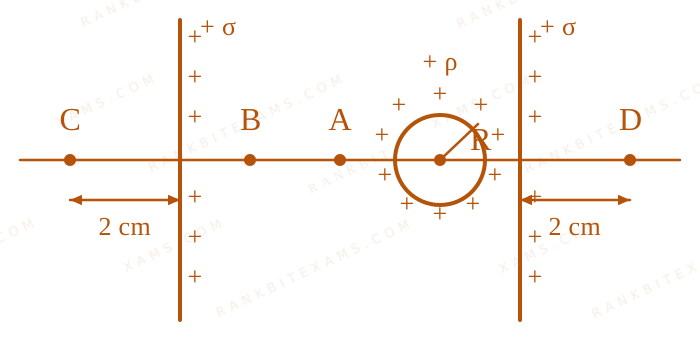
Two infinite identical charged sheets and a charged spherical body of charge density '
ho$
ho$' are arranged as shown in figure. Then the correct relation between the electrical fields at A, B, C and D points is :
The figure illustrates two parallel infinite charged plates with a uniform charge density along with an embedded solid spherical charge mass distributed near reference measurement tags labeled A, B, C, and D.
### Related Formula
Superposition of electric field tracks:
vecE*textnet = vecE*textsheets + vecE*textsphere$$\vec{E}*{\text{net}} = \vec{E}*{\text{sheets}} + \vec{E}*{\text{sphere}}$$
### Core Logic
Evaluate local positional tracking parameters:
* The fields due to the infinite plates add or subtract symmetrically across regions.
* The central sphere introduces a radially varying vector component (E propto frac1r^2$E \propto \frac{1}{r^2}$ outside or E propto r$E \propto r$ inside) whose structural mapping changes direction between symmetric tracking tags.
* At points C$C$ and D$D$, the directional orientation components of the spherical vector directly contrast each other, meaning vecE_C
e vecE_D$\vec{E}_C
e \vec{E}_D$.
* Sifting structural balances reveals field amplification profiles near point A$A$ exceeding local parameters at B$B$ due to positive alignment additions, so vecE_A > vecE_B$\vec{E}_A > \vec{E}_B$.
### Pattern Recognition
Vector fields demand both magnitude and coordinate direction vector compliance. Symmetries can ensure equal scalar values while completely breaking vector equivalence.
### Evaluation Rubric / Model Answer
null
### Chapter Mix
Class 12 Physics: Electrostatics
Q19jee_main_2025_04_april_morningTorque on an Electric Dipole
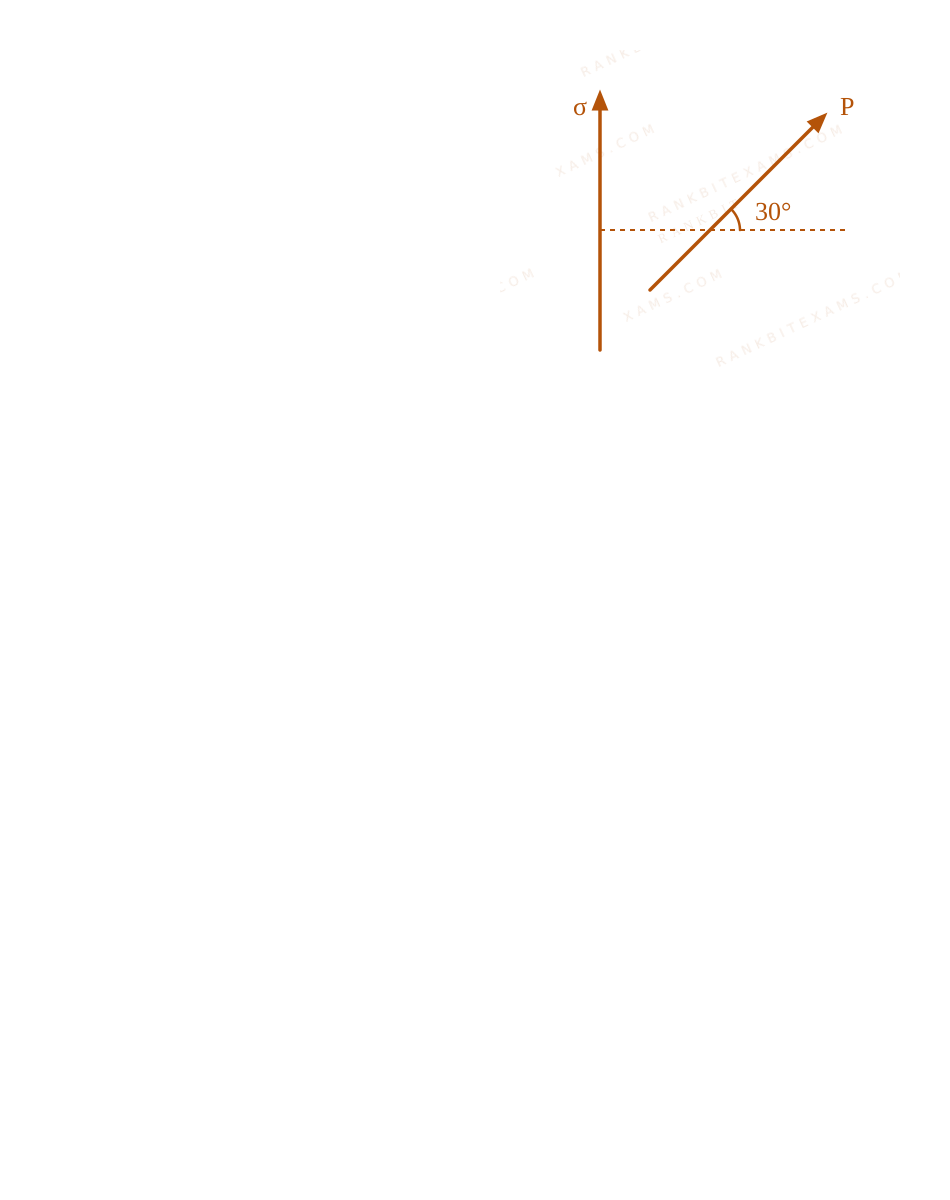
Two small spherical balls of mass 10g each with charges -2mumathrmC$-2mumathrm{C}$ and 2mumathrmC$2mumathrm{C}$, are attached to two ends of very light rigid rod of length 20 cm. The arrangement is now placed near an infinite non-conducting charge sheet with uniform charge density of 100mumathrmC/m^2$100mumathrm{C/m}^{2}$ such that length of rod makes an angle of 30^circ$30^{\circ}$ with electric field generated by charge sheet. Net torque acting on the rod is:
(Take epsilon*o = 8.85times10^-12mathrmC^2/mathrmNm^2$\epsilon*{o} = 8.85\times10^{-12}\mathrm{C}^{2}/\mathrm{Nm}^{2}$)
A. 112 Nm
B. 1.12 Nm
C. 2.24 Nm
D. 11.2 Nm
Solution
### Related Formula
Electric field due to an infinite non-conducting sheet:
E = fracsigma2epsilon_0$$E = \frac{\sigma}{2\epsilon_0}$$
Torque on an electric dipole configuration:
tau = p E sintheta$$\tau = p E \sin\theta$$
where p = q cdot d$p = q \cdot d$ (dipole moment).
### Core Logic
Given parameters:
* Charge, q = 2 times 10^-6mathrm~C$q = 2 \times 10^{-6}\mathrm{~C}$
* Separation length, d = 20mathrm~cm = 0.2mathrm~m$d = 20\mathrm{~cm} = 0.2\mathrm{~m}$
* Charge density, sigma = 100 times 10^-6mathrm~C/m^2$\sigma = 100 \times 10^{-6}\mathrm{~C/m}^2$
* Orientation angle, theta = 30^circ$\theta = 30^{\circ}$
### Step 1: Compute Field and Torque Value
First, evaluate the field matrix strength value:
E = frac100 times 10^-62 times 8.85 times 10^-12$$E = \frac{100 \times 10^{-6}}{2 \times 8.85 \times 10^{-12}}$$
Now insert everything into the torque expression:
tau = (q cdot d) cdot E cdot sin(30^circ)$$\tau = (q \cdot d) \cdot E \cdot \sin(30^{\circ})$$tau = left[ (2 times 10^-6) cdot (0.2)
ight] cdot left[ frac100 times 10^-62 times 8.85 times 10^-12
ight] cdot left( frac12
ight)$$\tau = \left[ (2 \times 10^{-6}) \cdot (0.2)
ight] \cdot \left[ \frac{100 \times 10^{-6}}{2 \times 8.85 \times 10^{-12}}
ight] \cdot \left( \frac{1}{2}
ight)$$tau = frac108.85 approx 1.12mathrm~Nm$$\tau = \frac{10}{8.85} \approx 1.12\mathrm{~Nm}$$Dipole torque vector field distribution alignment for Q19 - JEE Main 2025 Morning
### Pattern Recognition
Equal and opposite charges separated by a fixed distance form an electric dipole. The torque in a uniform electric field depends exclusively on the dipole moment value, field strength, and the sine of the orientation angle.
### Evaluation Rubric / Model Answer
null
### Chapter Mix
Class 12 Physics: Electrostatics
Q24jee_main_2025_04_april_morningCombination of Capacitors
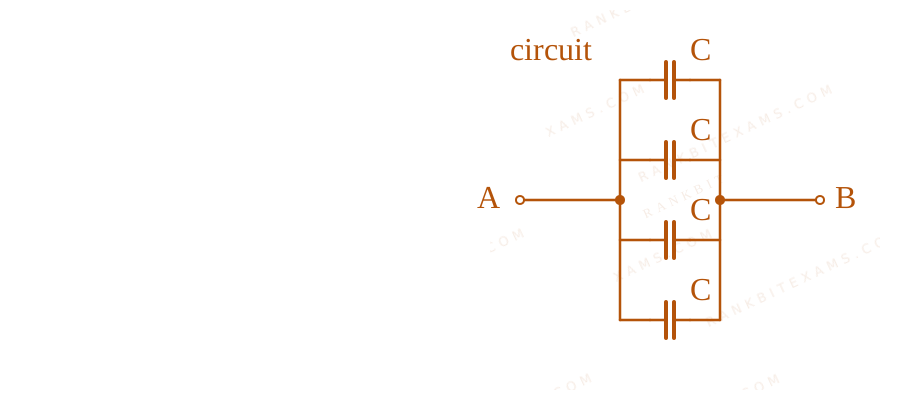
Four capacitor each of capacitance 16mumathrmF$16mumathrm{F}$ are connected as shown in the figure. The capacitance between points A and B is: (in mumathrmF$mumathrm{F}$).
The figure details an interconnected array layout composed of four identical storage components branching outwards between primary measurement terminals A and B.
Numerical Answer.Answer: 64 to 64
Solution
### Related Formula
Equivalent capacitance for a parallel configuration network:
C_texteq = C_1 + C_2 + C_3 + dots$$C_{\text{eq}} = C_1 + C_2 + C_3 + dots$$
### Core Logic
By tracing node connectivity potentials carefully throughout the short-circuit wire paths, we can label the plates of all four capacitors.
The figure details an interconnected array layout composed of four identical storage components branching outwards between primary measurement terminals A and B.
Redrawing the circuit connection matrix map reveals that all 4 capacitors are connected directly in parallel between node terminal A and node terminal B.
### Step 1: Calculate Equivalent Value
Since they are in parallel:
C_texteq = 4 cdot C$$C_{\text{eq}} = 4 \cdot C$$
Given each individual element carries C = 16mumathrmF$C = 16mumathrm{F}$:
C_texteq = 4 times 16 = 64mumathrmF$$C_{\text{eq}} = 4 \times 16 = 64mumathrm{F}$$The figure details an interconnected array layout composed of four identical storage components branching outwards between primary measurement terminals A and B.
### Pattern Recognition
Shorting loops across alternate terminals routinely unravels interlocking rows back into straightforward parallel grids. Always trace and label nodes first.
### Evaluation Rubric / Model Answer
null
### Chapter Mix
Class 12 Physics: Electrostatics
More Electrostatics Questions — jee_main_2025_03_april_morning
We Map Every Repeating Question in Competitive Exams.
Say goodbye to generic mock test fatigue. RankBit uses smart analysis to group past exam questions into their foundational Repeating Question Types. Find chapter weightage, track repeating questions, and score higher with targeted practice.
Select Your Target Exam
Choose an exam track below to find formulas per chapter and patterns.
Syncing Exam Intelligence
Mapping formulas and patterns across all tracks…
PATH A — FULL LENGTH PRACTICE
Full Mock Test Hub
Simulate real NTA exam conditions with fully tracked mocks. Time yourself against past papers.
Practice past-year questions one chapter at a time. Pick an exam → subject → chapter and get every PYQ for that topic — pulled together from all past papers — with the chapter's key formulas alongside.