A wire of length 25~m$25\mathrm{~m}$ and cross-sectional area 5~mm²$5\mathrm{~mm}^2$ having resistivity of 2× 10⁻⁶Ω~m$2\times 10^{-6}\Omega\mathrm{~m}$ is bent into a complete circle. The resistance between diametrically opposite points will be:
A.12.5Ω$12.5\Omega$
B.50Ω$50\Omega$
C.100Ω$100\Omega$
D.25Ω$25\Omega$
Solution & Explanation
Related Formula
Resistance of a uniform wire:
R = (ρ L)/(A)$$R = \frac{\rho L}{A}$$
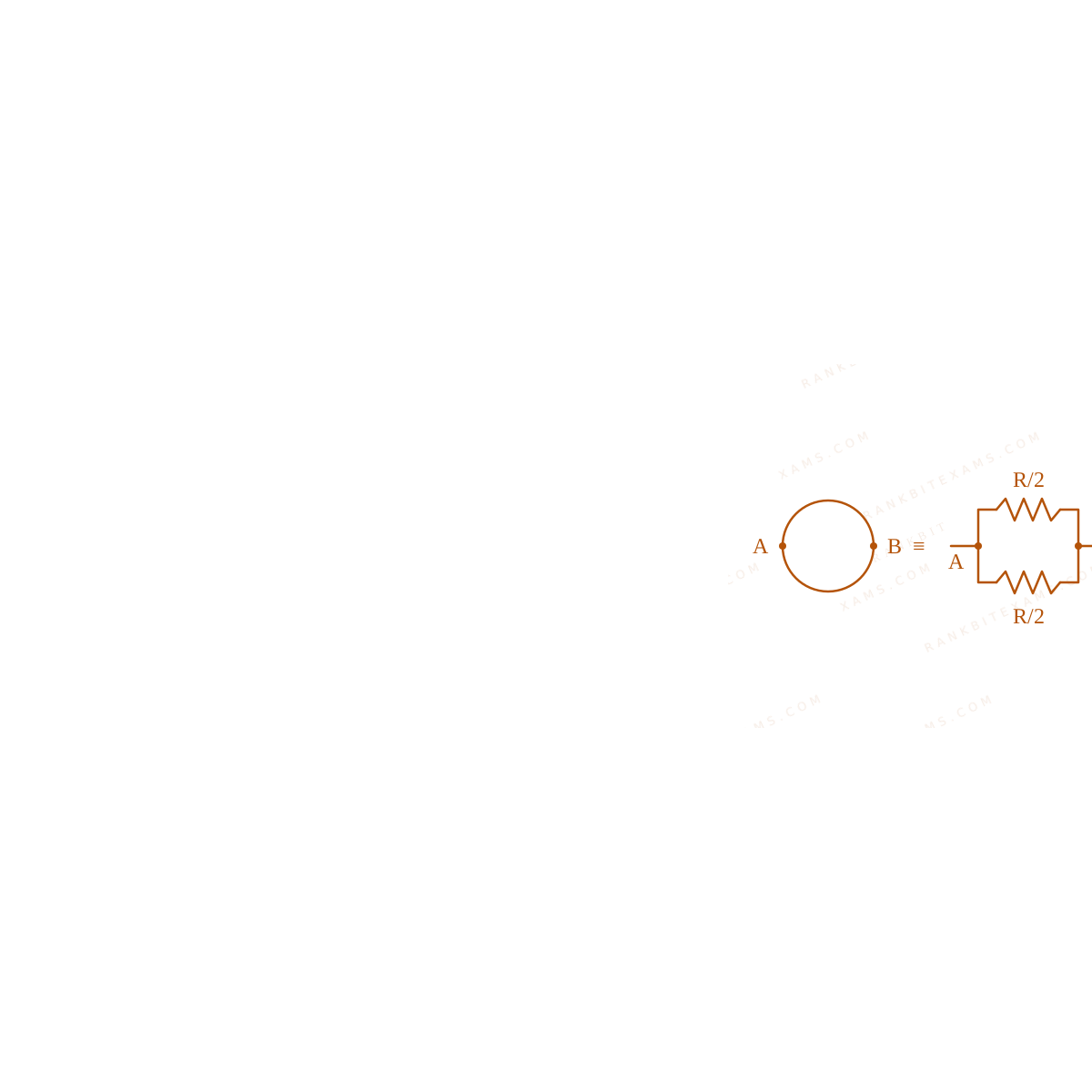
Equivalent resistance of two identical resistors in parallel:
When the wire is bent into a complete circle, measuring the resistance between two diametrically opposite points splits the wire into two parallel halves of equal length.
Circular loop splitting resistance across diameter for Q5
Step 2: Conclusion & Discrepancy
The actual mathematically rigorous answer is 2.5Ω$2.5\Omega$. Since 2.5Ω$2.5\Omega$ is not present in the given options, the question is marked as a Bonus question by standard key evaluation guidelines. If forced to choose a theoretical option due to printing mistakes, some keys may relate it to 10Ω / 4 = 2.5Ω$10\Omega / 4 = 2.5\Omega$, but scientifically it stands as a bonus.
Pattern Recognition
Shortcut: A wire of total resistance R$R$ bent into a circle has an effective resistance across its diameter equal to Req = R/4$R_{\text{eq}} = R/4$. Memorize this ratio! Here R = 10Ω$R = 10\Omega$, so Req = 10/4 = 2.5Ω$R_{\text{eq}} = 10/4 = 2.5\Omega$.
Keywords:#wire bent into circle resistance#JEE Main 2025 Morning Q5#diametrically opposite resistance#Current electricity parallel loop
More Current Electricity Previous-Year Questions — Page 8
Qjee_main_2024_27_jan_morningCapacitor in DC Circuit
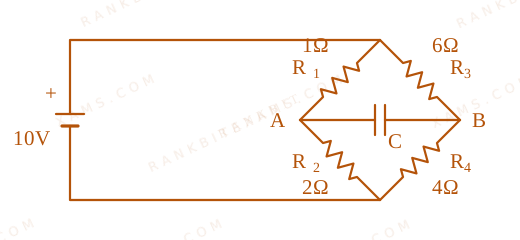
The charge accumulated on the capacitor connected in the following circuit is ______ $\mu\text{C}$. (Given C = 150$C = 150\ \mu\text{F}$).
The layout shows an integrated network of resistors labeled R1 to R4 powered by a 10V DC source loop with a branch housing a 150 uF capacitor element bridging distinct structural potential nodes.
The layout shows an integrated network of resistors labeled R1 to R4 powered by a 10V DC source loop with a branch housing a 150 uF capacitor element bridging distinct structural potential nodes.
Numerical Answer.Answer: 400 to 400
Solution
Related Formula
Q = C · Δ VC$$Q = C \cdot \Delta V_C$$
Core Logic
In steady state, no current flows through the capacitor branch. Analyze potential levels at node loops using standard Kirchhoff mesh values mapped across the core loop resistors:
Steady state capacitor loops act as open electrical cuts, transforming active mesh equations into simple layout node checks.
Chapter Mix
Class 12 Physics: Current Electricity
Q48jee_main_2024_27_jan_morningMeter Bridge and Resistivity
A wire of length 10 cm$10\text{ cm}$ and radius √(7) × 10⁻⁴ m$\sqrt{7} \times 10^{-4}\text{ m}$ is connected across the right gap of a meter bridge. When a resistance of 4.5 Ω$4.5\ \Omega$ is connected on the left gap by using a resistance box, the balance length is found to be at 60 cm$60\text{ cm}$ from the left end.
If the resistivity of the wire is R × 10⁻⁷$R \times 10^{-7}\ \Omega\text{m}$, then the value of R$R$ is:
Given ρ = R × 10⁻⁷$\rho = R \times 10^{-7}$, comparing coefficients gives:
R = 66$R = 66$
Pattern Recognition
Meter bridge balance simplifies directly to simple scalar component checks. The √(7)$\sqrt{7}$ term perfectly neutralizes the fractional (22)/(7)$\frac{22}{7}$ constant in circular area profiles.
Chapter Mix
Class 12 Physics: Current Electricity
Q49jee_main_2024_27_jan_morningCombination of Resistors
A wire of resistance R$R$ and length L$L$ is cut into 5$5$ equal parts. If these parts are joined parallely, then the resultant resistance will be:
A.(1)/(25)R$\frac{1}{25}R$
B.(1)/(5)R$\frac{1}{5}R$
C.25R$25R$
D.5R$5R$
Solution
Core Logic
Resistance is directly proportional to length (R ∝ L$R \propto L$). Cutting the wire into 5 equal pieces reduces the resistance of each segment to:
R' = (R)/(5)$$R' = \frac{R}{5}$$
Step 1: Compute parallel value
Connecting 5 identical resistors R'$R'$ in parallel gives a total equivalent resistance of:
Cutting an item into N$N$ components and grouping them in parallel scales the overall baseline systemic value down cleanly by a factor of N²$N^2$.
Chapter Mix
Class 12 Physics: Current Electricity
Qjee_main_2024_29_jan_morningKirchhoff's Laws and RC Circuits
A 16 Ω$16 \, \Omega$ wire is bend to form a square loop. A 9V battery with internal resistance 1 Ω$1 \, \Omega$ is connected across one of its sides. If a 4 μ F$4 \, \mu \mathrm{F}$ capacitor is connected across one of its diagonals, the energy stored by the capacitor will be (x)/(2) μ J$\frac{x}{2} \, \mu \mathrm{J}$. where x =$x = $ _________.
Numerical Answer.Answer: 81 to 81
Solution
Related Formula
Energy stored (U$U$) by a capacitor of capacitance C$C$ under steady state voltage VC$V_C$:
U = (1)/(2) C VC²$$U = \frac{1}{2} C V_C^2$$
Core Logic
A wire of resistance 16 Ω$16 \, \Omega$ is bent into a square, so each of the 4 sides has a resistance of:
The battery is connected across one side. Let this side have resistance 4 Ω$4 \, \Omega$. The remaining three sides are connected in series, creating a parallel branch with a combined resistance of:
Step 3: Find Potential Difference across the Diagonal
In a steady state, the capacitor acts as an open circuit. Let the diagonal link nodes be A$A$ and B$B$. The path contains two sides of the 12 Ω$12 \, \Omega$ branch (total resistance = 8 Ω$8 \, \Omega$):
Comparing this directly with the expression (x)/(2) μ J$\frac{x}{2} \, \mu \mathrm{J}$:
x = 81$x = 81$
Therefore, the value of x$x$ is 81$81$.
Pattern Recognition
Remember that capacitors act as standard open circuits when reaching steady-state DC conditions. Simply calculate the node potentials across the bridge connection points using standard current distribution laws first, then execute the energy equation.
Chapter Mix
Class 12 Physics: Current Electricity
Class 12 Physics: Electrostatic Potential and Capacitance
Q32jee_main_2024_29_jan_morningElectric Current and Charge
The electric current through a wire varies with time as I = I₀ + β t$I = I_0 + \beta t$, where I₀ = 20 ~A$I_0 = 20 \mathrm{~A}$ and β = 3 ~A / s$\beta = 3 \mathrm{~A / s}$. The amount of electric charge crossed through a section of the wire in 20 ~s$20 \mathrm{~s}$ is:
A.80 ~C$80 \mathrm{~C}$
B.1000 ~C$1000 \mathrm{~C}$
C.800 ~C$800 \mathrm{~C}$
D.1600 ~C$1600 \mathrm{~C}$
Solution
Related Formula
The relationship between current, charge, and time is given by:
I = (dq)/(dt) q = ∫ I dt$$I = \frac{dq}{dt} \implies q = \int I \, dt$$
Core Logic
Given the current variation:
I = I₀ + β t$$I = I_0 + \beta t$$
Substituting the given values, I₀ = 20 ~A$I_0 = 20 \mathrm{~A}$ and β = 3 ~A/s$\beta = 3 \mathrm{~A/s}$:
I = 20 + 3t$I = 20 + 3t$
Thus:
(dq)/(dt) = 20 + 3t$$\frac{dq}{dt} = 20 + 3t$$
Step 1: Integrate to Find Charge
To find the total charge crossing a section of wire from t = 0$t = 0$ to t = 20 ~s$t = 20 \mathrm{~s}$:
Therefore, the charge crossed is 1000 ~C$1000 \mathrm{~C}$.
Pattern Recognition
Whenever current is given as a function of time I(t)$I(t)$, the total charge is simply the area under the I-t$I-t$ curve, which mathematically corresponds to the definite integral ∫t₁t₂ I(t) dt$\int_{t_1}^{t_2} I(t) \, dt$.
Chapter Mix
Class 12 Physics: Current Electricity
More Current Electricity Questions — jee_main_2025_03_april_morning
Practice past-year questions one chapter at a time. Pick an exam → subject → chapter and get every PYQ for that topic — pulled together from all past papers — with the chapter's key formulas alongside.