A wire of length 25~m$25\mathrm{~m}$ and cross-sectional area 5~mm²$5\mathrm{~mm}^2$ having resistivity of 2× 10⁻⁶Ω~m$2\times 10^{-6}\Omega\mathrm{~m}$ is bent into a complete circle. The resistance between diametrically opposite points will be:
A.12.5Ω$12.5\Omega$
B.50Ω$50\Omega$
C.100Ω$100\Omega$
D.25Ω$25\Omega$
Solution & Explanation
Related Formula
Resistance of a uniform wire:
R = (ρ L)/(A)$$R = \frac{\rho L}{A}$$
Equivalent resistance of two identical resistors in parallel:
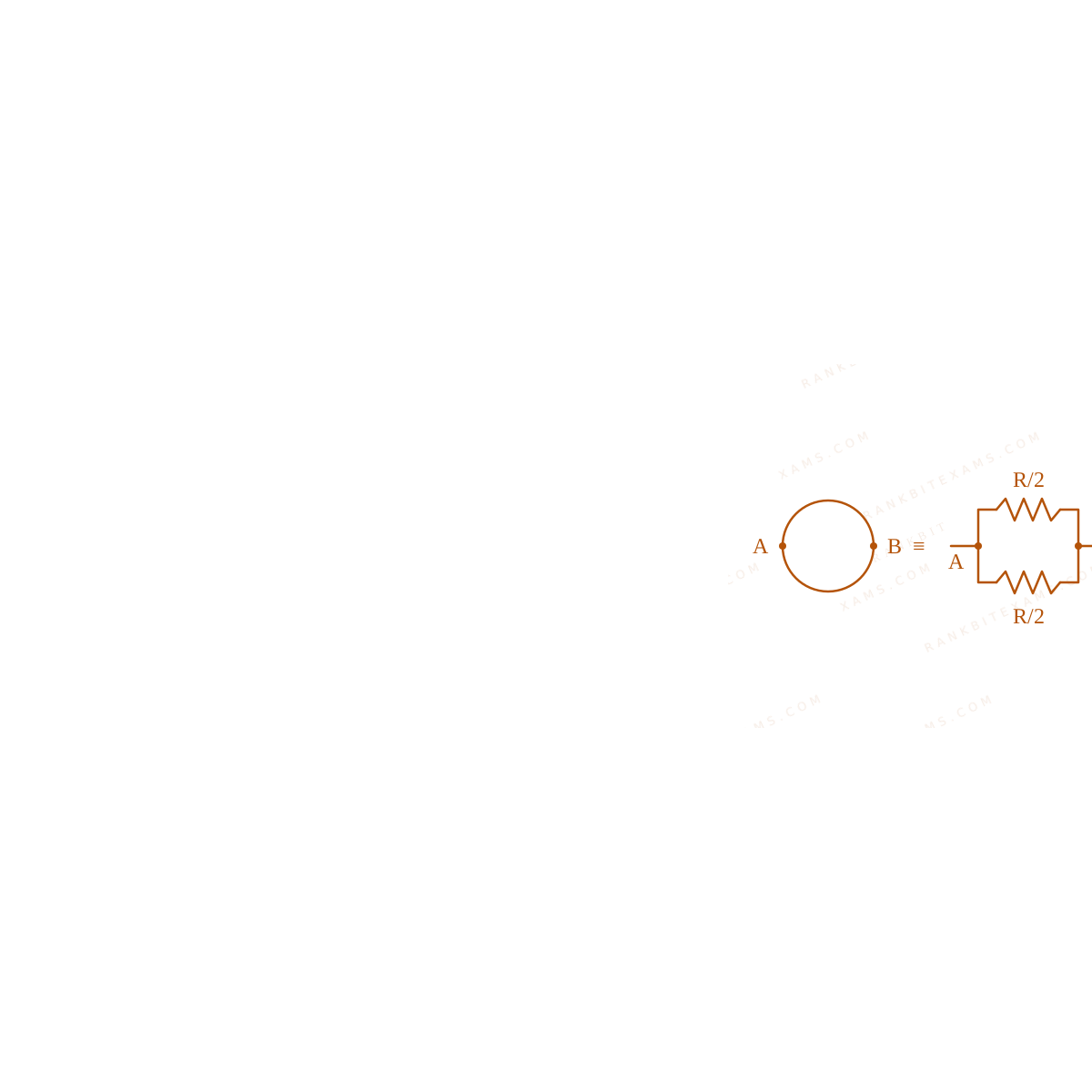
When the wire is bent into a complete circle, measuring the resistance between two diametrically opposite points splits the wire into two parallel halves of equal length.
Circular loop splitting resistance across diameter for Q5
Step 2: Conclusion & Discrepancy
The actual mathematically rigorous answer is 2.5Ω$2.5\Omega$. Since 2.5Ω$2.5\Omega$ is not present in the given options, the question is marked as a Bonus question by standard key evaluation guidelines. If forced to choose a theoretical option due to printing mistakes, some keys may relate it to 10Ω / 4 = 2.5Ω$10\Omega / 4 = 2.5\Omega$, but scientifically it stands as a bonus.
Pattern Recognition
Shortcut: A wire of total resistance R$R$ bent into a circle has an effective resistance across its diameter equal to Req = R/4$R_{\text{eq}} = R/4$. Memorize this ratio! Here R = 10Ω$R = 10\Omega$, so Req = 10/4 = 2.5Ω$R_{\text{eq}} = 10/4 = 2.5\Omega$.
Keywords:#wire bent into circle resistance#JEE Main 2025 Morning Q5#diametrically opposite resistance#Current electricity parallel loop
More Current Electricity Previous-Year Questions — Page 2
Q36jee_main_2026_22_january_eveningPower Transmission and Efficiency
An electric power line having total resistance of 2 Ω$2 \Omega$, delivers 1 kW of power of 250 V. The percentage efficiency of transmission line is ____.
A.96.9$96.9$
B.86.5$86.5$
C.100$100$
D.92.5$92.5$
Solution
Related Formula
Pout = V · I$$P_{\text{out}} = V \cdot I$$Ploss = I² R$$P_{\text{loss}} = I^2 R$$η = ( PoutPₙₑₜ) × 100%$$\eta = \left(\frac{P_{\text{out}}}{P_{\text{net}}}\right) \times 100\%$$
Core Logic
Calculating total current I$I$:
1000 = 250 × I I = 4 ~A$$1000 = 250 \times I \implies I = 4 \mathrm{~A}$$
Calculating power loss along the line Ploss$P_{\text{loss}}$:
The percentage efficiency of the transmission line is 96.9%$96.9\%$.
Pattern Recognition
Efficiency formula: η = PoutPout + I² R × 100%$\eta = \frac{P_{\text{out}}}{P_{\text{out}} + I^2 R} \times 100\%$.
Current I = 1000/250 = 4~A$I = 1000/250 = 4\mathrm{~A}$. Loss = 16 × 2 = 32~W$= 16 \times 2 = 32\mathrm{~W}$. η = 1000/1032 = 96.9%$\eta = 1000/1032 = 96.9\%$.
Chapter Mix
Class 12 Physics: Current Electricity
Q49jee_main_2026_22_january_eveningDrift Velocity and Electron Mobility
A cylindrical conductor of length 2m and area of cross-section 0.2 ~mm²$0.2 \mathrm{~mm}^2$ carries an electric current of 1.6 A when its ends are connected to a 2V battery. Mobility of electrons in the conductor is α × 10⁻³ ~m²/V⋯$\alpha \times 10^{-3} \mathrm{~m}^2/\mathrm{V}\cdot\mathrm{s}$. The value of α$\alpha$ is :
(electron concentration = 5 × 10²⁸/m³$5 \times 10^{28}/\mathrm{m}^3$ and electron charge = 1.6 × 10⁻¹⁹$1.6 \times 10^{-19}$ C)
Numerical Answer.Answer: 1 to 1
Solution
Related Formula
I = n e A vd$I = n e A v_d$
vd = μ E = μ (V)/(l)$$v_d = \mu E = \mu \frac{V}{l}$$μ = (I l)/(n e A V)$$\mu = \frac{I l}{n e A V}$$
Core Logic
Combining current density and mobility equations:
I = n e A (μ (V)/(l)) μ = (I · l)/(n · e · A · V)$$I = n e A \left(\mu \frac{V}{l}\right) \implies \mu = \frac{I \cdot l}{n \cdot e \cdot A \cdot V}$$
Substituting given values I = 1.6 ~A, l = 2 ~m, n = 5 × 10²⁸ /m³, e = 1.6 × 10⁻¹⁹ ~C, A = 0.2 × 10⁻⁶ ~m², V = 2 ~V$I = 1.6 \mathrm{~A}, l = 2 \mathrm{~m}, n = 5 \times 10^{28} /\mathrm{m}^3, e = 1.6 \times 10^{-19} \mathrm{~C}, A = 0.2 \times 10^{-6} \mathrm{~m}^2, V = 2 \mathrm{~V}$:
Mobility formula: μ = I l / (n e A V)$\mu = I l / (n e A V)$. Direct parameter plug-in yields α = 1$\alpha = 1$.
Chapter Mix
Class 12 Physics: Current Electricity
Q34jee_main_2026_23_january_morningResistance and Ohm's Law
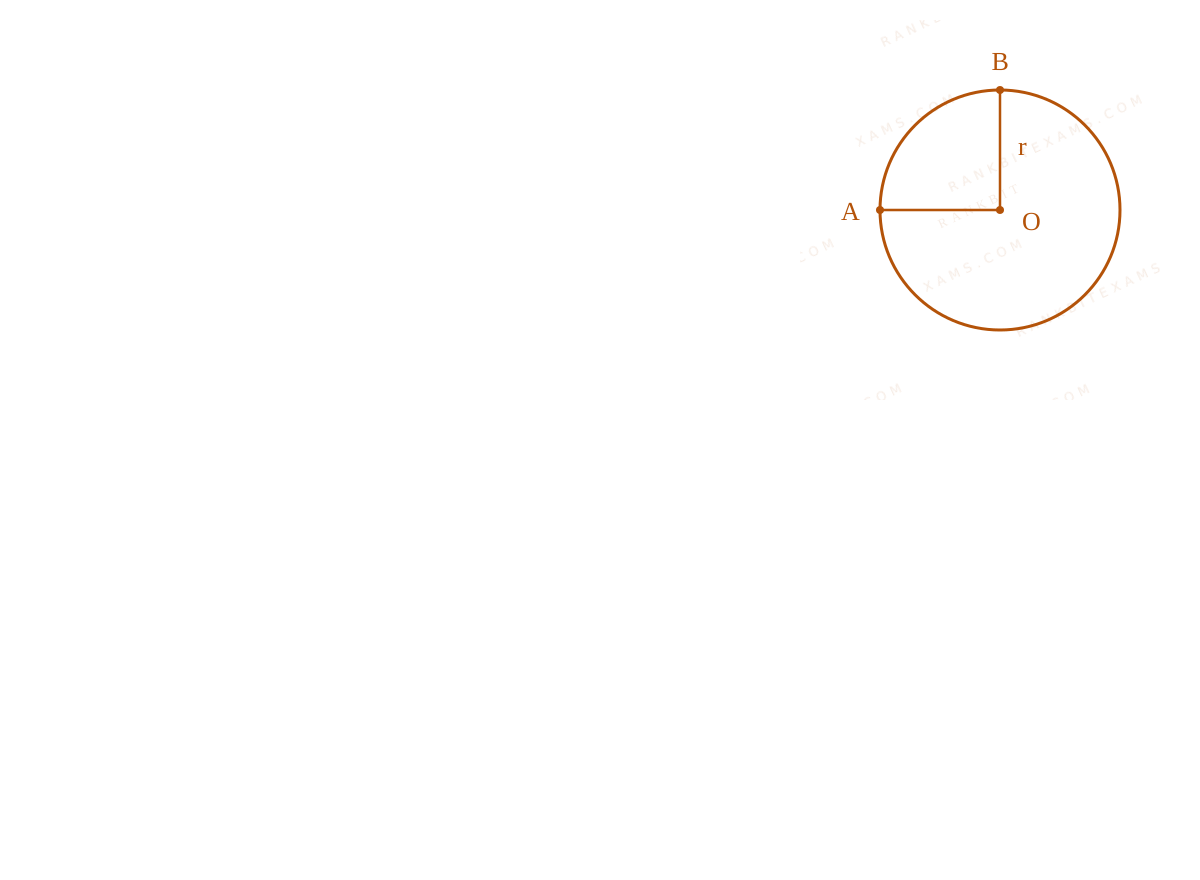
A wire of uniform resistance λΩ/m$\lambda\Omega/m$ is bent into a circle of radius r and another piece of wire with length 2r is connected between points A and B (AOB) as shown in figure. The equivalent resistance between points A and B is ____ Ω$\Omega$.
A ring with nodes A and B connected across a diameter forming parallel branches.
The system represents three resistors connected in parallel between nodes A and B: the upper arc, the lower arc, and the straight diameter wire. Using R = λ L$R = \lambda L$ where λ$\lambda$ is resistance per unit length.
RAB = λ r ((6π)/(16 + 3π))$$R_{AB} = \lambda r \left(\frac{6\pi}{16 + 3\pi}\right)$$
Pattern Recognition
Sees: "Uniform resistance wire bent into shape" → immediately break the shape down into parallel/series segments defined purely by their arc/line lengths multiplied by the linear density λ$\lambda$.
To compare EMF of two cells using potentiometer the balancing lengths obtained are 200 cm and 150 cm. The least count of scale is 1 cm. The percentage error in the ratio of EMFs is ____
Note: The calculated exact percentage error is 1.16%, which does not match any of the provided options exactly. The closest official option provided was tracked as index (2) marking 1.65 by some keys, though technically a bonus question.
Chapter Mix
Class 12 Physics: Current Electricity
Class 11 Physics: Units and Measurements
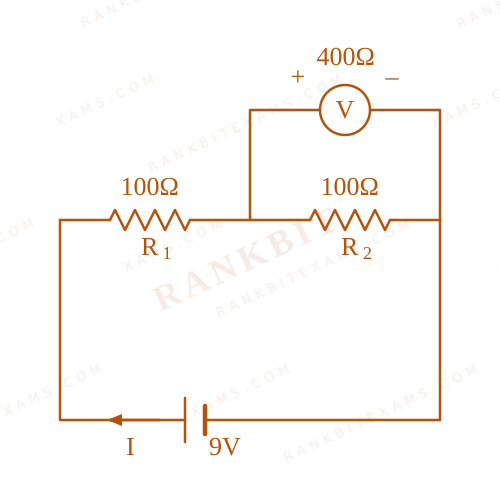
Two resistors of 100 Ω$100 \, \Omega$ each are connected in series with a 9V battery. A voltmeter of 400Ω$400\Omega$ resistance is connected to measure the voltage drop across one of the resistors. The voltmeter reading is ____ V.
Practice past-year questions one chapter at a time. Pick an exam → subject → chapter and get every PYQ for that topic — pulled together from all past papers — with the chapter's key formulas alongside.