JEE Main · Chemistry ↓ Falling

Biomolecules appeared 36 times across 3 years — 4.2% of Chemistry. This question is from Carbohydrate Structures.

Year 2026 2025 2024 Total
Questions 9 19 8 36

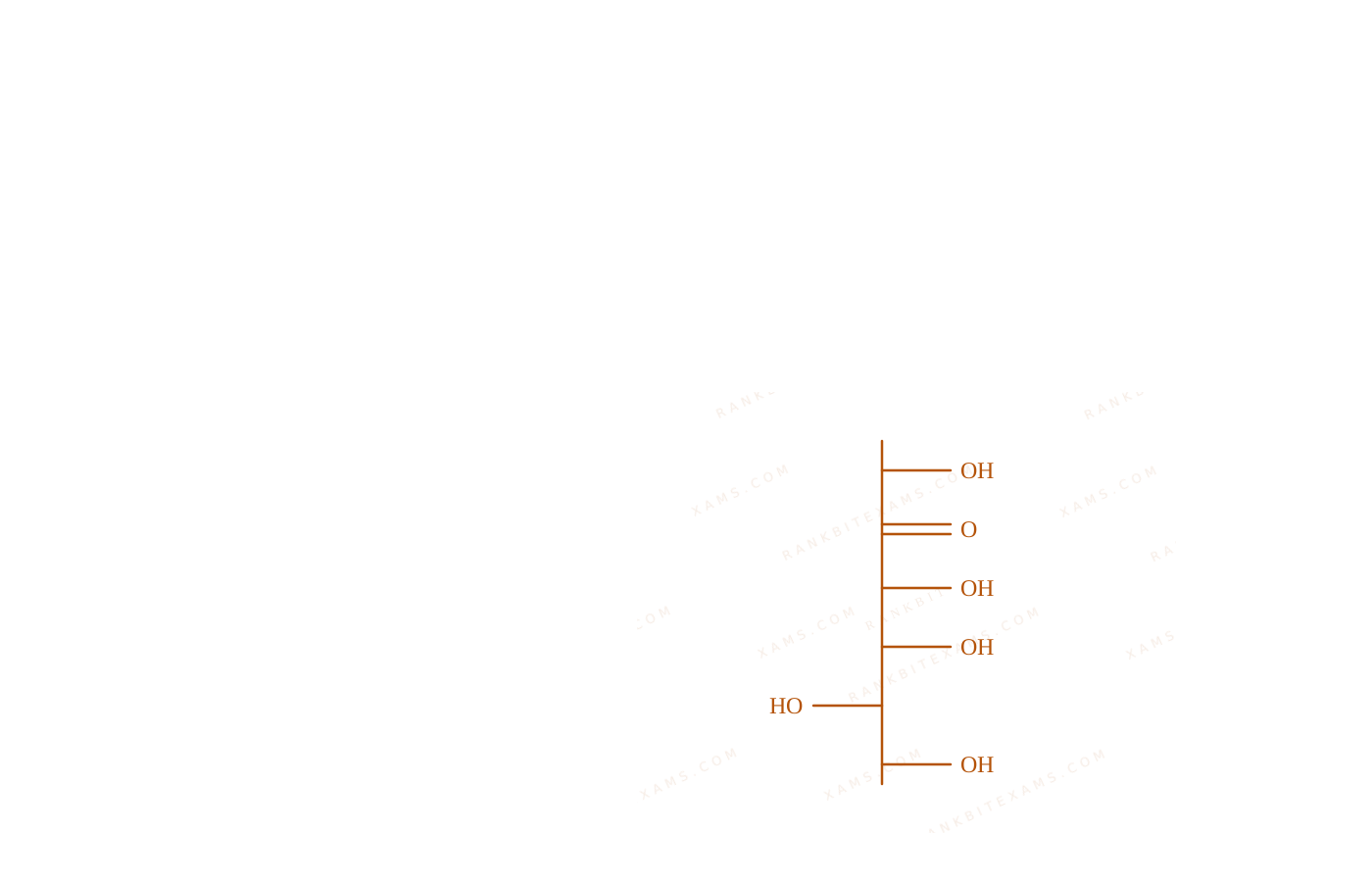
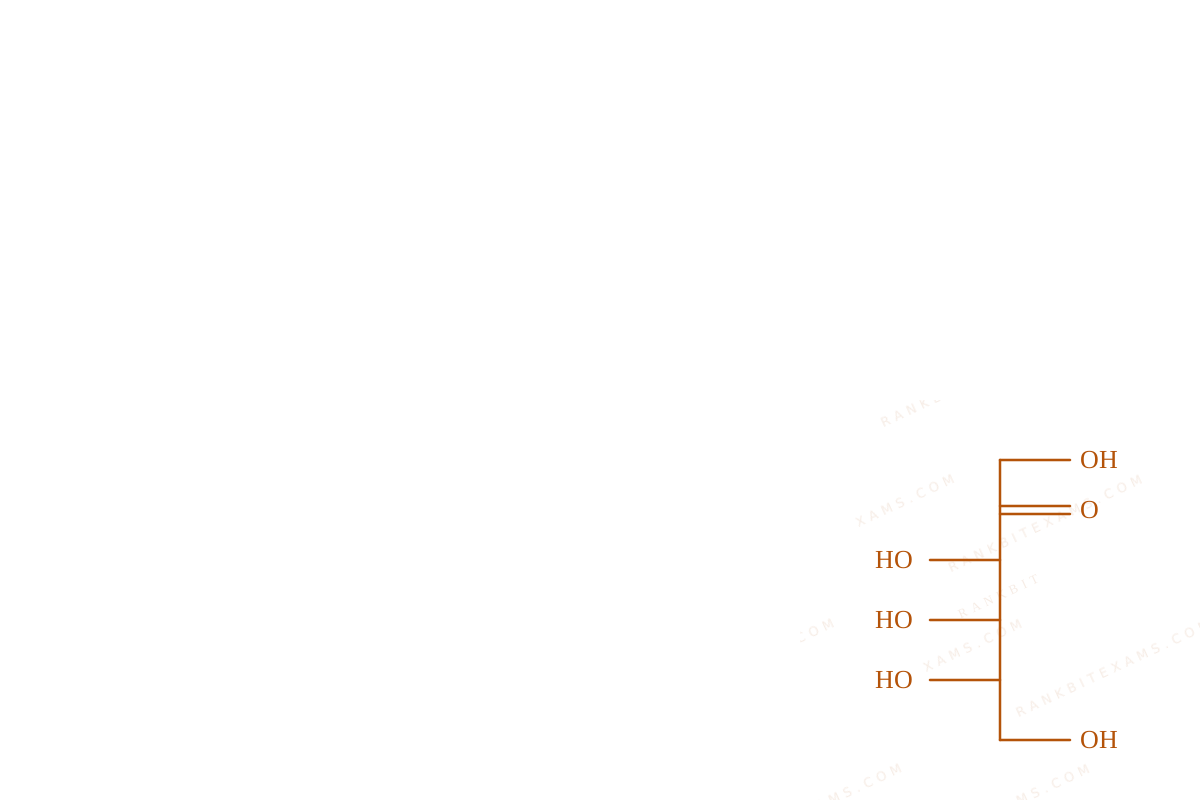
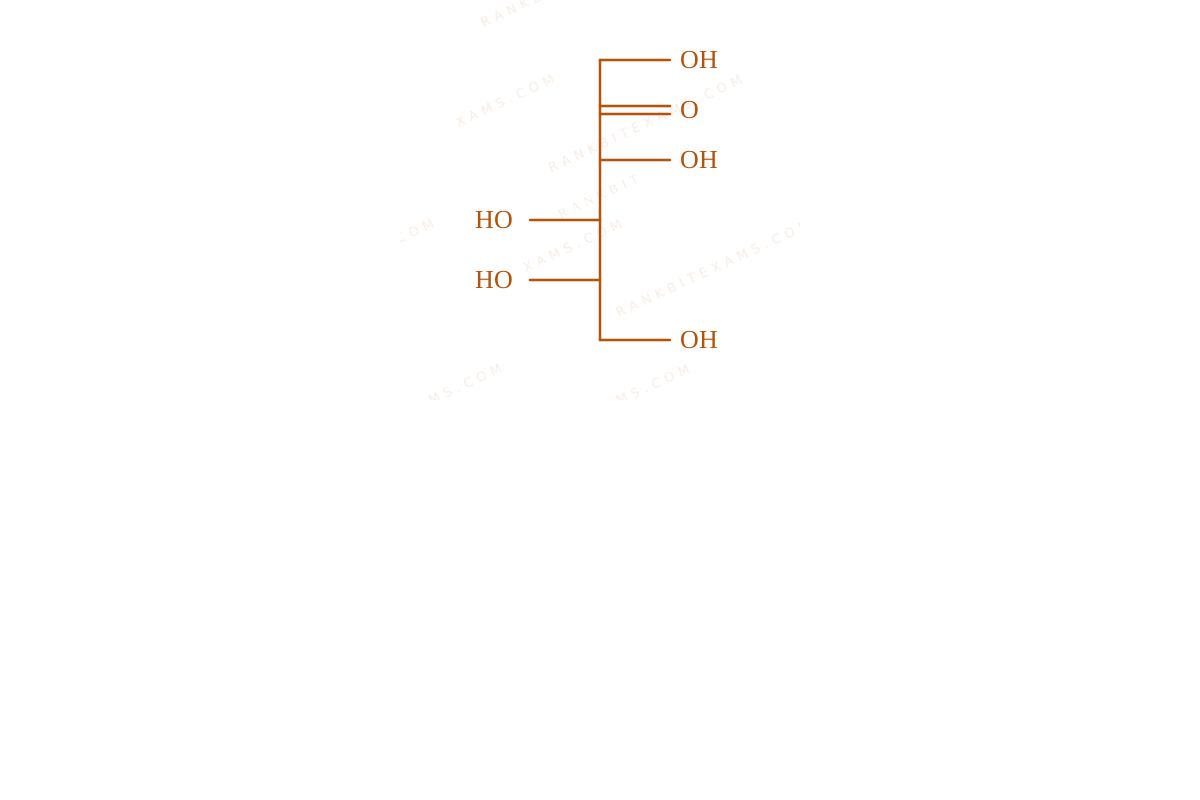
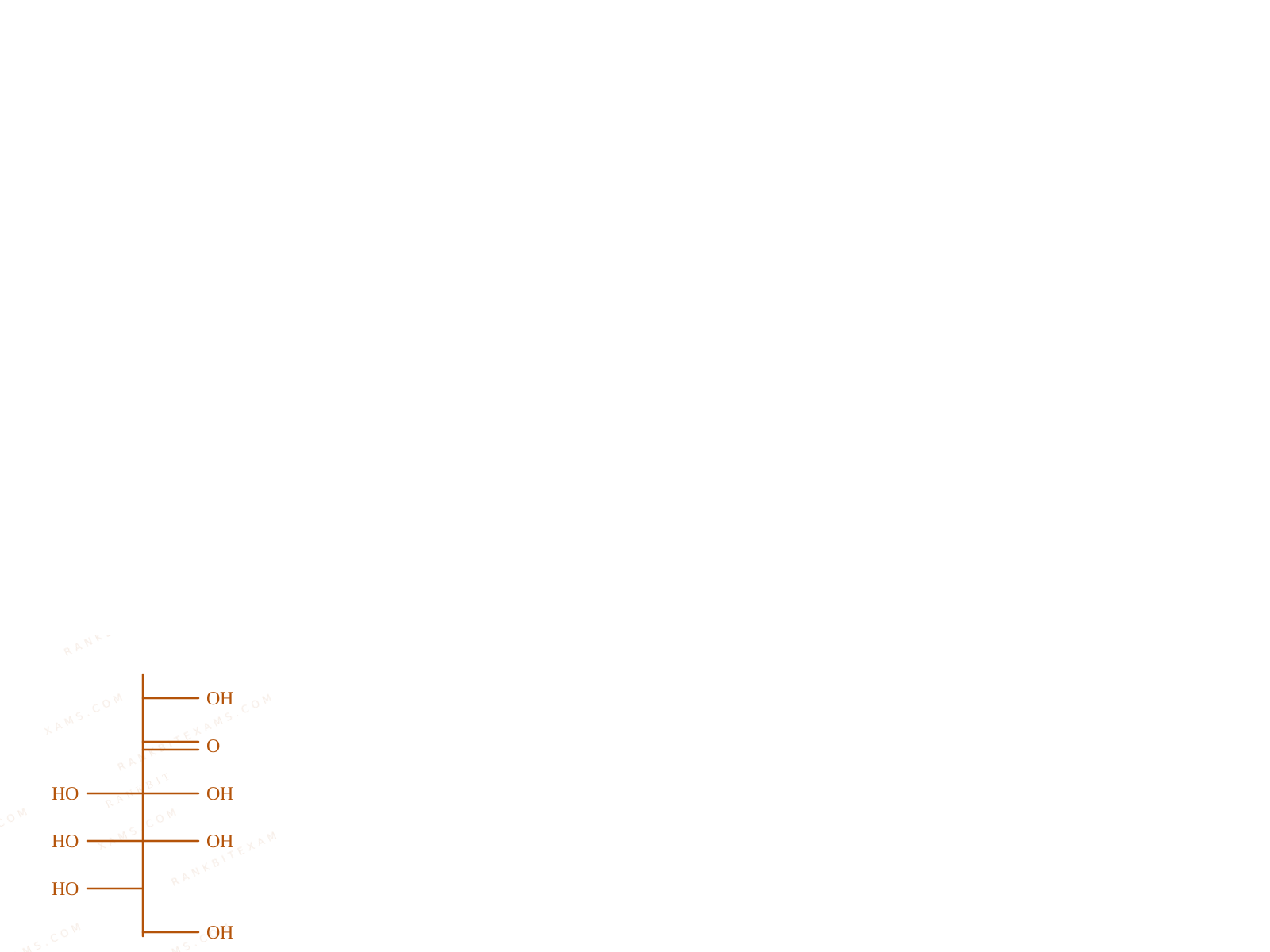
Which of the following is the correct structure of L-fructose?

Solution & Explanation

Related Formula

D- and L-enantiomers are non-superimposable mirror images of each other at all chiral centers.

Core Logic

D-fructose has the -OH group at C-5 positioned on the right in its Fischer projection. L-fructose is the exact enantiomer (mirror image) of D-fructose, meaning all chiral centers (C-3, C-4, C-5) have inverted configurations, with the -OH group at C-5 on the left.

Step 1: Structural Verification

Structure (3) correctly displays the Fischer projection of L-fructose with C-3 -OH on the right, and C-4, C-5 -OH groups on the left.

Pattern Recognition

L-isomer is the exact mirror image of the D-isomer across all stereocenters.

Chapter Mix

Class 12 Chemistry: Biomolecules

Reference Study Guides

More Biomolecules Previous-Year Questions — Page 6

Q28 jee_main_2025_28_jan_evening Carbohydrates and Glycosidic Linkages
Match List-I with List-II
List-I (Saccharides)List-II (Glycosidic-linkages found)
(A) Sucrose(I) α 1-4
(B) Maltose(II) α 1-4 and α 1-6
(C) Lactose(III) α 1 - β 2
(D) Amylopectin(IV) β 1-4
Choose the correct answer from the options given below :
  • A. (A)-(III), (B)-(I), (C)-(IV), (D)-(II)
  • B. (A)-(IV), (B)-(II), (C)-(I), (D)-(III)
  • C. (A)-(II), (B)-(IV), (C)-(III), (D)-(I)
  • D. (A)-(I), (B)-(II), (C)-(III), (D)-(IV)

Solution

Related Formula

Glycosidic linkages define the connectivity between monosaccharide units in disaccharides and polysaccharides.

Core Logic

Analyzing each saccharide configuration:

  • Sucrose: Formed by α-D-glucose and β-D-fructose via a α 1 - β 2 glycosidic linkage.
  • Maltose: Composed of two α-D-glucose units connected by a α 1-4 glycosidic linkage.
  • Lactose: Composed of β-D-galactose and β-D-glucose via a β 1-4 glycosidic linkage.
  • Amylopectin: A branched polymer of glucose with linear α 1-4 linkages and branching at α 1-6 positions.
Step 1: Final Mapping

Matching pairs lead to: (A)-(III), (B)-(I), (C)-(IV), (D)-(II).

Pattern Recognition

Remember shortcuts for common linkages:

  • Sucrose is a non-reducing sugar involving the anomeric carbons of both units (α 1 - β 2).
  • Lactose has a β-linkage (β 1-4).
  • Amylopectin represents branched starch (α 1-4 and α 1-6).
Chapter Mix

Class 12 Chemistry: Biomolecules

Q32 jee_main_2025_28_jan_evening Hydrolysis of Carbohydrates
Identify correct conversion during acidic hydrolysis from the following: (A) starch gives galactose. (B) cane sugar gives equal amount of glucose and fructose. (C) milk sugar gives glucose and galactose. (D) amylopectin gives glucose and fructose. (E) amylose gives only glucose. Choose the correct answer from the options given below :
  • A. (C), (D) and (E) only
  • B. (A), (B) and (C) only
  • C. (B), (C) and (E) only
  • D. (B), (C) and (D) only

Solution

Related Formula

Acidic or enzymatic hydrolysis cleaves the glycosidic linkages to yield constituent monosaccharides:

Polysaccharide/Disaccharide H^+ / H₂O Monosaccharides
Core Logic

Evaluating each conversion statement:

  • (A) Starch H^+ only Glucose (not galactose) arrow Incorrect
  • (B) Cane sugar (Sucrose) H^+ 50% Glucose + 50% Fructose arrow Correct
  • (C) Milk sugar (Lactose) H^+ Glucose + Galactose arrow Correct
  • (D) Amylopectin H^+ only Glucose (not fructose) arrow Incorrect
  • (E) Amylose H^+ only Glucose arrow Correct
Step 1: Finding the Matching Options

Statements (B), (C), and (E) are strictly correct according to carbohydrate biochemistry properties.

Pattern Recognition

Amylose and amylopectin are both structural components of starch, meaning their hydrolysis yields only D-glucose units. Fructose is obtained from sucrose, while galactose comes exclusively from lactose.

Chapter Mix

Class 12 Chemistry: Biomolecules

Q jee_main_2025_29_jan_morning Carbohydrates - Polysaccharides
List - I (Carbohydrate) List - II (Linkage / Source)
(A) Amylose (I) β−C1−C4 plant
(B) Cellulose (II) α−C1−C4, α−C1−C6 animal
(C) Glycogen (III) α−C1−C4, α−C1−C6 plant
(D) Amylopectin (IV) α−C1−C4 plant
Carbohydrates linkage source list diagram for Q43 - JEE Main 2025 Morning
The structural visual index links common natural polysaccharides to glycosidic configurations.
Carbohydrates linkage source list diagram for Q43 - JEE Main 2025 Morning
The structural visual index links common natural polysaccharides to glycosidic configurations.
  • A. (A)-(III), (B)-(II), (C)-(I), (D)-(IV)
  • B. (A)-(IV), (B)-(I), (C)-(II), (D)-(III)
  • C. (A)-(II), (B)-(III), (C)-(I), (D)-(IV)
  • D. (A)-(IV), (B)-(I), (C)-(III), (D)-(II)

Solution

Related Formula

Polysaccharides are defined by specific monomer units bound through distinct α or β glycosidic linkages.

Core Logic

Reviewing biological carbohydrate structural configurations based on standard biochemical definitions:

  • (A) Amylose: Linear unbranched chain polymer of glucose connected via α-C₁-C₄ paths in plants arrow (IV).
  • (B) Cellulose: Linear polymer containing glucose linkages connected exclusively via β-C₁-C₄ paths in plants arrow (I).
  • (C) Glycogen: Animal storage polysaccharide with highly branched links α-C₁-C₄ and α-C₁-C₆ pathways arrow (II).
  • (D) Amylopectin: Branched plant starch components showing mixed linear α-C₁-C₄ and branched α-C₁-C₆ lines arrow (III).
  • This maps precisely to option (2).

Pattern Recognition

Cellulose represents the primary standard framework containing β-linkages exclusively; standard starch components like amylose utilize α-configurations.

Chapter Mix

Class 12 Chemistry: Biomolecules
Q jee_main_2024_01_february_morning Nucleic Acids
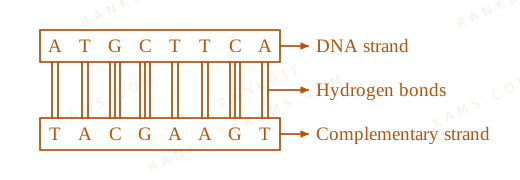
If one strand of a DNA has the sequence ATGCTTCA, sequence of the bases in complementary strand is:
  • A. CATTAGCT
  • B. TACGAAGT
  • C. GTACTTAC
  • D. ATGCGACT

Solution

Core Logic

Adenine (A) base pairs with Thymine (T) with 2 hydrogen bonds, and Cytosine (C) base pairs with Guanine (G) with 3 hydrogen bonds.

For the given DNA strand: A arrow T T arrow A G arrow C C arrow G T arrow A T arrow A C arrow G A arrow T

Step 1: Sequence Matching

Given sequence: A T G C T T C A Complementary: T A C G A A G T

Nucleic Acids diagram for Q61 - JEE Main 2024 Morning

Pattern Recognition

DNA base pairing strictly follows Chargaff's rule: A=T and G≡C. Just swap A with T, and C with G in the exact order.

Chapter Mix

Class 12 Chemistry: Biomolecules

Q62 jee_main_2024_29_january_evening Polymers and Monomers
Match List I with List II:
List I (Bio Polymer)List II (Monomer)
A. StarchI. nucleotide
B. CelluloseII. α-glucose
C. Nucleic acidIII. β-glucose
D. ProteinIV. α-amino acid
Choose the correct answer from the options given below :
  • A. A-II, B-I, C-III, D-IV
  • B. A-IV, B-II, C-I, D-III
  • C. A-I, B-III, C-IV, D-II
  • D. A-II, B-III, C-I, D-IV

Solution

Related Formula

Factual knowledge of biopolymers and their fundamental repeating units (monomers).

Core Logic

Analyzing each polymer component:

  • Starch is a polymer composed entirely of α-glucose units.
  • Cellulose is a linear structural polymer consisting of linear chains of β-glucose units.
  • Nucleic acids (DNA/RNA) are long chains composed of repeating nucleotide units.
  • Proteins are polypeptides made from combined α-amino acid sequences.
Step 1: Final Match Alignment

Matching structural links properly leads cleanly to the configuration: A-II, B-III, C-I, D-IV.

Pattern Recognition

Standard memorization trick: Plants store starch using alpha linkers, but build rigid cell walls via beta linkers.

Chapter Mix

Class 12 Chemistry: Biomolecules

More Biomolecules Questions — jee_main_2025_03_april_morning

Practice all Biomolecules previous-year questions →

Rankbit System
JEE Physics: Waves (+15.5%) | Electrostatics: Concentric Shells (-29.7%) | Modern Physics: Photoelectric Clones (+34.2%) | Mathematics: Definite Integrals (+18.1%) | Chemistry: Coordination Splitting (-11.4%) | JEE Physics: Waves (+15.5%) | Electrostatics: Concentric Shells (-29.7%) | Modern Physics: Photoelectric Clones (+34.2%) | Mathematics: Definite Integrals (+18.1%) | Chemistry: Coordination Splitting (-11.4%)