Related Formula
By conservation of linear momentum, the common velocity vcm$v_{\text{cm}}$ of the combined mass system is:
m₁ v₁ + m₂ v₂ = (m₁ + m₂) vcm$$m_1 v_1 + m_2 v_2 = (m_1 + m_2) v_{\text{cm}}$$
By conservation of energy, the loss in Kinetic Energy during maximum compression converted to the potential energy of the spring:
Δ K = (1)/(2) k x² ⇒ (1)/(2) m₁ v² - (1)/(2) (m₁ + m₂) vcm² = (1)/(2) k x²$$\Delta K = \frac{1}{2} k x^2 \Rightarrow \frac{1}{2} m_1 v^2 - \frac{1}{2} (m_1 + m_2) v_{\text{cm}}^2 = \frac{1}{2} k x^2$$
Core Logic
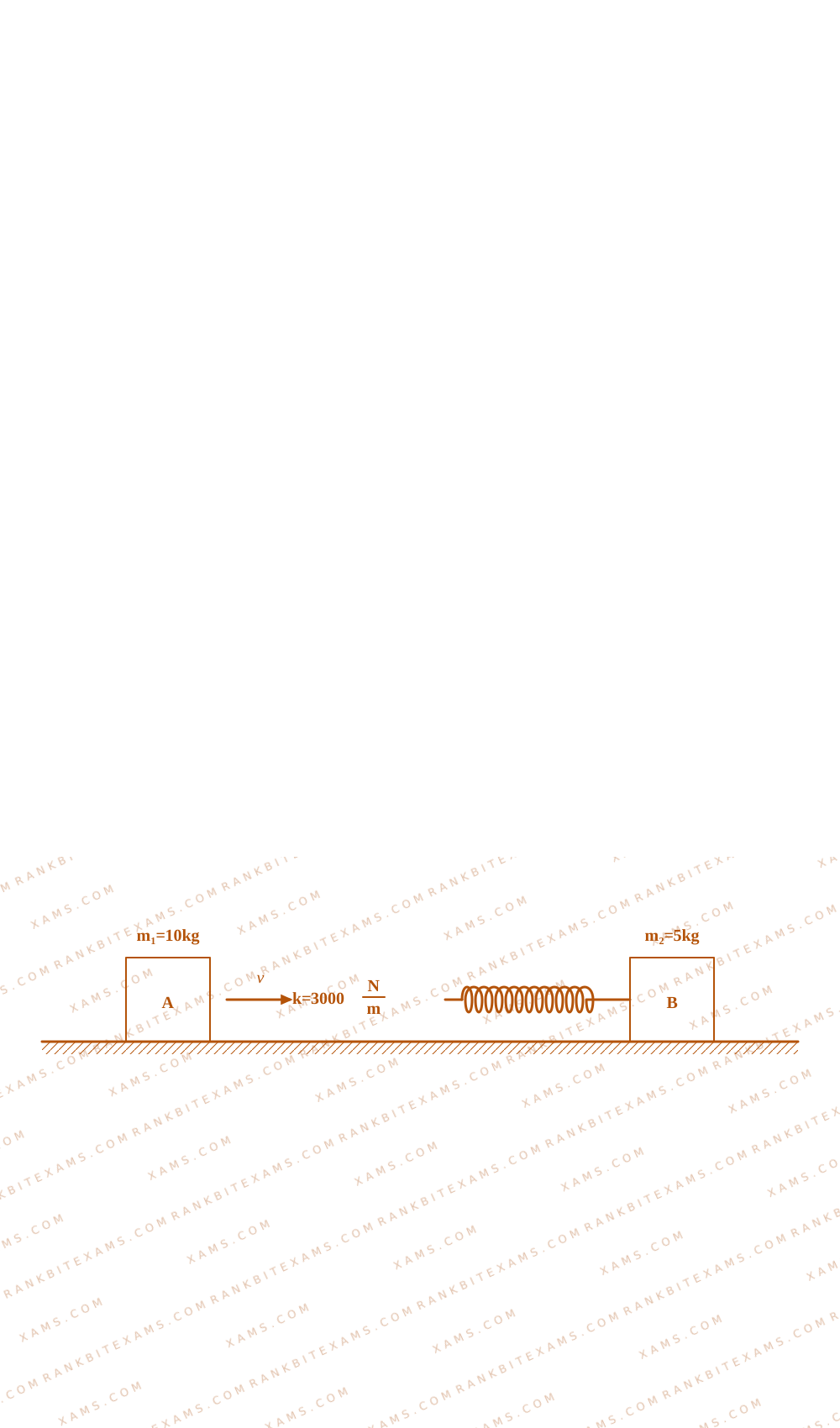
Given parameters:
- m₁ = 10~kg$m_1 = 10\mathrm{~kg}$, m₂ = 5~kg$m_2 = 5\mathrm{~kg}$
- Initial velocity of A: v = 3~m/s$v = 3\mathrm{~m/s}$
- Initial velocity of B: v₂ = 0$v_2 = 0$
- Spring constant k = 3000~N/m$k = 3000\mathrm{~N/m}$
Step 1: Calculate the common center of mass velocity (vcm$v_{\text{cm}}$)
vcm = (10 × 3 + 5 × 0)/(10 + 5) = (30)/(15) = 2~m/s$$v_{\text{cm}} = \frac{10 \times 3 + 5 \times 0}{10 + 5} = \frac{30}{15} = 2\mathrm{~m/s}$$Step 2: Apply Energy Conservation to find spring compression (
$
Step 2: Apply Energy Conservation to find spring compression ($
x
)$)
$(1)/(2) k x² = Kᵢ - Kf$\frac{1}{2} k x^2 = K_i - K_f$$
$(1)/(2) (3000) x² = [ (1)/(2) (10) (3²) ] - [ (1)/(2) (10 + 5) (2²) ]$\frac{1}{2} (3000) x^2 = \left[ \frac{1}{2} (10) (3^2) \right] - \left[ \frac{1}{2} (10 + 5) (2^2) \right]$$
$1500 x² = (1)/(2)(90) - (1)/(2)(15)(4)$1500 x^2 = \frac{1}{2}(90) - \frac{1}{2}(15)(4)$$
$1500 x² = 45 - 30 = 15$1500 x^2 = 45 - 30 = 15$$
$x² = (15)/(1500) = (1)/(100)$x^2 = \frac{15}{1500} = \frac{1}{100}$$
$x = (1)/(10)~m = 0.1~m$x = \frac{1}{10}\mathrm{~m} = 0.1\mathrm{~m}$Pattern Recognition
For maximum compression in block-spring-block collisions, the relative kinetic energy gets fully transformed into spring potential energy.
$
Pattern Recognition
For maximum compression in block-spring-block collisions, the relative kinetic energy gets fully transformed into spring potential energy.
$(1)/(2) μ vrel² = (1)/(2) k x²$\frac{1}{2} \mu v_{\text{rel}}^2 = \frac{1}{2} k x^2$where
$
where $
\mu = \frac{m_1 m_2}{m_1 + m_2}
is the reduced mass. Here:$ is the reduced mass. Here:
$μ = (10 × 5)/(15) = (10)/(3)~kg$\mu = \frac{10 \times 5}{15} = \frac{10}{3}\mathrm{~kg}$$
$(1)/(2) ((10)/(3)) (3)² = (1)/(2) (3000) x² ⇒ 15 = 1500 x² ⇒ x = 0.1~m$\frac{1}{2} \left(\frac{10}{3}\right) (3)^2 = \frac{1}{2} (3000) x^2 \Rightarrow 15 = 1500 x^2 \Rightarrow x = 0.1\mathrm{~m}$$
Using reduced mass simplifies center-of-mass collision problems instantly.
Chapter Mix
Class 11 Physics: Work, Energy and Power