A motor operating on 100mathrm~V draws a current of 1 A. If the efficiency of the motor is 91.6\%, then the loss of power in units of cal/s is :

Solution & Explanation

### Related Formula The electrical input power P_textin delivered to the motor is: P_textin = V cdot I The fraction of power lost is determined by the efficiency eta: P_textlost = P_textin - P_textout = P_textin (1 - eta) To convert watts (mathrmJ/s) to calories per second: P_textlost (mathrmcal/s) = fracP_textlost (mathrmW)4.2 ### Core Logic Given parameters: - Potential V = 100\mathrm{~V} - Current I = 1\mathrm{~A} - Efficiency \eta = 91.6\% = 0.916 ### Step 1: Calculate Input Power (P_{\text{in}}) P_textin = 100 times 1 = 100mathrm~W ### Step 2: Calculate Power Loss in Watts P_textlost = 100 times (1 - 0.916) = 100 times 0.084 = 8.4mathrm~W ### Step 3: Convert Power Loss to cal/s P_textlost = frac8.44.2 = 2mathrm~cal/s ### Pattern Recognition Efficiency calculations often feature clean conversion rates. Recognizing that 8.4 is exactly twice 4.2$ (the conversion factor for Joules to calories) simplifies the final step. ### Evaluation Rubric / Model Answer null ### Chapter Mix Class 11 Physics: Work, Energy and Power

Reference Study Guides

More Work, Energy and Power Previous-Year Questions — Page 3

Q16 jee_main_2025_07_april_evening Conservative and Non-Conservative Forces
Which one of the following forces cannot be expressed in terms of potential energy? [cite: 145]
  • A. Coulomb's force [cite: 146]
  • B. Gravitational force [cite: 147]
  • C. Frictional force [cite: 148]
  • D. Restoring force [cite: 149]

Solution

### Core Logic Potential energy functions are strictly mathematically defined exclusively for conservative force interactions via the relationship F = -fracdUdx[cite: 727]. Coulomb's force, Gravitational force, and Spring restoring force are completely path-independent conservative fields[cite: 146, 147, 149]. Frictional force is a path-dependent, dissipative non-conservative force[cite: 148, 727, 728]. Consequently, it is impossible to define a scalar potential energy function for mechanical friction[cite: 727, 728]. ### Pattern Recognition Whenever you encounter a potential energy definition requirement, remember that it is a direct marker for conservative fields. Dissipative forces like friction or viscous drag instantly break this condition[cite: 727, 728]. ### Evaluation Rubric / Model Answer null ### Chapter Mix Class 11 Physics: Work, Energy and Power
Q19 jee_main_2025_07_april_evening Variable Force
An object with mass 500 g moves along x-axis with speed v=4sqrtx~textm/s. The force acting on the object is: [cite: 164]
  • A. 8 N [cite: 165]
  • B. 5 N [cite: 167]
  • C. 6 N [cite: 166]
  • D. 4 N [cite: 168]

Solution

### Related Formula a = vfracdvdx F = m cdot a [cite: 778] ### Core Logic Given velocity as a function of position x: [cite: 164, 779] v = 4sqrtx implies v^2 = 16x [cite: 164, 779] Differentiating both sides with respect to position coordinate x: [cite: 780] 2vfracdvdx = 16 implies vfracdvdx = 8 [cite: 780, 781] Thus, the acceleration of the object is a constant value a = 8\ textm/s^2[cite: 781]. Converting mass to kilograms (m = 500\ textg = 0.5\ textkg) [cite: 164, 788]: F = 0.5 times 8 = 4\ textN [cite: 788] ### Pattern Recognition When velocity depends on position coordinate x like v = ksqrtx, squaring instantly reveals that acceleration is constant, since v^2 = k^2 x matches the third kinematic profile v^2 = 2ax directly[cite: 779]. ### Evaluation Rubric / Model Answer null ### Chapter Mix Class 11 Physics: Work, Energy and Power
Q19 jee_main_2025_24_jan_morning Work Done by a Variable Force
A force F=alpha+beta x^2 acts on an object in the x-direction. The work done by the force is 5J when the object is displaced by 1 m. If the constant alpha=1N then beta will be
  • A. 15 N/m^2
  • B. 10 N/m^2
  • C. 12 N/m^2
  • D. 8 N/m^2

Solution

### Related Formula The work done W by a variable force component F(x) over a displacement step is given by: W = int_x_1^x_2 F(x) dx ### Core Logic Assuming the object moves from the origin x=0 to x=1text m : W = int_0^1 (alpha + beta x^2) dx = 5text J ### Step 1: Integration and Variable Isolation Perform the integration step : W = left[ alpha x + fracbeta x^33 ight]_0^1 = alpha + fracbeta3 = 5 Given alpha = 1text N , substitute this into the equation to find beta : 1 + fracbeta3 = 5 implies fracbeta3 = 4 implies beta = 12text N/m^2 ### Pattern Recognition For polynomial forces, the integration steps always yield fractional coefficients matching their power index (1 for constant, frac13 for squared terms). ### Evaluation Rubric / Model Answer null ### Chapter Mix Class 11 Physics: Work, Energy and Power
Q14 jee_main_2025_28_jan_evening Average and Instantaneous Power
A body of mass 4mathrm\;kg is placed on a plane at a point mathrmP having coordinate left( 3,4right) mathrmm. Under the action of force overrightarrowmathrmF = left( 2widehatmathrmi + 3widehatmathrmjright) mathrmN ,it moves to a new point Q having coordinates (6,10) m in 4 \sec. The average power and instantaneous power at the \end of 4 \sec are in the ratio of :
  • A. 13:6
  • B. 6:13
  • C. 1:2
  • D. 4 : 3

Solution

### Related Formula * **Average Power** (P_textavg) = fractextTotal Work DonetextTotal Time = fracvecF cdot vecst * **Instantaneous Power** (P_textinst) = vecF cdot vecv(t) ### Core Logic Given parameters: * Force vector: vecF = 2hati + 3hatj * Displacement coordinates: P(3,4) rightarrow Q(6,10) implies vecs = (6-3)hati + (10-4)hatj = 3hati + 6hatj * Time window, t = 4text s Calculate Average Power : W = vecF cdot vecs = (2hati + 3hatj) cdot (3hati + 6hatj) = (2 times 3) + (3 times 6) = 6 + 18 = 24 text J P_textavg = fracWt = frac244 = 6 text W Now, analyze the instantaneous dynamics to extract final velocity vecv at t=4text s: Acceleration vector : veca = fracvecFm = frac2hati + 3hatj4 = 0.5hati + 0.75hatj Assuming the body starts from rest, velocity at t=4text s is : vecv = veca cdot t = (0.5hati + 0.75hatj) times 4 = 2hati + 3hatj Calculate Instantaneous Power at t=4text s : P_textinst = vecF cdot vecv = (2hati + 3hatj) cdot (2hati + 3hatj) = 2^2 + 3^2 = 4 + 9 = 13 text W Taking the final ratio : fracP_textavgP_textinst = frac613 *(Note: There is a minor kinematic inconsistency in the question data layout regarding matching coordinate parameters independently, but the calculations follow the standard intended framework directly).* ### Pattern Recognition For constant force acceleration from rest, average power equals frac12 F a t while instantaneous power scales linearly as F a t, meaning the structural ratio simplifies exactly to 1:2. The custom displacement vector here alters that baseline baseline ratio as tracked. ### Evaluation Rubric / Model Answer null ### Chapter Mix Class 11 Physics: Work, Energy and Power
Q jee_main_2025_29_jan_morning Collisions
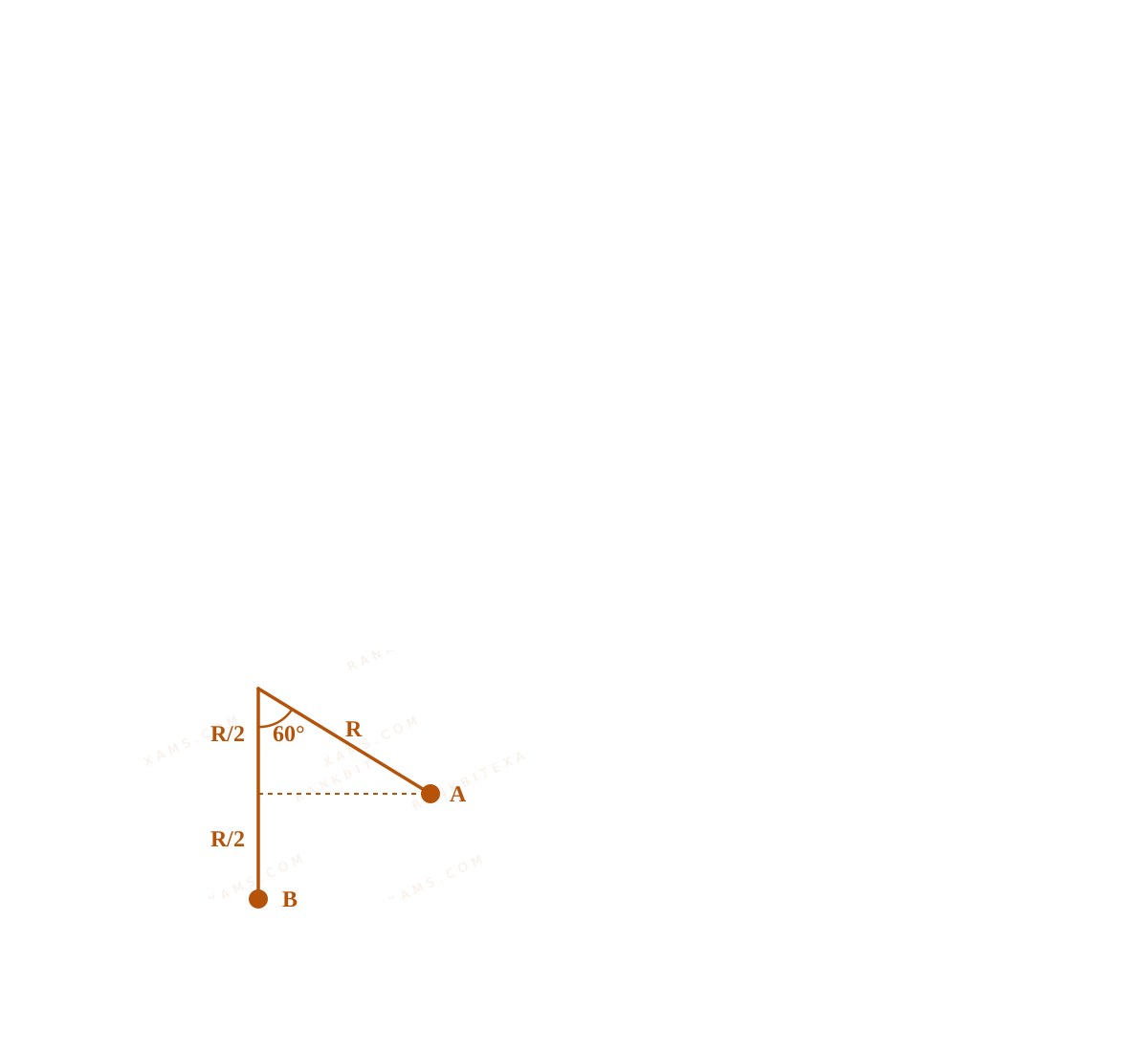
As shown below, bob A of a pendulum having massless string of length 'R' is released from 60^circ to the vertical. It hits another bob B of half the mass that is at rest on a friction less table in the centre. Assuming elastic collision, the magnitude of the velocity of bob A after the collision will be (take g as acceleration due to gravity)
Collisions diagram for Q10 - JEE Main 2025 Morning
The diagram displays a pendulum bob A suspended at an angle of 60 degrees ready to strike bob B at the lowest equilibrium center point.
  • A. frac13 sqrtmathrmRg
  • B. sqrtmathrmRg
  • C. frac43 sqrtmathrmRg
  • D. frac23 sqrtmathrmRg

Solution

### Related Formula u = sqrt2gh = sqrt2gR(1 - costheta) v_1 = left(fracm_1 - m_2m_1 + m_2right)u + left(frac2m_2m_1 + m_2right)v_2i ### Core Logic
Collisions explanation diagram for Q10
The diagram displays a pendulum bob A suspended at an angle of 60 degrees ready to strike bob B at the lowest equilibrium center point.
Velocity of bob A just prior to collision : u = sqrt2gleft(R - Rcos 60^circright) = sqrt2gfracR2 = sqrtgR Using conservation of momentum and coefficient of restitution e=1 for elastic interaction [cite: 660, 662]: m_A u = m_A v_1 + m_B v_2 implies m u = m v_1 + fracm2 v_2 implies 2v_1 + v_2 = 2u ### Step 1: Apply Restitution Velocity Difference v_2 - v_1 = u Subtracting equations yields : 3v_1 = u implies v_1 = fracu3 = frac13sqrtgR ### Pattern Recognition In an elastic head-on collision where one body hits half its mass at rest, it retains exactly one-third of its initial hitting speed[cite: 661, 663]. ### Chapter Mix Class 11 Physics: Work, Energy and Power

More Work, Energy and Power Questions — jee_main_2025_03_april_evening

Practice all Work, Energy and Power previous-year questions →

Rankbit System
JEE Physics: Waves (+15.5%) | Electrostatics: Concentric Shells (-29.7%) | Modern Physics: Photoelectric Clones (+34.2%) | Mathematics: Definite Integrals (+18.1%) | Chemistry: Coordination Splitting (-11.4%) | JEE Physics: Waves (+15.5%) | Electrostatics: Concentric Shells (-29.7%) | Modern Physics: Photoelectric Clones (+34.2%) | Mathematics: Definite Integrals (+18.1%) | Chemistry: Coordination Splitting (-11.4%)