Two cells of emf 1V and 2V and internal resistance 2Ω$2\Omega$ and 1Ω$1\Omega$, respectively, are connected in series with an external resistance of 6Ω$6\Omega$. The total current in the circuit is I₁$I_{1}$ Now the same two cells in parallel configuration are connected to same external resistance. In this case, the total current drawn is I₂$I_{2}$. The value of ( I₁I₂)$(\frac{I_{1}}{I_{2}})$ is (x)/(3)$\frac{x}{3}$. The value of x is ________.
For cells connected in parallel, the formula for equivalent EMF
$
Pattern Recognition
For cells connected in parallel, the formula for equivalent EMF $
\varepsilon_{\text{eq}}$ can be viewed as a weighted average. Connecting cells in series maximizes EMF but increases internal resistance, while parallel configuration limits EMF to an intermediate value while reducing equivalent internal resistance.
Chapter Mix
Class 12 Physics: Current Electricity
More Current Electricity Previous-Year Questions — Page 9
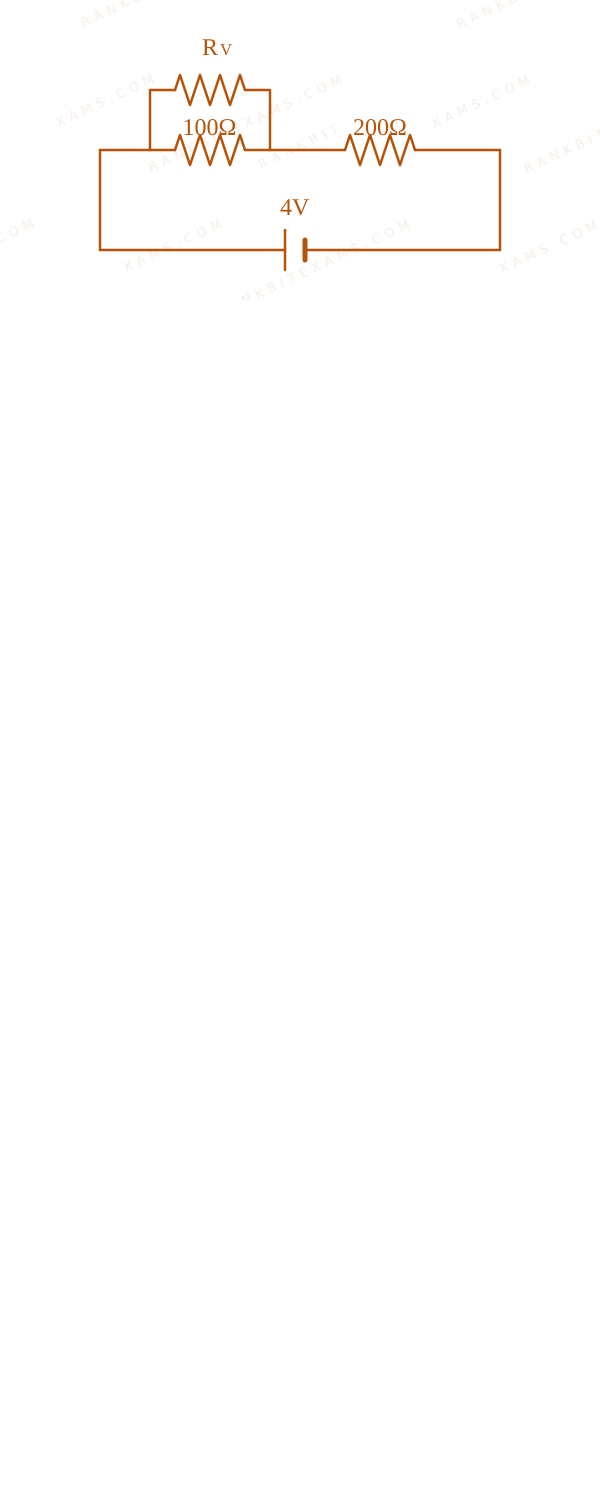
Two resistance of 100Ω$100\Omega$ and 200Ω$200\Omega$ are connected in series with a battery of 4 ~V$4 \mathrm{~V}$ and negligible internal resistance. A voltmeter is used to measure voltage across 100Ω$100\Omega$ resistance, which gives reading as 1 ~V$1 \mathrm{~V}$. The resistance of voltmeter must be ________ Ω$\Omega$.
Numerical Answer.Answer: 200 to 200
Solution
Related Formula
V = I Req$$V = I R_{\text{eq}}$$Rparallel = (R₁ R₂)/(R₁ + R₂)$$R_{\text{parallel}} = \frac{R_1 R_2}{R_1 + R_2}$$
Core Logic
Voltmeter Resistance diagram for Q60 - JEE Main 2024 Evening
The voltmeter has some internal resistance Rv$R_v$ and is connected in parallel with the 100Ω$100\Omega$ resistor.
The equivalent resistance of this parallel combination is Rₚ = (100 Rv)/(100 + Rv)$R_p = \frac{100 R_v}{100 + R_v}$.
This combination is in series with the 200Ω$200\Omega$ resistor. The total voltage applied is 4 ~V$4 \mathrm{~V}$.
Step 1: Set up Voltage Divider
The voltage across the parallel combination (the voltmeter reading) is 1 ~V$1 \mathrm{~V}$.
Therefore, the voltage across the 200Ω$200\Omega$ resistor must be 4 ~V - 1 ~V = 3 ~V$4 \mathrm{~V} - 1 \mathrm{~V} = 3 \mathrm{~V}$.
Using the voltage divider rule (or equating currents since they are in series):
If the voltage splits as 1V$1\mathrm{V}$ to 3V$3\mathrm{V}$, the resistances must be in a 1:3$1:3$ ratio. So Rₚ = 200 / 3$R_p = 200 / 3$. Equating 100 Rv / (100+Rv) = 200/3$100 R_v / (100+R_v) = 200/3$ instantly gives Rv = 200$R_v = 200$.
Chapter Mix
Class 12 Physics: Current Electricity
Q48jee_main_2024_30_january_eveningPower Dissipation in Resistors
When a potential difference V$V$ is applied across a wire of resistance R$R$, it dissipates energy at a rate W$W$. If the wire is cut into two halves and these halves are connected mutually parallel across the same supply, the energy dissipation rate will become:
A.1 / 4 W$1 / 4 \mathrm{W}$
B.1 / 2 W$1 / 2 \mathrm{W}$
C.2 ~W$2 \mathrm{~W}$
D.4 ~W$4 \mathrm{~W}$
Solution
Related Formula
P = V²Req$$P = \frac{V^2}{R_{\text{eq}}}$$
Core Logic
Initially, the power (rate of energy dissipation) is W = (V²)/(R)$W = \frac{V^2}{R}$.
When the wire is cut into two halves, each half will have a resistance of (R)/(2)$\frac{R}{2}$ (since resistance is directly proportional to length).
Step 1: Equivalent Resistance
When these two halves (each of (R)/(2)$\frac{R}{2}$) are connected in parallel, their equivalent resistance Req$R_{\text{eq}}$ is:
Cutting a resistor into n$n$ equal parts and connecting them in parallel reduces the total resistance by a factor of n²$n^2$. Consequently, for a constant voltage supply, the power dissipated increases by a factor of n²$n^2$.
Chapter Mix
Class 12 Physics: Current Electricity
Qjee_main_2024_30_jan_morningCells in Opposition and Terminal Voltage
Two cells are connected in opposition as shown. Cell E₁$E_1$ is of 8V$8\mathrm{V}$ emf and 2Ω$2\Omega$ internal resistance; the cell E₂$E_2$ is of 2V$2\mathrm{V}$ emf and 4Ω$4\Omega$ internal resistance. The terminal potential difference of cell E₂$E_2$ is:
Two batteries pushing current against each other.
Numerical Answer.Answer: 6 to 6
Solution
Related Formula
I = EₙₑₜReq$$I = \frac{E_{\text{net}}}{R_{\text{eq}}}$$V = E - Ir (Discharging)$$V = E - Ir \quad (\text{Discharging})$$V = E + Ir (Charging)$$V = E + Ir \quad (\text{Charging})$$
Core Logic
Two batteries pushing current against each other.
Because the cells are in opposition, the net EMF drives current from the higher potential cell (8V$8\mathrm{V}$) to the lower potential cell (2V$2\mathrm{V}$). Thus, the 2V$2\mathrm{V}$ cell acts as a load and undergoes charging.
When a smaller battery is forced backwards by a larger battery, it gets "charged". Consequently, its terminal voltage increases above its nominal EMF: V = E + Ir$V = E + Ir$.
Chapter Mix
Class 12 Physics: Current Electricity
Q33jee_main_2024_30_jan_morningResistors in Series and Voltage Dividers
A potential divider circuit is shown in figure. The output voltage V₀$V_0$ is
Circuit containing multiple resistors in series and parallel calculating a specific output voltage.
Observe the circuit diagram. The total equivalent resistance Req$R_{\text{eq}}$ of the series network must be calculated by summing all the resistance values shown in the main branch.
Step 1: Calculate Total Resistance and Current
From the given network, assuming the total series resistance is 4000 Ω$4000 \,\Omega$ (comprising the 3.3kΩ$3.3\mathrm{k}\Omega$ resistor and seven 100 Ω$100\,\Omega$ resistors).
Req = 4000 Ω$$R_{\text{eq}} = 4000 \,\Omega$$
The total voltage applied across the network is 4 ~V$4 \mathrm{~V}$.
A potential divider simply scales the input voltage by the fraction of the resistance tapped over the total resistance: V₀ = Vᵢₙ × (Rₜₐₚ / Rtotal)$V_0 = V_{in} \times (R_{\text{tap}} / R_{\text{total}})$. Standard DC circuit division.
Chapter Mix
Class 12 Physics: Current Electricity
Q43jee_main_2024_30_jan_morningTemperature Dependence of Resistivity
An electric toaster has resistance of 60Ω$60\Omega$ at room temperature (27°C)$(27^{\circ}\mathrm{C})$. The toaster is connected to a 220V$220\mathrm{V}$ supply. If the current flowing through it reaches 2.75A$2.75\mathrm{A}$, the temperature attained by toaster is around: (if α = 2× 10⁻⁴ / °C$\alpha = 2\times 10^{-4} / ^{\circ}\mathrm{C}$)
First, evaluate the final resistance RT$R_T$ at the operating condition using Ohm's law. Second, plug the final resistance into the linear temperature dependence equation for resistance to solve for final temperature T$T$.
Step 1: Calculate Final Resistance
Given V = 220 ~V$V = 220 \mathrm{~V}$ and I = 2.75 ~A$I = 2.75 \mathrm{~A}$:
Always separate the final temperature T$T$ from Δ T$\Delta T$. The most common error is forgetting to add back the initial reference temperature (27^$27^\circ\mathrm{C}$) at the end.
Chapter Mix
Class 12 Physics: Current Electricity
More Current Electricity Questions — jee_main_2025_03_april_evening
Practice past-year questions one chapter at a time. Pick an exam → subject → chapter and get every PYQ for that topic — pulled together from all past papers — with the chapter's key formulas alongside.