JEE Main · Chemistry ↓ Falling

Thermodynamics appeared 44 times across 3 years — 5.1% of Chemistry. This question is from Latent Heat and Phase Equilibrium.

Year 2026 2025 2024 Total
Questions 12 24 8 44

Given below are two statements: Statement I: When a system containing ice in equilibrium with water (liquid) is heated, heat is absorbed by the system and there is no change in the temperature of the system until whole ice gets melted. Statement II: At melting point of ice, there is absorption of heat in order to overcome intermolecular forces of attraction within the molecules of water in ice and kinetic energy of molecules is not increased at melting point. In the light of the above statements, choose the correct answer from the options given below:

Solution & Explanation

Related Formula

During phase transition, latent heat of fusion (Lf) is absorbed:

Q = m Lf

Temperature remains constant because the average kinetic energy of the molecules does not change; instead, potential energy changes during phase transition:

Temperature T ∝ Average Kinetic Energy of molecules
Core Logic

Statement I Analysis:

  • During a phase transition (such as ice melting at 0°C), any added heat is utilized as latent heat of fusion. The system remains at a constant temperature of 0°C as long as both solid and liquid phases coexist in equilibrium. Thus, Statement I is True.
Step 1: Analyze Statement II
  • Statement II explains why this happens: The thermal energy is spent entirely to break down the highly ordered crystalline hydrogen-bonded lattice of ice into liquid water. It does not increase the translational kinetic energy of the molecules. Since kinetic energy is constant, temperature remains constant. Thus, Statement II is True.
Step 2: Conclusion

Therefore, both Statement I and Statement II are True, matching Option (3).

Pattern Recognition

For any phase transition (melting, boiling, sublimation): Temperature stays flat. The added energy goes entirely into latent heat (potential energy change to overcome intermolecular forces), meaning average kinetic energy is constant.

Chapter Mix

Class 11 Chemistry: Thermodynamics Class 11 Physics: Thermal Properties of Matter

Reference Study Guides

More Thermodynamics Previous-Year Questions — Page 7

Q41 jee_main_2025_24_jan_evening Hess's Law of Constant Heat Summation
S(g) + (3)/(2) O₂(g) arrow SO₃(g) + 2x kcal SO2(g) + (1)/(2)O2(g) arrow SO3(g) + y kcal The heat of formation of SO₂(g) is given by:
  • A. \frac{2x}{y}\mathrm{\ kcal}
  • B. y - 2x\mathrm{\ kcal}
  • C. 2x + y\mathrm{\ kcal}
  • D. x + y\mathrm{\ kcal}

Solution

Related Formula

Using Hess's Law, the enthalpy change of a net reaction can be determined by linearly combining the steps:

Δ Hnet = Σ Δ Hproducts - Σ Δ Hreactants
Core Logic

The heat of formation of SO₂(g) corresponds to the target thermochemical equation:

Target: S(g) + O2(g) arrow SO2(g) Δ Hf = ?

Let's write out the given equations along with their enthalpy changes (remembering that exothermic reactions release heat, so Δ H = -Q): 1. S(g) + (3)/(2)O₂(g) arrow SO₃(g) Δ H₁ = -2x kcal 2. SO₂(g) + (1)/(2)O₂(g) arrow SO₃(g) Δ H₂ = -y kcal

To isolate SO₂(g) on the product side, subtract Equation (2) from Equation (1):

[S(g) + (3)/(2)O2(g)] - [SO2(g) + (1)/(2)O2(g)] arrow SO3(g) - SO3(g) S(g) + O2(g) arrow SO2(g)

Now apply the same operation to the enthalpy values:

Δ Hf = Δ H1 - Δ H₂ = -2x - (-y) = y - 2x kcal

This matches Option (2).

Pattern Recognition

To isolate your target species on the desired side of the equation, use Hess's Law to add or subtract the given elemental equations. Make sure to invert the sign of the enthalpy change if you reverse a reaction.

Chapter Mix

Class 11 Chemistry: Thermodynamics
Q33 jee_main_2025_24_jan_morning Spontaneity and Gibbs Energy Change
Let us consider an endothermic reaction which is non-spontaneous at the freezing point of water. However, the reaction is spontaneous at boiling point of water. Choose the correct option.
  • A. Both Δ H and Δ S are (+ve)
  • B. Δ H is (-ve) but Δ S is (+ve)
  • C. Δ H is (+ve) but Δ S is (-ve)
  • D. Both Δ H and Δ S are (-ve)

Solution

Related Formula
Δ G = Δ H - TΔ S
Core Logic

An endothermic profile specifies that Δ H > 0. For the system to become spontaneous (Δ G < 0) specifically when shifting to higher temperatures (T), the temperature-dependent entropic subtraction term (-TΔ S) must outweigh the enthalpic barrier. This transition demands a positive structural entropy step, i.e., Δ S > 0.

Hence, both Δ H and Δ S are positive.

Pattern Recognition

Spontaneity driven purely by elevated thermal thresholds mandates matching positive signs for enthalpy and entropy.

Chapter Mix

Class 11 Chemistry: Chemical Thermodynamics

Q47 jee_main_2025_24_jan_morning Gibbs Free Energy and Equilibrium Temperature
Standard entropies of X₂, Y₂ and XY₅ are 70, 50 and 110 ~J ~K⁻¹ ~mol⁻¹ respectively. The temperature in Kelvin at which the reaction (1)/(2) X _ 2 + (5)/(2) Y _ 2 arrow X Y _ 5 Δ H ^ ° = - 3 5 k J m o l ^ - 1 will be at equilibrium is (Nearest integer)
Numerical Answer. Answer: 700 to 700

Solution

Related Formula
Δ Sᵣₓₙ⁰ = Σ Sproducts⁰ - Σ Sreactants⁰ and T = (Δ H⁰)/(Δ S⁰) at equilibrium (Δ G⁰ = 0)
Core Logic

First, calculate the standard entropy change for the reaction system (Δ Sᵣₓₙ⁰):

Δ Sᵣₓₙ⁰ = S⁰(XY₅) - [ (1)/(2)S⁰(X₂) + (5)/(2)S⁰(Y₂) ] Δ Sᵣₓₙ⁰ = 110 - [ ((1)/(2) × 70) + ((5)/(2) × 50) ] = 110 - [35 + 125] Δ Sᵣₓₙ⁰ = 110 - 160 = -50 J K⁻¹ mol⁻¹

At thermodynamic equilibrium, the change in Gibbs free energy drops to zero (Δ G⁰ = 0):

0 = Δ H⁰ - TΔ S⁰ T = (Δ H⁰)/(Δ S⁰)

Convert the enthalpy value into Joules (Δ H⁰ = -35 × 10³ J/mol) and substitute the parameters:

T = -35000 J mol⁻¹-50 J K⁻¹ mol⁻¹ = 700 Kelvin
Pattern Recognition

Ensure all variables use matching energy units (Joules vs. Kilojoules) before setting up your final division step.

Chapter Mix

Class 11 Chemistry: Chemical Thermodynamics

Q jee_main_2025_28_jan_evening First Law of Thermodynamics and State Functions
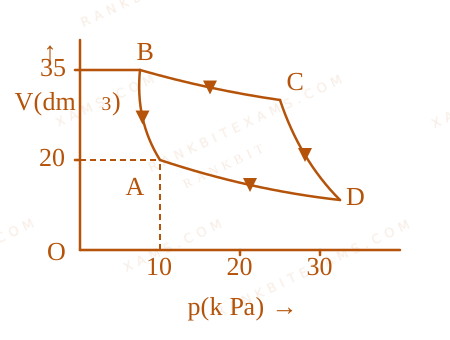
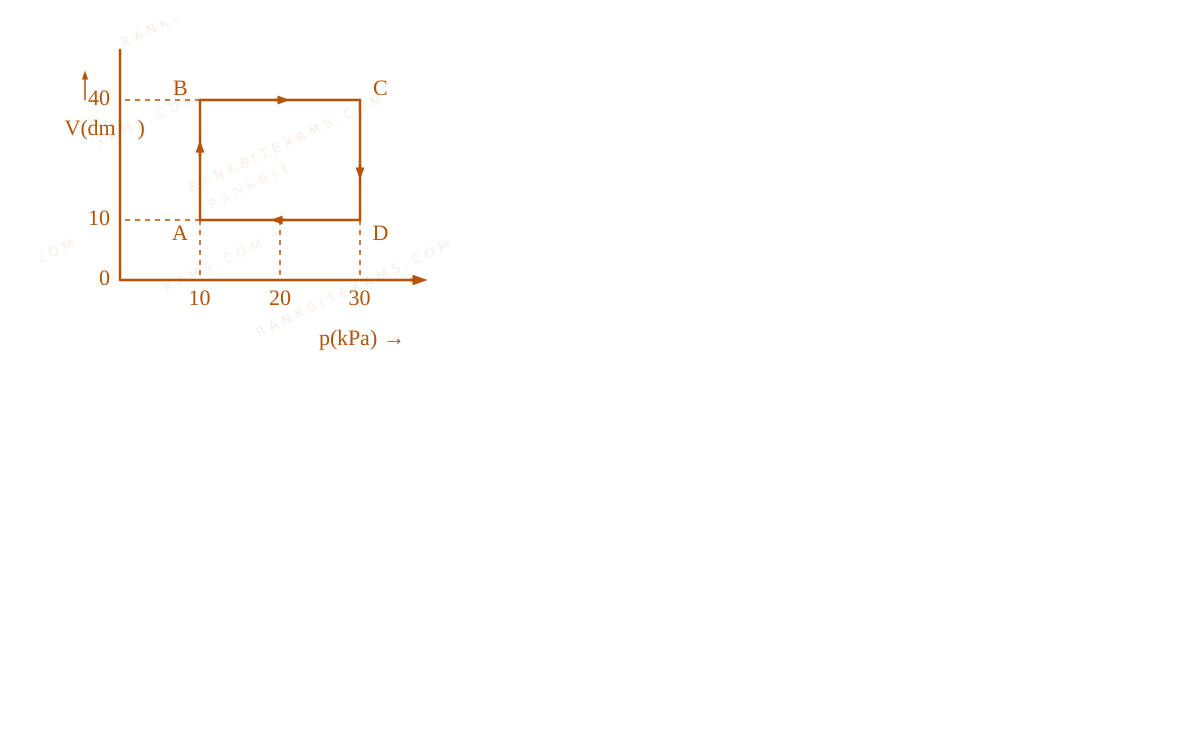
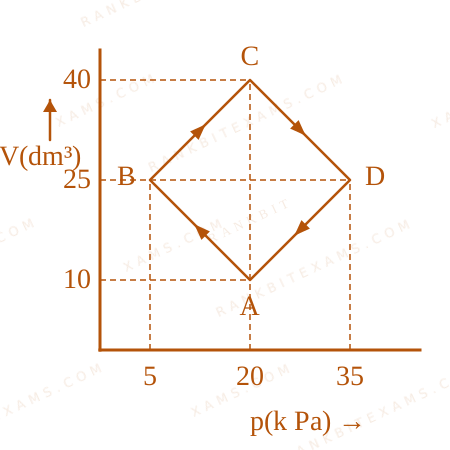
An ideal gas undergoes a cyclic transformation starting from the point A and coming back to the same point by tracing the path A→ B→ C arrow Darrow A as shown in the three cases below. Choose the correct option regarding Δ U:
Thermodynamic cyclic path diagrams for Q33 - JEE Main 2025
The diagram displays three distinct cyclic paths (Case I, Case II, Case III) on volume vs pressure graphs.
Thermodynamic cyclic path diagrams for Q33 - JEE Main 2025
The diagram displays three distinct cyclic paths (Case I, Case II, Case III) on volume vs pressure graphs.
Thermodynamic cyclic path diagrams for Q33 - JEE Main 2025
The diagram displays three distinct cyclic paths (Case I, Case II, Case III) on volume vs pressure graphs.
  • A. Δ U (Case-III) > Δ U (Case-II) > Δ U (Case-I)
  • B. Δ U (Case-I) > Δ U (Case-II) > Δ U (Case-III)
  • C. Δ U (Case-I) > Δ U (Case-III) > Δ U (Case-II)
  • D. Δ U (Case-I) = Δ U (Case-II) = Δ U (Case-III)

Solution

Related Formula

For any state function like Internal Energy (U), the cyclic integral over a complete closed loop is identically zero:

∮ dU = 0 Δ Ucyclic = 0
Core Logic

Internal energy (U) depends only on the initial and final states of the thermodynamic system, not on the path followed.

In all three listed cases, the ideal gas undergoes a complete cyclic path that returns to its original configuration state A.

Step 1: Final Evaluation

Since every transformation begins and ends at point A:

Δ UCase-I = 0 Δ UCase-II = 0 Δ UCase-III = 0

Therefore, Δ U (Case-I) = Δ U (Case-II) = Δ U (Case-III).

Pattern Recognition

Do not waste time calculating path areas or values if the question asks for a state function change (Δ U, Δ H, Δ S, Δ G) over a cyclic loop. The answer is instantly zero for all cases!

Chapter Mix

Class 11 Chemistry: Thermodynamics
Q47 jee_main_2025_28_jan_evening Hess's Law / Enthalpy of Formation
Consider the following data: Heat of formation of CO₂(g) = -393.5 ~kJ~mol⁻¹ Heat of formation of H₂O(l) = -286.0 ~kJ~mol⁻¹ Heat of combustion of benzene = -3267.0 ~kJ~mol⁻¹ The heat of formation of benzene is ______ kJ~mol⁻¹ (Nearest integer).
Numerical Answer. Answer: 48 to 48

Solution

Related Formula

Enthalpy of reaction from enthalpy of formation data:

Δ Hreaction = Σ Δ Hf(Products) - Σ Δ Hf(Reactants)
Core Logic

Write out the balanced thermochemical equation for the combustion of benzene (C₆H₆):

C₆H₆(l) + (15)/(2)O₂(g) arrow 6CO₂(g) + 3H₂O(l)

Given parameters:

  • Δ Hc = -3267.0 kJ/mol
  • Δ Hf[CO₂] = -393.5 kJ/mol
  • Δ Hf[H₂O] = -286.0 kJ/mol
  • Δ Hf[O₂] = 0 kJ/mol
Step 1: Applying Hess's Law

Substitute these values into the reaction expression:

-3267 = [6(-393.5) + 3(-286.0)] - Δ Hf[C₆H₆] -3267 = [-2361.0 - 858.0] - Δ Hf[C₆H₆] -3267 = -3219.0 - Δ Hf[C₆H₆] Δ Hf[C₆H₆] = -3219.0 + 3267.0 = 48 kJ/mol
Pattern Recognition

Always set up products minus reactants when using heat of formation data. Pay close attention to stoichiometric coefficients (multiply CO₂ by 6 and H₂O by 3) to ensure accurate bookkeeping.

Chapter Mix

Class 11 Chemistry: Thermodynamics
More Thermodynamics Questions — jee_main_2025_03_april_evening

Practice all Thermodynamics previous-year questions →

Rankbit System
JEE Physics: Waves (+15.5%) | Electrostatics: Concentric Shells (-29.7%) | Modern Physics: Photoelectric Clones (+34.2%) | Mathematics: Definite Integrals (+18.1%) | Chemistry: Coordination Splitting (-11.4%) | JEE Physics: Waves (+15.5%) | Electrostatics: Concentric Shells (-29.7%) | Modern Physics: Photoelectric Clones (+34.2%) | Mathematics: Definite Integrals (+18.1%) | Chemistry: Coordination Splitting (-11.4%)
