JEE Main · Chemistry ↓ Falling

Thermodynamics appeared 44 times across 3 years — 5.1% of Chemistry. This question is from Work Done in Reversible Cyclic Processes.

Year 2026 2025 2024 Total
Questions 12 24 8 44

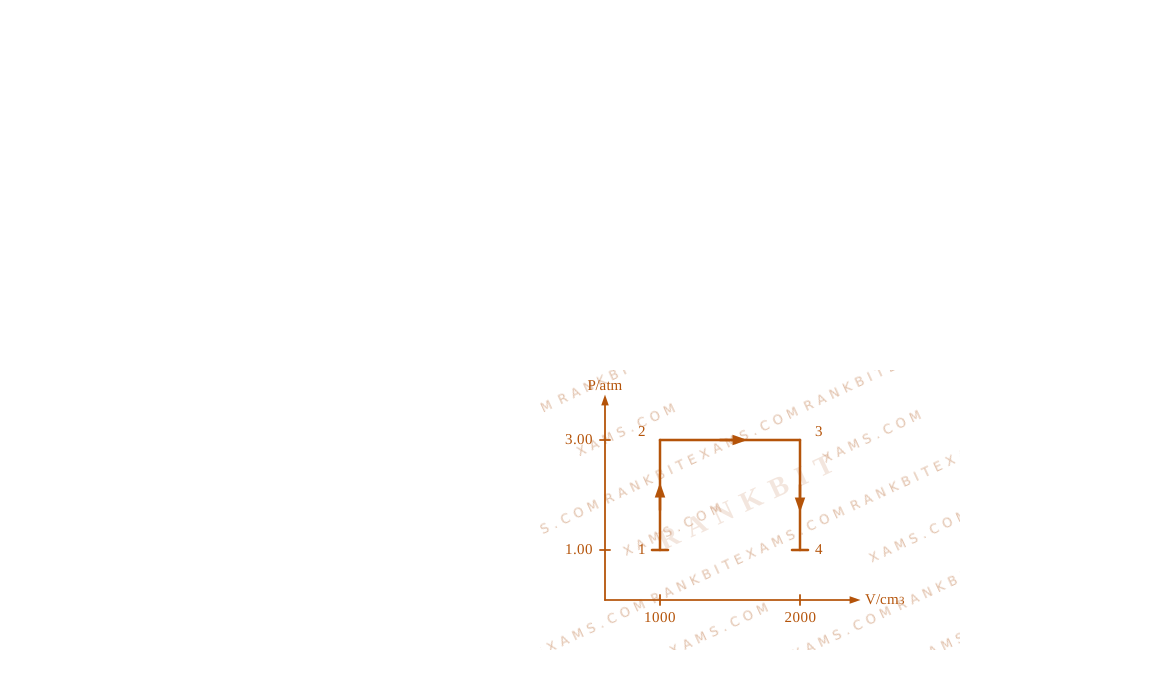
A perfect gas (0.1~mol) having Cv=1.50~R (independent of temperature) undergoes the transformation from point 1 to point 4 as shown in the pressure-volume diagram below. If each step is reversible, the total work done (w) while going from point 1 to point 4 is (-) ________ J. (nearest integer)
P-V path diagram for Q47 - JEE Main 2025 Evening
P-V graph showing a thermodynamic process from point 1 to point 4 containing an isobaric step and isochoric steps.
[Given: R=0.082 ~L~atm~K⁻¹~mol⁻¹ = 8.314 ~J~K⁻¹~mol⁻¹]

Numerical Answer Type:
Enter a numerical value Answer: 304 to 304 +4 marks

Solution & Explanation

Related Formula

Thermodynamic work done (w) for each step:

  • Isochoric step (V = constant):
  • w = 0

  • Isobaric step (P = constant):
  • w = -P Δ V

Core Logic

The process from point 1 to point 4 consists of three distinct segments:

  • Step 1 arrow 2: Isochoric cooling at constant volume V₁ = 1000~cm³. Work done w1arrow 2 = 0.
  • Step 2 arrow 3: Isobaric compression at constant pressure P = 3.00~atm from volume 2000~cm³ to 1000~cm³.
  • Step 3 arrow 4: Isochoric step at constant volume. Work done w3arrow 4 = 0.
Step 1: Calculate work done in the isobaric step (2 arrow 3)

The volume changes from Vᵢ = 2000~cm³ = 2.0~L to Vf = 1000~cm³ = 1.0~L:

w2arrow 3 = -P Δ V = -3.00~atm × (1.0~L - 2.0~L) = +3.00~L· atm
Step 2: Convert work to Joules and analyze direction

Convert

Step 2: Convert work to Joules and analyze direction

Convert $\mathrm{L\cdot atm}to Joules:

w2arrow 3 = 3.00 × 101.325~J = 303.975~J ≈ 304~J

The question asks for the total work done as (

The question asks for the total work done as ($-) ________ J, meaning work done by the system (expansion) is negative and work done on the system (compression) is positive. Since this is compression, work done on the gas is+304\mathrm{~J}, which is represented as-(-304)\mathrm{~J}in typical IUPAC convention where work of expansion is examined. The absolute magnitude of the work is304\mathrm{~J}.

Pattern Recognition

During any cyclic or multi-step path on a P-V graph, work is done only when there is a change in volume (

Pattern Recognition

During any cyclic or multi-step path on a P-V graph, work is done only when there is a change in volume ($W = -\int P dV$). Any vertical line (constant volume) represents an isochoric step where work is exactly zero. The horizontal segment directly represents rectangular area under the path.

Chapter Mix

Class 11 Chemistry: Thermodynamics Class 11 Physics: Thermodynamics

Reference Study Guides

More Thermodynamics Previous-Year Questions — Page 6

Q27 jee_main_2025_04_april_morning Spontaneity and Gibbs Energy
Let us consider a reversible reaction at temperature, T. In this reaction, both Δ H and Δ S were observed to have positive values. If the equilibrium temperature is Tₑ, then the reaction becomes spontaneous at:
  • A. T = Tₑ
  • B. Tₑ > T
  • C. T > Tₑ
  • D. Tₑ = 5T

Solution

Related Formula
Δ G = Δ H - TΔ S
Core Logic

For a reaction to be spontaneous, the change in Gibbs free energy must be negative:

Δ G < 0 Δ H - TΔ S < 0

Given that both Δ H > 0 and Δ S > 0:

Δ H < TΔ S T > (Δ H)/(Δ S)

At the equilibrium temperature Tₑ, Δ G = 0, which gives:

Tₑ = (Δ H)/(Δ S)

Substituting this back into the inequality reveals that the reaction is spontaneous when:

T > Tₑ

Pattern Recognition

When both Δ H and Δ S are positive, the reaction is entropy-driven and becomes spontaneous only at higher temperatures (T > Tₑ).

Chapter Mix

Class 11 Chemistry: Chemical Thermodynamics

Q30 jee_main_2025_04_april_morning Isothermal and Reversible Expansion
One mole of an ideal gas expands isothermally and reversibly from 10~dm³ to 20~dm³ at 300~K. Δ U, q and work done in the process respectively are: Given: R = 8.3 ~J~K⁻¹~mol⁻¹, ln 10 = 2.3, 2 = 0.30, 3 = 0.48
  • A. 0, 21.84~kJ, -1.26~kJ
  • B. 0, -17.18~kJ, 1.718~J
  • C. 0, 21.84~kJ, 21.84~kJ
  • D. 0, 1.718~kJ, -1.718~kJ

Solution

Related Formula
Δ U = n Cv Δ T w = -n R T ln((V₂)/(V₁)) Δ U = q + w
Core Logic

Since the expansion step is strictly isothermal (Δ T = 0):

Δ U = 0

Now compute the work command parameter w:

w = -n R T ln((V₂)/(V₁)) = -1 · 8.3 · 300 · ln((20)/(10)) w = -2490 · ln(2) = -2490 · (2.3 · 2) w = -2490 · (2.3 · 0.30) = -2490 · 0.69 = -1718.1~J = -1.718~kJ

Applying the first law equation constraint:

q = -w = +1.718~kJ

Hence, Δ U = 0, q = 1.718~kJ, w = -1.718~kJ.

Pattern Recognition

Isothermal expansion of an ideal gas ALWAYS yields Δ U = 0. Work is negative (done by system) and heat exchange q matches work magnitude inversely.

Chapter Mix

Class 11 Chemistry: Chemical Thermodynamics

Q28 jee_main_2025_07_april_evening Lattice Enthalpy and Born-Haber Cycle
The hydration energies of K^+ and Cl^- are -x and -y kJ/mol respectively. If lattice energy of KCl is -z kJ/mol, then the heat of solution of KCl is:
  • A. +x - y - z
  • B. x + y + z
  • C. z - (x + y)
  • D. -z - (x + y)

Solution

Related Formula
Δ Hsol = Lattice Energy (L.E.) + Δ Hhyd(Cation) + Δ Hhyd(Anion)
Core Logic

According to Hess's Law, the dissolution process can be mapped as follows:

Lattice Enthalpy and Born-Haber Cycle diagram for Q28 - JEE Main 2025 Evening

Given parameters:

  • Lattice Energy of KCl breaking into gaseous ions = -(-z) = z kJ/mol (since lattice energy released on formation is given as -z).
  • Hydration energy of K^+ = -x kJ/mol
  • Hydration energy of Cl^- = -y kJ/mol
Step 1: Computation

Substituting the values into the governing formulation:

Δ Hsol = z + (-x) + (-y) Δ Hsol = z - x - y = z - (x + y)
Pattern Recognition

To dissolve an ionic crystal, energy equal to the lattice energy must be supplied (endothermic step, +z), and hydration releases energy (exothermic steps, -x and -y). Net heat of solution is simply the sum of these parts: z - x - y.

Chapter Mix

Class 11 Chemistry: Chemical Thermodynamics Class 11 Chemistry: Chemical Bonding and Molecular Structure

Q33 jee_main_2025_07_april_evening Standard Enthalpy of Formation
The correct statement amongst the following is:
  • A. The term 'standard state' implies that the temperature is 0°C
  • B. The standard state of pure gas is the pure gas at a pressure of 1 and temperature 273 K
  • C. ΔfH298θ is zero for O(g)
  • D. ΔfH500θ is zero for O2(g)

Solution

Related Formula
ΔfHθ = 0 for an element in its reference/most stable standard state
Core Logic
  • Standard state conditions prescribe a pressure of 1. Temperature is not fixed by definition but is explicitly specified (often reference tables use 298.15 K).
  • Oxygen naturally and stably exists as diatomic gas molecules (O₂(g)) at standard thresholds.
  • The enthalpy of formation of an element in its reference elemental state is identically zero at any reference temperature:
ΔfH₅₀₀θ[O2(g)] = 0

Conversely, atomic oxygen gas (O(g)) is not the reference phase, so its formation enthalpy is non-zero.

Step 1: Verification of Options

Statement (4) accurately aligns with thermodynamic core definitions, while statement (1) and (2) mistakenly conflate standard ambient reference states with STP conditions (273.15 K, 1 atm).

Pattern Recognition

Standard state definitions checklist: Pressure = 1. Temperature is variable/assigned independently. Elements in their most stable natural form take ΔfHθ = 0 at all thermal profiles.

Chapter Mix

Class 11 Chemistry: Chemical Thermodynamics

Q31 jee_main_2025_24_jan_evening Enthalpy of Neutralization
Which of the following mixing of 1M base and 1M acid leads to the largest increase in temperature?
  • A. \text{30 mL HCl and 30 mL NaOH}
  • B. \text{30 mL } \mathrm{CH_{3}COOH} \text{ and 30 mL NaOH}
  • C. \text{50 mL HCl and 20 mL NaOH}
  • D. \text{45 mL } \mathrm{CH_{3}COOH} \text{ and 25 mL NaOH}

Solution

Related Formula
Q = nreacted · Δ Hneutralization Δ T = (Q)/(m · c)
Core Logic

The temperature rise depends directly on the total heat released (Q) normalized by the total heat capacity of the resulting mixed volume (m · c). Let's evaluate the millimoles of H^+ and OH^- that react in each mixture:

  • Option 1: 30 mL of 1M HCl + 30 mL of 1M NaOH
  • Reactive millimoles = 30 mmol. Both are strong electrolytes, releasing full neutralization energy (-57.3 kJ/mol). Total volume = 60 mL.

  • Option 2: 30 mL of 1M CH₃COOH + 30 mL of 1M NaOH
  • Reactive millimoles = 30 mmol. However, since acetic acid is a weak acid, part of the heat is consumed in its ionization. Thus, less total heat is evolved compared to Option 1.

  • Option 3: 50 mL of 1M HCl + 20 mL of 1M NaOH
  • Limiting reagent = NaOH = 20 mmol. Only 20 mmol reacts. Total volume = 70 mL.

  • Option 4: 45 mL of 1M CH₃COOH + 25 mL of 1M NaOH
  • Limiting reagent = 25 mmol weak neutralization profile.

    Comparing Option 1 and Option 3, Option 1 releases significantly more heat (30 mmol vs 20 mmol) into a smaller volume (60 mL vs 70 mL), yielding the largest increase in temperature Δ T.

Pattern Recognition

To maximize Δ T, look for the option that maximizes the amount of reacting strong acid and strong base equivalents while keeping the total solution volume as small as possible.

Chapter Mix

Class 11 Chemistry: Thermodynamics Class 11 Chemistry: Equilibrium
More Thermodynamics Questions — jee_main_2025_03_april_evening

Practice all Thermodynamics previous-year questions →

Rankbit System
JEE Physics: Waves (+15.5%) | Electrostatics: Concentric Shells (-29.7%) | Modern Physics: Photoelectric Clones (+34.2%) | Mathematics: Definite Integrals (+18.1%) | Chemistry: Coordination Splitting (-11.4%) | JEE Physics: Waves (+15.5%) | Electrostatics: Concentric Shells (-29.7%) | Modern Physics: Photoelectric Clones (+34.2%) | Mathematics: Definite Integrals (+18.1%) | Chemistry: Coordination Splitting (-11.4%)
