JEE Main · Chemistry ↓ Falling

Thermodynamics appeared 44 times across 3 years — 5.1% of Chemistry. This question is from Work Done in Reversible Cyclic Processes.

Year 2026 2025 2024 Total
Questions 12 24 8 44

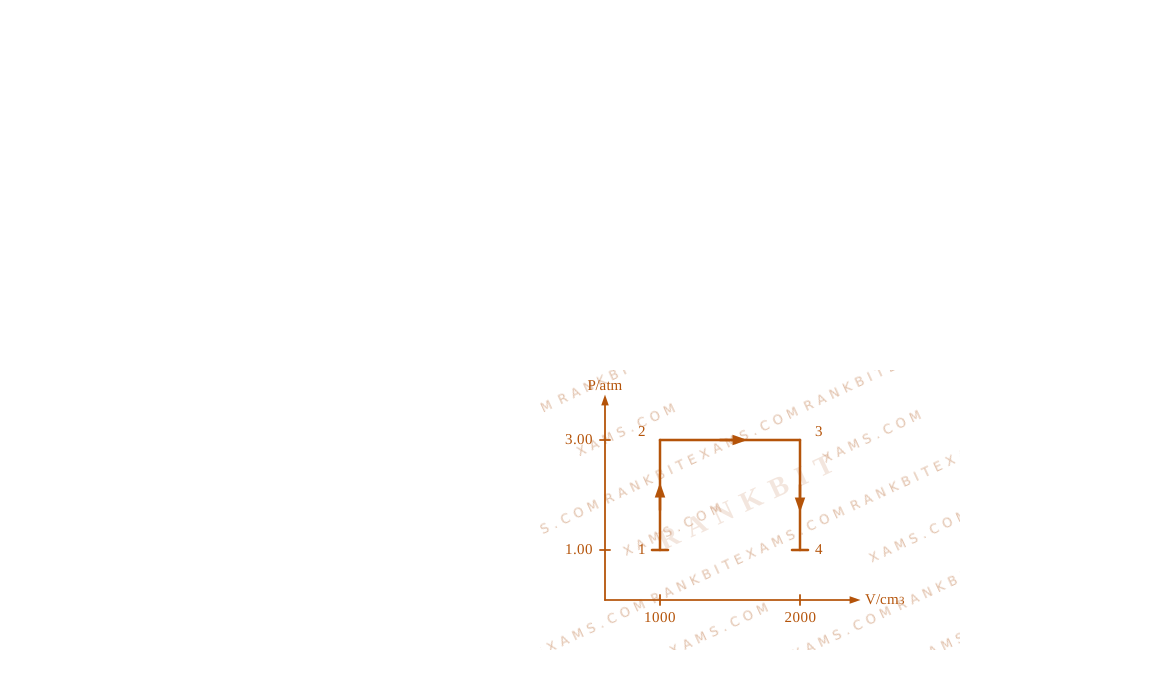
A perfect gas (0.1~mol) having Cv=1.50~R (independent of temperature) undergoes the transformation from point 1 to point 4 as shown in the pressure-volume diagram below. If each step is reversible, the total work done (w) while going from point 1 to point 4 is (-) ________ J. (nearest integer)
P-V path diagram for Q47 - JEE Main 2025 Evening
P-V graph showing a thermodynamic process from point 1 to point 4 containing an isobaric step and isochoric steps.
[Given: R=0.082 ~L~atm~K⁻¹~mol⁻¹ = 8.314 ~J~K⁻¹~mol⁻¹]

Numerical Answer Type:
Enter a numerical value Answer: 304 to 304 +4 marks

Solution & Explanation

Related Formula

Thermodynamic work done (w) for each step:

  • Isochoric step (V = constant):
  • w = 0

  • Isobaric step (P = constant):
  • w = -P Δ V

Core Logic

The process from point 1 to point 4 consists of three distinct segments:

  • Step 1 arrow 2: Isochoric cooling at constant volume V₁ = 1000~cm³. Work done w1arrow 2 = 0.
  • Step 2 arrow 3: Isobaric compression at constant pressure P = 3.00~atm from volume 2000~cm³ to 1000~cm³.
  • Step 3 arrow 4: Isochoric step at constant volume. Work done w3arrow 4 = 0.
Step 1: Calculate work done in the isobaric step (2 arrow 3)

The volume changes from Vᵢ = 2000~cm³ = 2.0~L to Vf = 1000~cm³ = 1.0~L:

w2arrow 3 = -P Δ V = -3.00~atm × (1.0~L - 2.0~L) = +3.00~L· atm
Step 2: Convert work to Joules and analyze direction

Convert

Step 2: Convert work to Joules and analyze direction

Convert $\mathrm{L\cdot atm}to Joules:

w2arrow 3 = 3.00 × 101.325~J = 303.975~J ≈ 304~J

The question asks for the total work done as (

The question asks for the total work done as ($-) ________ J, meaning work done by the system (expansion) is negative and work done on the system (compression) is positive. Since this is compression, work done on the gas is+304\mathrm{~J}, which is represented as-(-304)\mathrm{~J}in typical IUPAC convention where work of expansion is examined. The absolute magnitude of the work is304\mathrm{~J}.

Pattern Recognition

During any cyclic or multi-step path on a P-V graph, work is done only when there is a change in volume (

Pattern Recognition

During any cyclic or multi-step path on a P-V graph, work is done only when there is a change in volume ($W = -\int P dV$). Any vertical line (constant volume) represents an isochoric step where work is exactly zero. The horizontal segment directly represents rectangular area under the path.

Chapter Mix

Class 11 Chemistry: Thermodynamics Class 11 Physics: Thermodynamics

Reference Study Guides

More Thermodynamics Previous-Year Questions — Page 5

Q34 jee_main_2025_28_jan_morning Phase Equilibrium and Le Chatelier's Principle
Ice and water are placed in a closed container at a pressure of 1 atm and temperature 273.15K . If pressure of the system is increased 2 times, keeping temperature constant, then identify correct observation from following:
  • A. Volume of system increases.
  • B. Liquid phase disappears completely.
  • C. The amount of ice decreases.
  • D. The solid phase (ice) disappears completely.

Solution

Core Logic

Water has a unique property where the density of the liquid phase is greater than the density of the solid phase (ice). Consequently, the molar volume of ice is larger than that of liquid water:

Vm(ice) > Vm(water)

According to Le Chatelier's Principle, increasing the pressure favors the phase that occupies a smaller volume to alleviate the applied stress. Thus, shifting the system forward converts ice into liquid water:
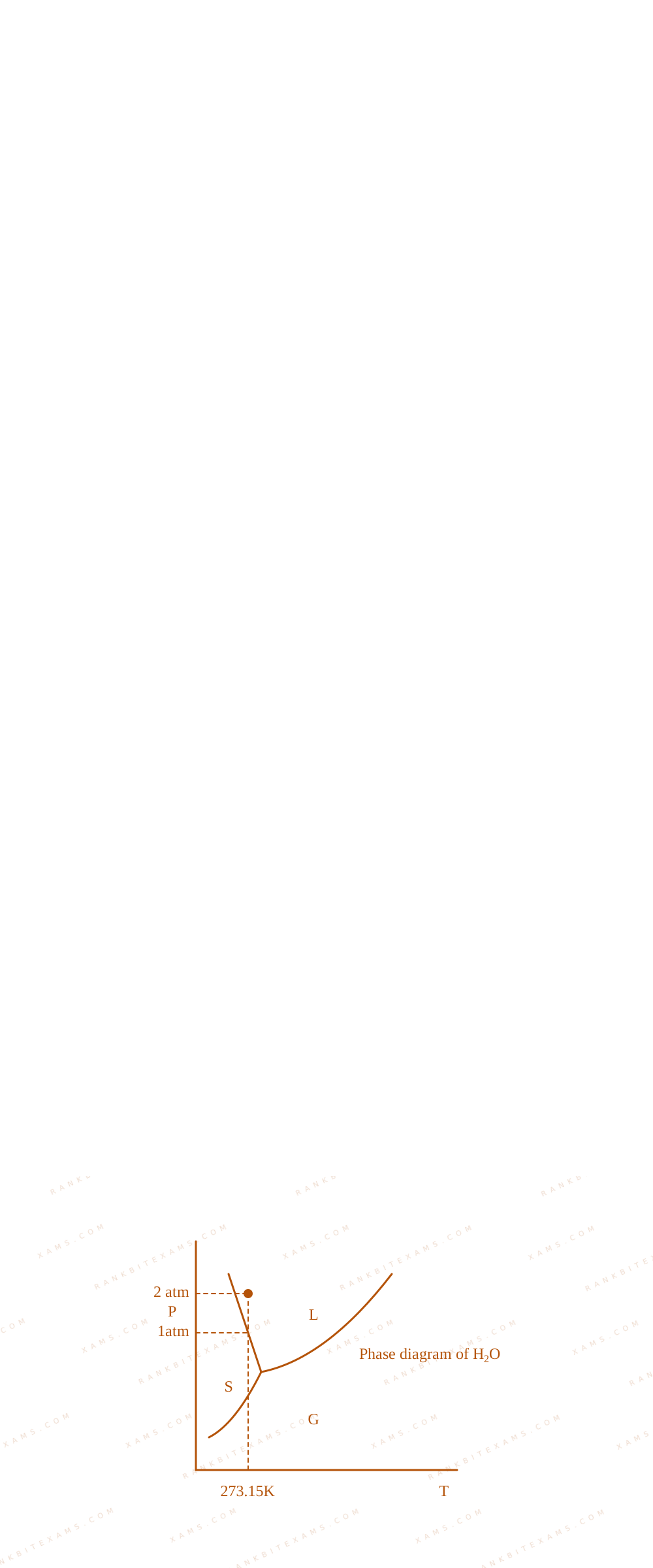
Phase shift diagram for Q34 - JEE Main 2025 Morning

If the pressure is increased considerably (such as doubling it to 2 atm) at 273.15K, the melting point decreases, causing the entire solid phase (ice) to disappear completely.

Pattern Recognition

Sees: Ice-water system under pressure change. Trap: Assuming that an increase in pressure always favors the solid phase. Water has an anomalous phase curve with a negative slope.

Chapter Mix

Class 11 Chemistry: Chemical Thermodynamics

Q50 jee_main_2025_28_jan_morning Bond Enthalpy Calculation
The formation enthalpies, Δ Hf for H(g) and O(g) are 220.0 and 250.0~kJ~mol⁻¹ , respectively, at 298.15K , and Δ Hf⁻ for H₂O(g) is -242.0kJ mol⁻¹ at the same temperature. The average bond enthalpy of the O-H bond in water at 298.15K is ___________________________________________________ (nearest integer).
Numerical Answer. Answer: 466 to 466

Solution

Related Formula

Reaction enthalpy based on atomization processes:

Δᵣ H = Σ Δf H(products) - Σ Δf H(reactants)
Step 1: Map the Dissociation Reaction

Consider the dissociation of gas phase water molecules into constituent gaseous atoms:

H₂O(g) arrow 2H(g) + O(g)

The total energy required corresponds to breaking exactly two O-H bonds:

Δᵣ H = 2 × B.E.(O-H)
Step 2: Calculate Δᵣ H

Using the enthalpies of formation:

Δᵣ H = [2 × Δf H(H(g)) + Δf H(O(g))] - Δf H(H₂O(g)) Δᵣ H = [2 × 220.0 + 250.0] - (-242.0) Δᵣ H = [440.0 + 250.0] + 242.0 = 690.0 + 242.0 = 932.0 kJ mol⁻¹
Step 3: Solve for Single Bond Enthalpy
2 × B.E.(O-H) = 932.0 B.E.(O-H) = (932.0)/(2) = 466 kJ mol⁻¹
Pattern Recognition

Sees: Atomization state values used to evaluate single bond metrics. Shortcut: Remember Total Dissociation Energy = Σ Δf H(atoms) - Δf H(molecule). Halving the result gives the average bond enthalpy.

Chapter Mix

Class 11 Chemistry: Chemical Thermodynamics

Q35 jee_main_2025_03_april_morning Intensive and Extensive Properties
Which of the following properties will change when system containing solution 1 will become solution 2?
System mixture comparison diagram for Q35 - JEE Main 2025 Morning
Diagram showing solution 1 (10 mol solute in 10 L water) and solution 2 (1 mol solute in 1 L water).
  • A. Molar heat capacity
  • B. Density
  • C. Concentration
  • D. Gibbs free energy

Solution

Related Formula

G = H - TS

Extensive properties depend on mass/amount of matter; Intensive properties are independent of amount.

Core Logic

Both solution 1 (10 mol/10 L = 1 M) and solution 2 (1 mol/1 L = 1 M) have identical concentrations and chemical compositions.

Intensive properties (molar heat capacity, density, concentration) depend only on composition and temperature, so they remain unchanged.

Gibbs free energy (G) is an extensive property, proportional to the total amount of substance present, so it changes.

Step 1: Final Conclusion

Gibbs free energy changes because it is an extensive property.

Pattern Recognition

Same concentration/composition arrow Intensive properties stay equal. Total amount changes arrow Extensive properties (G, H, U, S) change.

Chapter Mix

Class 11 Chemistry: Thermodynamics

Q49 jee_main_2025_03_april_morning Enthalpy of Formation and Bond Enthalpies
Given: Δ Hsub [C(graphite)] = 710 ~kJ~mol⁻¹ ΔC-H H = 414 ~kJ~mol⁻¹ ΔH-H H = 436 ~kJ~mol⁻¹ ΔC=C H = 611 ~kJ~mol⁻¹ The Δ Hf for CH₂ = CH₂ is ________ kJ~mol⁻¹ (nearest integer value)
Numerical Answer. Answer: 24 to 26

Solution

Related Formula
Δ Hf(C₂H₄) = 2 Δ Hsub[C(s)] + 2 ΔH-H H - [1 ΔC=C H + 4 ΔC-H H]
Core Logic

Target formation reaction:

2C(graphite, s) + 2H₂(g) arrow CH₂=CH₂(g)
  • Sublimation of 2 moles of C(s) to gaseous atoms: 2 × 710 = 1420~kJ
  • Dissociation of 2 moles of H₂(g) to 4H(g) atoms: 2 × 436 = 872~kJ
  • Formation of 1 × C=C double bond: -611~kJ
  • Formation of 4 × C-H single bonds: -4 × 414 = -1656~kJ
Step 1: Calculation
Δ Hf = 1420 + 872 - 611 - 1656 Δ Hf = 2292 - 2267 = 25 ~kJ~mol⁻¹
Pattern Recognition

Standard Enthalpy of Formation = Atomization Enthalpies of Reactants - Bond Enthalpies of Products formed.

Chapter Mix

Class 11 Chemistry: Thermodynamics

Q37 jee_main_2025_04_april_evening Thermochemistry
Consider the given data : (a) HCl(g) + 10H₂O(l)arrow HCl.10H₂O Δ H = - 6 9. 0 1 k J m o l ^ - 1 (b) HCl(g) + 40H₂O(l)arrow HCl.40H₂O Δ H = - 7 2. 7 9 k J m o l ^ - 1 Choose the correct statement :
  • A. Dissolution of gas in water is an endothermic process
  • B. The heat of solution depends on the amount of solvent.
  • C. The heat of dilution for the HCl (HCl.10H₂O to HCl.40H₂O) is 3.78kJ mol⁻¹.
  • D. The heat of formation of HCl solution is represented by both (a) and (b)

Solution

Related Formula
Δ Hdilution = Δ H₂ - Δ H₁
Core Logic

Analyzing the thermodynamic statements:

  • Δ H values are negative, so the dissolution of HCl(g) is clearly exothermic, eliminating option (1).
  • Since the enthalpy release changes when the moles of water solvent shift from 10 to 40 (-69.01 vs -72.79), the heat of solution depends explicitly on the amount of solvent (Statement 2 is true).
  • Let's check Statement 3: By subtracting equation (a) from (b):
HCl·10H₂O + 30H₂O arrow HCl·40H₂O Δ H = -72.79 - (-69.01) = -3.78 ~kJ· mol⁻¹

The value is negative, indicating an exothermic process, so calling it +3.78 makes option (3) incorrect.

Pattern Recognition

The standard integral enthalpy of solution varies with solvent concentration until infinite dilution is achieved. Thus, concentration dependence is a core property of partial molar solution variables.

Chapter Mix

Class 11 Chemistry: Chemical Thermodynamics

More Thermodynamics Questions — jee_main_2025_03_april_evening

Practice all Thermodynamics previous-year questions →

Rankbit System
JEE Physics: Waves (+15.5%) | Electrostatics: Concentric Shells (-29.7%) | Modern Physics: Photoelectric Clones (+34.2%) | Mathematics: Definite Integrals (+18.1%) | Chemistry: Coordination Splitting (-11.4%) | JEE Physics: Waves (+15.5%) | Electrostatics: Concentric Shells (-29.7%) | Modern Physics: Photoelectric Clones (+34.2%) | Mathematics: Definite Integrals (+18.1%) | Chemistry: Coordination Splitting (-11.4%)