A sample of n-octane (1.14mathrm~g) was completely burnt in excess of oxygen in a bomb calorimeter, whose heat capacity is 5mathrm~kJ~K^-1. As a result of combustion reaction, the temperature of the calorimeter is increased by 5 K. The magnitude of the heat of combustion of octane at constant volume is ________ mathrmkJ~mol^-1. (nearest integer)

Numerical Answer Type:
Enter a numerical value Answer: 2500 to 2500 +4 marks

Solution & Explanation

### Related Formula Heat released at constant volume (q_v) in a bomb calorimeter is: q_v = C_textcal cdot Delta T Molar heat of combustion at constant volume (Delta U_textcomb): Delta U_textcomb = fracq_vn_textfuel ### Core Logic Given parameters: - Mass of n-octane m = 1.14mathrm~g - Heat capacity of calorimeter C_textcal = 5mathrm~kJ/K - Temperature rise Delta T = 5mathrm~K - Formula of octane: mathrmC_8H_18 Rightarrow Molar mass = 8(12) + 18(1) = 114mathrm~g/mol ### Step 1: Calculate heat absorbed by the calorimeter (q_v) q_v = 5mathrm~kJ/K times 5mathrm~K = 25mathrm~kJ ### Step 2: Calculate moles of octane n = frac1.14mathrm~g114mathrm~g/mol = 0.01mathrm~mol ### Step 3: Calculate molar heat of combustion Delta U_textcomb = frac25mathrm~kJ0.01mathrm~mol = 2500mathrm~kJ/mol The magnitude of the heat of combustion is 2500\mathrm{~kJ~mol^{-1}}. ### Pattern Recognition A bomb calorimeter operates at rigid constant volume, meaning boundary work w = 0. Thus, by the first law of thermodynamics, the measured heat flow represents the internal energy change (\Delta U), not the enthalpy change (\Delta H$, which occurs at constant pressure). ### Evaluation Rubric / Model Answer null ### Chapter Mix Class 11 Chemistry: Thermodynamics

Reference Study Guides

More Thermodynamics Previous-Year Questions — Page 5

Q31 jee_main_2025_24_jan_evening Enthalpy of Neutralization
Which of the following mixing of 1M base and 1M acid leads to the largest increase in temperature?
  • A. \text{30 mL HCl and 30 mL NaOH}
  • B. \text{30 mL } \mathrm{CH_{3}COOH} \text{ and 30 mL NaOH}
  • C. \text{50 mL HCl and 20 mL NaOH}
  • D. \text{45 mL } \mathrm{CH_{3}COOH} \text{ and 25 mL NaOH}

Solution

### Related Formula Q = n_textreacted cdot Delta H_textneutralization Delta T = fracQm cdot c ### Core Logic The temperature rise depends directly on the total heat released (Q) normalized by the total heat capacity of the resulting mixed volume (m cdot c). Let's evaluate the millimoles of mathrmH^+ and mathrmOH^- that react in each mixture: 1. **Option 1:** 30text mL of 1mathrmM mathrmHCl + 30text mL of 1mathrmM mathrmNaOH textReactive millimoles = 30text mmol. Both are strong electrolytes, releasing full neutralization energy (sim -57.3text kJ/mol). Total volume = 60text mL. 2. **Option 2:** 30text mL of 1mathrmM mathrmCH_3COOH + 30text mL of 1mathrmM mathrmNaOH textReactive millimoles = 30text mmol. However, since acetic acid is a weak acid, part of the heat is consumed in its ionization. Thus, less total heat is evolved compared to Option 1. 3. **Option 3:** 50text mL of 1mathrmM mathrmHCl + 20text mL of 1mathrmM mathrmNaOH textLimiting reagent = mathrmNaOH = 20text mmol. Only 20text mmol reacts. Total volume = 70text mL. 4. **Option 4:** 45text mL of 1mathrmM mathrmCH_3COOH + 25text mL of 1mathrmM mathrmNaOH textLimiting reagent = 25text mmol weak neutralization profile. Comparing Option 1 and Option 3, Option 1 releases significantly more heat (30text mmol vs 20text mmol) into a smaller volume (60text mL vs 70text mL), yielding the largest increase in temperature Delta T. ### Pattern Recognition To maximize Delta T, look for the option that maximizes the amount of reacting strong acid and strong base equivalents while keeping the total solution volume as small as possible. ### Evaluation Rubric / Model Answer null ### Chapter Mix Class 11 Chemistry: Thermodynamics Class 11 Chemistry: Equilibrium
Q41 jee_main_2025_24_jan_evening Hess's Law of Constant Heat Summation
mathrmS(g) + frac32 O_2(g) ightarrow SO_3(g) + 2xtext kcal mathrmSO2(mathrmg) + frac12mathrmO2(mathrmg) ightarrow mathrmSO3(mathrmg) + ytext kcal The heat of formation of mathrmSO_2(mathrmg) is given by:
  • A. \frac{2x}{y}\mathrm{\ kcal}
  • B. y - 2x\mathrm{\ kcal}
  • C. 2x + y\mathrm{\ kcal}
  • D. x + y\mathrm{\ kcal}

Solution

### Related Formula Using Hess's Law, the enthalpy change of a net reaction can be determined by linearly combining the steps: Delta Htextnet = sum Delta Htextproducts - sum Delta Htextreactants ### Core Logic The heat of formation of mathrmSO_2(g) corresponds to the target thermochemical equation: textTarget: mathrmS(g) + mathrmO2(g) ightarrow mathrmSO2(g) quad Delta H_f = ? Let's write out the given equations along with their enthalpy changes (remembering that exothermic reactions release heat, so Delta H = -Q): 1. mathrmS(g) + frac32mathrmO_2(g) ightarrow mathrmSO_3(g) quad Delta H_1 = -2xtext kcal 2. mathrmSO_2(g) + frac12mathrmO_2(g) ightarrow mathrmSO_3(g) quad Delta H_2 = -ytext kcal To isolate mathrmSO_2(g) on the product side, subtract Equation (2) from Equation (1): left[mathrmS(g) + frac32mathrmO2(g) ight] - left[mathrmSO2(g) + frac12mathrmO2(g) ight] ightarrow mathrmSO3(g) - mathrmSO3(g) mathrmS(g) + mathrmO2(g) ightarrow mathrmSO2(g) Now apply the same operation to the enthalpy values: Delta H_f = Delta H1 - Delta H_2 = -2x - (-y) = y - 2xtext kcal This matches Option (2). ### Pattern Recognition To isolate your target species on the desired side of the equation, use Hess's Law to add or subtract the given elemental equations. Make sure to invert the sign of the enthalpy change if you reverse a reaction. ### Evaluation Rubric / Model Answer null ### Chapter Mix Class 11 Chemistry: Thermodynamics
Q33 jee_main_2025_24_jan_morning Spontaneity and Gibbs Energy Change
Let us consider an endothermic reaction which is non-spontaneous at the freezing point of water. However, the reaction is spontaneous at boiling point of water. Choose the correct option.
  • A. Both Delta H and Delta S are (+ve)
  • B. Delta H is (-ve) but Delta S is (+ve)
  • C. Delta H is (+ve) but Delta S is (-ve)
  • D. Both Delta H and Delta S are (-ve)

Solution

### Related Formula Delta G = Delta H - TDelta S ### Core Logic An endothermic profile specifies that Delta H > 0. For the system to become spontaneous (Delta G < 0) specifically when shifting to higher temperatures (T), the temperature-dependent entropic subtraction term (-TDelta S) must outweigh the enthalpic barrier. This transition demands a positive structural entropy step, i.e., Delta S > 0. Hence, both Delta H and Delta S are positive. ### Pattern Recognition Spontaneity driven purely by elevated thermal thresholds mandates matching positive signs for enthalpy and entropy. ### Evaluation Rubric / Model Answer null ### Chapter Mix Class 11 Chemistry: Chemical Thermodynamics
Q47 jee_main_2025_24_jan_morning Gibbs Free Energy and Equilibrium Temperature
Standard entropies of mathrmX_2, mathrmY_2 and mathrmXY_5 are 70, 50 and 110 mathrm~J mathrm~K^-1 mathrm~mol^-1 respectively. The temperature in Kelvin at which the reaction frac 12 mathrm X _ 2 + frac 52 mathrm Y _ 2 rightarrow mathrm X Y _ 5 quad Delta mathrm H ^ circ = - 3 5 mathrm k J mathrm m o l ^ - 1 will be at equilibrium is (Nearest integer)
Numerical Answer. Answer: 700 to 700

Solution

### Related Formula Delta S_textrxn^0 = sum S_textproducts^0 - sum S_textreactants^0 quad textand quad T = fracDelta H^0Delta S^0 quad textat equilibrium (Delta G^0 = 0text) ### Core Logic First, calculate the standard entropy change for the reaction system (Delta S_textrxn^0): Delta S_textrxn^0 = S^0(XY_5) - left[ frac12S^0(X_2) + frac52S^0(Y_2) right] Delta S_textrxn^0 = 110 - left[ left(frac12 times 70right) + left(frac52 times 50right) right] = 110 - [35 + 125] Delta S_textrxn^0 = 110 - 160 = -50text J K^-1text mol^-1 At thermodynamic equilibrium, the change in Gibbs free energy drops to zero (Delta G^0 = 0): 0 = Delta H^0 - TDelta S^0 implies T = fracDelta H^0Delta S^0 Convert the enthalpy value into Joules (Delta H^0 = -35 times 10^3text J/mol) and substitute the parameters: T = frac-35000text J mol^-1-50text J K^-1text mol^-1 = 700text Kelvin ### Pattern Recognition Ensure all variables use matching energy units (Joules vs. Kilojoules) before setting up your final division step. ### Evaluation Rubric / Model Answer null ### Chapter Mix Class 11 Chemistry: Chemical Thermodynamics
Q33 jee_main_2025_28_jan_evening First Law of Thermodynamics and State Functions
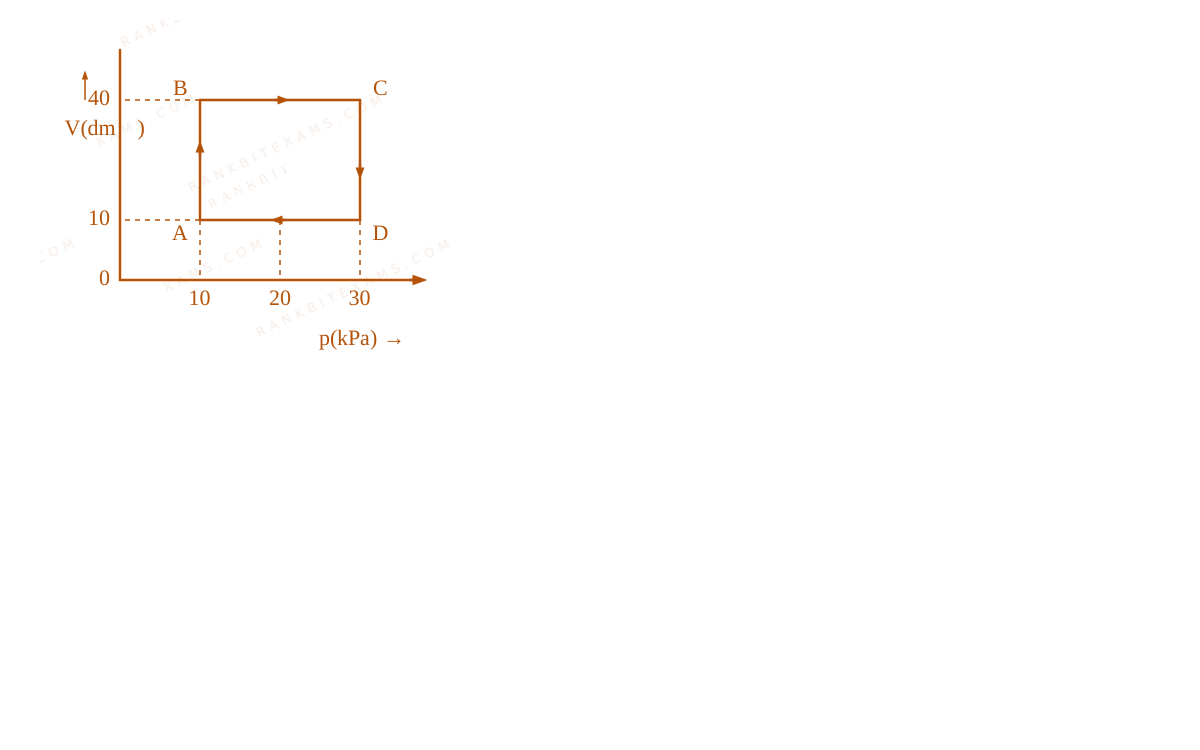
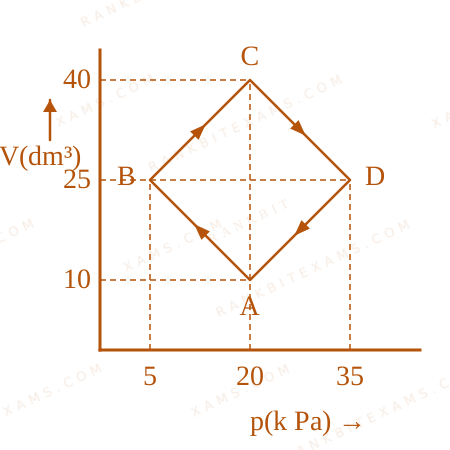
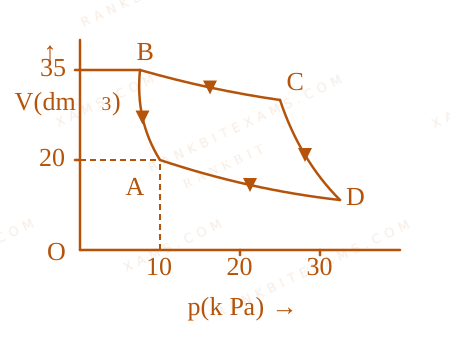
An ideal gas undergoes a cyclic transformation starting from the point A and coming back to the same point by tracing the path mathrmAto mathrmBto mathrmC rightarrow mathrmDrightarrow mathrmA as shown in the three cases below.
Thermodynamic cyclic path diagrams for Q33 - JEE Main 2025
The diagram displays three distinct cyclic paths (Case I, Case II, Case III) on volume vs pressure graphs.
Choose the correct option regarding Delta U:
Thermodynamic cyclic path diagrams for Q33 - JEE Main 2025
The diagram displays three distinct cyclic paths (Case I, Case II, Case III) on volume vs pressure graphs.
Thermodynamic cyclic path diagrams for Q33 - JEE Main 2025
The diagram displays three distinct cyclic paths (Case I, Case II, Case III) on volume vs pressure graphs.
  • A. Delta Utext (Case-III) > Delta Utext (Case-II) > Delta Utext (Case-I)
  • B. Delta Utext (Case-I) > Delta Utext (Case-II) > Delta Utext (Case-III)
  • C. Delta Utext (Case-I) > Delta Utext (Case-III) > Delta Utext (Case-II)
  • D. Delta Utext (Case-I) = Delta Utext (Case-II) = Delta Utext (Case-III)

Solution

### Related Formula For any state function like Internal Energy (U), the cyclic integral over a complete closed loop is identically zero: oint dU = 0 implies Delta U_textcyclic = 0 ### Core Logic Internal energy (U) depends only on the initial and final states of the thermodynamic system, not on the path followed. In all three listed cases, the ideal gas undergoes a complete cyclic path that returns to its original configuration state A. ### Step 1: Final Evaluation Since every transformation begins and ends at point A: Delta U_textCase-I = 0 Delta U_textCase-II = 0 Delta U_textCase-III = 0 Therefore, Delta Utext (Case-I) = Delta Utext (Case-II) = Delta Utext (Case-III). ### Pattern Recognition Do not waste time calculating path areas or values if the question asks for a state function change (Delta U, Delta H, Delta S, Delta G) over a cyclic loop. The answer is instantly zero for all cases! ### Evaluation Rubric / Model Answer null ### Chapter Mix Class 11 Chemistry: Thermodynamics

More Thermodynamics Questions — jee_main_2025_03_april_evening

Practice all Thermodynamics previous-year questions →

Rankbit System
JEE Physics: Waves (+15.5%) | Electrostatics: Concentric Shells (-29.7%) | Modern Physics: Photoelectric Clones (+34.2%) | Mathematics: Definite Integrals (+18.1%) | Chemistry: Coordination Splitting (-11.4%) | JEE Physics: Waves (+15.5%) | Electrostatics: Concentric Shells (-29.7%) | Modern Physics: Photoelectric Clones (+34.2%) | Mathematics: Definite Integrals (+18.1%) | Chemistry: Coordination Splitting (-11.4%)