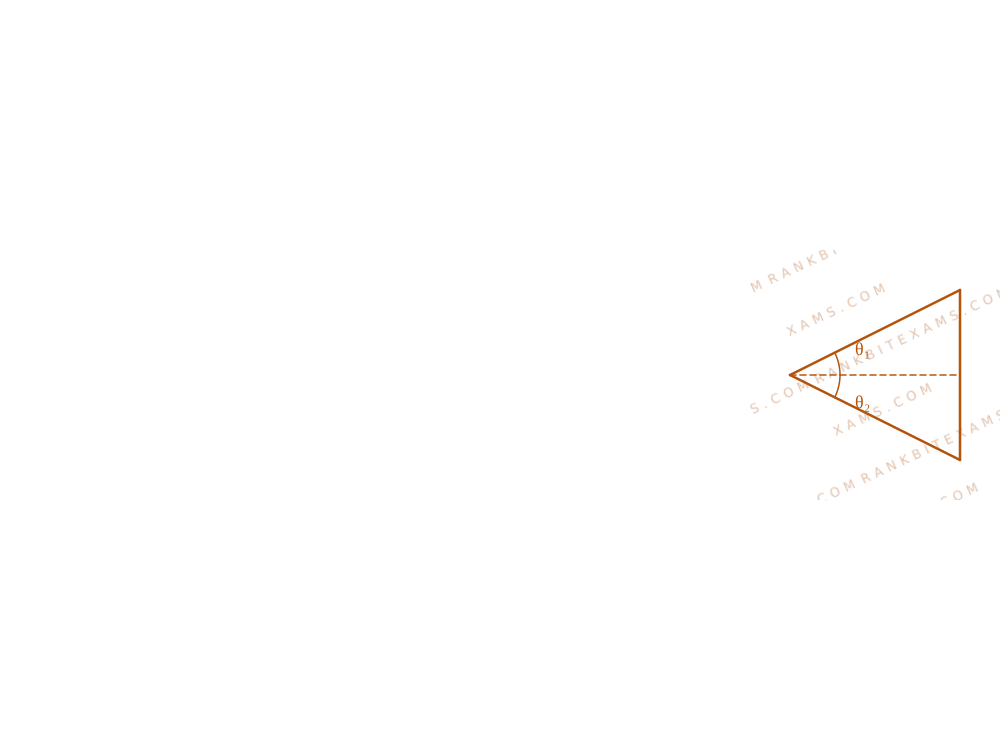
If the measured angular separation between the second minimum to the left of the central maximum and the third minimum to the right of the central maximum is 30^circ in a single slit diffraction pattern recorded using 628mathrm~nm light, then the width of the slit is mumathrmm.

Numerical Answer Type:
Enter a numerical value Answer: 6 to 6 +4 marks

Solution & Explanation

### Related Formula a sintheta_n = n lambda theta_textapprox = n fraclambdaa quad text(for small angles) ### Core Logic Let the width of the slit be a, and the light wavelength be lambda = 628mathrm~nm = 628 times 10^-9mathrm~m. The second minimum (n = 2) is located at angular position: sintheta_1 = frac2lambdaa The third minimum (n = 3) is located at angular position: sintheta_2 = frac3lambdaa The total angular separation is 30^circ: theta_1 + theta_2 = 30^circ = fracpi6mathrm~rad Using the small-angle approximation (where theta approx sintheta): theta_1 + theta_2 approx frac2lambdaa + frac3lambdaa = frac5lambdaa Equating to the given separation: frac5lambdaa = fracpi6 implies a = frac30lambdapi Substitute the given values (using pi approx 3.14): a = frac30 times 628 times 10^-9mathrm~m3.14 = 30 times 200 times 10^-9mathrm~m = 6 times 10^-6mathrm~m = 6mathrm~mu m ### Step 1: Final Conclusion The width of the slit is 6\mathrm{~\mu m}. ### Pattern Recognition In single slit diffraction, the position of minima is a \sin\theta = n \lambda. The angular spread from the n_1-th minimum on one side to the n_2-th minimum on the other is (n_1 + n_2) \frac{\lambda}{a}. Since \pi \approx 3.14, note how 628 / 3.14 = 200$, resolving to a neat integer. ### Evaluation Rubric / Model Answer null ### Chapter Mix Class 12 Physics: Wave Optics
Diffraction geometry diagram

Reference Study Guides

More Wave Optics Previous-Year Questions — Page 5

Q41 jee_main_2024_30_january_evening Polarisation of Light
A beam of unpolarised light of intensity I_0 is passed through a polaroid mathrmA and then through another polaroid mathrmB which is oriented so that its principal plane makes an angle of 45^circ relative to that of mathrmA. The intensity of emergent light is :
  • A. mathrmI_0 / 4
  • B. mathbfI_0
  • C. mathrmI_0 / 2
  • D. mathrmI_0 / 8

Solution

### Related Formula I = I_textincident cos^2 theta quad text(Malus's Law) ### Core Logic When unpolarised light of intensity I_0 passes through the first polaroid mathrmA, it becomes plane-polarised, and its intensity drops by exactly half. I_1 = fracI_02 When this polarised light passes through the second polaroid mathrmB, the transmitted intensity is determined by Malus's Law. ### Step 1: Apply Malus's Law The angle between the principal planes of polaroids mathrmA and mathrmB is theta = 45^circ. I_2 = I_1 cos^2(45^circ) I_2 = left(fracI_02right) left(frac1sqrt2right)^2 I_2 = fracI_02 times frac12 = fracI_04 ### Pattern Recognition Unpolarised to Polarised rightarrow I_0/2. Polarised to Polarised rightarrow I cos^2theta. At theta = 45^circ, cos^2theta = 1/2, resulting in a final intensity of I_0/4. ### Evaluation Rubric / Model Answer null ### Chapter Mix Class 12 Physics: Wave Optics
Q40 jee_main_2024_30_jan_morning Diffraction from a Single Slit
The diffraction pattern of a light of wavelength 400 nm diffracting from a slit of width 0.2 mathrm~mm is focused on the focal plane of a convex lens of focal length 100 mathrm~cm. The width of the 1^mathrmst secondary maxima will be :
  • A. 2 mathrm~mm
  • B. 2 mathrm~cm
  • C. 0.02 mathrm~mm
  • D. 0.2 mathrm~mm

Solution

### Related Formula textWidth of secondary maxima = fraclambda Da ### Core Logic In a single slit diffraction pattern, the linear width of any secondary maxima (fringe width of secondary bright bands) is given by W = fraclambda Da, whereas the central maximum is double this width (2fraclambda Da). ### Step 1: Parameter Identification Given values: Slit width, a = 0.2 times 10^-3 mathrm~m Wavelength, lambda = 400 times 10^-9 mathrm~m Distance to screen (focal length of the lens), D = 100 times 10^-2 mathrm~m = 1 mathrm~m ### Step 2: Execution Substitute these into the formula: textWidth = frac400 times 10^-90.2 times 10^-3 times 1 textWidth = frac4000.2 times 10^-6 mathrm~m textWidth = 2000 times 10^-6 mathrm~m = 2 times 10^-3 mathrm~m textWidth = 2 mathrm~mm ### Pattern Recognition Remember to strictly distinguish between central maximum (2lambda D/a) and secondary maxima (lambda D/a). ### Evaluation Rubric / Model Answer null ### Chapter Mix Class 12 Physics: Wave Optics

Q36 jee_main_2024_31_jan_evening Polarization by Reflection (Brewster's Law)
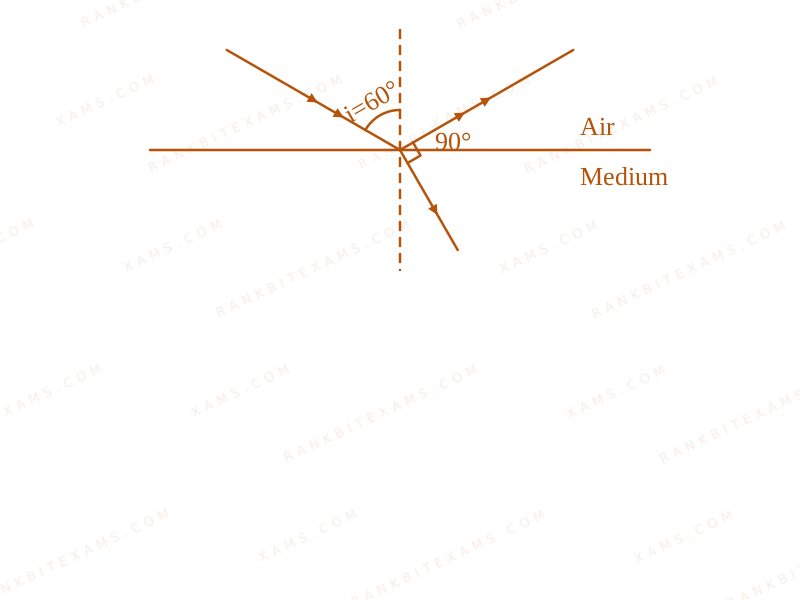
When unpolarized light is incident at an angle of 60^circ on a transparent medium from air. The reflected ray is completely polarized. The angle of refraction in the medium is
  • A. 30^circ
  • B. 60^circ
  • C. 90^circ
  • D. 45^circ

Solution

### Related Formula Brewster's Law states that at complete polarization upon reflection, the reflected and refracted rays are perpendicular to each other: i_p + r = 90^circ ### Core Logic The incident angle is given as i_p = 60^circ. At this angle, since the reflected ray is completely polarized, the geometry of Brewster's angle applies.
Polarization by Reflection (Brewster's Law) diagram for Q36 - JEE Main 2024 Evening
### Step 1: Calculate Refraction Angle 60^circ + r = 90^circ r = 90^circ - 60^circ = 30^circ ### Pattern Recognition The condition "reflected ray is completely polarized" is a direct trigger for Brewster's Law (i_p + r = 90^circ). No refractive index (mu) calculation is needed if only the geometric angle is asked. ### Evaluation Rubric / Model Answer null ### Chapter Mix Class 12 Physics: Wave Optics Class 12 Physics: Ray Optics and Optical Instruments
Q56 jee_main_2024_31_jan_morning Interference Of Waves
Two waves of intensity ratio 1:9 cross each other at a point. The resultant intensities at the point, when (a) Waves are incoherent is I_1 (b) Waves are coherent is I_2 and differ in phase by 60^circ. If fracI_1I_2 = frac10x then x =
Numerical Answer. Answer: 13 to 13

Solution

### Related Formula I_textincoherent = I_A + I_B I_textcoherent = I_A + I_B + 2sqrtI_A I_B cosphi ### Core Logic Let the individual intensities be I_A = I_0 and I_B = 9I_0. For incoherent waves, the net intensity is simply the algebraic sum: I_1 = I_A + I_B = I_0 + 9I_0 I_1 = 10I_0 ### Step 2: Coherent Waves Interference For coherent waves with a phase difference of phi = 60^circ: I_2 = I_A + I_B + 2sqrtI_A I_B cos(60^circ) I_2 = I_0 + 9I_0 + 2sqrt(I_0)(9I_0) left(frac12right) I_2 = 10I_0 + 2(3I_0) left(frac12right) I_2 = 10I_0 + 3I_0 = 13I_0 ### Step 3: Finding x Taking the ratio: fracI_1I_2 = frac10I_013I_0 = frac1013 Comparing with the given expression frac10x, we get: x = 13 ### Evaluation Rubric / Model Answer null ### Chapter Mix Class 12 Physics: Wave Optics

More Wave Optics Questions — jee_main_2025_02_april_morning

Practice all Wave Optics previous-year questions →

Rankbit System
JEE Physics: Waves (+15.5%) | Electrostatics: Concentric Shells (-29.7%) | Modern Physics: Photoelectric Clones (+34.2%) | Mathematics: Definite Integrals (+18.1%) | Chemistry: Coordination Splitting (-11.4%) | JEE Physics: Waves (+15.5%) | Electrostatics: Concentric Shells (-29.7%) | Modern Physics: Photoelectric Clones (+34.2%) | Mathematics: Definite Integrals (+18.1%) | Chemistry: Coordination Splitting (-11.4%)