Related Formula
For a first order dark fringe (minima) to form, the net optical path difference between the interfering paths must be an odd multiple of half-wavelength:
Δ x = (λ)/(2)$$\Delta x = \frac{\lambda}{2}$$
Core Logic
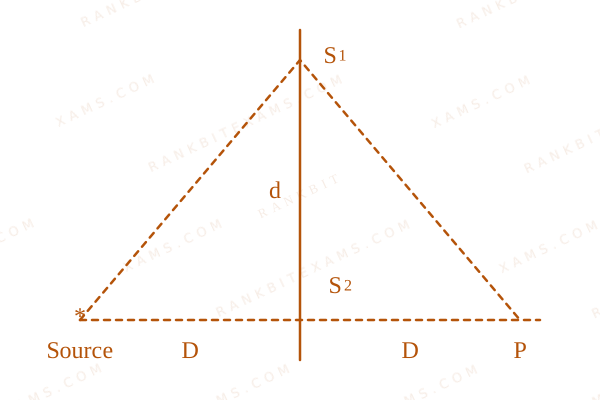
From the symmetric setup diagram geometry:
- Total path length 1 = Source arrow S₁ arrow P = √(D² + d²) + √(D² + d²) = 2√(D² + d²)$\text{Source} \rightarrow S_1 \rightarrow P = \sqrt{D^2 + d^2} + \sqrt{D^2 + d^2} = 2\sqrt{D^2 + d^2}$
- Total path length 2 = Source arrow S₂ arrow P = D + D = 2D$\text{Source} \rightarrow S_2 \rightarrow P = D + D = 2D$
Hence, the exact geometric path difference is:
Δ x = 2√(D² + d²) - 2D$$\Delta x = 2\sqrt{D^2 + d^2} - 2D$$
Step 1: Set up Path Difference Balance
Equating path difference to the minima criterion:
2√(D² + d²) - 2D = (λ)/(2)$$2\sqrt{D^2 + d^2} - 2D = \frac{\lambda}{2}$$
√(D² + d²) - D = (λ)/(4) √(D² + d²) = D + (λ)/(4)$$\sqrt{D^2 + d^2} - D = \frac{\lambda}{4} \implies \sqrt{D^2 + d^2} = D + \frac{\lambda}{4}$$
Step 2: Expand and Isolate Slit Space d
Squaring both sides:
D² + d² = D² + (λ²)/(16) + (2 D λ)/(4)$$D^2 + d^2 = D^2 + \frac{\lambda^2}{16} + \frac{2 D \lambda}{4}$$
d² = (D λ)/(2) + (λ²)/(16)$$d^2 = \frac{D \lambda}{2} + \frac{\lambda^2}{16}$$
Step 3: Approximate and Substitute Values
Since λ$\lambda$ (400 ~nm$400 \mathrm{~nm}$) is tiny compared to D$D$ (0.2 ~m$0.2 \mathrm{~m}$), the term (λ²)/(16)$\frac{\lambda^2}{16}$ is completely negligible:
d² ≈ (D λ)/(2)$$d^2 \approx \frac{D \lambda}{2}$$
Substituting values:
d² = 0.2 × 400 × 10⁻⁹2 = 400 × 10⁻¹⁰ ~m²$$d^2 = \frac{0.2 \times 400 \times 10^{-9}}{2} = 400 \times 10^{-10} \mathrm{~m^2}$$
d = 400 × 10⁻¹⁰ = 20 × 10⁻⁵ ~m = 0.20 × 10⁻³ ~m = 0.20 ~mm$$d = \sqrt{400 \times 10^{-10}} = 20 \times 10^{-5} \mathrm{~m} = 0.20 \times 10^{-3} \mathrm{~m} = 0.20 \mathrm{~mm}$$
Therefore, the minimum distance between the slits is 0.20 ~mm$0.20 \mathrm{~mm}$.
Pattern Recognition
This non-standard double slit setup calculates the primary total path directly from geometric lines rather than relying on standard angular small angle assumptions (y d / D$y d / D$). Recognizing when secondary higher-order differentials (λ²$\lambda^2$) can be safely dropped keeps calculations clean.
Chapter Mix
Class 12 Physics: Wave Optics