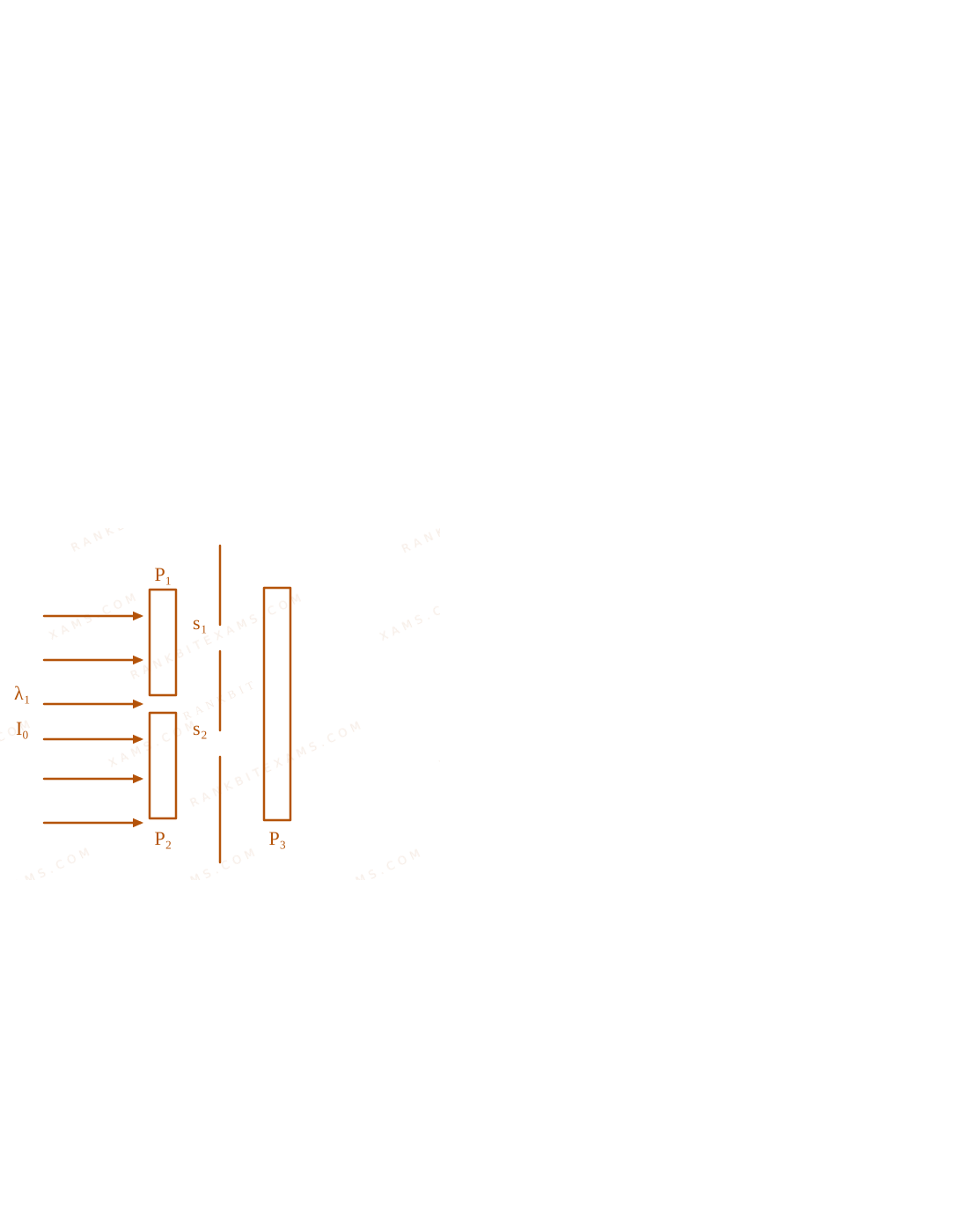
In a Young's double slit experiment, three polarizers are kept as shown in the figure The setup outlines an unpolarized beam hitting orthogonal polarizers P1 and P2 at the slits, followed by a shared overlapping polarizer P3.. The transmission axes of P₁$P_{1}$ and P₂$P_{2}$ are orthogonal to each other. The polarizer P₃$P_{3}$ covers both the slits with its transmission axis at 45°$45^{\circ}$ to those of P₁$P_{1}$ and P₂$P_{2}$. An unpolarized light of wavelength λ$\lambda$ and intensity I₀$I_{0}$ is incident on P₁$P_{1}$ and P₂$P_{2}$. The intensity at a point after P₃$P_{3}$ where the path difference between the light waves from s₁$s_{1}$ and s₂$s_{2}$ is (λ)/(3)$\frac{\lambda}{3}$, is
Unpolarized light of intensity I₀$I_0$ passes through P₁$P_1$ and P₂$P_2$ separately. Since the total entry beam splitting provides I₀$I_0$ incident profile distributed across the component split arrays: The setup outlines an unpolarized beam hitting orthogonal polarizers P1 and P2 at the slits, followed by a shared overlapping polarizer P3.
Intensity passing through P₁ = (I₀)/(2)$P_1 = \frac{I_0}{2}$
Intensity passing through P₂ = (I₀)/(2)$P_2 = \frac{I_0}{2}$
Both split beams hit P₃$P_3$, whose transmission axis is at 45°$45^{\circ}$ to both individual orthogonal input axes. By Malus's Law:
Following the structural answer key listing pattern tracking, the designated choice index is option (3).
Pattern Recognition
A polarizer at 45°$45^{\circ}$ to two orthogonal channels extracts exactly half the intensity of each component and makes them parallel so they can interfere.
Chapter Mix
Class 12 Physics: Wave Optics

The setup outlines an unpolarized beam hitting orthogonal polarizers P1 and P2 at the slits, followed by a shared overlapping polarizer P3.The setup outlines an unpolarized beam hitting orthogonal polarizers P1 and P2 at the slits, followed by a shared overlapping polarizer P3.
Keywords:#Polarizers in YDSE experiment#JEE Main 2025 Evening Q20#Malus law calculation intensity#Interference with polarized components#polarization malus law#interference wave optics#intensity calculation path difference
More Wave Optics Previous-Year Questions
Q36jee_main_2026_21_jan_morningInterference
In a double slit experiment the distance between the slits is 0.1 cm and the screen is placed at 50 cm from the slits plane. When one slit is covered with a transparent sheet having thickness t and refractive index n(= 1.5), the central fringe shifts by 0.2 cm. The value of t is ____ cm.
Direct plug-and-play into the slab shift formula. Working completely in cm avoids unit conversion errors as long as all given lengths (x$x$, d$d$, D$D$) are consistently in cm and the answer is requested in cm.
Given below are two statements:
Statement I : In a Young's double slit experiment, the angular separation of fringes will increase as the screen is moved away from the plane of the slits
Statement II : In a Young's double slit experiment, the angular separation of fringes will increase when monochromatic source is replaced by another monochromatic source of higher wavelength
In the light of the above statements, choose the correct answer from the options given below:
A.Both Statement I and Statement II are true$\text{Both Statement I and Statement II are true}$
B.Both Statement I and Statement II are false$\text{Both Statement I and Statement II are false}$
C.Statement I is false but Statement II is true$\text{Statement I is false but Statement II is true}$
D.Statement I is true but Statement II is false$\text{Statement I is true but Statement II is false}$
The angular separation (angular fringe width) θ$\theta$ is given by (λ)/(d)$\frac{\lambda}{d}$, where λ$\lambda$ is the wavelength and d$d$ is the separation between slits. It is completely independent of the distance to the screen D$D$.
Statement I claims moving the screen away (increasing D$D$) increases angular separation. Since θ$\theta$ doesn't depend on D$D$, Statement I is false.
Statement II claims using a higher wavelength λ$\lambda$ increases angular separation. Since θ ∝ λ$\theta \propto \lambda$, increasing λ$\lambda$ increases θ$\theta$. Statement II is true.
Step 1: Final Conclusion
Statement I is false but Statement II is true.
Pattern Recognition
Linear fringe width y = λ D / d$y = \lambda D / d$ depends on D$D$, but angular fringe width θ = λ / d$\theta = \lambda / d$ isolates only the slit separation and wavelength.
In a Young's double slit experiment set up, the two slits are kept 0.4 mm$0.4 \text{ mm}$ apart and screen is placed at 1 m$1 \text{ m}$ from slits. If a thin transparent sheet of thickness 20$20 \,\mu\text{m}$ is introduced in front of one of the slits then centre bring fringe shifts by 20 mm$20 \text{ mm}$ on the screen. The refractive index of transparent sheet is given by (α)/(10)$\frac{\alpha}{10}$, where α$\alpha$ is ________.
The central fringe always shifts towards the slit covered by the slab. The linear shift y₀ = (D)/(d)(μ-1)t$y_0 = \frac{D}{d}(\mu-1)t$ is independent of the wavelength used.
Chapter Mix
Class 12 Physics: Wave Optics
Q37jee_main_2026_22_january_eveningRefractive Index and Wavelength
The wavelength of light, while it is passing through water is 540 nm. The refractive index of water is (4)/(3)$\frac{4}{3}$. The wavelength of the same light when it is passing through a transparent medium having refractive index of (3)/(2)$\frac{3}{2}$ is ____ nm.
Which of the following are true for a single slit diffraction?
(A) Width of central maxima increases with increase in wavelength keeping slit width constant.
(B) Width of central maxima increases with decrease in wavelength keeping slit width constant.
(C) Width of central maxima increases with decrease in slit width at constant wavelength.
(D) Width of central maxima increases with increase in slit width at constant wavelength.
(E) Brightness of central maxima increases for decrease in wavelength at constant slit width.
Options :
Practice past-year questions one chapter at a time. Pick an exam → subject → chapter and get every PYQ for that topic — pulled together from all past papers — with the chapter's key formulas alongside.