Related Formula
v⊥ = vbr θ$$v_{\perp} = v_{br} \sin\theta$$
w = v⊥ · t$$w = v_{\perp} \cdot t$$
Core Logic
Let the West-to-East river flow direction be along the positive x$x$-axis.
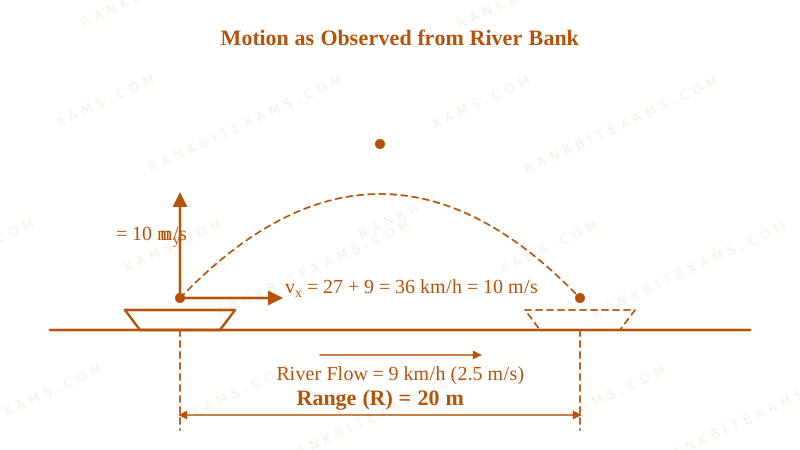
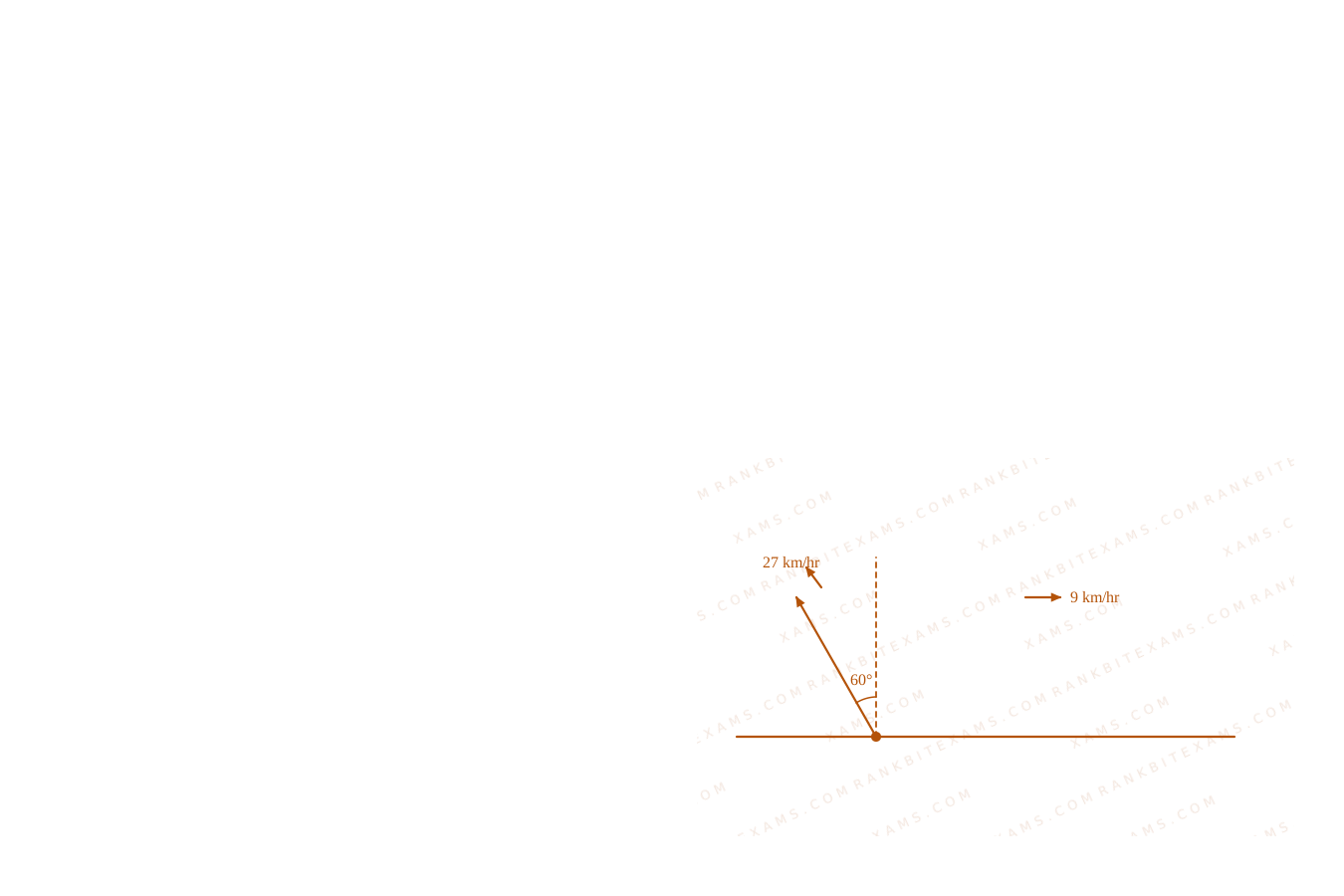
The boat's velocity relative to water is vbr = 27~km/h$v_{br} = 27\mathrm{~km/h}$ at an angle of 150°$150^{\circ}$ with respect to the river flow (which is 30°$30^{\circ}$ upstream from the perpendicular crossing line).
To find the width of the river, we only need the component of the boat's velocity perpendicular to the river bank (y$y$-axis):
v⊥ = vbr (150°) = 27 (150°) = 27 × (1)/(2) = 13.5~km/h$$v_{\perp} = v_{br} \sin(150^{\circ}) = 27 \sin(150^{\circ}) = 27 \times \frac{1}{2} = 13.5\mathrm{~km/h}$$
Convert this velocity to SI units:
v⊥ = 13.5 × (5)/(18)~m/s = 3.75~m/s$$v_{\perp} = 13.5 \times \frac{5}{18}\mathrm{~m/s} = 3.75\mathrm{~m/s}$$
Given the crossing time is half a minute (t = 30~s$t = 30\mathrm{~s}$):
w = v⊥ · t = 3.75 × 30 = 112.5~m$$w = v_{\perp} \cdot t = 3.75 \times 30 = 112.5\mathrm{~m}$$
Step 1: Final Conclusion
The width of the river is 112.5~m$112.5\mathrm{~m}$.
Pattern Recognition
In river-boat crossing problems, river velocity (vᵣ$v_r$) only causes drift along the bank; it has zero impact on crossing time or the crossing width calculations when the angle is defined relative to the flow. Use the vertical velocity component exclusively.
Chapter Mix
Class 11 Physics: Kinematics