Related Formula
E = σᵢₙₙₑᵣε₀$$E = \frac{\sigma_{\text{inner}}}{\epsilon_0}$$
Core Logic
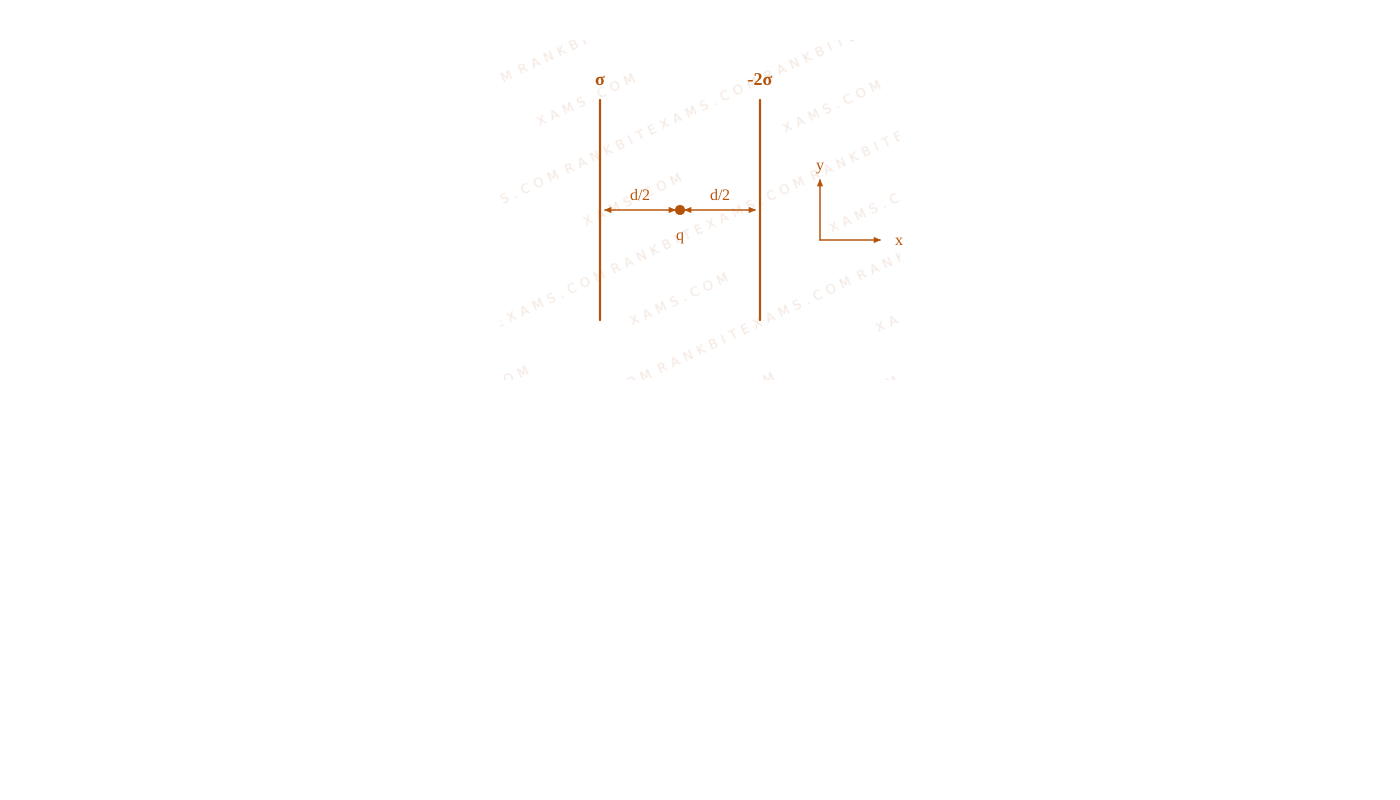
For parallel conducting plates of large area, charges redistribute on the outer and inner faces to maintain electrostatic equilibrium.
Total charge per unit area on Plate 1: q₁ = σ$q_1 = \sigma$
Total charge per unit area on Plate 2: q₂ = -2σ$q_2 = -2\sigma$
The outer surface charge density on the far sides of both plates must be equal:
σouter = (q₁ + q₂)/(2) = (σ - 2σ)/(2) = -(σ)/(2)$$\sigma_{\text{outer}} = \frac{q_1 + q_2}{2} = \frac{\sigma - 2\sigma}{2} = -\frac{\sigma}{2}$$
Now, compute the charges on the inner facing surfaces:
σᵢₙₙₑᵣ₁ = q₁ - σouter = σ - (-(σ)/(2)) = (3σ)/(2)$$\sigma_{\text{inner1}} = q_1 - \sigma_{\text{outer}} = \sigma - \left(-\frac{\sigma}{2}\right) = \frac{3\sigma}{2}$$
σᵢₙₙₑᵣ₂ = q₂ - σouter = -2σ - (-(σ)/(2)) = -(3σ)/(2)$$\sigma_{\text{inner2}} = q_2 - \sigma_{\text{outer}} = -2\sigma - \left(-\frac{\sigma}{2}\right) = -\frac{3\sigma}{2}$$
In the region between the plates, both inner surfaces create an electric field in the same direction (away from the positive plate 1 and towards negative plate 2):
E = σᵢₙₙₑᵣ₁2ε₀ + |σᵢₙₙₑᵣ₂|2ε₀ = (3σ/2)/(2ε₀) + (3σ/2)/(2ε₀) = (3σ)/(2ε₀)$$E = \frac{\sigma_{\text{inner1}}}{2\epsilon_0} + \frac{|\sigma_{\text{inner2}}|}{2\epsilon_0} = \frac{3\sigma/2}{2\epsilon_0} + \frac{3\sigma/2}{2\epsilon_0} = \frac{3\sigma}{2\epsilon_0}$$
Thus, the electrostatic force on +q$+q$ is:
F = q E = (3σ q)/(2ε₀)$$F = q E = \frac{3\sigma q}{2\epsilon_0}$$
Step 1: Final Conclusion
The force experienced by the point charge +q$+q$ is (3σ q)/(2ε₀)$\frac{3\sigma q}{2\epsilon_0}$.
Pattern Recognition
For conducting plates with total charges Q₁$Q_1$ and Q₂$Q_2$, always calculate the outer charge first: Qouter = (Q₁+Q₂)/(2)$Q_{\text{outer}} = \frac{Q_1+Q_2}{2}$. The field inside the gap is exclusively due to the inner surfaces: E = σᵢₙₙₑᵣε₀$E = \frac{\sigma_{\text{inner}}}{\epsilon_0}$.
Chapter Mix
Class 12 Physics: Electrostatics