Identify the characteristics of an adiabatic process in a monoatomic gas. (A) Internal energy is constant. (B) Work done in the process is equal to the change in internal energy. (C) The product of temperature and volume is a constant. (D) The product of pressure and volume is a constant. (E) The work done to change the temperature from T_1 to T_2 is proportional to (T_2 - T_1) Choose the correct answer from the options given below:

Solution & Explanation

### Related Formula 1. First Law of Thermodynamics: dQ = dU + dW In an adiabatic process: dQ = 0 implies dW = -dU 2. Change in Internal Energy: dU = n C_v dT = n C_v (T_2 - T_1) ### Core Logic Let's analyze each statement: - **(A) Internal energy is constant:** Incorrect. Since temperature changes during an adiabatic expansion/compression, internal energy (U propto T) must change. - **(B) Work done is equal to the change in internal energy:** Correct in magnitude (|dW| = |dU|). By definition, dW = -dU, which correlates the magnitude of work to the change in internal energy. - **(C) Product of temperature and volume is constant:** Incorrect. The adiabatic equation of state is T V^gamma-1 = textconstant. - **(D) Product of pressure and volume is constant:** Incorrect. The relation is P V^gamma = textconstant. - **(E) Work done is proportional to (T_2 - T_1):** Correct. Since dW = -dU = -n C_v (T_2 - T_1), work done is directly proportional to the temperature change (T_2 - T_1). ### Step 1: Determine the correct option Since only statements (B) and (E) are correct, the correct option is (3). ### Pattern Recognition Sees: Characteristics of adiabatic thermodynamic process. Trap: Confusing adiabatic state relations (PV^gamma = C, TV^gamma-1 = C) with isothermal state relations (PV = C, T = C). Shortcut: First law of thermodynamics under dQ=0 strictly enforces |dW| = |dU|, which validates statement B and E immediately. ### Evaluation Rubric / Model Answer null ### Chapter Mix Class 11 Physics: Thermodynamics

Reference Study Guides

More Thermodynamics Previous-Year Questions — Page 4

Q6 jee_main_2025_24_jan_evening Adiabatic Processes
Given below are two statements. One is labelled as Assertion (A) and the other is labelled as Reason (R). Assertion (A) : In an insulated container, a gas is adiabatically shrunk to half of its initial volume. The temperature of the gas decreases. Reason (R) : Free expansion of an ideal gas is an irreversible and an adiabatic process. In the light of the above statement, choose the correct answer from the options given below :
  • A. Both (A) and (R) are true and (R) is the correct explanation of (A)
  • B. (A) is true but (R) is false
  • C. (A) is false but (R) is true
  • D. Both (A) and (R) are true but (R) is NOT the correct explanation of (A)

Solution

### Related Formula T_1 V_1^gamma-1 = T_2 V_2^gamma-1 ### Core Logic Assertion (A) review: An insulated container means the process is adiabatic (Q=0). When the gas is shrunk (compressed) to half its volume (V_2 = V_1 / 2), T_2 = T_1 left(fracV_1V_2 ight)^gamma-1 = T_1 (2)^gamma-1 Since gamma > 1, T_2 > T_1. Therefore, temperature increases during adiabatic compression, which makes Assertion (A) false. Reason (R) review: Free expansion occurs when a gas expands into a vacuum inside an insulated container. No work is done (W=0) and no heat is exchanged (Q=0), hence it is adiabatic. It cannot spontaneously reverse, so it is irreversible. Thus, Reason (R) is true. ### Pattern Recognition Adiabatic compression always raises temperature due to work being done on the gas, while free expansion keeps the temperature of an ideal gas constant (dI=0 as W=0, Q=0). ### Evaluation Rubric / Model Answer null ### Chapter Mix Class 11 Physics: Thermodynamics
Q13 jee_main_2025_24_jan_evening Cyclic Processes
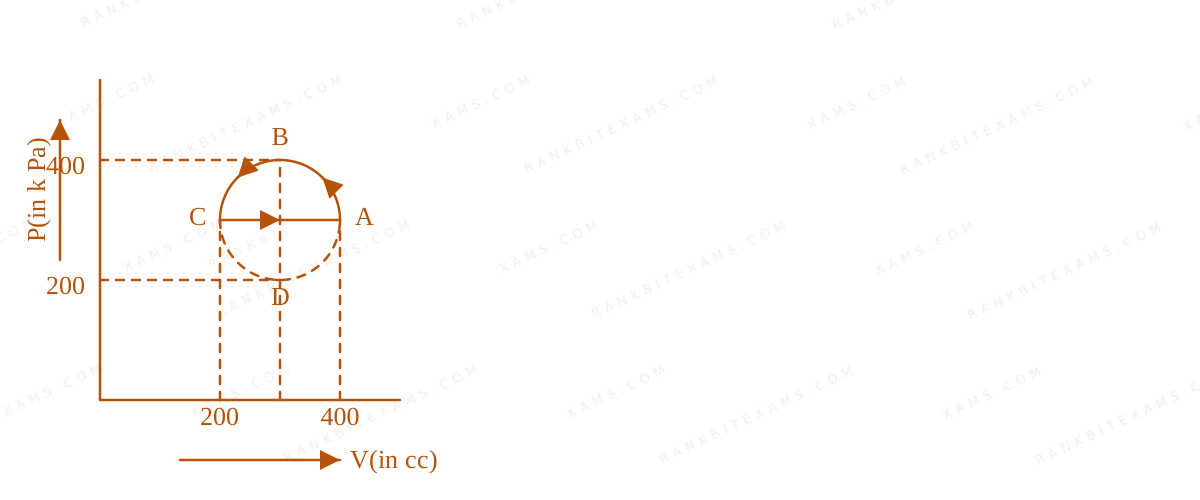
The magnitude of heat exchanged by a system for the given cyclic process ABCA (as shown in figure
Cyclic semi-circular P-V process indicator diagram Q13
The image shows a P-V cycle consisting of a horizontal line from C to A and a semicircular loop from A back to C via B.
) is (in SI unit)
  • A. 10pi
  • B. 5pi
  • C. zero
  • D. 40pi

Solution

### Related Formula From the first law of thermodynamics for a complete cycle: Delta U = 0 implies Q = W = textArea of the loop ### Core Logic The graph shows a semicircle in a Ptext-V indicator diagram.
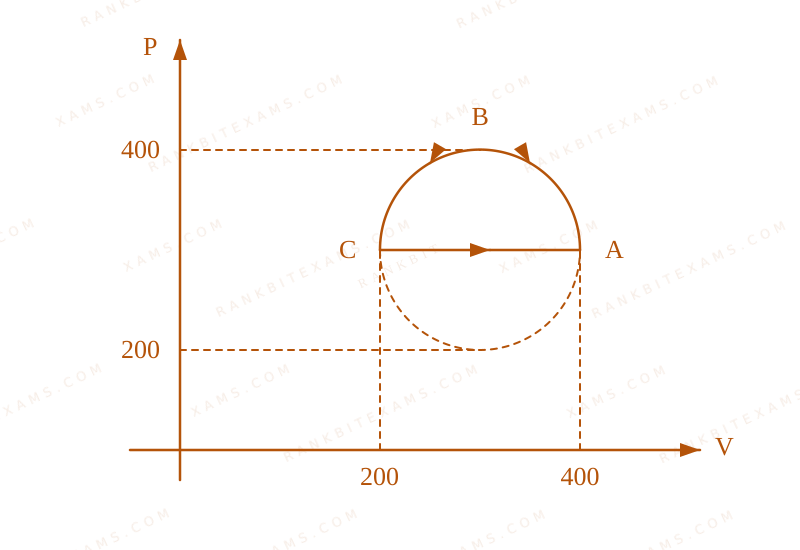
P-V cycle geometry calculation graph Q13
The image shows a P-V cycle consisting of a horizontal line from C to A and a semicircular loop from A back to C via B.
- Pressure dimension diameter: Delta P = 400 - 200 = 200\ mathrmkPa = 200 times 10^3\ mathrmPa - Volume dimension diameter: Delta V = 400 - 200 = 200\ mathrmcc = 200 times 10^-6\ mathrmm^3 Radius along Pressure axis: R_P = 100 times 10^3\ mathrmPa Radius along Volume axis: R_V = 100 times 10^-6\ mathrmm^3 Area of the closed semicircular path: W = frac12 pi R_P R_V W = frac12 times pi times (100 times 10^3) times (100 times 10^-6) W = frac10pi2 = 5pi\ mathrmJ Since Q = W, the heat exchanged has a magnitude of 5pi\ mathrmJ. ### Pattern Recognition For a cycle on an indicator chart with mismatched scales, use the elliptic area template pi a b (or frac12pi a b for a half-ellipse/semicircle). ### Evaluation Rubric / Model Answer null ### Chapter Mix Class 11 Physics: Thermodynamics
Q20 jee_main_2025_24_jan_morning Thermodynamic Processes
An ideal gas goes from an initial state to final state. During the process, the pressure of gas increases linearly with temperature. A. The work done by gas during the process is zero. B. The heat added to gas is different from change in its internal energy. C. The volume of the gas is increased. D. The internal energy of the gas is increased. E. The process is isochoric (constant volume process) Choose the correct answer from the options given below :-
  • A. A, B, C, D Only
  • B. A, D, E Only
  • C. E Only
  • D. A, C Only

Solution

### Related Formula From the Ideal Gas Law: PV = nRT According to the First Law of Thermodynamics: Delta Q = Delta U + W ### Core Logic The question states that pressure increases linearly with temperature, which means their ratio is constant : P = kT implies fracPT = textconstant Since fracPT = fracnRV, the volume V must remain constant throughout the process. This identifies it as an isochoric process (Statement E is true). ### Step 1: Evaluate All Statements * Statement A: True. In an isochoric process, dV = 0 implies W = int P dV = 0. * Statement B: False. Since work is zero, the First Law simplifies to Delta Q = Delta U, meaning heat added equals the change in internal energy. * Statement C: False. Volume is constant, so it does not increase. * Statement D: True. As pressure increases linearly with temperature, temperature increases, which causes the internal energy of the gas to increase. ### Step 2: Final Selection Gathering the true statements (A, D, and E) points directly to Option (2). ### Pattern Recognition A linear P-T line passing through the origin always indicates a constant volume graph. For constant volume graphs, work done is zero, which simplifies the first law calculation. ### Evaluation Rubric / Model Answer null ### Chapter Mix Class 11 Physics: Thermodynamics

Q25 jee_main_2025_24_jan_morning Specific Heat Capacities of Gases
The temperature of 1 mole of an ideal monoatomic gas is increased by 50^circC at constant pressure. The total heat added and change in internal energy are E_1 and E_2, respectively. If fracE_1E_2=fracx9 then the value of x is
Numerical Answer. Answer: 15 to 15

Solution

### Related Formula For an ideal gas thermodynamic process: * Total heat added at constant pressure (isobaric process) is : E_1 = n C_P Delta T * Total change in internal energy is given by : E_2 = n C_V Delta T The ratio of specific heat capacities is defined as: gamma = fracC_PC_V ### Core Logic Taking the ratio of the two energy expressions[cite: 179, 823]: fracE_1E_2 = fracn C_P Delta Tn C_V Delta T = fracC_PC_V = gamma ### Step 1: Evaluating for a Monoatomic Gas For an ideal monoatomic gas, the degrees of freedom are f = 3. This gives an adiabatic index of : gamma = 1 + frac2f = 1 + frac23 = frac53 Equating this value to the given ratio expression [cite: 179, 826]: frac53 = fracx9 x = frac5 times 93 = 15 ### Pattern Recognition The ratio of heat added to the change in internal energy during an isobaric process is always equal to the adiabatic exponent gamma of the gas. ### Evaluation Rubric / Model Answer null ### Chapter Mix Class 11 Physics: Thermodynamics
Q jee_main_2025_29_jan_morning Adiabatic Process
The workdone in an adiabatic change in an ideal gas depends upon only :
  • A. change in its pressure
  • B. change in its specific heat
  • C. change in its volume
  • D. change in its temperature

Solution

### Related Formula Delta W = -Delta U = -n C_v Delta T ### Core Logic In an adiabatic system, no heat exchange occurs (Q=0). By the first law of thermodynamics, Delta W = -Delta U. Since internal energy U depends explicitly on temperature metrics, the total work output shifts uniquely based on temperature variation Delta T. ### Chapter Mix Class 11 Physics: Thermodynamics

More Thermodynamics Questions — jee_main_2025_02_april_evening

Practice all Thermodynamics previous-year questions →

Rankbit System
JEE Physics: Waves (+15.5%) | Electrostatics: Concentric Shells (-29.7%) | Modern Physics: Photoelectric Clones (+34.2%) | Mathematics: Definite Integrals (+18.1%) | Chemistry: Coordination Splitting (-11.4%) | JEE Physics: Waves (+15.5%) | Electrostatics: Concentric Shells (-29.7%) | Modern Physics: Photoelectric Clones (+34.2%) | Mathematics: Definite Integrals (+18.1%) | Chemistry: Coordination Splitting (-11.4%)