Identify the characteristics of an adiabatic process in a monoatomic gas. (A) Internal energy is constant. (B) Work done in the process is equal to the change in internal energy. (C) The product of temperature and volume is a constant. (D) The product of pressure and volume is a constant. (E) The work done to change the temperature from T_1 to T_2 is proportional to (T_2 - T_1) Choose the correct answer from the options given below:

Solution & Explanation

### Related Formula 1. First Law of Thermodynamics: dQ = dU + dW In an adiabatic process: dQ = 0 implies dW = -dU 2. Change in Internal Energy: dU = n C_v dT = n C_v (T_2 - T_1) ### Core Logic Let's analyze each statement: - **(A) Internal energy is constant:** Incorrect. Since temperature changes during an adiabatic expansion/compression, internal energy (U propto T) must change. - **(B) Work done is equal to the change in internal energy:** Correct in magnitude (|dW| = |dU|). By definition, dW = -dU, which correlates the magnitude of work to the change in internal energy. - **(C) Product of temperature and volume is constant:** Incorrect. The adiabatic equation of state is T V^gamma-1 = textconstant. - **(D) Product of pressure and volume is constant:** Incorrect. The relation is P V^gamma = textconstant. - **(E) Work done is proportional to (T_2 - T_1):** Correct. Since dW = -dU = -n C_v (T_2 - T_1), work done is directly proportional to the temperature change (T_2 - T_1). ### Step 1: Determine the correct option Since only statements (B) and (E) are correct, the correct option is (3). ### Pattern Recognition Sees: Characteristics of adiabatic thermodynamic process. Trap: Confusing adiabatic state relations (PV^gamma = C, TV^gamma-1 = C) with isothermal state relations (PV = C, T = C). Shortcut: First law of thermodynamics under dQ=0 strictly enforces |dW| = |dU|, which validates statement B and E immediately. ### Evaluation Rubric / Model Answer null ### Chapter Mix Class 11 Physics: Thermodynamics

Reference Study Guides

More Thermodynamics Previous-Year Questions — Page 2

Q5 jee_main_2025_08_april_evening Specific Heat Capacity
Water falls from a height of 200mathrm~m into a pool. Calculate the rise in temperature of the water assuming no heat dissipation from the water in the pool. (Take g = 10mathrm~m/s^2, specific heat of water = 4200mathrm~J/(kgcdot K))
  • A. 0.23mathrm~K
  • B. 0.36mathrm~K
  • C. 0.14mathrm~K
  • D. 0.48mathrm~K

Solution

### Related Formula Delta U = mgh quad textand quad Q = msDelta T By conservation of energy (assuming all potential energy goes into heating the water): mgh = msDelta T implies Delta T = fracghs where, g = acceleration due to gravity h = height of the fall s = specific heat of water Delta T = rise in temperature ### Core Logic Given parameters: - h = 200mathrm~m - g = 10mathrm~m/s^2 - s = 4200mathrm~J/(kgcdot K) Substitute the values to find Delta T: Delta T = frac10 times 2004200 = frac20004200 Delta T = frac1021 approx 0.476mathrm~K approx 0.48mathrm~K ### Pattern Recognition Sees: "Water falling from height h raises temperature" → Mass cancels out. Delta T = fracghs. Shortcut: Always use SI units (s_textwater = 4200mathrm~J/kgcdot K is given; if given in mathrmcal/gcdot^circ C, convert using 1mathrm~cal = 4.184mathrm~J). ✓ ### Evaluation Rubric / Model Answer null ### Chapter Mix Class 11 Physics: Thermodynamics Class 11 Physics: Work, Energy and Power

Q11 jee_main_2025_08_april_evening Thermodynamic Processes
A monoatomic gas having gamma = frac53 is stored in a thermally insulated container and the gas is suddenly compressed to left(frac18right)^mathrmth of its initial volume. The ratio of final pressure and initial pressure is: (gamma is the ratio of specific heats of the gas at constant pressure and at constant volume)
  • A. 16
  • B. 40
  • C. 32
  • D. 28

Solution

### Related Formula P_i V_i^gamma = P_f V_f^gamma where, P_i, P_f = initial and final pressures V_i, V_f = initial and final volumes gamma = adiabatic exponent ### Core Logic Since the gas is stored in a "thermally insulated container" and is compressed "suddenly", the process is **adiabatic**. From the adiabatic relation: fracP_fP_i = left(fracV_iV_fright)^gamma Given: - V_f = frac18 V_i implies fracV_iV_f = 8 - gamma = frac53 ### Step 1: Computation Substitute the values to find the pressure ratio: fracP_fP_i = (8)^5/3 = left(2^3right)^5/3 fracP_fP_i = 2^5 = 32 ### Pattern Recognition Sees: "suddenly compressed" or "thermally insulated container" → Adiabatic process. Shortcut: P V^gamma = textconstant. Since the volume goes down by 8 times, the pressure increases by 8^gamma = 8^5/3 = 32 times. ✓ ### Evaluation Rubric / Model Answer null ### Chapter Mix Class 11 Physics: Thermodynamics
Q jee_main_2025_29_jan_evening Isothermal and Adiabatic Processes
Given below are two statements. One is labelled as Assertion (A) and the other is labelled as Reason (R).

**Assertion** (A): With the increase in the pressure of an ideal gas, the volume falls off more rapidly in an isothermal process in comparison to the adiabatic process.

Reason (R): In isothermal process, PV = textconstant, while in adiabatic process PV^gamma = textconstant. Here gamma is the ratio of specific heats, P is the pressure and V is the volume of the ideal gas.

In the light of the above statements, choose the correct answer from the options given below:
  • A. textBoth (A) and (R) are true but (R) is NOT the correct explanation of (A)
  • B. text(A) is true but (R) is false
  • C. textBoth (A) and (R) are true and (R) is the correct explanation of (A)
  • D. text(A) is false but (R) is true

Solution

### Related Formula left(fracdPdVright)_textisothermal = -fracPV left(fracdPdVright)_textadiabatic = -gamma fracPV ### Core Logic The slope of an adiabatic process on a P-V diagram is gamma times steeper than that of an isothermal process: left|left(fracdPdVright)_textadiabaticright| > left|left(fracdPdVright)_textisothermalright|
Isothermal and Adiabatic Processes diagram for Q2 - JEE Main 2025 Evening
When pressure increases (compression), the volume drops. Because the adiabatic curve is steeper, the pressure rises more rapidly for a given drop in volume, or conversely, for a specified increase in pressure, the volume falls off more rapidly in the isothermal process than the adiabatic process. Hence, Assertion (A) is true. Reason (R) states the governing equations PV = C and PV^gamma = C, which directly lead to these slope expressions via differentiation. Thus, Reason (R) is true and correctly explains Assertion (A). ### Pattern Recognition Adiabatic curves are steeper than isothermal curves on a P-V diagram because gamma > 1. For any expansion or compression process, remember that slope magnitude satisfies textSlope_textadi = gamma cdot textSlope_textiso. ### Evaluation Rubric / Model Answer null ### Chapter Mix Class 11 Physics: Thermodynamics
Q6 jee_main_2025_29_jan_evening Heat and Work in Thermodynamic Processes
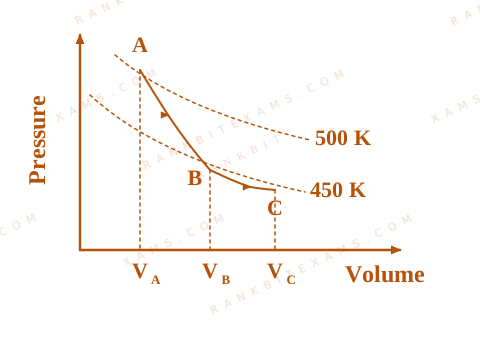
A poly-atomic molecule (C_V = 3R, C_P = 4R, where R is gas constant) goes from phase space point A(P_A = 10^5mathrm~Pa, V_A = 4 times 10^-6mathrm~m^3) to point B(P_B = 5 times 10^4mathrm~Pa, V_B = 6 times 10^-6mathrm~m^3) to point C(P_C = 10^4mathrm~Pa, V_C = 8 times 10^-6mathrm~m^3). A to B is an adiabatic path and B to C is an isothermal path. The net heat absorbed per unit mole by the system is:
Heat and Work in Thermodynamic Processes diagram for Q6 - JEE Main 2025 Evening
The graph depicts a pressure vs volume plot indicating paths from state A to B (adiabatic) and from B to C (isothermal).
  • A. 500 mathrm~R(ln 3 + ln 4)
  • B. 450 mathrm~R(ln 4 - ln 3)
  • C. 500 mathrm~Rln 2
  • D. 400 mathrm~R ln 4

Solution

### Related Formula Delta Q_textnet = Delta Q_AB + Delta Q_BC Delta Q_textisothermal = nRT lnleft(fracV_fV_i ight) = P_i V_i lnleft(fracV_fV_i ight) ### Core Logic For path A rightarrow B: Since it is given as an adiabatic path: Delta Q_AB = 0 For path B rightarrow C: Since it is given as an isothermal path, the change in internal energy Delta U_BC = 0. From the first law of thermodynamics, heat absorbed equals work done: Delta Q_BC = W_BC = nRT_B lnleft(fracV_CV_B ight) Using the ideal gas state at point B, nRT_B = P_B V_B: P_B V_B = (5 times 10^4 mathrm~Pa) times (6 times 10^-6 mathrm~m^3) = 0.3 mathrm~J Wait, let's express it in terms of the gas constant R for a single mole (n=1) using temperature data directly provided in the original figure labels (T_B = 450mathrm~K): Delta Q_BC = (1) cdot R cdot (450) cdot lnleft(frac8 times 10^-66 times 10^-6right) Delta Q_BC = 450 R lnleft(frac43 ight) = 450 R (ln 4 - ln 3) Thus, the total net heat absorbed per unit mole is: Delta Q = 0 + 450 R (ln 4 - ln 3) = 450 R (ln 4 - ln 3) ### Pattern Recognition Adiabatic paths have zero heat exchange by baseline definition. The calculation boils down directly to the work done during the isothermal stage B rightarrow C matching RT ln(V_f/V_i). ### Evaluation Rubric / Model Answer null ### Chapter Mix Class 11 Physics: Thermodynamics
Q7 jee_main_2025_28_jan_morning Carnot Engine and Efficiency
A Carnot engine (E) is working between two temperatures 473K and 273K. In a new system two engines - engine mathrmE_1 works between 473K to 373K and engine mathrmE_2 works between 373K to 273K. If eta_12 , eta_1 and eta_2 are the efficiencies of the engines E, mathrmE_1 and mathrmE_2 , respectively, then
  • A. eta_12 < eta_1 + eta_2
  • B. eta_12 = eta_1eta_2
  • C. eta_12 = eta_1 + eta_2
  • D. eta_12 geq eta_1 + eta_2

Solution

### Related Formula eta = 1 - fracmathrmT_LmathrmT_H ### Core Logic Let's compute the efficiency parameters explicitly: eta_12 = 1 - frac273473 = frac200473 approx 0.423 eta_1 = 1 - frac373473 = frac100473 approx 0.211 eta_2 = 1 - frac273373 = frac100373 approx 0.268 Evaluating the linear sum of fractional bounds: eta_1 + eta_2 = 0.211 + 0.268 = 0.479 Comparing the outputs clearly demonstrates: eta_12 < eta_1 + eta_2 ### Step 1: Final Conclusion Thus, the inequality satisfies option (1). ### Pattern Recognition The joint efficiency of cascading perfect thermodynamic steps is bounded multiplicatively as (1-eta_12) = (1-eta_1)(1-eta_2), which algebraically forces eta_12 = eta_1 + eta_2 - eta_1eta_2 < eta_1 + eta_2. ### Evaluation Rubric / Model Answer null ### Chapter Mix Class 11 Physics: Thermodynamics

More Thermodynamics Questions — jee_main_2025_02_april_evening

Practice all Thermodynamics previous-year questions →

Rankbit System
JEE Physics: Waves (+15.5%) | Electrostatics: Concentric Shells (-29.7%) | Modern Physics: Photoelectric Clones (+34.2%) | Mathematics: Definite Integrals (+18.1%) | Chemistry: Coordination Splitting (-11.4%) | JEE Physics: Waves (+15.5%) | Electrostatics: Concentric Shells (-29.7%) | Modern Physics: Photoelectric Clones (+34.2%) | Mathematics: Definite Integrals (+18.1%) | Chemistry: Coordination Splitting (-11.4%)