The moment of inertia of a circular ring of mass M$M$ and diameter r$r$ about a tangential axis lying in the plane of the ring is:
A.frac12 M r^2$\frac{1}{2} M r^2$
B.frac38 M r^2$\frac{3}{8} M r^2$
C.frac32 M r^2$\frac{3}{2} M r^2$
D.2 M r^2$2 M r^2$
Solution & Explanation
### Related Formula
1. Moment of inertia of a circular ring of mass M$M$ and radius R$R$ about a diametrical axis in its plane:
I_textdia = frac12 M R^2$$I_{\text{dia}} = \frac{1}{2} M R^2$$
2. Parallel Axis Theorem:
I = I_textcm + M d^2$$I = I_{\text{cm}} + M d^2$$
where d$d$ is the perpendicular distance between the center of mass axis and the parallel axis.
### Core Logic
The axis of rotation is tangential and lies in the plane of the ring. Thus, the distance from the center of mass axis (which is also diametrical and in-plane) is equal to the radius R$R$.
Using the parallel axis theorem:
I_texttangent = I_textdia + M R^2 = frac12 M R^2 + M R^2 = frac32 M R^2$$I_{\text{tangent}} = I_{\text{dia}} + M R^2 = \frac{1}{2} M R^2 + M R^2 = \frac{3}{2} M R^2$$
### Step 1: Express in terms of diameter r$r$
The question specifies the diameter of the ring is r$r$.
Therefore, the radius R$R$ is:
R = fracr2$$R = \frac{r}{2}$$
Substitute R = fracr2$R = \frac{r}{2}$ into the moment of inertia formula:
I_texttangent = frac32 M left(fracr2right)^2 = frac38 M r^2$$I_{\text{tangent}} = \frac{3}{2} M \left(\frac{r}{2}\right)^2 = \frac{3}{8} M r^2$$
Thus, the moment of inertia is frac38 M r^2$\frac{3}{8} M r^2$.
### Pattern Recognition
Sees: Circular ring tangential axis in-plane.
Trap: Directly using radius r$r$ instead of diameter r$r$. Read variables carefully: often r$r$ is radius, but here it is explicitly given as diameter!
Shortcut: Standard in-plane tangent is frac32MR^2$\frac{3}{2}MR^2$. Substitute R = fracr2$R = \frac{r}{2}$ to get frac38Mr^2$\frac{3}{8}Mr^2$.
### Evaluation Rubric / Model Answer
null
### Chapter Mix
Class 11 Physics: System of Particles and Rotational Motion
Keywords:#moment of inertia of ring in-plane tangent#circular ring diameter r moment of inertia#Rotational Motion JEE Main 2025#System of Particles and Rotational Motion
More System of Particles and Rotational Motion Previous-Year Questions — Page 6
Q8jee_main_2025_24_jan_morningAngular Momentum
An object of mass 'm' is projected from origin in a vertical xy plane at an angle 45^circ$45^{\circ}$ with the x-axis with an initial velocity v_0$v_{0}$ The magnitude and direction of the angular momentum of the object with respect to origin, when it reaches at the maximum height, will be
[g is acceleration due to gravity]
A.fracmv_0^32sqrt2g$\frac{mv_{0}^{3}}{2\sqrt{2}g}$ along negative z-axis
B.fracmv_0^32sqrt2g$\frac{mv_{0}^{3}}{2\sqrt{2}g}$ along positive z-axis
C.fracmv_0^34sqrt2g$\frac{mv_{0}^{3}}{4\sqrt{2}g}$ along positive z-axis
D.fracmv_0^34sqrt2g$\frac{mv_{0}^{3}}{4\sqrt{2}g}$ along negative z-axis
Solution
### Related Formula
The definition of angular momentum vector vecL$\vec{L}$ relative to the origin is:
vecL = vecr times vecp = m(vecr times vecv) $$\vec{L} = \vec{r} \times \vec{p} = m(\vec{r} \times \vec{v}) $$
In scalar form for a horizontal speed component at a maximum altitude H$H$:
L = m v_x H$L = m v_{x} H$
### Core Logic
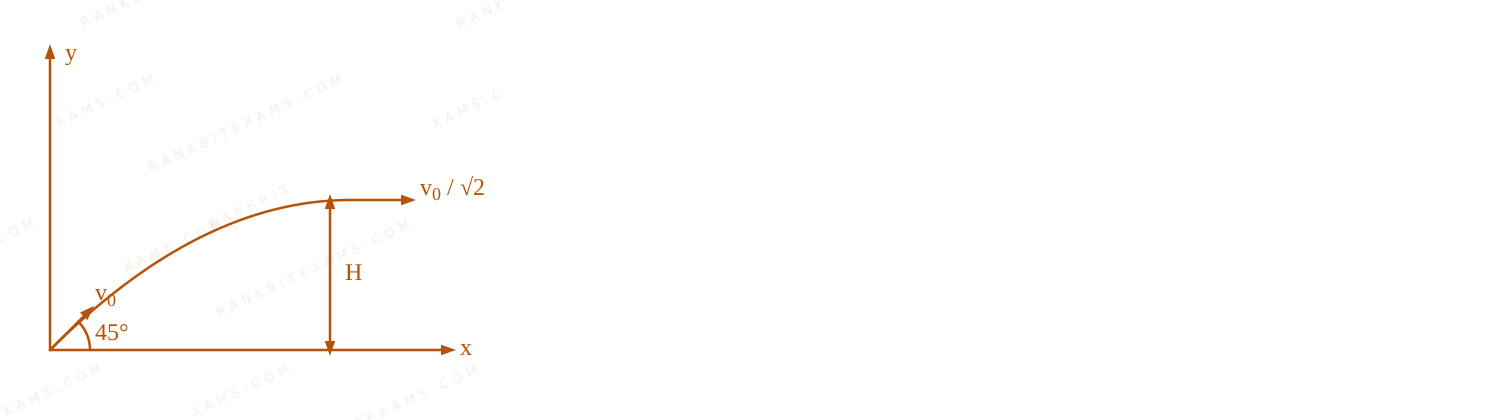
At maximum height, the vertical speed component drops to zero, and the projectile travels entirely horizontally along the curve profile as shown in Angular Momentum diagram for Q8 - JEE Main 2025 Morning :
v_x = v_0 cos 45^circ = fracv_0sqrt2$$v_{x} = v_{0} \cos 45^{\circ} = \frac{v_{0}}{\sqrt{2}}$$H = fracv_0^2 sin^2 45^circ2g = fracv_0^24g$$H = \frac{v_{0}^{2} \sin^{2} 45^{\circ}}{2g} = \frac{v_{0}^{2}}{4g}$$
### Step 1: Calculating Magnitude and Vector Direction
Evaluate the horizontal vector cross components:
L = m left(fracv_0sqrt2
ight) left(fracv_0^24g
ight) = fracmv_0^34sqrt2g$$L = m \left(\frac{v_{0}}{\sqrt{2}}
ight) \left(\frac{v_{0}^{2}}{4g}
ight) = \frac{mv_{0}^{3}}{4\sqrt{2}g}$$
Using the right-hand rule, vecr$\vec{r}$ points into quadrant-1 while velocity points towards +hati$+\hat{i}$. Therefore, vecr times vecv$\vec{r} \times \vec{v}$ tracks clockwise, yielding a negative hatk$\hat{k}$ orientation (along the negative z-axis).
### Pattern Recognition
At peak height, always map vecL$\vec{L}$ using m cdot v_textpeak cdot y_textmax$m \cdot v_{\text{peak}} \cdot y_{\text{\max}}$. This scalar form simplifies the calculation significantly.
### Evaluation Rubric / Model Answer
null
### Chapter Mix
Class 11 Physics: System of Particles and Rotational Motion
Q11jee_main_2025_24_jan_morningRolling Motion
A uniform solid cylinder of mass 'm' and radius 'r' rolls along an inclined rough plane of inclination 45^circ$45^{\circ}$ If it starts to roll from rest from the top of the plane then the linear acceleration of the cylinder axis will be :-
A.frac1sqrt2 g$\frac{1}{\sqrt{2}} g$
B.frac13sqrt2 g$\frac{1}{3\sqrt{2}} g$
C.fracsqrt2 g3$\frac{\sqrt{2} g}{3}$
D.sqrt2 g$\sqrt{2} g$
Solution
### Related Formula
The linear acceleration a$a$ for pure rolling motion down an incline profile is:
a = fracgsintheta1 + fracImr^2$$a = \frac{g\sin\theta}{1 + \frac{I}{mr^{2}}}$$
### Core Logic
For a uniform solid cylinder, the moment of inertia around its central axis is:
I = frac12mr^2 implies fracImr^2 = frac12$$I = \frac{1}{2}mr^{2} \implies \frac{I}{mr^{2}} = \frac{1}{2}$$
### Step 1: Calculating Acceleration
Substitute theta = 45^circ$\theta = 45^{\circ}$ and the cylinder inertial factor into the formula :
a = fracgsin 45^circ1 + frac12 = fracfracgsqrt2frac32$$a = \frac{g\sin 45^{\circ}}{1 + \frac{1}{2}} = \frac{\frac{g}{\sqrt{2}}}{\frac{3}{2}}$$a = frac2g3sqrt2 = fracsqrt2g3$$a = \frac{2g}{3\sqrt{2}} = \frac{\sqrt{2}g}{3}$$
### Pattern Recognition
Solid cylinder rolls with acceleration matching frac23 gsintheta$\frac{2}{3} g\sin\theta$. Since sin 45^circ = frac1sqrt2$\sin 45^{\circ} = \frac{1}{\sqrt{2}}$, this simplifies directly to fracsqrt2g3$\frac{\sqrt{2}g}{3}$.
### Evaluation Rubric / Model Answer
null
### Chapter Mix
Class 11 Physics: System of Particles and Rotational Motion
Q17jee_main_2025_28_jan_eveningTorque and Equilibrium
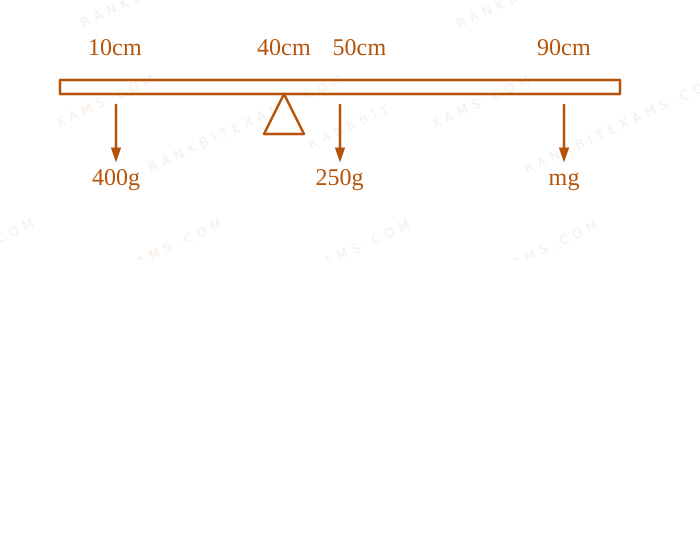
A uniform rod of mass 250mathrmg$250\mathrm{g}$ having length 100mathrmcm$100\mathrm{cm}$ is balanced on a sharp edge at 40mathrmcm$40\mathrm{cm}$ mark[cite: 150, 151]. A mass of 400mathrmg$400\mathrm{g}$ is suspended at 10mathrmcm$10\mathrm{cm}$ mark. To maintain the balance of the rod, the mass to be suspended at 90mathrmcm$90\mathrm{cm}$ mark, is [cite: 154, 156]
A.300mathrmg$300\mathrm{g}$
B.190mathrmg$190\mathrm{g}$
C.200mathrmg$200\mathrm{g}$
D.290mathrmg$290\mathrm{g}$
Solution
### Related Formula
For rotational equilibrium, the \sum of all counter-clockwise torques about the pivot point must exactly balance the \sum of all clockwise torques:
sum tau_textpivot = 0 implies sum (m_i cdot g cdot x_i) = 0$$\sum \tau_{\text{pivot}} = 0 \implies \sum (m_i \cdot g \cdot x_i) = 0$$
### Core Logic
The rod is uniform, meaning its mass (250text g$250\text{ g}$) acts exactly at its geometric center of mass, the 50text cm$50\text{ cm}$ mark[cite: 150, 151]. Let the pivot point be the sharp edge at the 40text cm$40\text{ cm}$ mark .
Calculate the relative lever arms from the pivot [cite: 775, 776, 777]:
* 400text g$400\text{ g}$ mass at 10text cm$10\text{ cm}$ mark: lever arm = 40 - 10 = 30text cm$= 40 - 10 = 30\text{ cm}$ (counter-clockwise)
* 250text g$250\text{ g}$ rod mass at 50text cm$50\text{ cm}$ mark: lever arm = 50 - 40 = 10text cm$= 50 - 40 = 10\text{ cm}$ (clockwise)
* Unknown mass M$M$ at 90text cm$90\text{ cm}$ mark: lever arm = 90 - 40 = 50text cm$= 90 - 40 = 50\text{ cm}$ (clockwise)
Setting up the torque balance equation:
400 times 30 = (250 times 10) + (M times 50)$$400 \times 30 = (250 \times 10) + (M \times 50)$$12000 = 2500 + 50M$$12000 = 2500 + 50M$$50M = 9500 implies M = frac950050 = 190text g$$50M = 9500 \implies M = \frac{9500}{50} = 190\text{ g}$$
### Step 1: Visual Context
The structural layout of forces acting on the balanced rod system is shown below:
Torque and Equilibrium balancing diagram for Q17
### Pattern Recognition
Never forget to include the weight of a uniform rod itself in equilibrium equations. It is a common oversight to omit the rod's mass, which always acts at its geometric center.
### Evaluation Rubric / Model Answer
null
### Chapter Mix
Class 11 Physics: System of Particles and Rotational Motion
Qjee_main_2025_29_jan_morningTorque
The coordinates of a particle with respect to origin in a given reference frame is (1, 1, 1) meters. If a force of vecmathrmF = hatmathrmi -hatmathrmj +hatmathrmk$\vec{\mathrm{F}} = \hat{\mathrm{i}} -\hat{\mathrm{j}} +\hat{\mathrm{k}}$ acts on the particle, then the magnitude of torque (with respect to origin) in z$z$ -direction is
Numerical Answer.Answer: 2 to 2
Solution
### Related Formula
vectau = vecr times vecF$$\vec{\tau} = \vec{r} \times \vec{F}$$
### Core Logic
Given position vector vecr = hati + hatj + hatk$\vec{r} = \hat{i} + \hat{j} + \hat{k}$ and force vecF = hati - hatj + hatk$\vec{F} = \hat{i} - \hat{j} + \hat{k}$:
vectau = left| beginarrayccc hati & hatj & hatk \\ 1 & 1 & 1 \\ 1 & -1 & 1 endarray right|$$\vec{\tau} = \left| \begin{array}{ccc} \hat{i} & \hat{j} & \hat{k} \\ 1 & 1 & 1 \\ 1 & -1 & 1 \end{array} \right|$$
### Step 1: Isolate z-component
tau_z = hatk(1(-1) - 1(1)) = -2hatk$$\tau_z = \hat{k}(1(-1) - 1(1)) = -2\hat{k}$$
The absolute magnitude of the torque component in the z$z$-direction equals 2 mathrm~N cdot m$2 \mathrm{~N \cdot m}$.
### Chapter Mix
Class 11 Physics: System of Particles and Rotational Motion
Q56jee_main_2024_01_february_morningCentre of Mass
The identical spheres each of mass 2M are placed at the corners of a right angled triangle with mutually perpendicular sides equal to 4mathrm~m$4\mathrm{~m}$ each. Taking point of intersection of these two sides as origin, the magnitude of position vector of the centre of mass of the system is frac4sqrt2x$\frac{4\sqrt{2}}{x}$, where the value of x$x$ is ______.
Numerical Answer.Answer: 3 to 3
Solution
### Related Formula
Position vector of the Centre of Mass (COM):
vecr_textCOM = fracm_1vecr_1 + m_2vecr_2 + m_3vecr_3m_1 + m_2 + m_3$$\vec{r}_{\text{COM}} = \frac{m_1\vec{r}_1 + m_2\vec{r}_2 + m_3\vec{r}_3}{m_1 + m_2 + m_3}$$
### Core Logic
Assign coordinates to the three masses (m_1=m_2=m_3=2M$m_1=m_2=m_3=2M$):
- Origin mass: vecr_1 = 0hati + 0hatj$\vec{r}_1 = 0\hat{i} + 0\hat{j}$
- X-axis mass: vecr_2 = 4hati + 0hatj$\vec{r}_2 = 4\hat{i} + 0\hat{j}$
- Y-axis mass: vecr_3 = 0hati + 4hatj$\vec{r}_3 = 0\hat{i} + 4\hat{j}$
Substitute these into the COM formula:
vecr_textCOM = frac2M(0) + 2M(4hati) + 2M(4hatj)2M + 2M + 2M = frac8Mhati + 8Mhatj6M = frac43hati + frac43hatj$$\vec{r}_{\text{COM}} = \frac{2M(0) + 2M(4\hat{i}) + 2M(4\hat{j})}{2M + 2M + 2M} = \frac{8M\hat{i} + 8M\hat{j}}{6M} = \frac{4}{3}\hat{i} + \frac{4}{3}\hat{j}$$
### Step 1: Calculate Position Vector Magnitude
|vecr_textCOM| = sqrtleft(frac43right)^2 + left(frac43right)^2 = frac4sqrt23$$|\vec{r}_{\text{COM}}| = \sqrt{\left(\frac{4}{3}\right)^2 + \left(\frac{4}{3}\right)^2} = \frac{4\sqrt{2}}{3}$$
Matching this directly with the given template frac4sqrt2x$\frac{4\sqrt{2}}{x}$ shows that x = 3$x = 3$.
### Pattern Recognition
Since the mass layout is completely symmetric along both right-angle legs, the COM coordinates are identical (x_textCOM = y_textCOM$x_{\text{COM}} = y_{\text{COM}}$).
### Evaluation Rubric / Model Answer
null
### Chapter Mix
Class 11 Physics: System of Particles and Rotational Motion
More System of Particles and Rotational Motion Questions — jee_main_2025_02_april_evening
We Map Every Repeating Question in Competitive Exams.
Say goodbye to generic mock test fatigue. RankBit uses smart analysis to group past exam questions into their foundational Repeating Question Types. Find chapter weightage, track repeating questions, and score higher with targeted practice.
Select Your Target Exam
Choose an exam track below to find formulas per chapter and patterns.
Syncing Exam Intelligence
Mapping formulas and patterns across all tracks…
PATH A — FULL LENGTH PRACTICE
Full Mock Test Hub
Simulate real NTA exam conditions with fully tracked mocks. Time yourself against past papers.
Practice past-year questions one chapter at a time. Pick an exam → subject → chapter and get every PYQ for that topic — pulled together from all past papers — with the chapter's key formulas alongside.