Given below are two statements: one is labelled as Assertion (A) and the other is labelled as Reason (R).
Assertion (A): Net dipole moment of a polar linear isotropic dielectric substance is not zero even in the absence of an external electric field.
Reason (R): In absence of an external electric field, the different permanent dipoles of a polar dielectric substance are oriented in random directions.
In the light of the above statements, choose the most appropriate answer from the options given below:
A.(A) is correct but (R) is not correct$(A)\text{ is correct but }(R)\text{ is not correct}$
B.Both (A) and (R) are correct but (R) is not the correct explanation of (A)$\text{Both }(A)\text{ and }(R)\text{ are correct but }(R)\text{ is not the correct explanation of }(A)$
C.Both (A) and (R) are correct and (R) is the correct explanation of (A)$\text{Both }(A)\text{ and }(R)\text{ are correct and }(R)\text{ is the correct explanation of }(A)$
D.(A) is not correct but (R) is correct$(A)\text{ is not correct but }(R)\text{ is correct}$
where:
Pₙₑₜ$\vec{P}_{\text{net}}$ = net dipole moment of the dielectric
pᵢ$\vec{p}_i$ = dipole moment of the individual i$i$-th molecule
Core Logic
No external electric field is present (Eₑₓₜ = 0$E_{\text{ext}} = 0$). Due to thermal agitation, all molecular permanent dipoles are randomly oriented in space:
Assertion (A) is false because it claims the net dipole moment is non-zero even without an external field.
Reason (R) is true because it correctly describes that different permanent dipoles are randomly oriented.
Step 1: Final Conclusion
Therefore, (A) is not correct but (R) is correct.
Pattern Recognition
Sees: "polar dielectric" + "no external field" → net bulk dipole moment is always zero.
Trap: Confusing the molecular level with the macroscopic level. Each molecule in a polar dielectric has a permanent dipole moment, but the macro substance has zero net moment due to random thermal orientations.
Shortcut: No external field means vectors cancel globally, which implies zero net moment. Thus (A) is false immediately.
Keywords:#Net dipole moment of a polar linear isotropic dielectric#JEE Main 2025 Evening Q1#Electrostatics JEE Main 2025#Dielectrics and Polarization JEE Main 2025
More Electrostatics Previous-Year Questions — Page 4
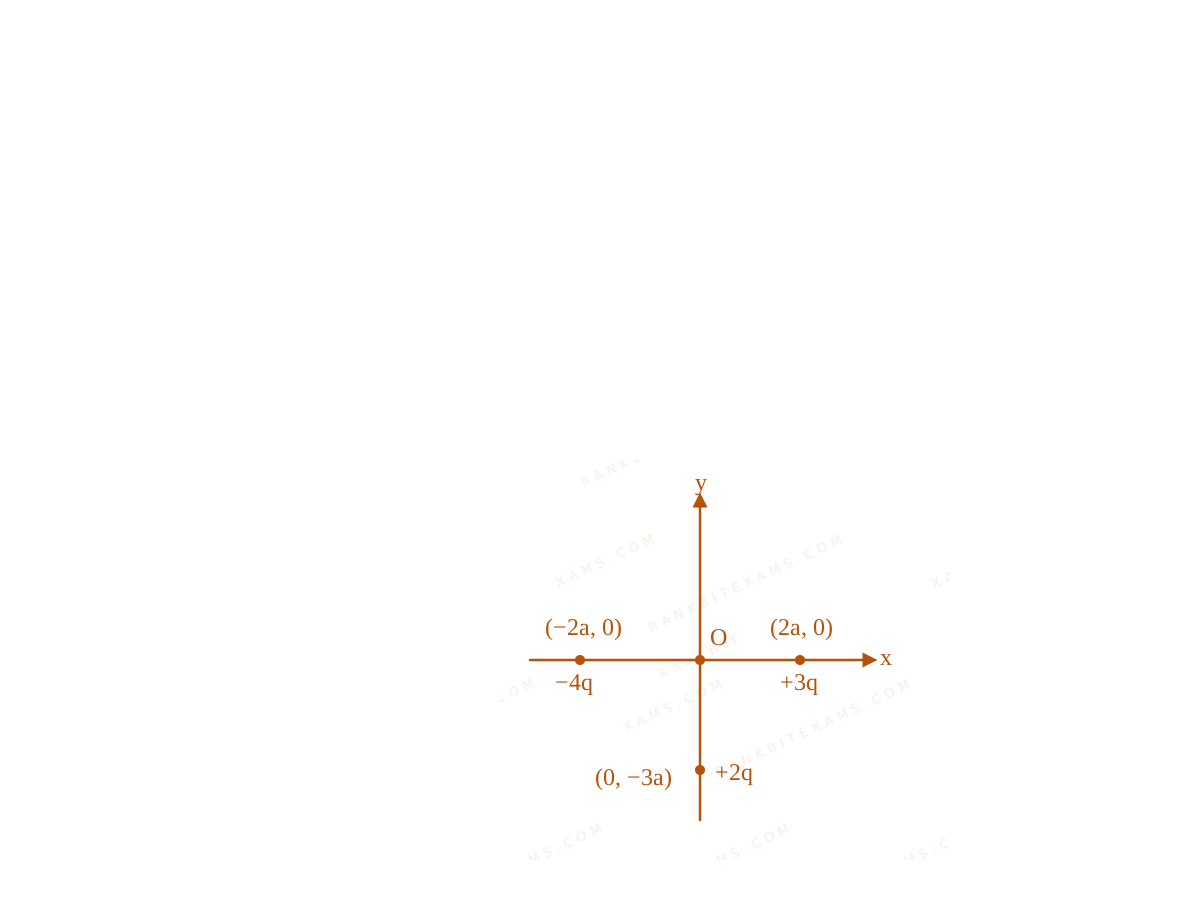
Three charges +2q$+2q$, +3q$+3q$ and -4q$-4q$ are situated at (0,-3a)$(0,-3a)$, (2a, 0)$(2a, 0)$ and (-2a,0)$(-2a,0)$ respectively in the xy plane. The resultant dipole moment about origin is
For a system of point charges where the net charge is non-zero, the dipole moment depends on the origin. However, taking the standard formula Σ qᵢ rᵢ$\sum q_i r_i$ yields the required mathematical expression directly.
Chapter Mix
Class 12 Physics: Electric Charges and Fields
Q40jee_main_2026_24_january_morningGauss's Law
The electrostatic potential in a charged spherical region of radius r varies as V = ar³ + b$V = ar^{3} + b$, where a and b are constants. The total charge in the sphere of unit radius is α × π a in₀$\alpha \times \pi a \in_{0}$. The value of α$\alpha$ is ____. (permittivity of vacuum is in₀$\in_{0}$)
A.-12$-12$
B.-6$-6$
C.-9$-9$
D.-8$-8$
Solution
Related Formula
E = -(dV)/(dr)$$E = -\frac{dV}{dr}$$∮ E · d A = qencε₀$$\oint \vec{E} \cdot d\vec{A} = \frac{q_{\text{enc}}}{\epsilon_0}$$
Core Logic
Gauss law for a spherical region
Given potential V = ar³ + b$V = ar^3 + b$.
The electric field E$E$ is given by the negative gradient of potential:
E = -(dV)/(dr) = -(d)/(dr)(ar³ + b) = -3ar²$$E = -\frac{dV}{dr} = -\frac{d}{dr}(ar^3 + b) = -3ar^2$$
Using Gauss's Law to find the enclosed charge for a spherical region:
Φclosed = E · A = qencε₀$$\Phi_{\text{closed}} = E \cdot A = \frac{q_{\text{enc}}}{\epsilon_0}$$
Step 1: Enclosed Charge Calculation
The surface area of a sphere of radius r=1$r=1$ is A = 4π(1)² = 4π$A = 4\pi(1)^2 = 4\pi$.
The electric field at r=1$r=1$ is:
E = -3a(1)² = -3a$$E = -3a(1)^2 = -3a$$
So,
qenc = ε₀ · E · A = ε₀ (-3a) (4π) = -12π a ε₀$$q_{\text{enc}} = \epsilon_0 \cdot E \cdot A = \epsilon_0 (-3a) (4\pi) = -12\pi a \epsilon_0$$
Comparing with the given expression α × π a ε₀$\alpha \times \pi a \epsilon_0$, we get:
α = -12$\alpha = -12$
Pattern Recognition
For spherical symmetry, extracting total charge enclosed is fastest using Gauss's Law at the boundary surface rather than integrating local charge density ρ(r)$\rho(r)$ using Poisson's equation.
Chapter Mix
Class 12 Physics: Electrostatics
Q44jee_main_2026_24_january_morningElectric Potential of Spherical Shells
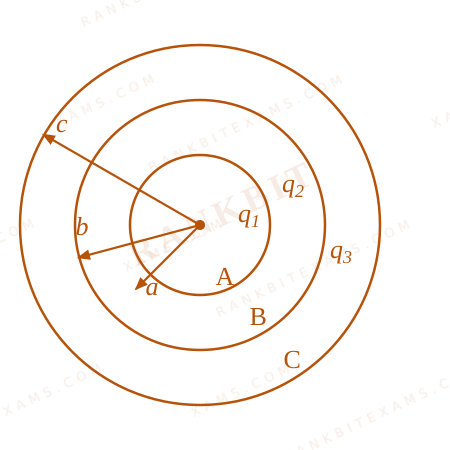
There are three co-centric conducting spherical shells A, B and C of radii a, b and c respectively. The potential of the spheres A, B and C respectively, are :
Potential at surface of middle sphere B (radius b$b$):
For charge q₁$q_1$, this is an outside point. For q₂$q_2$, it's on the surface. For q₃$q_3$, it's inside.
Matching these results shows option (3) represents the potentials perfectly.
Pattern Recognition
Potential on a sphere from inner charges uses its own radius, whereas potential from outer shells uses the outer shell's radius. Inner charges "collapse" computationally to the sphere's center.
Chapter Mix
Class 12 Physics: Electrostatics
Q35jee_main_2026_24_january_eveningCapacitors with Dielectrics
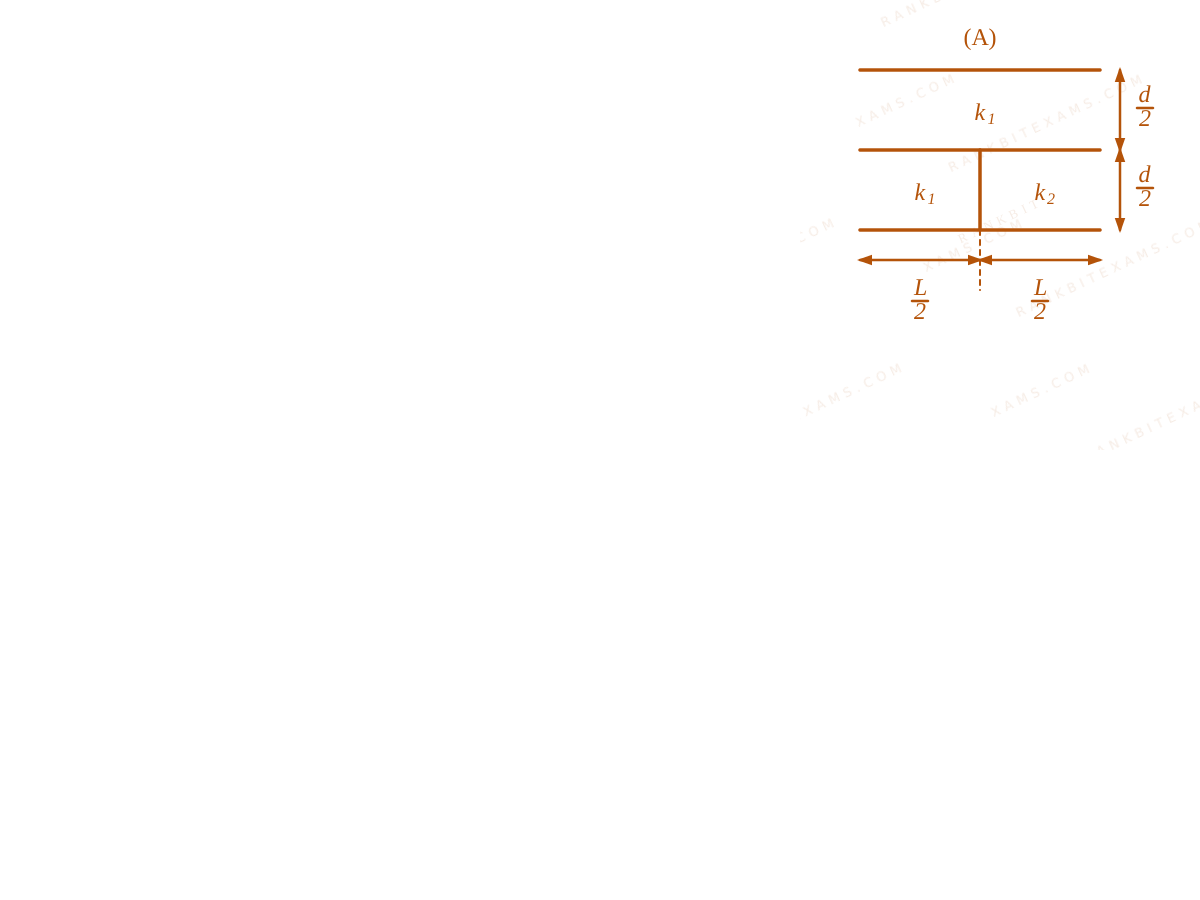
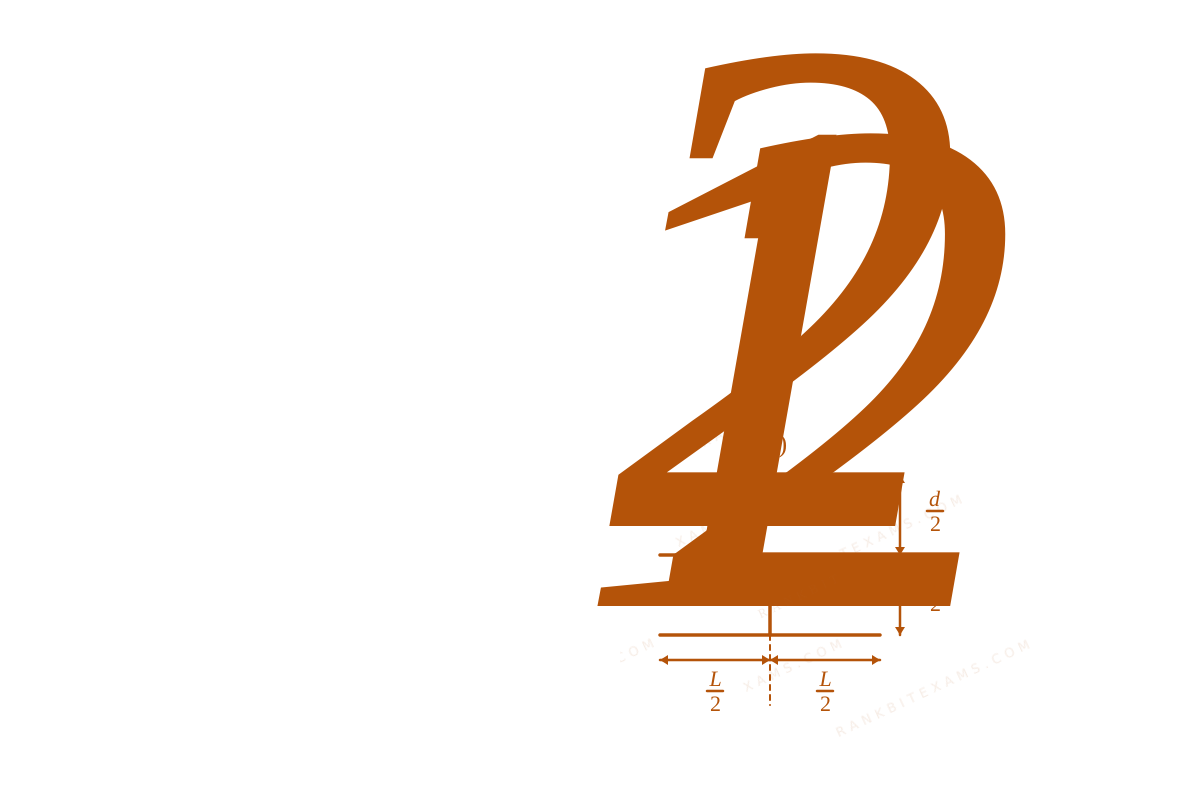
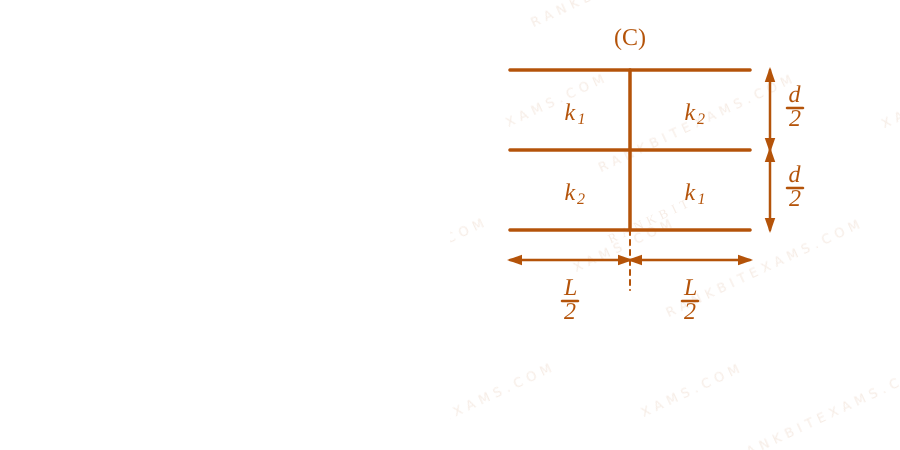
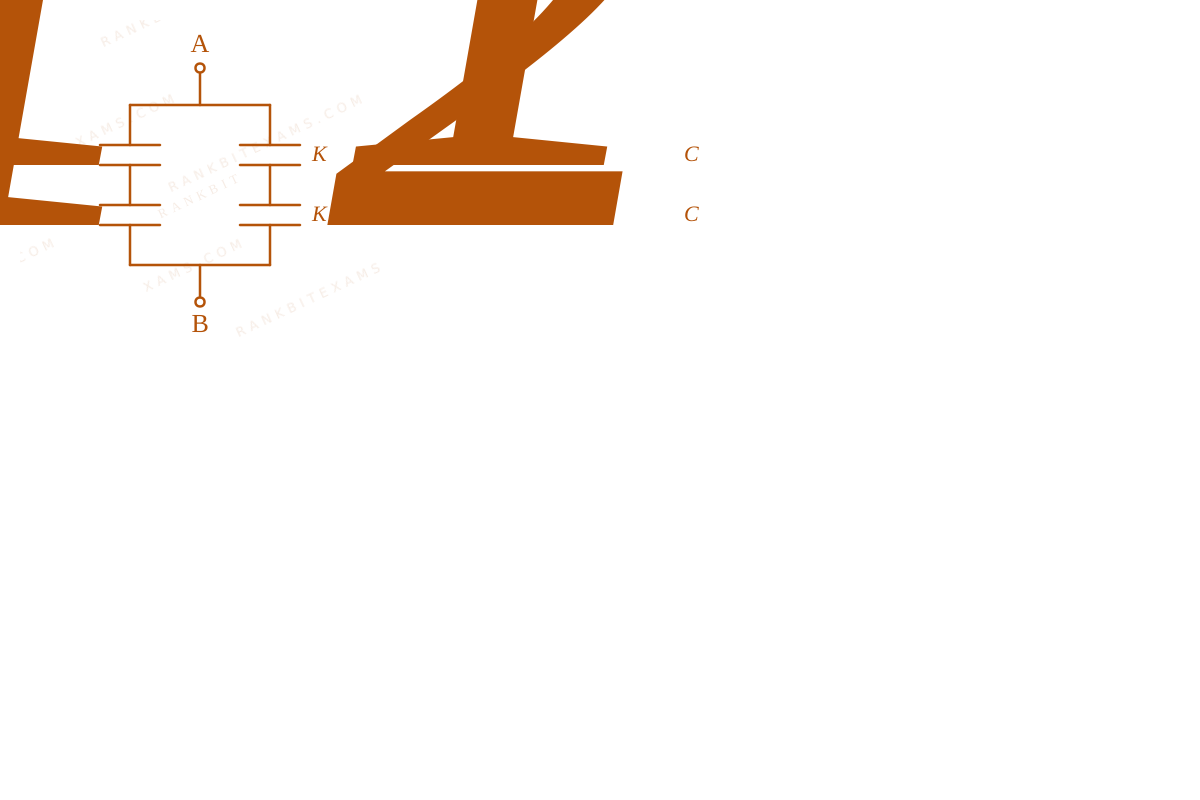
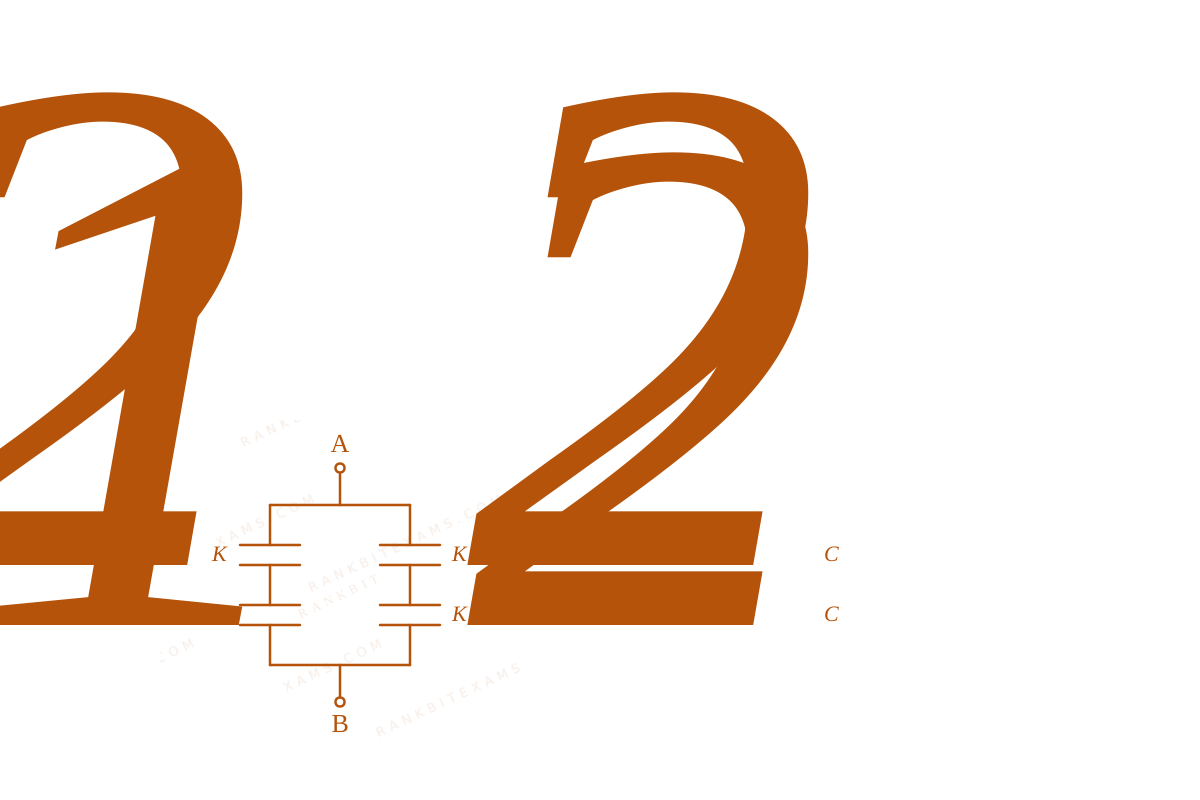
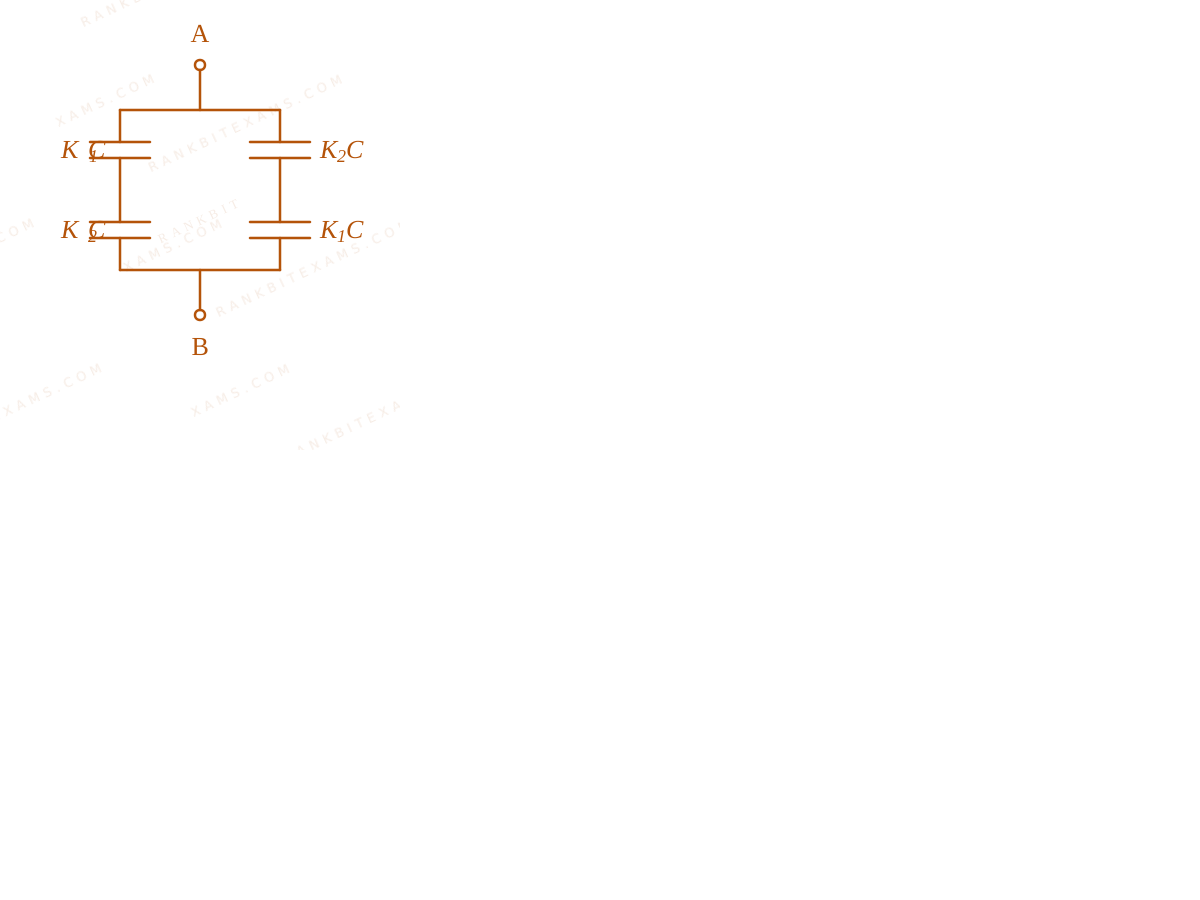
Three parallel plate capacitors each with area A and separation d are filled with two dielectric ( k₁$k_{1}$ and k₂$k_{2}$ ) in the following fashion. Which of the following is true? ( k₁ > k₂$k_{1} > k_{2}$ )
Three different capacitor configurations showing dielectrics k1 and k2 split vertically or horizontally.Three different capacitor configurations showing dielectrics k1 and k2 split vertically or horizontally.Three different capacitor configurations showing dielectrics k1 and k2 split vertically or horizontally.
A.CB > CC > CA$\mathrm{C_B > C_C > C_A}$
B.CC > CB > CA$\mathrm{C_C > C_B > C_A}$
C.CC > CA > CB$\mathrm{C_C > C_A > C_B}$
D.CA > CC > CB$\mathrm{C_A > C_C > C_B}$
Solution
Related Formula
C = (ε₀ A)/(d)$$C = \frac{\epsilon_0 A}{d}$$
Core Logic
Let C = (ε₀ A)/(d)$C = \frac{\epsilon_0 A}{d}$. We decompose the configurations into equivalent circuits.
For CA$C_A$:
Three different capacitor configurations showing dielectrics k1 and k2 split vertically or horizontally.
Since K₁ > K₂$K_1 > K_2$:
Comparing CA$C_A$ and CC$C_C$, and CC$C_C$ and CB$C_B$, algebraic manipulation proves:
CA > CC > CB$C_A > C_C > C_B$
Pattern Recognition
Symmetry dictates the capacity. Adding more of the higher dielectric constant material (K₁$K_1$) in parallel paths effectively boosts total capacitance significantly, while stacking lower K₂$K_2$ diminishes it.
Chapter Mix
Class 12 Physics: Electrostatics
Q47jee_main_2026_24_january_eveningCoulomb's Law and Continuous Charge Distribution
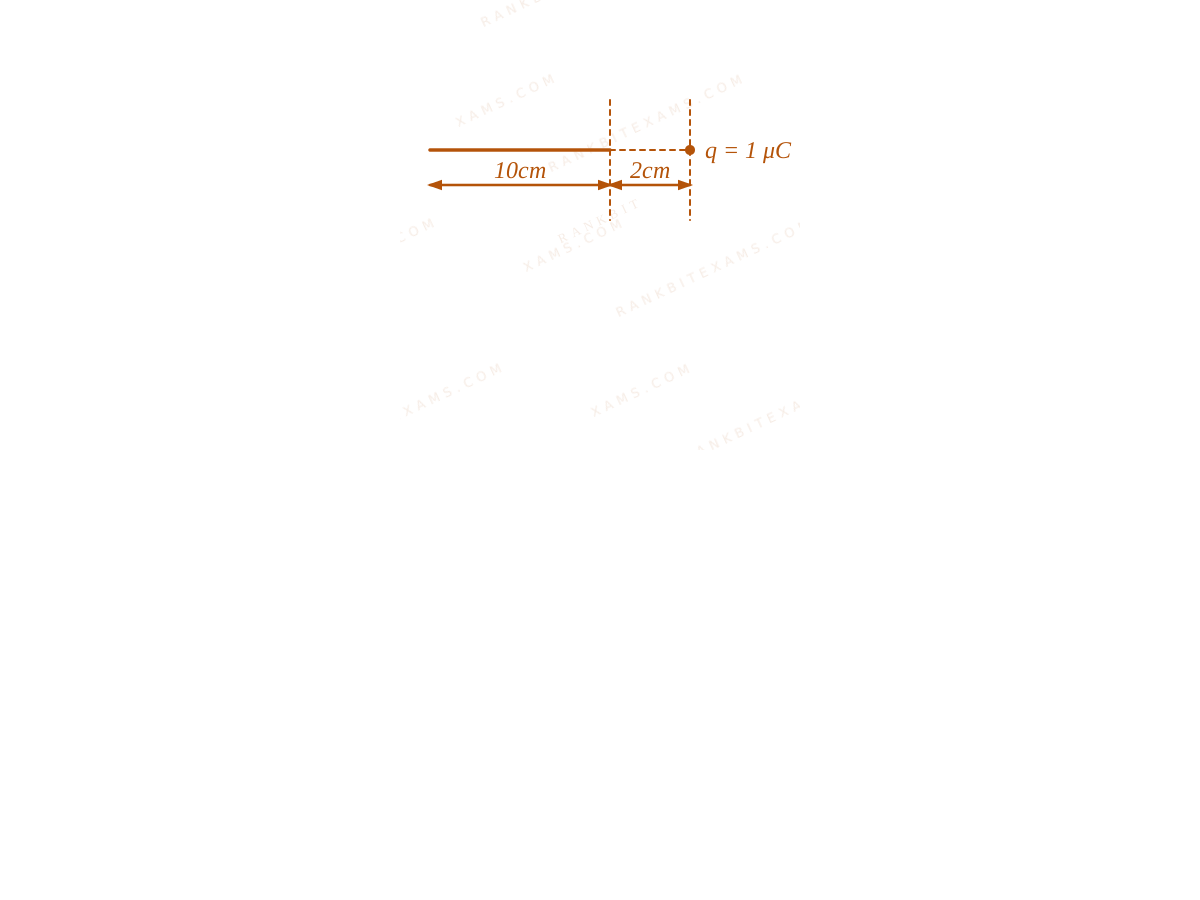
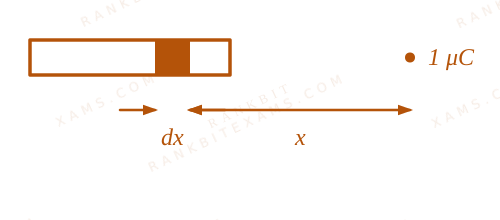
A point charge q = 1 μ C$q = 1 \mu C$ is located at a distance 2 cm from one end of a thin insulating wire of length 10 cm having a charge Q = 24 μ C$Q = 24 \mu C$ , distributed uniformly along its length, as shown in figure. Force between q and wire is ____ N.
( Use 14 π ε_ 0 = 9 × 1 0 ^ 9 N.m ^ 2 / C ^ 2)$\left(\text { Use } \frac {1}{4 \pi \epsilon_ {0}} = 9 \times 1 0 ^ {9} \mathrm{N.m} ^ {2} / \mathrm{C} ^ {2}\right)$A point charge placed 2 cm coaxially from a uniformly charged wire of length 10 cm.
For a point charge q$q$ acting on a line charge of length L$L$ separated by distance a$a$, F = (k q Q)/(a(a+L))$F = \frac{k q Q}{a(a+L)}$. Directly applying this bypasses the integration completely.
Chapter Mix
Class 12 Physics: Electrostatics
More Electrostatics Questions — jee_main_2025_02_april_evening
Practice past-year questions one chapter at a time. Pick an exam → subject → chapter and get every PYQ for that topic — pulled together from all past papers — with the chapter's key formulas alongside.