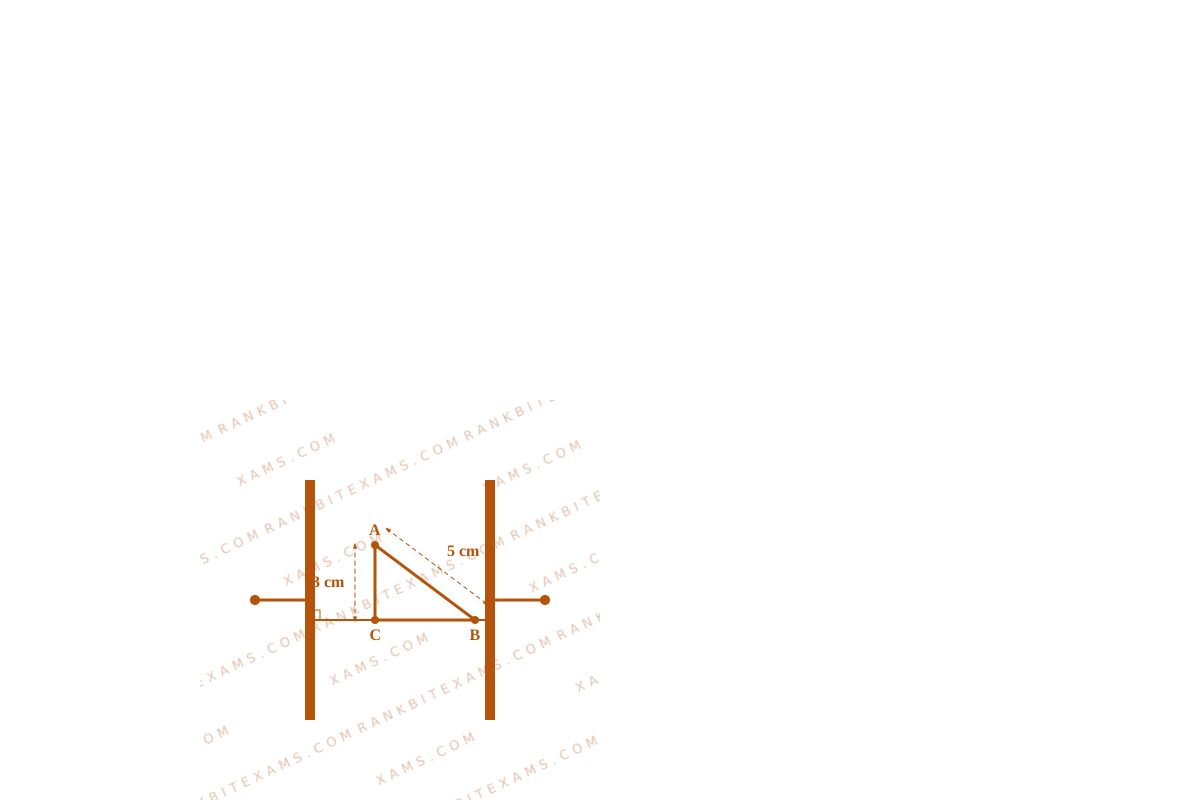
Two large plane parallel conducting plates are kept 10cm apart as shown in figure. The potential difference between them is V. The potential difference between the points A and B (shown in the figure) is :
Parallel conducting plates with potential difference V showing points A and B
The diagram shows two parallel plates separated by 10 cm, with points A and B defining a right triangle of legs 3 cm and 4 cm.

Solution & Explanation

Related Formula
  • Uniform Electric Field between parallel plates:
E = (V)/(d)
  • Potential difference between two points along the direction of the field:
Δ V = E · Δ x
Core Logic

The separation between the plates is d = 10 cm. The electric field E between them is uniform and runs perpendicularly between the plates (along the horizontal direction, +x):

E = (V)/(10) V/cm

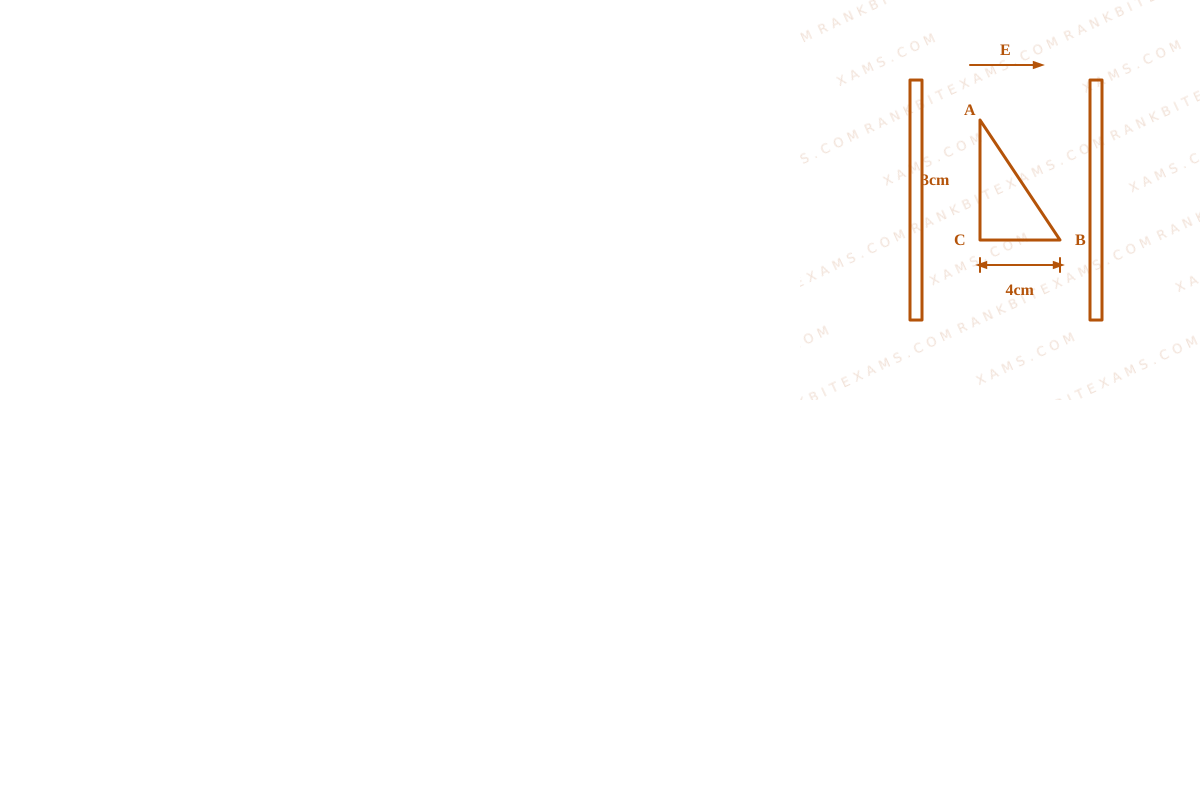
From the geometry shown in the figure:

  • AC = 3 cm is perpendicular to E (vertical direction).
  • CB = 4 cm is parallel to E (horizontal direction).
Step 1: Calculate potential difference between A and B

Since line AC is perpendicular to E:

VA - VC = 0 VA = VC

Thus, the potential difference between A and B is completely due to the horizontal displacement CB:

VAB = VA - VB = E · (CB)

Substitute the values:

VAB = ((V)/(10)) × 4 = (2)/(5) V

Thus, the potential difference between A and B is (2)/(5)V.

Pattern Recognition

Sees: Uniform electric field, potential difference over diagonal paths. Trap: Projecting along the hypotenuse length (5 cm) directly without considering the electric field's physical direction. Shortcut: Electric field is purely horizontal. Hence, only horizontal displacement matters. The horizontal displacement is 4 cm out of 10 cm total plate gap, so the potential difference is (4)/(10)V = (2)/(5)V.

Chapter Mix

Class 12 Physics: Electrostatic Potential and Capacitance

Horizontal projection of points A and B along electric field lines
The diagram shows two parallel plates separated by 10 cm, with points A and B defining a right triangle of legs 3 cm and 4 cm.

Reference Study Guides

More Electrostatic Potential and Capacitance Previous-Year Questions — Page 6

Q20 jee_main_2025_02_april_evening Electric Field of a Ring
Consider a circular loop that is uniformly charged and has a radius a√(2) . Find the position along the positive z -axis of the cartesian coordinate system where the electric field is maximum if the ring was assumed to be placed in xy-plane at the origin:
  • A. a√(2)
  • B. (a)/(2)
  • C. a
  • D. 0

Solution

Related Formula
  • Electric field intensity on the axis of a ring of radius R at axial distance z:
E = k Q z(z² + R²)3/2
  • Condition for maximum electric field on the axis of a ring:
z = R√(2)
Core Logic

To find where the axial field is maximized, take the first derivative of E with respect to z and set it to zero:

(dE)/(dz) = 0 z² + R² - 3z² = 0 z = R√(2)

We are given:

  • Radius of the loop R = a√(2)
Step 1: Calculate the peak coordinate

Substitute the radius R = a√(2) into the maximized coordinate condition:

z = a√(2)√(2) = a

Thus, the electric field reaches its peak intensity at z = a.

Pattern Recognition

Sees: Maximum axial field location of circular charged ring. Trap: Simply picking radius R directly as the distance value, or omitting the 1/√(2) scaling factor. Shortcut: The peak of the axial field distribution of any ring always lies at z = R√(2). With R = a√(2), z resolves simply to a√(2)√(2) = a.

Chapter Mix

Class 12 Physics: Electric Charges and Fields
Q jee_main_2025_02_april_morning Electric Field and Gauss's Law
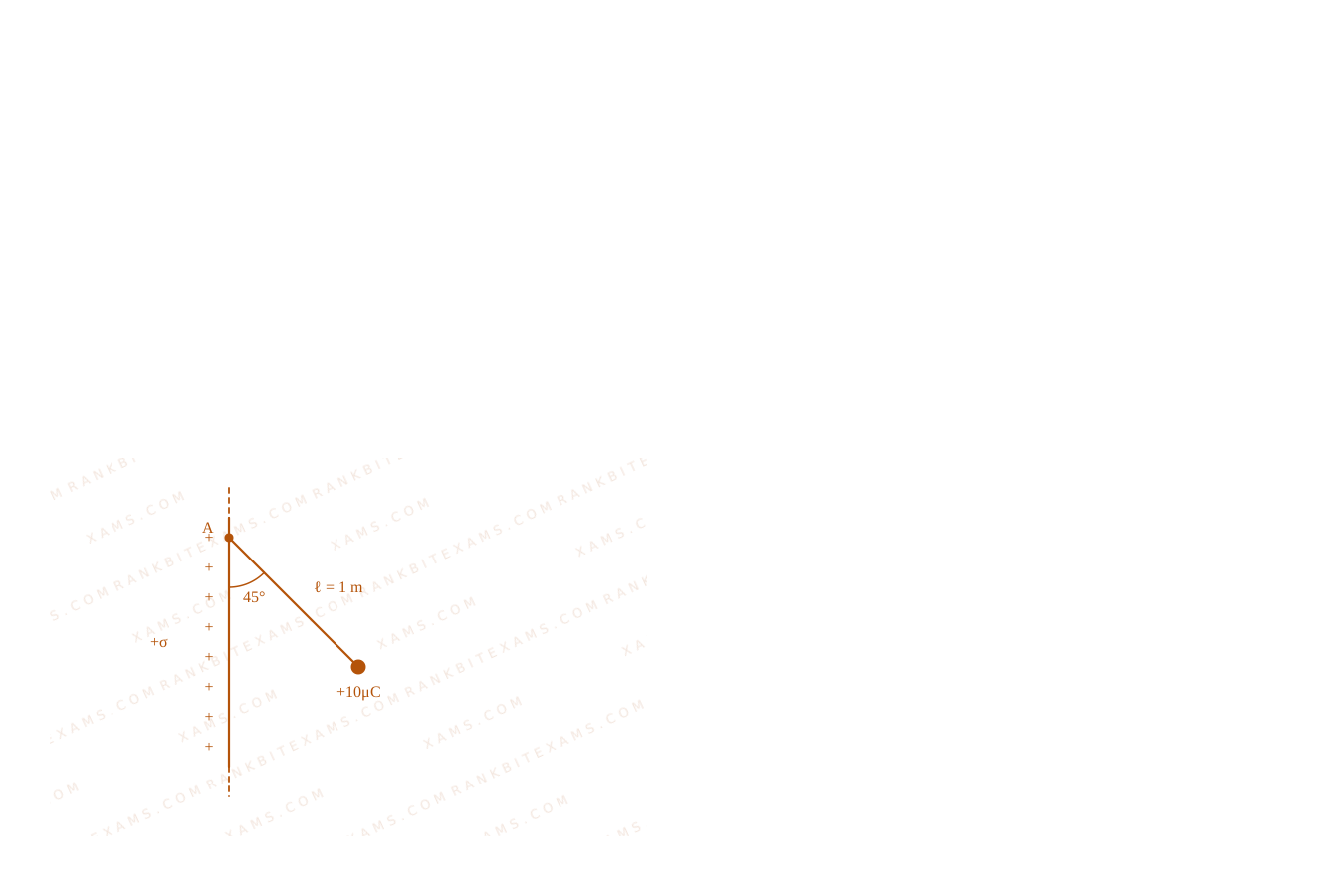
A small bob of mass 100~mg and charge +10~μ C is connected to an insulating string of length 1~m. It is brought near to an infinitely long non-conducting sheet of charge density 'σ' as shown in figure. If string subtends an angle of 45circ with the sheet at equilibrium the charge density of sheet will be: (Given, ε₀ = 8.85× 10⁻¹² Fm and acceleration due to gravity, g = 10~m/s²)
Charged bob suspended near sheet for Q19
A small charged bob hanging by a string of length 1 m subtending an angle of 45 degrees near a charged sheet.
  • A. 0.885 nC / m²
  • B. 17.7 nC / m²
  • C. 885 nC / m²
  • D. 1.77 nC / m²

Solution

Related Formula
E = (σ)/(2ε₀) (field of infinite non-conducting charged sheet) θ = (Fₑ)/(mg)
Core Logic

In equilibrium, three forces act on the suspended charged bob:

  • Tension T directed along the string at θ = 45° with the vertical sheet.
  • Weight mg directed vertically downwards.
  • Electrostatic repulsion force Fₑ = qE acting horizontally away from the sheet.
  • From the balance of forces in vertical and horizontal directions:

T (45°) = mg T (45°) = q E

Dividing the two equations:

(45°) = (q E)/(mg) = 1 q E = mg

Substitute the expression for E:

q ((σ)/(2ε₀)) = mg σ = (2 ε₀ m g)/(q)

Now plug in the given numerical values:

  • m = 100~mg = 100 × 10⁻⁶~kg = 10⁻⁴~kg
  • q = +10~μ C = 10 × 10⁻⁶~C = 10⁻⁵~C
  • g = 10~m/s²
  • ε₀ = 8.85 × 10⁻¹²~F/m
σ = 2 × (8.85 × 10⁻¹²) × 10⁻⁴ × 1010⁻⁵ σ = 17.7 × 10⁻¹⁰~C/m² = 1.77 × 10⁻⁹~C/m² = 1.77~nC/m²
Step 1: Final Conclusion

The charge density of the sheet is 1.77~nC/m².

Pattern Recognition

For a charge hanging near a vertical charged sheet, the equilibrium angle is governed by θ = (Fₑ)/(mg). For θ = 45°, the horizontal force equals the vertical force (Fₑ = mg). Be careful to use the field of a non-conducting sheet: E = (σ)/(2ε₀).

Chapter Mix

Class 12 Physics: Electrostatics

Q5 jee_main_2025_02_april_morning Electric Field and Gauss's Law
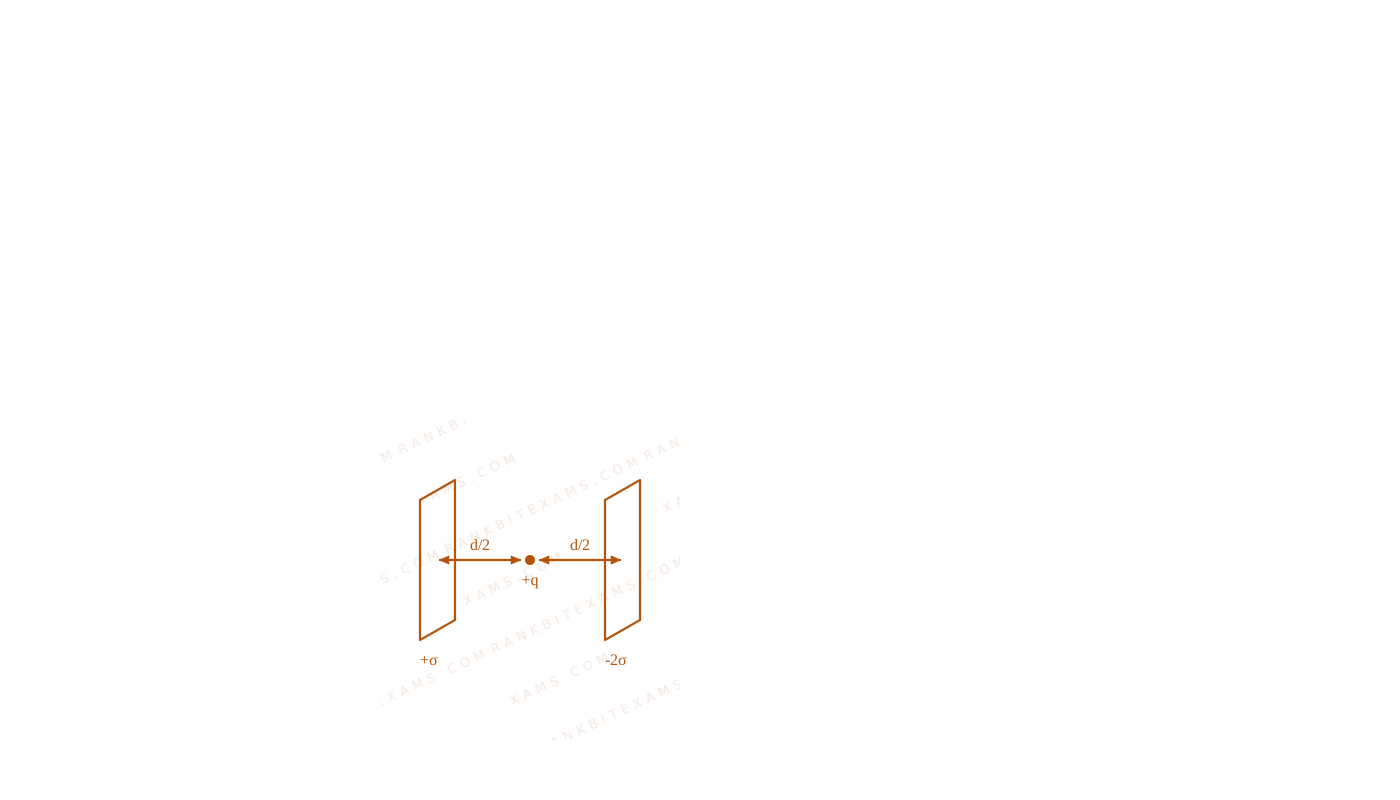
Consider two infinitely large plane parallel conducting plates as shown below. The plates are uniformly charged with a surface charge density +σ and -2σ. The force experienced by a point charge +q placed at the mid point between two plates will be:
Parallel conducting plates for Q5
Two parallel plates with charges +sigma and -2sigma and a point charge +q at the midpoint.
  • A. (σ q)/(4 ε₀)
  • B. (3σ q)/(2 ε₀)
  • C. (3σ q)/(4 ε₀)
  • D. (σ q)/(2 ε₀)

Solution

Related Formula
E = σᵢₙₙₑᵣε₀
Core Logic

For parallel conducting plates of large area, charges redistribute on the outer and inner faces to maintain electrostatic equilibrium. Total charge per unit area on Plate 1: q₁ = σ Total charge per unit area on Plate 2: q₂ = -2σ

The outer surface charge density on the far sides of both plates must be equal:

σouter = (q₁ + q₂)/(2) = (σ - 2σ)/(2) = -(σ)/(2)

Now, compute the charges on the inner facing surfaces:

  • Inner face of Plate 1:
σᵢₙₙₑᵣ₁ = q₁ - σouter = σ - (-(σ)/(2)) = (3σ)/(2)
  • Inner face of Plate 2:
σᵢₙₙₑᵣ₂ = q₂ - σouter = -2σ - (-(σ)/(2)) = -(3σ)/(2)

In the region between the plates, both inner surfaces create an electric field in the same direction (away from the positive plate 1 and towards negative plate 2):

E = σᵢₙₙₑᵣ₁2ε₀ + |σᵢₙₙₑᵣ₂|2ε₀ = (3σ/2)/(2ε₀) + (3σ/2)/(2ε₀) = (3σ)/(2ε₀)

Thus, the electrostatic force on +q is:

F = q E = (3σ q)/(2ε₀)
Step 1: Final Conclusion

The force experienced by the point charge +q is (3σ q)/(2ε₀).

Pattern Recognition

For conducting plates with total charges Q₁ and Q₂, always calculate the outer charge first: Qouter = (Q₁+Q₂)/(2). The field inside the gap is exclusively due to the inner surfaces: E = σᵢₙₙₑᵣε₀.

Chapter Mix

Class 12 Physics: Electrostatics

Q7 jee_main_2025_02_april_morning Electric Field and Gauss's Law
A point charge +q is placed at the origin. A second point charge +9q is placed at (d, 0, 0) in Cartesian coordinate system. The point in between them where the electric field vanishes is:
  • A. (4d / 3, 0, 0)
  • B. (d / 4, 0, 0)
  • C. (3d / 4, 0, 0)
  • D. (d / 3, 0, 0)

Solution

Related Formula
E = (k Q)/(r²) x = d1 + √((q₂)/(q₁))
Core Logic

Let the null point where the electric field is zero be at (x, 0, 0) where 0 < x < d.

At this point, the fields due to both charges are equal in magnitude and opposite in direction:

(k q)/(x²) = (k (9q))/((d - x)²)

Taking the square root on both sides:

(1)/(x) = (3)/(d - x) d - x = 3x 4x = d x = (d)/(4)

Thus, the coordinates of the null point are ((d)/(4), 0, 0).

Step 1: Final Conclusion

The point where the electric field vanishes is ((d)/(4), 0, 0).

Pattern Recognition

For two like charges, the zero-field null point always lies along the line joining them and is closer to the smaller charge. Use the standard shortcut: x = d1 + √(q₂/q₁) measured from charge q₁.

Chapter Mix

Class 12 Physics: Electrostatics

More Electrostatic Potential and Capacitance Questions — jee_main_2025_02_april_evening

Practice all Electrostatic Potential and Capacitance previous-year questions →

Rankbit System
JEE Physics: Waves (+15.5%) | Electrostatics: Concentric Shells (-29.7%) | Modern Physics: Photoelectric Clones (+34.2%) | Mathematics: Definite Integrals (+18.1%) | Chemistry: Coordination Splitting (-11.4%) | JEE Physics: Waves (+15.5%) | Electrostatics: Concentric Shells (-29.7%) | Modern Physics: Photoelectric Clones (+34.2%) | Mathematics: Definite Integrals (+18.1%) | Chemistry: Coordination Splitting (-11.4%)