Let mathrmA = \1, 2, 3, dots, 100\$\mathrm{A} = \{1, 2, 3, \dots, 100\}$ and mathrmR$\mathrm{R}$ be a relation on mathrmA$\mathrm{A}$ such that mathrmR = \(a, b) : a = 2b + 1\$\mathrm{R} = \{(a, b) : a = 2b + 1\}$. Let (a_1, a_2), (a_2, a_3), (a_3, a_4), dots, (a_k, a_k+1)$(a_1, a_2), (a_2, a_3), (a_3, a_4), \dots, (a_k, a_{k+1})$ be a sequence of k$k$ elements of mathrmR$\mathrm{R}$ such that the second entry of an ordered pair is equal to the first entry of the next ordered pair. Then the largest integer k$k$, for which such a sequence exists, is equal to:
A.6
B.7
C.5
D.8
Solution & Explanation
### Related Formula
textChain definition: a_i = 2 a_i+1 + 1 quad textfor i = 1, 2, dots, k$$\text{Chain definition: } a_{i} = 2 a_{i+1} + 1 \quad \text{for } i = 1, 2, \dots, k$$
### Core Logic
To find the longest sequence of connected pairs, we trace the relation backward starting from the smallest elements in A$A$.
### Step 1: Trace the relations backward
To maximize k$k$, we want the chain of elements to go down as low as possible. Let the final element in the chain be a_k+1 in mathrmA$a_{k+1} \in \mathrm{A}$.
Since a_k = 2 a_k+1 + 1$a_k = 2 a_{k+1} + 1$:
- If a_k+1 = 1 implies a_k = 3$a_{k+1} = 1 \implies a_k = 3$
- If a_k+1 = 2 implies a_k = 5$a_{k+1} = 2 \implies a_k = 5$
Let's test the chain starting with a_k+1 = 1$a_{k+1} = 1$:
- a_k = 2(1) + 1 = 3$a_k = 2(1) + 1 = 3$
- a_k-1 = 2(3) + 1 = 7$a_{k-1} = 2(3) + 1 = 7$
- a_k-2 = 2(7) + 1 = 15$a_{k-2} = 2(7) + 1 = 15$
- a_k-3 = 2(15) + 1 = 31$a_{k-3} = 2(15) + 1 = 31$
- a_k-4 = 2(31) + 1 = 63$a_{k-4} = 2(31) + 1 = 63$
- a_k-5 = 2(63) + 1 = 127$a_{k-5} = 2(63) + 1 = 127$ (but 127 notin mathrmA$127 \notin \mathrm{A}$!)
Thus, the longest chain within the set A$A$ has 6 elements:
\63, \, 31, \, 15, \, 7, \, 3, \, 1\$$\{63, \, 31, \, 15, \, 7, \, 3, \, 1\}$$
This chain corresponds to exactly 5 ordered pairs:
(63, 31), \, (31, 15), \, (15, 7), \, (7, 3), \, (3, 1)$$(63, 31), \, (31, 15), \, (15, 7), \, (7, 3), \, (3, 1)$$
So the maximum number of pairs in the sequence is k = 5$k = 5$.
### Step 2: Check alternative chains
If we start with a_k+1 = 2$a_{k+1} = 2$:
- a_k+1 = 2$a_{k+1} = 2$
- a_k = 5$a_k = 5$
- a_k-1 = 11$a_{k-1} = 11$
- a_k-2 = 23$a_{k-2} = 23$
- a_k-3 = 47$a_{k-3} = 47$
- a_k-4 = 95$a_{k-4} = 95$
- a_k-5 = 191 > 100$a_{k-5} = 191 > 100$
Again, the maximum number of pairs is k = 5$k = 5$. Thus, the largest integer k$k$ is 5.
### Pattern Recognition
Recursive scaling: Tracing exponential chains of the form x_n+1 = c x_n + d$x_{n+1} = c x_n + d$ shows that the elements grow very quickly. Calculating the limits of growth determines the maximum possible depth of the sequence.
### Evaluation Rubric / Model Answer
null
### Chapter Mix
Class 11 Mathematics: Relations and Functions
More Relations and Functions Previous-Year Questions — Page 9
Q27jee_main_2024_30_january_eveningTypes of Relations
The number of symmetric relations defined on the set \1, 2, 3, 4\$\{1, 2, 3, 4\}$ which are not reflexive is
Numerical Answer.Answer: 960 to 960
Solution
### Related Formula
textTotal number of symmetric relations on set with n text elements = 2^fracn(n+1)2$$\text{Total number of symmetric relations on set with } n \text{ elements} = 2^{\frac{n(n+1)}{2}}$$textTotal number of relations both symmetric and reflexive = 2^fracn(n-1)2$$\text{Total number of relations both symmetric and reflexive} = 2^{\frac{n(n-1)}{2}}$$
### Core Logic
A relation is represented by an n times n$n \times n$ matrix.
For symmetry, the upper triangle determines the lower triangle completely.
The diagonal elements (a_ii$a_{ii}$) can be either 0 or 1.
Number of independent elements (upper triangle + diagonal) = fracn^2 - n2 + n = fracn(n+1)2$\frac{n^2 - n}{2} + n = \frac{n(n+1)}{2}$.
Total symmetric relations = 2^fracn(n+1)2$2^{\frac{n(n+1)}{2}}$.
For a relation to be *both* symmetric and reflexive, all diagonal elements must be 1$1$.
The remaining independent elements (upper triangle) are fracn(n-1)2$\frac{n(n-1)}{2}$.
Total symmetric AND reflexive relations = 2^fracn(n-1)2$2^{\frac{n(n-1)}{2}}$.
### Step 1: Calculating for n = 4
For a set of n = 4$n = 4$ elements:
Total number of symmetric relations:
N_textsymm = 2^frac4(4+1)2 = 2^10 = 1024$$N_{\text{symm}} = 2^{\frac{4(4+1)}{2}} = 2^{10} = 1024$$
Total number of symmetric and reflexive relations:
N_textsymm+refl = 2^frac4(4-1)2 = 2^6 = 64$$N_{\text{symm+refl}} = 2^{\frac{4(4-1)}{2}} = 2^6 = 64$$
### Step 2: Finding Requested Number
We need the number of symmetric relations that are NOT reflexive.
N = N_textsymm - N_textsymm+refl$$N = N_{\text{symm}} - N_{\text{symm+refl}}$$N = 1024 - 64 = 960$$N = 1024 - 64 = 960$$
### Pattern Recognition
Condition 'not' acts as a simple set subtraction. Count the entire universe of symmetric relations (diagonal is free) and subtract the subset where reflexivity locks the diagonal elements to 1.
### Evaluation Rubric / Model Answer
null
### Chapter Mix
Class 11 Maths: Sets, Relations and Functions
Q12jee_main_2024_30_jan_morningDomain and Range
If the domain of the functionf(x) = cos^-1left(frac2 - |x|4right) + (log_e (3 - x))^-1$$f(x) = \cos^{-1}\left(\frac{2 - |x|}{4}\right) + (\log_e (3 - x))^{-1}$$
is [-alpha, beta) - \gamma\$[-\alpha, \beta) - \{\gamma\}$, then alpha + beta + gamma$\alpha + \beta + \gamma$ is equal to:
A.12$12$
B.9$9$
C.11$11$
D.8$8$
Solution
### Related Formula
-1 leq textargument of cos^-1 leq 1$$-1 \leq \text{argument of } \cos^{-1} \leq 1$$log_a x text is defined for x > 0 text and base a > 0, a neq 1$$\log_a x \text{ is defined for } x > 0 \text{ and base } a > 0, a \neq 1$$f^-1 text signifies denominator neq 0$$f^{-1} \text{ signifies denominator } \neq 0$$
### Core Logic
For f(x)$f(x)$ to be defined, both terms must be defined independently.
Term 1: cos^-1left(frac2 - |x|4right)$\cos^{-1}\left(\frac{2 - |x|}{4}\right)$
The domain requires:
-1 leq frac2 - |x|4 leq 1$$-1 \leq \frac{2 - |x|}{4} \leq 1$$-4 leq 2 - |x| leq 4$$-4 \leq 2 - |x| \leq 4$$-6 leq -|x| leq 2$$-6 \leq -|x| \leq 2$$-2 leq |x| leq 6$$-2 \leq |x| \leq 6$$
Since |x|$|x|$ is always non-negative, the valid condition reduces to |x| leq 6$|x| \leq 6$.
This implies x in [-6, 6] quad dots (1)$x \in [-6, 6] \quad \dots (1)$
### Step 1: Domain of logarithmic term
Term 2: (log_e(3 - x))^-1 = frac1log_e(3 - x)$(\log_e(3 - x))^{-1} = \frac{1}{\log_e(3 - x)}$
The argument of the logarithm must be positive:
3 - x > 0 Rightarrow x < 3 quad dots (2)$$3 - x > 0 \Rightarrow x < 3 \quad \dots (2)$$
Also, the denominator cannot be zero:
log_e(3 - x) neq 0 Rightarrow 3 - x neq 1 Rightarrow x neq 2 quad dots (3)$$\log_e(3 - x) \neq 0 \Rightarrow 3 - x \neq 1 \Rightarrow x \neq 2 \quad \dots (3)$$
### Step 2: Combining intersection regions
Taking the intersection of (1), (2), and (3):
x in [-6, 6] cap (-infty, 3) cap x neq 2$$x \in [-6, 6] \cap (-\infty, 3) \cap x \neq 2$$x in [-6, 3) - \2\$$x \in [-6, 3) - \{2\}$$
Comparing this with the given domain [-alpha, beta) - \gamma\$[-\alpha, \beta) - \{\gamma\}$:
alpha = 6$\alpha = 6$, beta = 3$\beta = 3$, gamma = 2$\gamma = 2$.
### Step 3: Calculating target value
alpha + beta + gamma = 6 + 3 + 2 = 11$\alpha + \beta + \gamma = 6 + 3 + 2 = 11$
### Pattern Recognition
Isolate the constraints of piecewise function composition: inner constraints (argument bounds), denominator zero-checks, and fundamental range boundaries.
### Evaluation Rubric / Model Answer
null
### Chapter Mix
Class 11 Maths: Relations and Functions
Q21jee_main_2024_30_jan_morningSet Operations
A group of 40 students appeared in an examination of 3 subjects - Mathematics, Physics & Chemistry. It was found that all students passed in at least one of the subjects, 20 students passed in Mathematics, 25 students passed in Physics, 16 students passed in Chemistry, at most 11 students passed in both Mathematics and Physics, at most 15 students passed in both Physics and Chemistry, at most 15 students passed in both Mathematics and Chemistry. The maximum number of students passed in all the three subjects is
Numerical Answer.Answer: 10 to 10
Solution
### Related Formula
n(M cup P cup C) = n(M) + n(P) + n(C) - n(M cap P) - n(P cap C) - n(M cap C) + n(M cap P cap C)$$n(M \cup P \cup C) = n(M) + n(P) + n(C) - n(M \cap P) - n(P \cap C) - n(M \cap C) + n(M \cap P \cap C)$$
### Core Logic
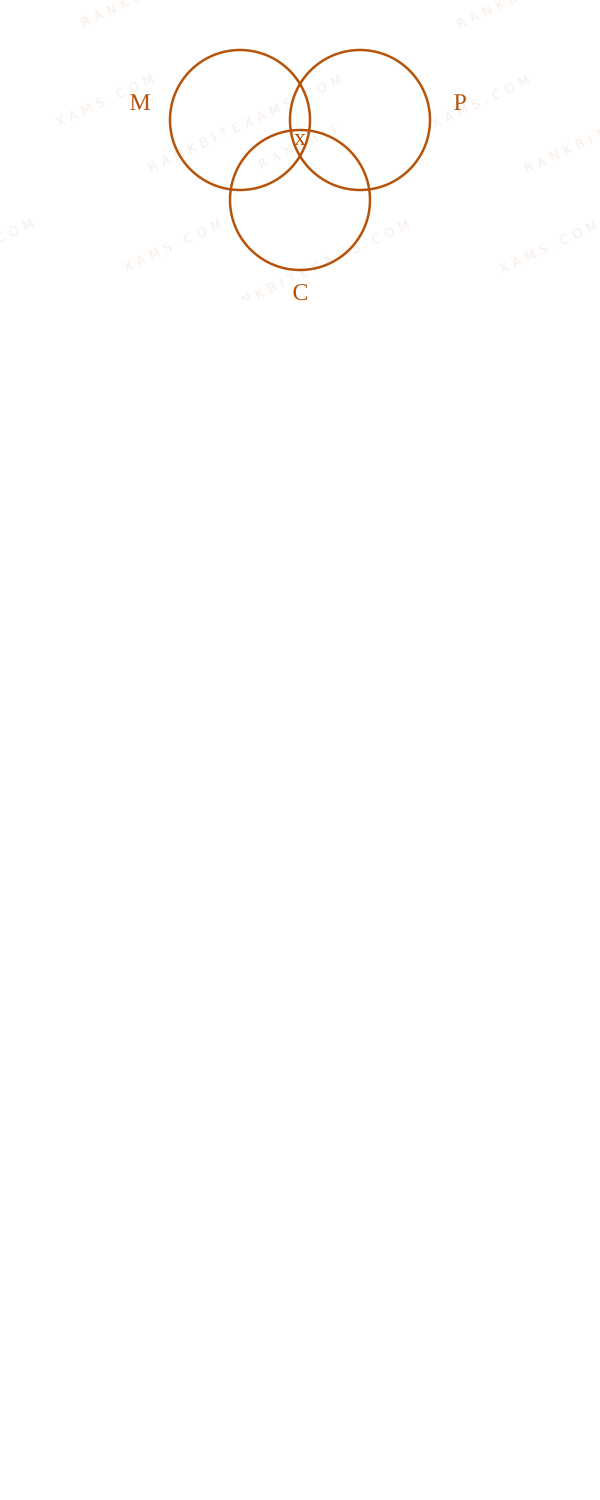
Set Operations diagram for Q21 - JEE Main 2024 Morning
Let x$x$ be the number of students who passed in all three subjects, so n(M cap P cap C) = x$n(M \cap P \cap C) = x$.
We are given:
n(M) = 20, n(P) = 25, n(C) = 16$n(M) = 20, n(P) = 25, n(C) = 16$n(M cup P cup C) = 40$n(M \cup P \cup C) = 40$
Constraints:
n(M cap P) le 11$n(M \cap P) \le 11$n(P cap C) le 15$n(P \cap C) \le 15$n(M cap C) le 15$n(M \cap C) \le 15$
If we let n(M cap P) = 11$n(M \cap P) = 11$, then the region representing only M cap P$M \cap P$ is 11 - x$11 - x$. For this to be non-negative, x le 11$x \le 11$.
### Step 1: Testing x = 11
Set Operations diagram for Q21 - JEE Main 2024 Morning
Assume x = 11$x = 11$.
To maximize, let's fix n(M cap P) = 11$n(M \cap P) = 11$. This leaves 0$0$ students in (M cap P) - (M cap P cap C)$(M \cap P) - (M \cap P \cap C)$.
Let n(M cap C) = 11 + z$n(M \cap C) = 11 + z$ and n(P cap C) = 11 + y$n(P \cap C) = 11 + y$.
Constraints limit these subsets:
11 + z le 15 Rightarrow z le 4$11 + z \le 15 \Rightarrow z \le 4$11 + y le 15 Rightarrow y le 4$11 + y \le 15 \Rightarrow y \le 4$
Filling the Venn diagram nodes:
Only M = 20 - 11 - z - 0 = 9 - z$M = 20 - 11 - z - 0 = 9 - z$
Only P = 25 - 11 - y - 0 = 14 - y$P = 25 - 11 - y - 0 = 14 - y$
Only C = 16 - 11 - y - z = 5 - y - z$C = 16 - 11 - y - z = 5 - y - z$
Summing all disjoint areas:
Total = (9 - z) + 0 + (14 - y) + z + 11 + y + (5 - y - z) = 40$= (9 - z) + 0 + (14 - y) + z + 11 + y + (5 - y - z) = 40$39 - y - z = 40 Rightarrow y + z = -1$39 - y - z = 40 \Rightarrow y + z = -1$
Since subsets cannot be negative, x=11$x=11$ is impossible.
### Step 2: Testing x = 10
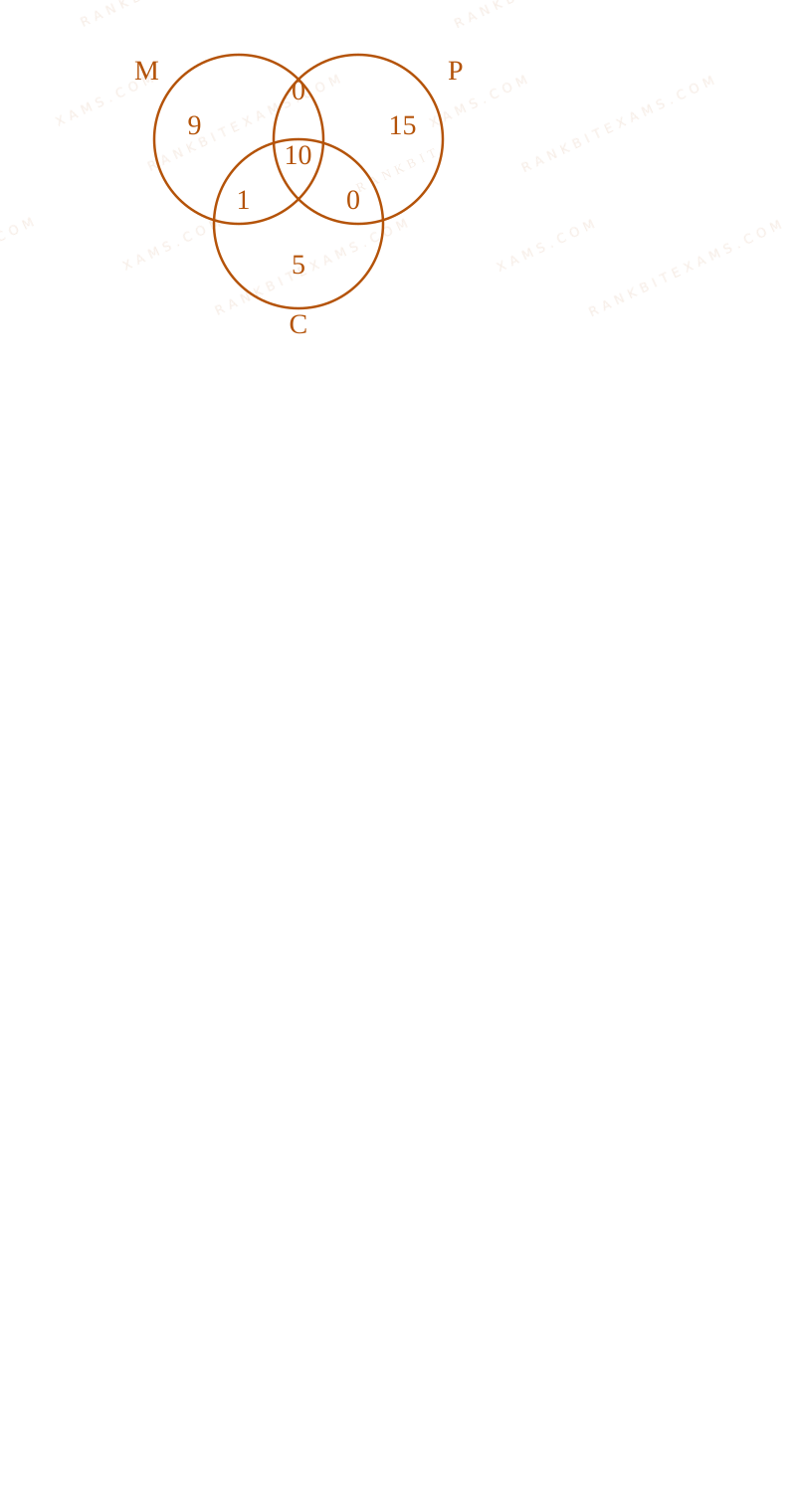
Set Operations diagram for Q21 - JEE Main 2024 Morning
Assume x = 10$x = 10$.
Let's construct a valid distribution with x = 10$x = 10$.
We can choose intersection values:
n(M cap P) = 10$n(M \cap P) = 10$, so only M cap P$M \cap P$ is 0$0$.
n(M cap C) = 11$n(M \cap C) = 11$, so only M cap C$M \cap C$ is 1$1$.
n(P cap C) = 10$n(P \cap C) = 10$, so only P cap C$P \cap C$ is 0$0$.
This gives:
Only M = 20 - 10 - 0 - 1 = 9$M = 20 - 10 - 0 - 1 = 9$
Only P = 25 - 10 - 0 - 0 = 15$P = 25 - 10 - 0 - 0 = 15$
Only C = 16 - 10 - 1 - 0 = 5$C = 16 - 10 - 1 - 0 = 5$
Summing up = 9 + 15 + 5 + 0 + 1 + 0 + 10 = 40$9 + 15 + 5 + 0 + 1 + 0 + 10 = 40$.
All conditions are satisfied perfectly.
Hence, the maximum number is 10.
### Pattern Recognition
In multi-constraint Venn diagram maximization, test the theoretical upper bound sequentially downward until a non-negative configuration for all disjoint subsets is achieved.
### Evaluation Rubric / Model Answer
null
### Chapter Mix
Class 11 Maths: Sets
Q24jee_main_2024_30_jan_morningTypes of Functions
Let A = \1, 2, 3, dots, 7\$A = \{1, 2, 3, \dots, 7\}$ and let P(A)$P(A)$ denote the power set of A$A$. If the number of functionsf: A to P(A)$f: A \to P(A)$ such that a in f(a)$a \in f(a)$forall a in A$\forall a \in A$ is m^n$m^n$, m$m$ and n in mathbbN$n \in \mathbb{N}$ and m$m$ is least, then m + n$m + n$ is equal to
Numerical Answer.Answer: 44 to 44
Solution
### Related Formula
textSize of Power Set |P(A)| = 2^|A|$$\text{Size of Power Set } |P(A)| = 2^{|A|}$$
### Core Logic
For a function f: A to P(A)$f: A \to P(A)$, each element a in A$a \in A$ maps to a subset of A$A$.
The condition is a in f(a)$a \in f(a)$.
This means that the subset assigned to a$a$ must contain the element a$a$.
How many such subsets exist in P(A)$P(A)$?
Since |A| = 7$|A| = 7$, there are 2^7$2^7$ total subsets. Exactly half of these contain a specific element a$a$.
Number of subsets containing 'a' is 2^7-1 = 2^6 = 64$2^{7-1} = 2^6 = 64$.
### Step 1: Calculating total functions
For each element in A$A$ (which has 7 elements), there are independently 2^6$2^6$ choices for its image in P(A)$P(A)$.
Total options for 1 will be 2^6$2^6$.
Similarly, for every other element up to 7.
Hence, total number of functions is:
(2^6) times (2^6) times (2^6) times (2^6) times (2^6) times (2^6) times (2^6) = (2^6)^7 = 2^42$$(2^6) \times (2^6) \times (2^6) \times (2^6) \times (2^6) \times (2^6) \times (2^6) = (2^6)^7 = 2^{42}$$
### Step 2: Extracting m and n
We need to express this as m^n$m^n$ where m$m$ is the least natural number.
The least base possible is m = 2$m = 2$.
Thus, m = 2$m = 2$ and n = 42$n = 42$.
m + n = 2 + 42 = 44$m + n = 2 + 42 = 44$.
### Pattern Recognition
Permutations into power sets with inclusion constraints always isolate the constrained element and leave the remaining elements free to permute in 2^k-1$2^{k-1}$ subsets.
### Evaluation Rubric / Model Answer
null
### Chapter Mix
Class 11 Maths: Sets
Class 12 Maths: Relations and Functions
Q30jee_main_2024_31_jan_eveningTypes of Relations
Let A = \1, 2, 3, dots dots dots 100\$A = \{1, 2, 3, \dots \dots \dots 100\}$. Let mathbfR$\mathbf{R}$ be a relation on A$A$ defined by (x, y) in mathbfR$(x, y) \in \mathbf{R}$ if and only if 2x = 3y$2x = 3y$. Let mathbfR_1$\mathbf{R}_1$ be a symmetric relation on A$A$ such that mathbfR subset mathbfR_1$\mathbf{R} \subset \mathbf{R}_1$ and the number of elements in mathbfR_1$\mathbf{R}_1$ is n$n$. Then, the minimum value of n$n$ is
Numerical Answer.Answer: 66 to 66
Solution
### Related Formula
textA relation R_1 text is symmetric if (x,y) in R_1 implies (y,x) in R_1$$\text{A relation } R_1 \text{ is symmetric if } (x,y) \in R_1 \implies (y,x) \in R_1$$
### Core Logic
Given 2x = 3y$2x = 3y$ for (x,y) in A times A$(x,y) \in A \times A$.
Elements in A$A$ range up to 100. Thus y = frac2x3$y = \frac{2x}{3}$. For y$y$ to be an integer, x$x$ must be a multiple of 3.
x in \3, 6, 9, dots, 99\$x \in \{3, 6, 9, \dots, 99\}$ are valid inputs. There are frac993 = 33$\frac{99}{3} = 33$ such elements.
The maximum value of x$x$ is 99$99$, which gives y = frac2(99)3 = 66 le 100$y = \frac{2(99)}{3} = 66 \le 100$ (valid).
The relation R$R$ explicitly contains 33 elements: R = \(3,2), (6,4), dots, (99,66)\$R = \{(3,2), (6,4), \dots, (99,66)\}$.
None of the pairs in R$R$ have x=y$x=y$ because 2x=3x implies x=0$2x=3x \implies x=0$, which is not in A$A$.
For mathbfR_1$\mathbf{R}_1$ to be a symmetric relation containing mathbfR$\mathbf{R}$, it must contain all elements of mathbfR$\mathbf{R}$ and their inverse pairs (y,x)$(y,x)$.
Minimum number of elements in mathbfR_1 = 2 times |mathbfR| = 2 times 33 = 66$\mathbf{R}_1 = 2 \times |\mathbf{R}| = 2 \times 33 = 66$.
### Evaluation Rubric / Model Answer
null
### Chapter Mix
Class 12 Maths: Relations and Functions
More Relations and Functions Questions — jee_main_2025_02_april_evening
We Map Every Repeating Question in Competitive Exams.
Say goodbye to generic mock test fatigue. RankBit uses smart analysis to group past exam questions into their foundational Repeating Question Types. Find chapter weightage, track repeating questions, and score higher with targeted practice.
Select Your Target Exam
Choose an exam track below to find formulas per chapter and patterns.
Syncing Exam Intelligence
Mapping formulas and patterns across all tracks…
PATH A — FULL LENGTH PRACTICE
Full Mock Test Hub
Simulate real NTA exam conditions with fully tracked mocks. Time yourself against past papers.
Practice past-year questions one chapter at a time. Pick an exam → subject → chapter and get every PYQ for that topic — pulled together from all past papers — with the chapter's key formulas alongside.