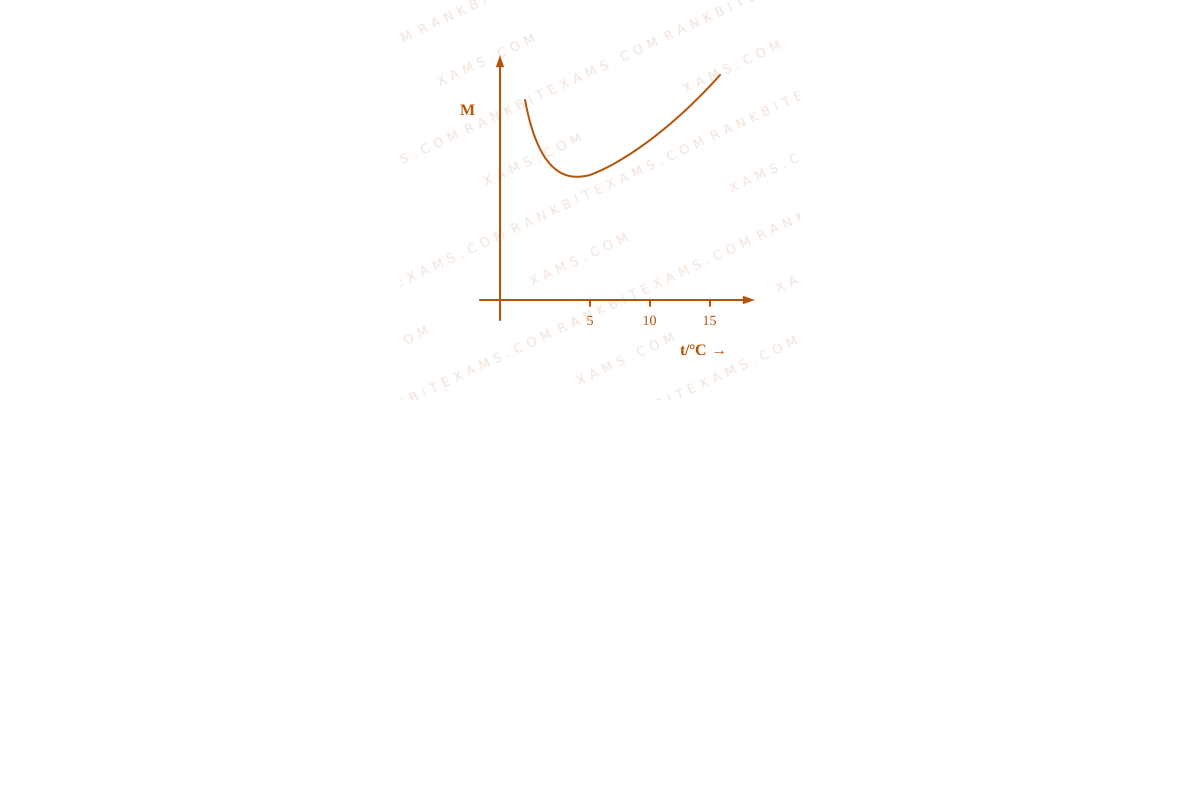
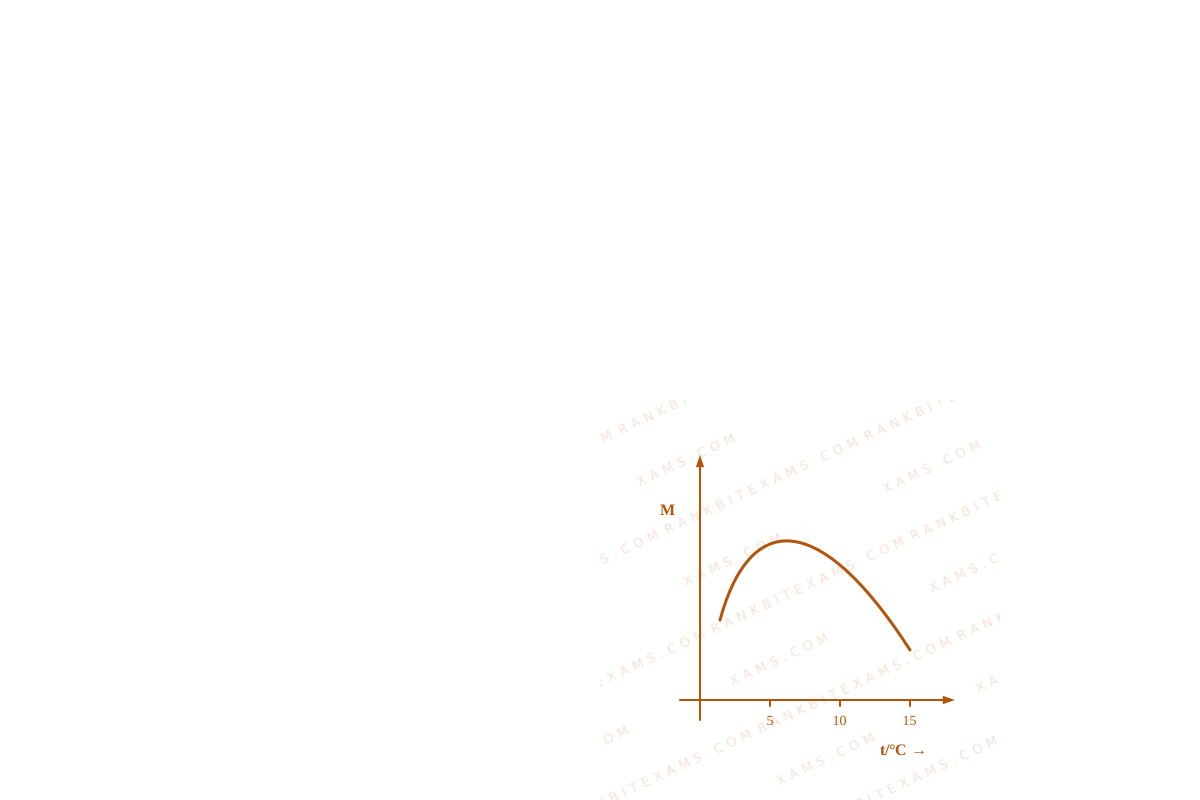
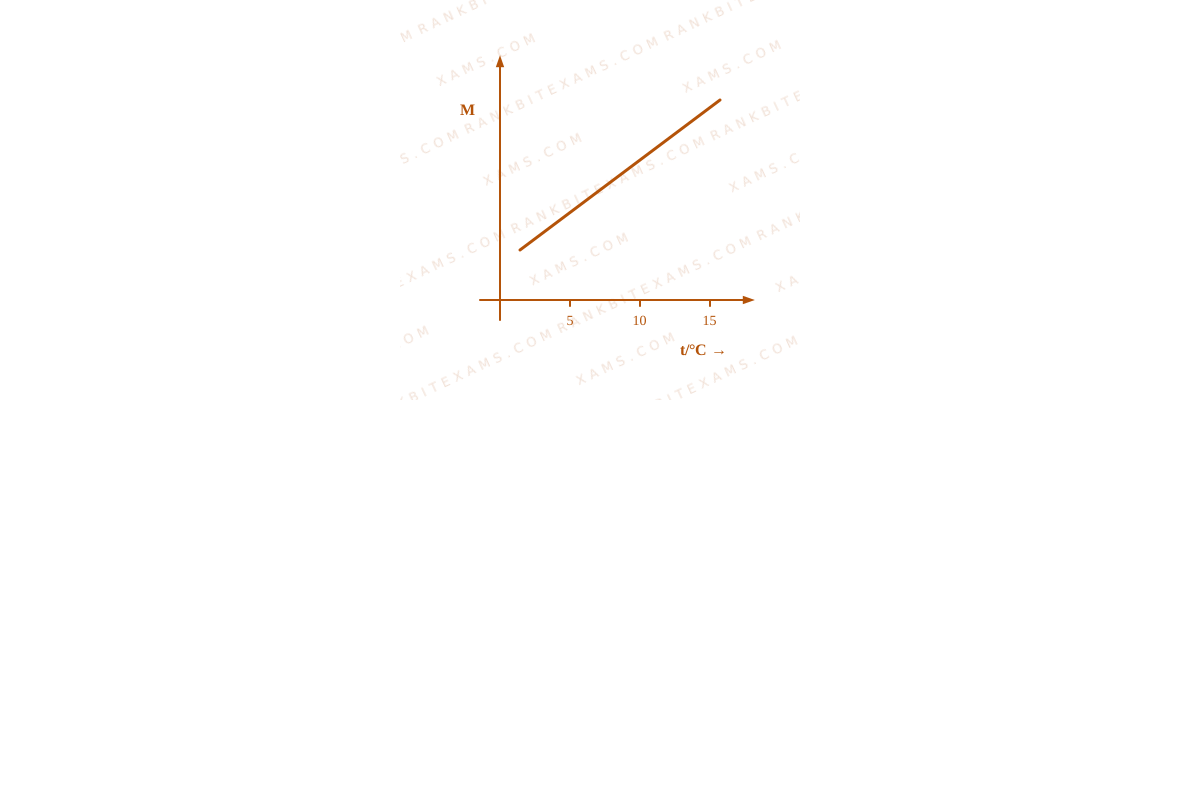
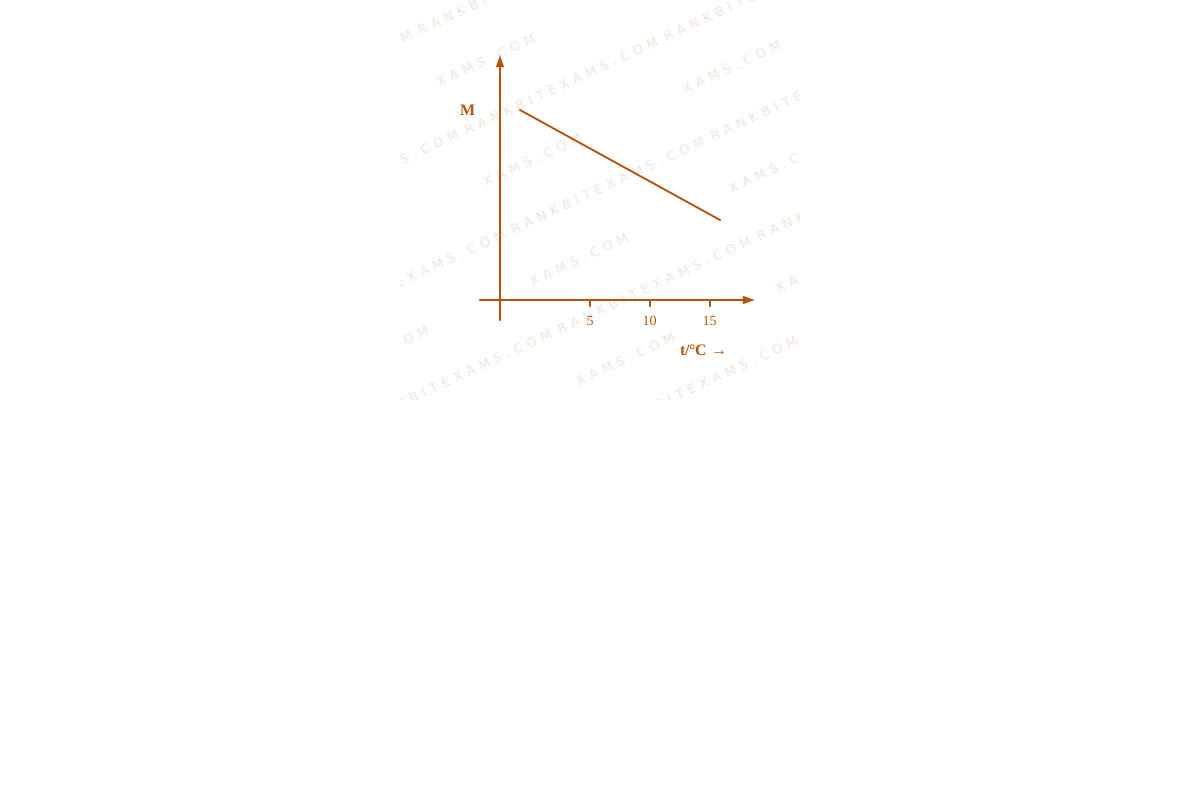
'x' g of NaCl is added to water in a beaker with a lid. The temperature of the system is raised from 1^circmathrmC to 25^circmathrmC. Which out of the following plots, is best suited for the change in the molarity (M) of the solution with respect to temperature? [Consider the solubility of NaCl remains unchanged over the temperature range]

Solution & Explanation

### Related Formula textMolarity (M) = fracn_textsoluteV_textsolution (mathrmL) ### Core Logic Since solubility of mathrmNaCl remains unchanged, the number of dissolved moles of mathrmNaCl solute (n_textsolute) remains strictly constant. Thus, molarity M is strictly dependent on the volume of water (solvent) as temperature changes: M propto frac1V_textsolution ### Step 1: Understand Water's Anomalous Expansion Water exhibits unique anomalous density behavior near freezing: - From 1^circmathrmC to 4^circmathrmC, the density of water **increases** to a maximum. This contraction means the volume (V) of water **decreases**. - From 4^circmathrmC to 25^circmathrmC, the density of water **decreases** due to standard thermal expansion. Consequently, the volume (V) **increases**. ### Step 2: Relate Volume to Molarity Because volume is in the denominator of the molarity equation: - From 1^circmathrmC to 4^circmathrmC: Volume decreases implies Molarity **increases**. - At 4^circmathrmC: Volume is minimum implies Molarity reaches a **maximum**. - From 4^circmathrmC to 25^circmathrmC: Volume increases implies Molarity **decreases**. This behavior is perfectly represented by **Plot (2)**, which features a distinct peak around 4^circmathrmC. ### Pattern Recognition Water is at its densest (and occupies minimum volume) at exactly 3.98^circmathrmC (4^circmathrmC). Any concentration unit based on volume (such as Molarity or Normality) will reach a corresponding maximum at this temperature. ### Evaluation Rubric / Model Answer null ### Chapter Mix Class 12 Chemistry: Solutions

Reference Study Guides

More Solutions Previous-Year Questions — Page 5

Q jee_main_2025_29_jan_morning van't Hoff Factor
If mathrmA_2mathrmB is 30\% ionised in an aqueous solution, then the value of van't Hoff factor (i) is ________ times 10^-1.
Numerical Answer. Answer: 16 to 16

Solution

### Related Formula i = 1 + (y - 1)alpha ### Core Logic For electrolyte mathrmA_2mathrmB undergoing dissociation: mathrmA_2B rightarrow 2mathrmA^+ + mathrmB^2- Total count of ions produced per molecule y = 3. Given degree of dissociation alpha = 30\% = 0.3. Substituting into the formula: i = 1 + (3 - 1) cdot 0.3 i = 1 + 2 cdot 0.3 = 1 + 0.6 = 1.6 Expressing the value in the requested format: 1.6 = 16 times 10^-1 Thus, the integer value to enter is 16. ### Pattern Recognition Always calculate total stoichiometric species y carefully before executing the linear factor combination to avoid basic arithmetic errors. ### Chapter Mix Class 12 Chemistry: Solutions

Q75 jee_main_2024_01_february_morning Abnormal Molar Masses
We have three aqueous solutions of NaCl labelled as 'A', 'B' and 'C' with concentration 0.1 mathrm~M, 0.01 mathrm~M & 0.001 mathrm~M, respectively. The value of van t’ Hoff factor (i) for these solutions will be in the order.
  • A. i_A < i_B < i_C
  • B. i_A < i_C < i_B
  • C. i_A = i_B = i_C
  • D. i_A > i_B > i_C

Solution

### Core Logic For a strong electrolyte like NaCl, the theoretical van 't Hoff factor i_theory is 2 (Na^+ and Cl^-). However, in real solutions, ion-pairing (interionic attraction) occurs. At higher concentrations, the ions are closer together, leading to stronger interionic attractions that reduce the effective number of independent particles, thus lowering the observed i. As the solution becomes infinitely dilute, interionic attractions approach zero, and the observed i approaches the theoretical value. ### Step 1: Correlate Concentration with i Higher concentration implies more ion-pairing implies lower i. Given concentrations: A = 0.1 mathrm~M (highest concentration) B = 0.01 mathrm~M C = 0.001 mathrm~M (most dilute) Therefore, the actual i values follow the reverse order of concentration: i_A (0.1 mathrm~M) < i_B (0.01 mathrm~M) < i_C (0.001 mathrm~M). ### Execution
SaltValues of i (for different conc. of a Salt)
0.1 M0.01 M0.001 M
NaCl1.871.941.97
i approaches 2 as the solution becomes very dilute. ### Pattern Recognition For strong electrolytes, effective dissociation (and thus i) increases as dilution increases because ions interfere with each other less. ### Evaluation Rubric / Model Answer null ### Chapter Mix Class 12 Chemistry: Solutions
Q84 jee_main_2024_29_january_evening Interconversion of Concentration Terms
Molality of 0.8mathrmM mathrmH_2mathrmSO_4 solution (density 1.06mathrmgcm^-3) is ________ times 10^-3mathrmm.
Numerical Answer. Answer: 815 to 815

Solution

### Related Formula m = fracM times 1000, (1000 times d) - (M times M_B) where, M = Molarity = 0.8text M d = Density = 1.06text g/cm^3 M_B = Molar mass of solute (H_2SO_4) = 98text g/mol ### Core Logic Substituting the given values into the equation: m = frac0.8 times 1000, (1000 times 1.06) - (0.8 times 98) Calculating the denominator parameters: textDenominator = 1060 - 78.4 = 981.6text g ### Step 1: Final Resolution Solving for molality: m = frac800, 981.6 approx 0.815text m = 815 times 10^-3text m Thus, the integer factor value is **815**. ### Pattern Recognition Ensure you explicitly subtract the mass of the solute from the total mass of the solution to correctly isolate the mass of the solvent needed for molality calculations. ### Evaluation Rubric / Model Answer null ### Chapter Mix Class 12 Chemistry: Solutions
Q67 jee_main_2024_27_jan_morning Vapour Pressure and Deviations from Raoult's Law
A solution of two miscible liquids showing negative deviation from Raoult's law will have:
  • A. increased vapour pressure, increased boiling point
  • B. increased vapour pressure, decreased boiling point
  • C. decreased vapour pressure, decreased boiling point
  • D. decreased vapour pressure, increased boiling point

Solution

### Core Logic A system demonstrating a negative deviation from Raoult's law implies tighter molecular attractions between components (A-B interactions are stronger than A-A or B-B). This decreases the aggregate escaping tendency, yielding a decreased total vapour pressure. Consequently, a higher thermal energy threshold is required to reach the boiling threshold, causing an increased boiling point. ### Pattern Recognition Negative deviation rightarrow Vapour Pressure drops rightarrow Boiling Point rises inversely. ### Chapter Mix Class 12 Chemistry: Solutions
Q85 jee_main_2024_29_jan_morning Concentration Terms
A solution of mathrmH_2mathrmSO_4 is 31.4\% mathrmH_2mathrmSO_4 by mass and has a density of 1.25mathrmg / mL . The molarity of the mathrmH_2mathrmSO_4 solution is \_\_\_\_\_\_ mathrmM (nearest integer) [Given molar mass of mathrmH_2mathrmSO_4 = 98mathrmg mol^-1 ]
Numerical Answer. Answer: 4 to 4

Solution

### Related Formula textMolarity (M) = frac\% text by mass times 10 times dM_w ### Core Logic Let's assume we have 100 g of the solution. Mass of H_2SO_4 in 100 g solution = 31.4text g. Moles of H_2SO_4 (n_textsolute) = frac31.498text mol. Volume of the solution (V) can be found using density: V = fractextMass of solutiontextDensity = frac1001.25text mL ### Step 1: Calculating Molarity Molarity is defined as moles of solute per liter of solution: M = fracn_textsoluteV(textin mL) times 1000 M = frac31.4 / 98100 / 1.25 times 1000 M = frac31.4 times 1.2598 times 100 times 1000 M = frac39.2598 times 10 M = 0.4005 times 10 M = 4.005text M Rounding off to the nearest integer gives 4. ### Pattern Recognition Whenever percentage by mass (w/w) and density (d in g/mL) are given, use the direct formula: M = frac\%(w/w) times d times 10M_w. This saves enormous time. ### Evaluation Rubric / Model Answer null ### Chapter Mix Class 12 Chemistry: Solutions Class 11 Chemistry: Some Basic Concepts of Chemistry

More Solutions Questions — jee_main_2025_02_april_evening

Practice all Solutions previous-year questions →

Rankbit System
JEE Physics: Waves (+15.5%) | Electrostatics: Concentric Shells (-29.7%) | Modern Physics: Photoelectric Clones (+34.2%) | Mathematics: Definite Integrals (+18.1%) | Chemistry: Coordination Splitting (-11.4%) | JEE Physics: Waves (+15.5%) | Electrostatics: Concentric Shells (-29.7%) | Modern Physics: Photoelectric Clones (+34.2%) | Mathematics: Definite Integrals (+18.1%) | Chemistry: Coordination Splitting (-11.4%)