| List-I | List-II | (A) Solution of chloroform and acetone | (I) Minimum boiling azeotrope | (B) Solution of ethanol and water | (II) Dimerizes | (C) Solution of benzene and toluene | (III) Maximum boiling azeotrope | (D) Solution of acetic acid in benzene | (IV) Delta Vtextmix=0
Choose the correct answer from the options given below:
Solution### Related Formula
textNegative Deviation from Raoult's Law implies textMaximum Boiling Azeotrope
textPositive Deviation from Raoult's Law implies textMinimum Boiling Azeotrope
textIdeal Solution implies Delta Vtextmix = 0
### Core Logic
Evaluating molecular interaction behaviors:
- (A) Chloroform and Acetone: Form intermolecular hydrogen bonds, showing negative deviation from Raoult's law, which forms a maximum boiling azeotrope
ightarrow (III)
- (B) Ethanol and Water: Exhibit hydrogen bond disruptions, leading to positive deviation, forming a minimum boiling azeotrope
ightarrow (I)
- (C) Benzene and Toluene: Highly structurally similar, forming a near-perfect ideal solution where Delta Vtextmix = 0
ightarrow (IV)
- (D) Acetic acid in benzene: Acetic acid undergoes intermolecular hydrogen bonding inside the non-polar solvent, causing it to dimerize
ightarrow (II)
### Step 1: Alignment Selection
Combining the pairs gives: (A)-(III), (B)-(I), (C)-(IV), (D)-(II).
### Pattern Recognition
Liquid properties shortcut: Acetic acid in benzene is a classic textbook example of dimerization (i=0.5). Benzene-toluene is the most famous ideal solution pair. Recognizing either instantly shortcuts the options list to the correct key.
### Evaluation Rubric / Model Answer
null
### Chapter Mix
Class 12 Chemistry: Solutions
Q46
jee_main_2025_24_jan_evening
Abnormal Molar Masses and Van't Hoff Factor
The observed and normal masses of compound mathrmMX_2 are 65.6 and 164 respectively. The percent degree of ionisation of mathrmMX_2 is ____ %. (Nearest integer)
Numerical Answer. Answer: 75 to 75
Solution### Related Formula
i = fractextNormal Molar MasstextObserved Molar Mass
i = 1 + (n - 1)alpha
### Core Logic
1. Calculate the van 't Hoff factor (i):
i = frac16465.6 = 2.5
2. Set up the dissociation equilibrium for the electrolyte mathrmMX_2:
mathrmMX_2
ightarrow mathrmM^2+ + 2mathrmX^-
Here, 1 molecule dissociates into n = 1 + 2 = 3 ions.
3. Relate i to the degree of ionization (alpha):
i = 1 + (3 - 1)alpha = 1 + 2alpha
2.5 = 1 + 2alpha implies 2alpha = 1.5 implies alpha = 0.75
4. Convert to a percentage:
textPercent dissociation = 0.75 cdot 100 = 75\%
### Pattern Recognition
For a salt that dissociates into three ions (like mathrmMX_2), the relationship simplifies to i = 1 + 2alpha. Calculating i from the ratio of the molar masses lets you find alpha directly.
### Evaluation Rubric / Model Answer
null
### Chapter Mix
Class 12 Chemistry: Solutions
Q42
jee_main_2025_24_jan_morning
Depression in Freezing Point
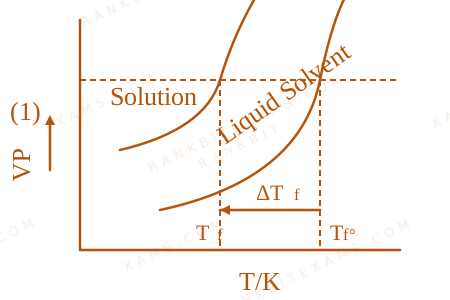
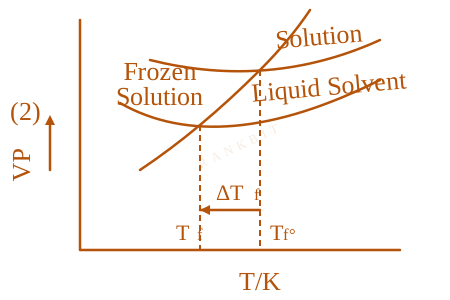
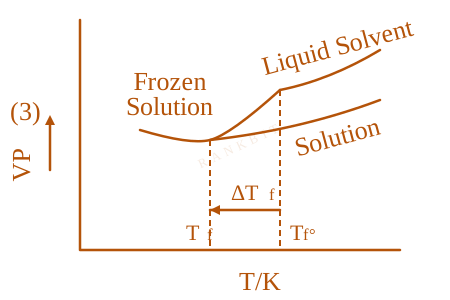
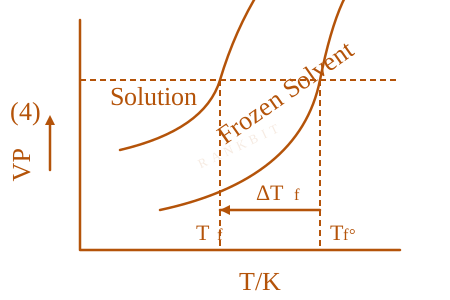
Consider the given plots of vapour pressure (VP) vs temperature (T/K) Which amongst the following options is correct graphical representation showing Delta T_mathrmf , depression in the freezing point of solvent in a solution?
Solution### Related Formula
Delta T_f = T_f^0 - T_f
### Core Logic
Dissolving a non-volatile solute lower the vapor pressure of the solution relative to the pure solvent across all temperature thresholds.
The freezing point is defined as the temperature at which the vapor pressure of the liquid phase matches that of its solid phase. Because the solution's vapor pressure curve lies below that of the pure liquid solvent, its intersection with the frozen solvent curve occurs at a lower temperature (T_f < T_f^0). This shift creates the characteristic freezing point depression step: Delta T_f = T_f^0 - T_f. Plot (3) correctly displays this thermodynamic behavior. 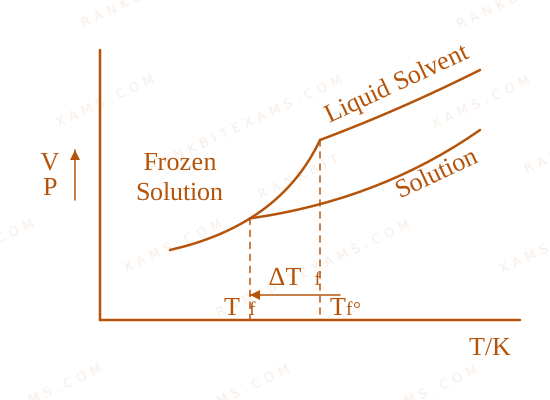
Q42
jee_main_2025_28_jan_evening
Osmosis and Osmotic Pressure
Assume a living cell with 0.9\% (omega/omega) of glucose solution (aqueous). This cell is immersed in another solution having equal mole fraction of glucose and water.
(Consider the data upto first decimal place only) The cell will:
Solution### Related Formula
Mass percentage from mole fraction calculation:
\%text w/w = fracx_1 cdot M_1x_1 cdot M_1 + x_2 cdot M_2 times 100
### Core Logic
Inside the living cell, glucose concentration is 0.9\%text w/w.
The surrounding solution has equal mole fractions of glucose and water (x_textglucose = 0.5, x_textwater = 0.5).
Let's calculate the mass percentage of the outer solution:
- Mass of glucose component = 0.5 times 180 = 90mathrm\ g
- Mass of water component = 0.5 times 18 = 9mathrm\ g
- Total solution mass = 90 + 9 = 99mathrm\ g
### Step 1: Concentration Determination and Osmosis Profile
Outer mass percentage:
\%text w/w = frac9099 times 100 approx 90.9\%
Because the external environment is highly concentrated (hypertonic) compared to the inner cell (0.9\%), water flows out of the cell via exosmosis, causing the **cell to shrink**.
Note: Because the reasoning establishes shrinkage but the quantitative figures in the options are highly mismatched, this question is officially designated as a **Bonus** question.
### Pattern Recognition
An equal mole fraction solution of a high-molar-mass solute (glucose, 180mathrm\ g/mol) and a low-molar-mass solvent (water, 18mathrm\ g/mol) is always extremely concentrated by mass. Placing a standard living cell into such a hypertonic solution inevitably causes fluid loss and cellular shrinkage.
### Evaluation Rubric / Model Answer
null
### Chapter Mix
Class 12 Chemistry: Solutions
Q
jee_main_2025_29_jan_morning
Abnormal Molar Mass and van't Hoff Factor
1.24 mathrm~g of mathrmAX_2 (molar mass 124 mathrm~g mathrm~mol^-1 ) is dissolved in 1 mathrm~kg of water to form a solution with boiling point of 100.0156^circ mathrmC , while 25.4 mathrm~g of mathrmAY_2 (molar mass 250 mathrm~g mathrm~mol^-1 ) in 2 mathrm~kg of water constitutes a solution with a boiling point of 100.0260^circ mathrmC .
mathrmK_b(H_2O) = 0.52 \, K \, kg \, mol^-1
Which of the following is correct?
Solution### Formulas Used
Elevation in boiling point formula involving the van't Hoff factor (i):
Delta T_b = i cdot K_b cdot m
Where:
* Delta T_b = T_b - T_b^circ (Boiling point elevation)
* K_b = textEbullioscopic constant
* m = textMolality of the solution left(fractextmoles of solutetextmass of solvent in kgright)
### Core Logic
**Step 1: Evaluate solution system mathrmAX_2**
Delta T_b = 100.0156^circmathrmC - 100.0000^circmathrmC = 0.0156^circmathrmC
textMolality m_1 = frac1.24text g / 124text g mol^-11text kg = 0.01text mol/kg
Using the elevation formula:
0.0156 = i_mathrmAX_2 cdot 0.52 cdot 0.01
i_mathrmAX_2 = frac0.01560.0052 = 3
Since theoretical dissociation of mathrmAX_2 rightarrow mathrmA^2+ + 2mathrmX^- produces 3 particles, i = 3 implies that **mathrmAX_2 is fully ionised**.
---
**Step 2: Evaluate solution system mathrmAY_2**
Delta T_b = 100.0260^circmathrmC - 100.0000^circmathrmC = 0.0260^circmathrmC
textMolality m_2 = frac25.4text g / 250text g mol^-12text kg = 0.0508text mol/kg
Using the elevation formula:
0.0260 = i_mathrmAY_2 cdot 0.52 cdot 0.0508
i_mathrmAY_2 = frac0.02600.0264 approx 1
Since i approx 1, it behaves as a non-electrolyte, meaning **mathrmAY_2 is completely unionised**.
Thus, **mathrmAX_2 is fully ionised while mathrmAY_2 is completely unionised**.
### Pattern Recognition
A van't Hoff factor matching the complete stoichiometric ion count (i = 3 for mathrmAX_2) confirms complete ionisation, whereas a factor near unity (i = 1) indicates no dissociation into separate ions.
**Correct Option:** **(D)** More Solutions Questions — jee_main_2025_02_april_eveningPractice all Solutions previous-year questions →

SYSTEM
Syllabus Analysis & Trend Mapping
Rankbit System
JEE Physics: Waves (+15.5%)
|
Electrostatics: Concentric Shells (-29.7%)
|
Modern Physics: Photoelectric Clones (+34.2%)
|
Mathematics: Definite Integrals (+18.1%)
|
Chemistry: Coordination Splitting (-11.4%)
|
JEE Physics: Waves (+15.5%)
|
Electrostatics: Concentric Shells (-29.7%)
|
Modern Physics: Photoelectric Clones (+34.2%)
|
Mathematics: Definite Integrals (+18.1%)
|
Chemistry: Coordination Splitting (-11.4%)
YOUR FIRST PREP STEP STARTS HERE
We Map Every Repeating Question in Competitive Exams.Say goodbye to generic mock test fatigue. RankBit uses smart analysis to group past exam questions into their foundational Repeating Question Types. Find chapter weightage, track repeating questions, and score higher with targeted practice. Select Your Target ExamChoose an exam track below to find formulas per chapter and patterns. Syncing Exam Intelligence Mapping formulas and patterns across all tracks…
PATH A — FULL LENGTH PRACTICE
Full Mock Test HubSimulate real NTA exam conditions with fully tracked mocks. Time yourself against past papers.
Now Live
Open
PATH B — TARGETED PRACTICE
Topic-wise Practice HubPractice past-year questions one chapter at a time. Pick an exam → subject → chapter and get every PYQ for that topic — pulled together from all past papers — with the chapter's key formulas alongside.
Loading Questions...
Browse Topics
Exam Analysis ToolsChapter weightage trends and topic-wise practice — all mapped from past shift papers. Chapter Weightage & TrendsSee high-yield chapters, year-wise counts and the frequency-based chance each topic repeats next exam.
Weightage Board
Open
Topic-wise Practice HubEvery past-year question for a chapter pulled from all papers, with its key formulas alongside.
One chapter at a time
Open
Latest from the Blog
View all →
Loading articles... JEE Main Exam PapersSelect a specific exam paper to view its topic-wise syllabus weightage, formula trends, and practice interactive questions.
Chapter-level Exam Weightage & Trends
Chapter Weightage BoardWe analyzed past shift papers to map these topics. Select a chapter to start targeted practice. ACTIVE SUBJECT Physics No chapters or subjects match your search. Formula Recognition
🔥 Practice Session
Live
Showing All Questions
Exam QuestionsTest your concepts live. Choose options or enter numerical values, then verify your answer to reveal the double-box solution matrix. Practice all questionsSelect an ExamPlease select a specific exam shift from the dashboard to unlock data-driven insights and practice materials. |
|---|
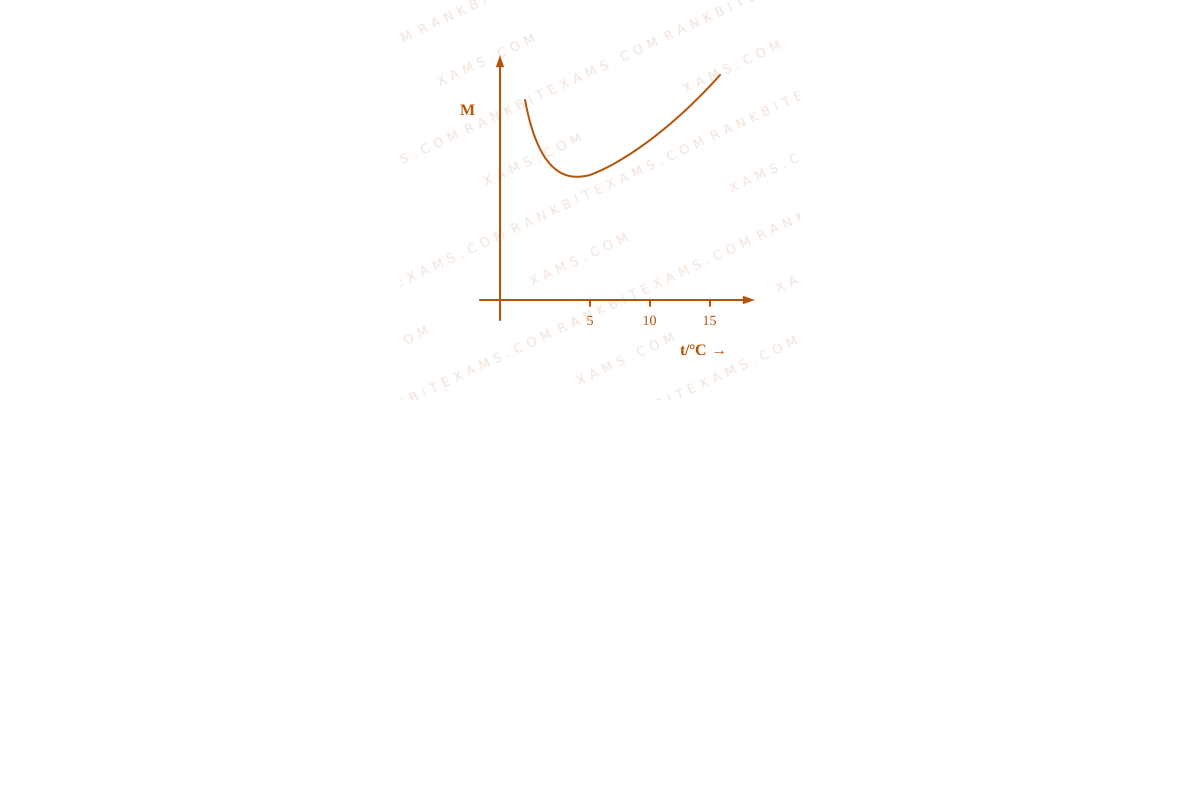
- A. textPlot (1)
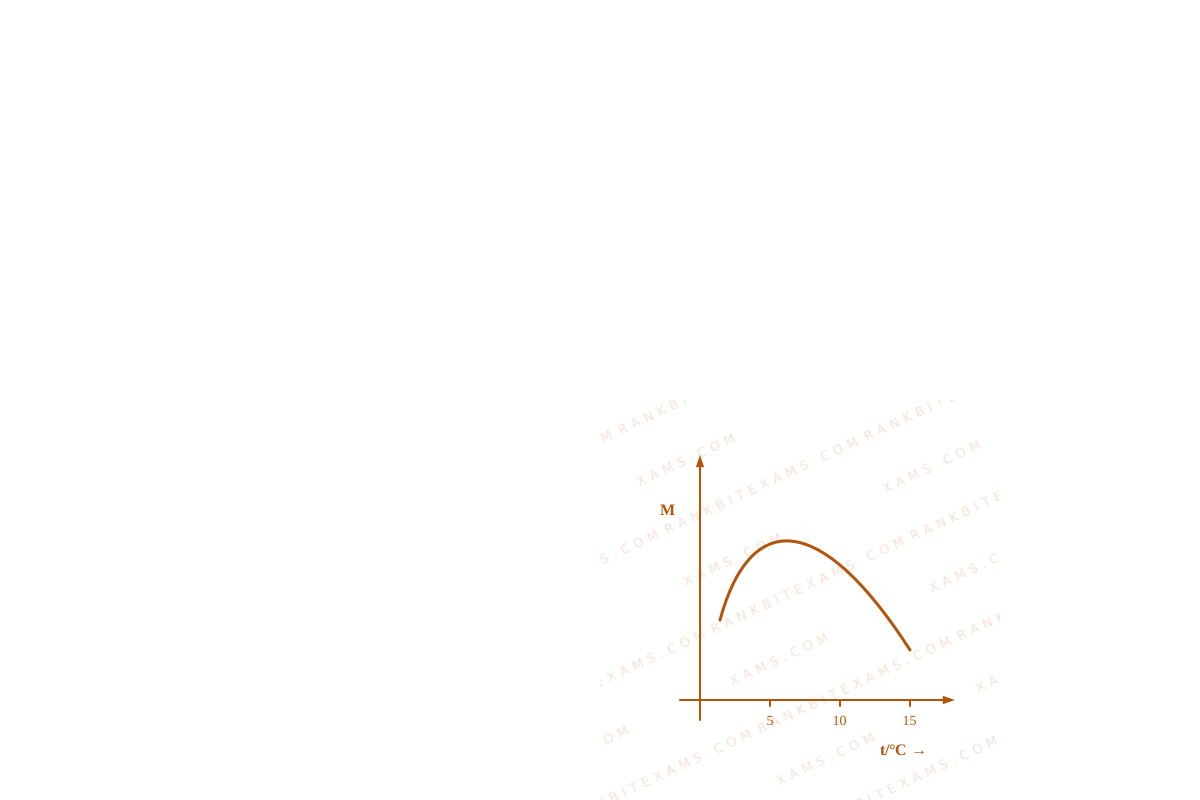
Molarity and Temperature Dependency - B. textPlot (2)
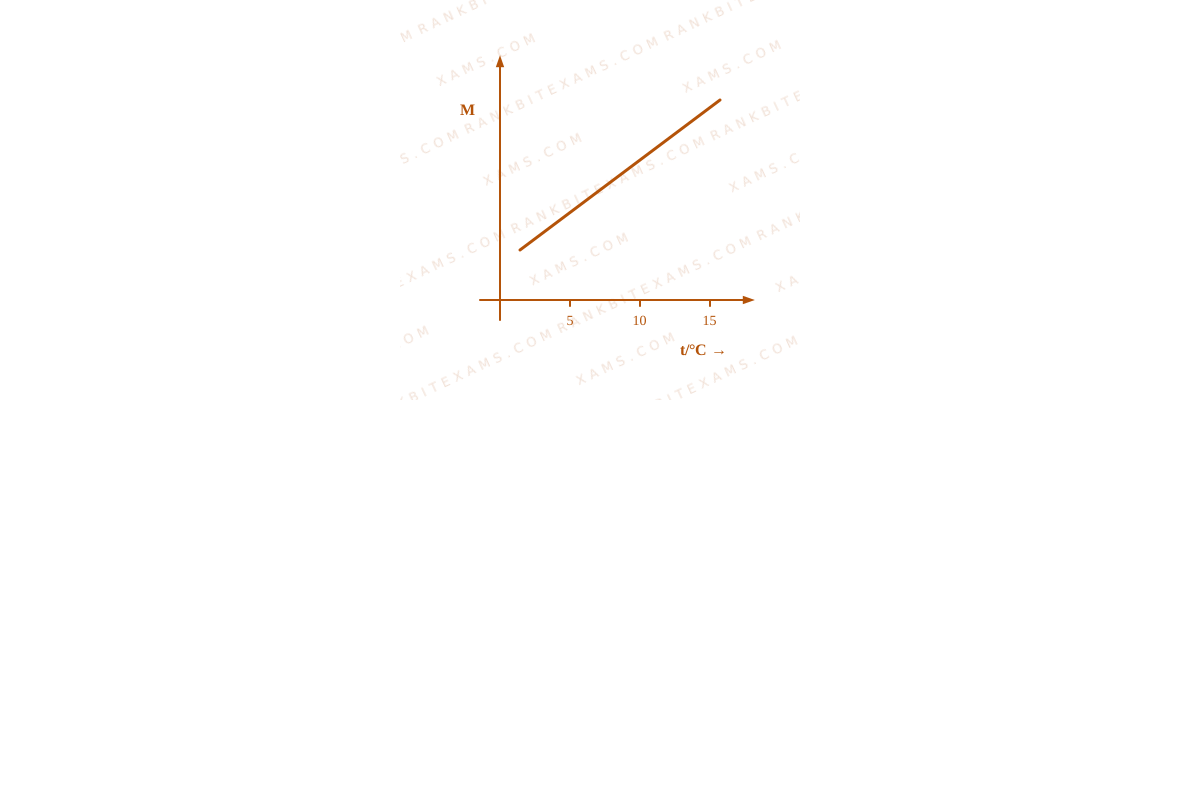
Molarity and Temperature Dependency - C. textPlot (3)
Molarity and Temperature Dependency - D. textPlot (4)
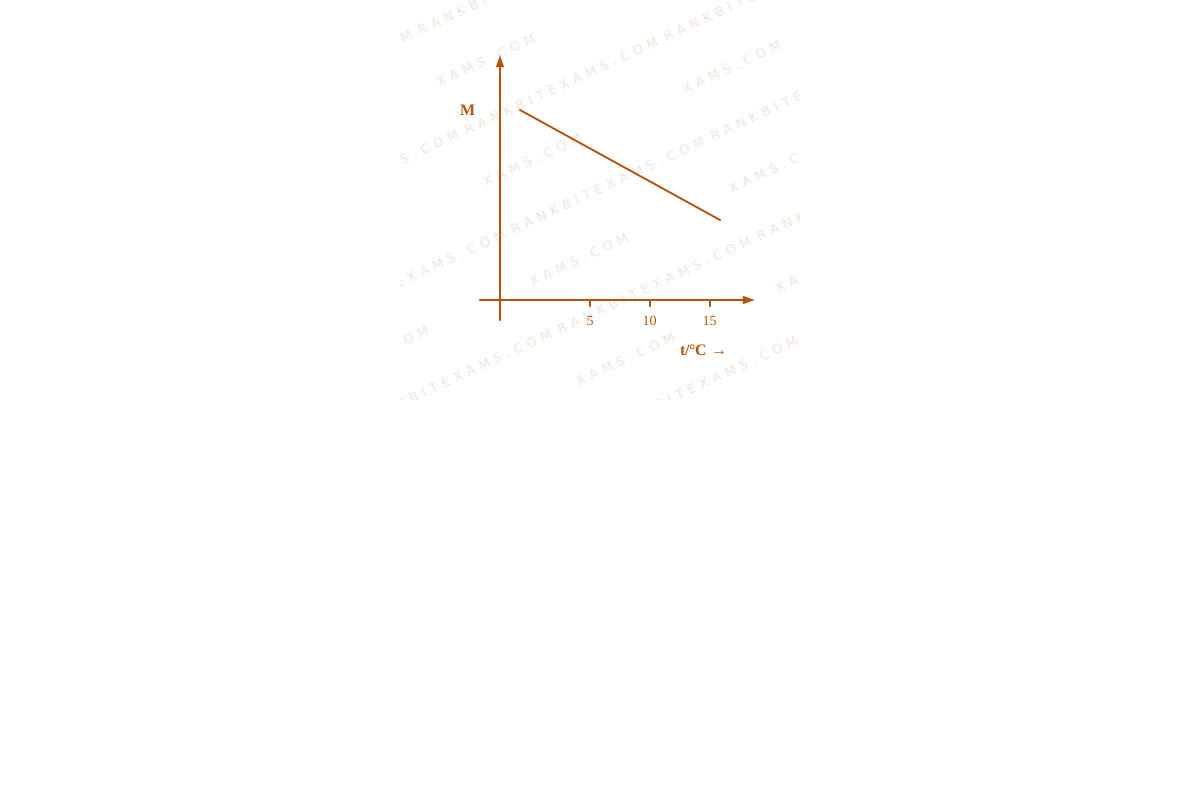
Molarity and Temperature Dependency
Solution & Explanation
### Related Formula
textMolarity (M) = fracn_textsoluteV_textsolution (mathrmL)
### Core Logic
Since solubility of mathrmNaCl remains unchanged, the number of dissolved moles of mathrmNaCl solute (n_textsolute) remains strictly constant. Thus, molarity M is strictly dependent on the volume of water (solvent) as temperature changes:
M propto frac1V_textsolution
### Step 1: Understand Water's Anomalous Expansion
Water exhibits unique anomalous density behavior near freezing:
- From 1^circmathrmC to 4^circmathrmC, the density of water **increases** to a maximum. This contraction means the volume (V) of water **decreases**.
- From 4^circmathrmC to 25^circmathrmC, the density of water **decreases** due to standard thermal expansion. Consequently, the volume (V) **increases**.
### Step 2: Relate Volume to Molarity
Because volume is in the denominator of the molarity equation:
- From 1^circmathrmC to 4^circmathrmC: Volume decreases implies Molarity **increases**.
- At 4^circmathrmC: Volume is minimum implies Molarity reaches a **maximum**.
- From 4^circmathrmC to 25^circmathrmC: Volume increases implies Molarity **decreases**.
This behavior is perfectly represented by **Plot (2)**, which features a distinct peak around 4^circmathrmC.
### Pattern Recognition
Water is at its densest (and occupies minimum volume) at exactly 3.98^circmathrmC (4^circmathrmC). Any concentration unit based on volume (such as Molarity or Normality) will reach a corresponding maximum at this temperature.
### Evaluation Rubric / Model Answer
null
### Chapter Mix
Class 12 Chemistry: Solutions
Reference Study Guides
More Solutions Previous-Year Questions — Page 4
Q38
jee_main_2025_07_april_evening
Azeotropes and Liquid Mixtures
Match List-I with List-II